
July 24, 2026
The Quiet Revolution Reshaping How the World Extracts Resources
Long before autonomous vehicles became a staple of urban mobility debates, the mining industry was quietly pioneering driverless technology at scale. Underground and open-pit mines have unique characteristics that actually make them more suitable for early autonomy adoption than public roads: defined haul routes, controlled access zones, predictable traffic patterns, and an overwhelming economic incentive to reduce human exposure to dangerous environments. What began as experimental deployments at a handful of iron ore operations in Western Australia has evolved into a global technology race, and China has emerged as the unexpected frontrunner.
The penetration of autonomous trucks in Chinese mining operations now sits at roughly 10% of all trucks, a figure that reflects both the scale of China's mining sector and the speed at which domestic technology firms have moved from prototype to commercial deployment. Within that landscape, CiDi autonomous mining machines overseas sales have become a central strategic priority, as the company's global expansion ambitions, asset-light commercial architecture, and pipeline of next-generation robotic systems make it one of the more strategically interesting technology companies operating at the intersection of heavy industry and artificial intelligence.
When big ASX news breaks, our subscribers know first
Understanding CiDi's Business Architecture Before Examining Its Growth
Most discussions of automation in mining centre on the vehicles themselves. CiDi's strategic differentiation, however, lies less in the hardware and more in how it structures its commercial relationships. Rather than owning and operating truck fleets, which requires substantial capital and creates ongoing operational liability, CiDi sells hardware and software systems directly to mine operators. Physical manufacturing is handled by partner equipment makers, keeping CiDi's balance sheet lean and its organisational focus squarely on software intelligence, fleet coordination, and technology development.
This asset-light approach carries specific implications for international scalability.
| Business Model | Capital Intensity | Scalability | International Agility | Revenue Predictability |
|---|---|---|---|---|
| Asset-Light (CiDi) | Low | High | High | Moderate |
| Fleet Ownership Model | High | Moderate | Low | High |
| Hybrid Model | Medium | Medium | Medium | Medium |
Fleet-owning competitors must replicate expensive physical infrastructure in every new market they enter. CiDi, by contrast, can enter new geographies by establishing distribution partnerships and certification pathways without deploying large amounts of capital upfront. This model is particularly well-suited to international expansion across jurisdictions with different regulatory requirements, equipment standards, and operational environments.
The asset-light model is not simply a financial strategy. It is an architectural choice that determines how quickly a technology company can move across borders, adapt to local conditions, and scale without being constrained by balance sheet capacity.
Revenue Growth and Fleet Deployment: The Metrics Behind the Story
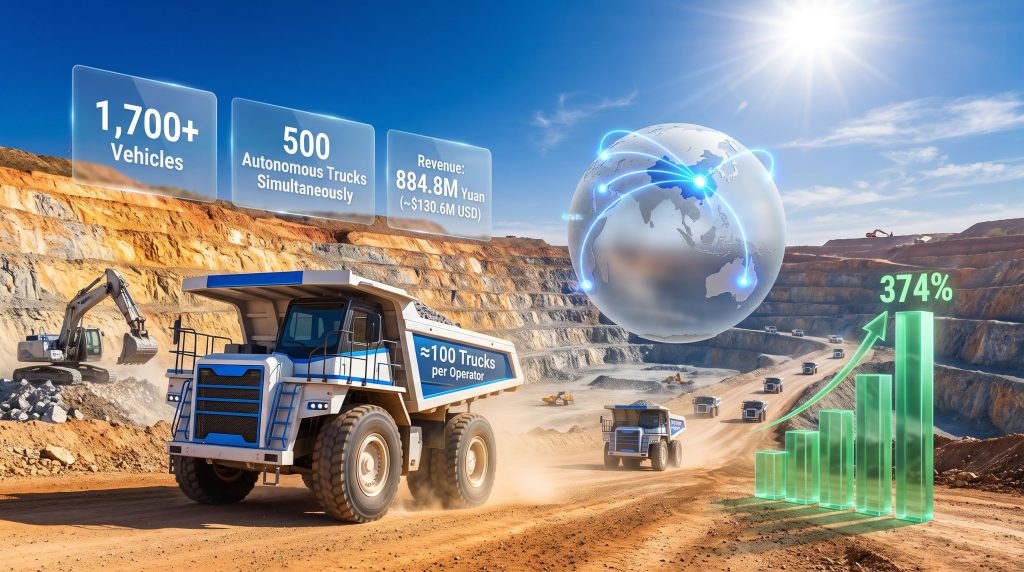
CiDi went public in late 2025, and its financial performance at the time of listing reflected a company growing well ahead of its own industry. In its most recent full financial year, the company recorded revenue of 884.8-million yuan, equivalent to approximately $130.6-million USD, representing year-on-year growth exceeding 100%. That figure alone would attract attention in most sectors.
Furthermore, what makes it more striking is the comparison to the broader market: CiDi's China-based deployments and revenue grew by approximately 374% during the same period, against an industry-wide growth rate of roughly 73%. These figures, detailed in the CIDI 2025 report on mining activity, underscore just how significantly the company is outpacing sector peers.
The operational footprint tells a similar story of rapid scaling.
| Metric | Figure |
|---|---|
| Total Global Fleet Size | 1,700+ vehicles |
| Active Quarries and Coal Mines | 30+ sites |
| Units Delivered in 2025 | 630 units/sets |
| Units Delivered or In Delivery (by February 2026) | 1,500+ units |
| Remote Monitoring Ratio | ~100 trucks per operator |
The remote monitoring ratio deserves particular attention. The ability for a single operator to oversee approximately 100 autonomous trucks simultaneously reflects the sophistication of CiDi's fleet coordination software. This is not simply a matter of cameras and GPS tracking. Managing a fleet of that density requires real-time decision-making across vehicles, dynamic route optimisation, collision avoidance protocols, and integration with mine management systems.
At large coal mine operations, CiDi's systems are currently coordinating the movement of up to 500 autonomous trucks simultaneously, a capability that CiDi's leadership has described as representing a major technological threshold within the autonomous mining sector. These data-driven mining operations represent a new standard for what fleet coordination software can achieve at scale.
A Case Study in Full Autonomy: The TCC Group Limestone Quarry
The clearest illustration of CiDi's current technological capabilities is visible at an open-pit limestone quarry in Jurong, Jiangsu Province, operated by cement conglomerate TCC Group Holdings. At this facility, 12 fully electric, unmanned trucks operate continuously without human drivers, autonomously hauling limestone from extraction zones to crushing facilities before returning to charging stations to replenish their batteries.
CiDi identifies this fleet as the world's first fully electric and fully autonomous mining truck fleet in commercial operation. The significance of this distinction is worth unpacking. Previous autonomous mining deployments have typically used diesel-powered vehicles with autonomous navigation layered on top. Combining full electrification with full autonomy introduces additional technical complexity: battery management must be integrated with route planning to ensure trucks return to chargers before power is depleted, and charging infrastructure must be designed to accommodate vehicles arriving on autonomous schedules rather than human-managed shift changes.
The Jurong site functions as both a commercial operation and a proof-of-concept for what CiDi's technology can achieve at scale, making it a natural showcase for prospective international clients.
CiDi's International Expansion Strategy: Markets, Partners, and Timelines
CiDi's overseas push is not a single-market experiment. The company is simultaneously pursuing entry across four distinct regions, each presenting different opportunity profiles and technical challenges. CiDi autonomous mining machines overseas sales are consequently being structured around flexible distribution models that accommodate local regulatory and operational conditions.
Australia is currently furthest along in the deployment pipeline. Partially automated autonomous excavators are already operational there, and a larger commercial rollout is planned for the current year. Australia's appeal as a first international market is logical: it hosts some of the world's largest open-cut mining operations, faces persistent skilled labour shortages in remote regions, and has an existing regulatory framework for autonomous mining equipment developed through decades of industry engagement. Underground drilling safety considerations are also shaping how CiDi approaches its Australian deployment strategy.
Middle East, South America, and Europe represent the next tier of CiDi's geographic ambitions. Each region brings distinct strategic value:
- The Middle East offers large-scale quarrying and mining operations with high labour costs and strong appetite for technology adoption.
- South America hosts major copper, lithium, and iron ore operations where autonomous technology can address both safety and productivity challenges at altitude and in remote terrain.
- Europe presents a premium-priced market with strong emphasis on safety compliance and environmental performance, areas where autonomous electric equipment can offer tangible advantages.
A critical enabler of this multi-front expansion strategy is CiDi's distribution partnership with MMD Group, a UK-based mining equipment manufacturer with established relationships and market access across international mining jurisdictions. According to reporting on the CiDi and MMD Group deal, the agreement is specifically structured to develop driverless mining haulage solutions for international markets. Distribution alliances of this kind serve a function beyond logistics: they provide local credibility, regulatory familiarity, and client relationships that a Chinese technology company would otherwise need years to develop independently.
CiDi's leadership has indicated the company is actively seeking additional international partners, including China-based mine operators with overseas assets who could serve as reference clients in new markets.
Beyond Trucks: The Robotic Frontier of Mining Automation
What New Technologies Is CiDi Developing?
The most forward-looking dimension of CiDi's technology roadmap extends well beyond autonomous haulage. The company is developing robotic systems designed specifically for two of the most hazardous tasks in mining: explosive handling and precision drilling. In addition, AI drilling and blasting capabilities are becoming increasingly central to how CiDi positions its next-generation product suite.
These are not incremental upgrades to existing truck technology. Blasting operations involve transporting, positioning, and detonating large quantities of industrial explosives in environments where a single error can be catastrophic. The scale of materials involved in open-pit and underground mining blasting is fundamentally different from controlled demolition in other industries. CiDi's explosive-handling robotic units are expected to enter service during Q3 of the current year, with initial deployments concentrated in Shanxi and Inner Mongolia provinces.
Drilling robots, which perform the precision borehole work required before explosive charges are placed, are scheduled for commercial availability in early 2027.
The timing of these deployments is not coincidental. A gas explosion at a Shanxi coal mine in May resulted in 82 worker fatalities, significantly intensifying regulatory scrutiny across China's coal sector. This tragedy has accelerated demand for autonomous and robotic solutions specifically in high-risk operational environments, creating a near-term commercial catalyst for CiDi's blasting and drilling robot programme.
CiDi is also pioneering what might be described as hybrid machine design: autonomous trucks equipped with robotic arms that allow them to perform manipulation tasks, blurring the traditional distinction between a vehicle and a robot. This convergence of mobility and manipulation capability represents a significant expansion of what a single deployed asset can accomplish at a mine site.
The next major ASX story will hit our subscribers first
The Competitive Landscape: How CiDi Positions Against Domestic Rivals
CiDi operates in a competitive domestic market. Fujian-based EACON is among the more prominent rivals, also pursuing autonomous truck deployments across Chinese mining operations. The competitive dynamics between these firms are important context for understanding CiDi's international push.
| Company | Headquarters | Business Model | Known International Presence | Technology Focus |
|---|---|---|---|---|
| CiDi | Hong Kong-listed | Asset-Light (HW + SW Sales) | Australia, Middle East, South America, Europe | Trucks, Excavators, Drilling and Blasting Robots |
| EACON | Fujian, China | Fleet Operations | Limited public disclosure | Autonomous Trucks |
CiDi's revenue growth of more than 100% year-on-year, compared to China's industry-wide rate of approximately 73%, indicates the company is gaining market share domestically even as it expands internationally. The asset-light model, by keeping capital requirements low, allows CiDi to compete on technology differentiation rather than physical scale. Furthermore, AI mining efficiency improvements are enabling CiDi to deliver measurably superior outcomes per deployed asset compared to traditional fleet operators.
Structural Barriers to International Adoption
Despite the commercial momentum, however, several structural challenges complicate overseas market entry for autonomous mining equipment manufacturers operating outside their domestic jurisdiction.
Regulatory frameworks for autonomous mining equipment vary considerably across jurisdictions:
- Australia has developed relatively mature guidelines for autonomous mining operations, informed by decades of industry experience with large-scale driverless haul trucks.
- European markets impose rigorous machinery safety directives and certification requirements that can extend equipment approval timelines significantly.
- South American and Middle Eastern markets vary widely in their regulatory maturity, with some jurisdictions offering flexibility for technology pilots but lacking established certification pathways for commercial deployment.
Beyond regulation, technical integration presents its own challenges. Mines operating existing equipment fleets from established manufacturers require autonomous systems that can communicate with legacy mine management platforms. CiDi's fleet coordination software must demonstrate interoperability across diverse operational environments, not just the purpose-built deployments where it has established its strongest track record.
Connectivity infrastructure is another consideration. Remote autonomous operations depend on reliable, high-bandwidth communications networks. In some of the regions CiDi is targeting, the telecommunications infrastructure required to support dense autonomous fleet coordination remains underdeveloped.
Why China's Domestic Scale Creates a Global Competitive Moat
China's lead in autonomous mining deployment reflects more than technological capability. It is the product of a specific convergence of factors: a large domestic mining sector that generates enormous demand for efficiency improvements, labour economics that create strong financial incentives for automation, and a regulatory environment that has historically permitted faster commercial deployment of emerging technologies than many Western markets.
For CiDi, this domestic foundation provides something that cannot be replicated quickly by competitors entering the autonomous mining space from outside China: real-world deployment data at massive scale. With more than 1,700 vehicles operating across over 30 sites, CiDi's fleet coordination algorithms are continuously learning from a volume of operational scenarios that few competitors can match.
Every hour of autonomous operation at a coal mine in Inner Mongolia or a limestone quarry in Jiangsu generates data that improves the system's ability to handle edge cases, equipment failures, and unexpected terrain conditions. Consequently, this data advantage is the less visible but potentially more durable competitive moat that underpins CiDi autonomous mining machines overseas sales ambitions.
Frequently Asked Questions: CiDi Autonomous Mining Machines and Overseas Sales
What Countries Is CiDi Targeting for Autonomous Mining Machine Sales?
CiDi is currently pursuing deployment in Australia, the Middle East, South America, and Europe, with Australia representing the most advanced stage of international rollout.
How Many Autonomous Mining Vehicles Does CiDi Currently Operate Globally?
CiDi's global fleet exceeds 1,700 vehicles, deployed across more than 30 quarries and coal mines, predominantly in China.
What Is CiDi's Asset-Light Business Model?
Rather than owning and operating truck fleets, CiDi sells hardware and software directly to mine operators while outsourcing physical manufacturing to partner equipment makers. This structure reduces capital requirements and accelerates international scalability.
What New Robotic Technologies Is CiDi Developing Beyond Autonomous Trucks?
CiDi is developing explosive-handling robotic units expected in Q3 of the current year, and drilling robots scheduled for commercial availability in early 2027, targeting deployment in Shanxi and Inner Mongolia initially.
How Does CiDi's Revenue Growth Compare to the Broader Autonomous Mining Industry?
CiDi's China-based deployment and revenue grew approximately 374% in its most recent reporting period, compared to an industry-wide growth rate of roughly 73%, representing a substantial outperformance relative to sector peers.
What Is the MMD Group Partnership?
MMD Group is a UK-based mining equipment manufacturer that serves as a key international distribution partner for CiDi, providing market access, client relationships, and regulatory familiarity across international mining jurisdictions.
What CiDi's Expansion Signals for the Broader Mining Industry
The trajectory of CiDi's international push carries implications that extend well beyond a single company's growth story. For mine operators evaluating autonomous equipment procurement, the emergence of competitive, well-capitalised Chinese technology providers introduces meaningful alternatives to the established Western and Australian equipment manufacturers that have historically dominated the autonomous mining space.
The total cost of ownership equation for autonomous mining fleets continues to improve as fleet sizes scale and software capabilities mature. Removing human operators from high-risk environments such as blasting zones and underground gas-exposed workings represents a safety benefit that is increasingly difficult for regulators and insurers to ignore. And as CiDi's robotic arm-equipped trucks demonstrate, the boundary between a mining vehicle and a mining robot is dissolving, pointing toward a future where a single deployed asset can perform multiple operational functions autonomously.
The long-term trajectory of autonomous mining technology is toward full-site autonomy, where extraction, haulage, processing logistics, and maintenance support functions are all executed without direct human intervention. CiDi's expanding technology stack, from electric autonomous trucks to explosive-handling robots to drilling systems, represents a deliberate progression along that roadmap. How quickly CiDi autonomous mining machines overseas sales translate into international commercial reality will depend on regulatory approvals, partnership execution, and the company's ability to adapt systems optimised for Chinese mining environments to the diverse operational conditions of Australia, Europe, South America, and the Middle East.
Disclaimer: This article contains forward-looking statements and references to financial targets and technology deployment timelines. These are subject to change and should not be construed as investment advice. Readers should conduct independent research before making investment decisions.
Want to Discover the Next Major ASX Mining Breakthrough Before the Market Does?
As autonomous mining technology reshapes resource extraction globally, the companies driving the next wave of mineral discoveries are emerging faster than ever — and Discovery Alert's proprietary Discovery IQ model ensures subscribers receive real-time alerts the moment significant ASX mineral discoveries are announced, turning complex data across 30+ commodities into clear, actionable opportunities. Explore how historic discoveries have generated extraordinary returns on Discovery Alert's dedicated discoveries page, and begin your 14-day free trial today to position yourself ahead of the market.