July 24, 2026
Floating Gas Infrastructure and the New Era of Deepwater Monetisation
Across Southeast Asia, the economics of deepwater gas development have shifted fundamentally over the past decade. Advances in floating production technology, combined with growing regional demand for cleaner-burning fuels and the persistent decline of mature shallow-water fields, have created conditions where ultra-large offshore gas hubs are not just viable but increasingly necessary. The Kutai Basin, sitting off the eastern coastline of Borneo in Indonesian waters, sits at the intersection of these forces. It is within this context that the Eni Petronas North Hub floating gas facility in Indonesia has emerged as one of the most consequential offshore energy investments in the region's recent history.
When big ASX news breaks, our subscribers know first
Understanding the North Hub Project: Scale, Structure, and Strategic Purpose
The Searah Joint Venture and Its Strategic Architecture
The Searah entity represents a calculated partnership between Italy's Eni and Malaysia's national oil company Petronas. The structure combines Eni's proven deepwater technical capabilities, developed across projects in the Gulf of Mexico, West Africa, and the Barents Sea, with Petronas's extensive regional operational knowledge and its established relationships within the Indonesian upstream regulatory ecosystem.
Indonesia's upstream oil and gas sector operates under the oversight of SKK Migas, the national upstream regulator responsible for supervising production sharing contracts and ensuring compliance with national energy objectives. SKK Migas plays a direct facilitation role in enabling large-scale foreign investment, and its involvement in the North Hub development underscores the regulatory seriousness with which this project has been approached.
The selection of the Kutai Basin as the development focus was not incidental. This sedimentary basin ranks among Southeast Asia's most hydrocarbon-bearing geological formations, with a history of commercial production stretching back several decades. Its deep-water zones, however, remained significantly underexplored relative to their resource potential until relatively recently.
The Geng North and Gehem Gas Fields
The North Hub development centres on two distinct gas fields: Geng North and Gehem, both positioned within the Kutai Basin's offshore acreage. Together, these fields underpin a 16-well development program, with each field contributing to a single integrated production system routed through the central FPSO processing hub.
While both fields feed into the same infrastructure, they differ in their reservoir characteristics. Geng North is understood to carry the larger resource base and forms the primary production anchor of the development. Gehem contributes incremental volumes that, combined with Geng North output, allow the overall system to sustain the targeted production plateau.
The architectural decision to integrate both fields into a unified subsea-to-FPSO system reflects a design philosophy aimed at maximising capital efficiency across a shared processing and export infrastructure. For further context on Eni's Indonesian upstream activities, including the broader portfolio of assets underpinning this development, their regional presence is extensive.
Key Insight: The Kutai Basin contains some of the deepest and most complex hydrocarbon-bearing stratigraphy in Southeast Asia, making multi-field integration through a single floating hub a technically sophisticated and commercially rational approach to resource monetisation.
How the North Hub FPSO Works: A Technical Breakdown
Why FPSO Technology Was Selected
A Floating Production, Storage, and Offloading vessel is a self-contained offshore industrial platform that processes hydrocarbons extracted from subsea wells, stores the resulting liquids, and periodically offloads them to shuttle tankers for transportation to shore or export terminals. Unlike fixed offshore platforms, an FPSO can be moored in deepwater environments where seabed-founded structures are not technically or economically feasible.
For the North Hub development, the deepwater context of the Kutai Basin made FPSO deployment the logical choice. Fixed platform alternatives would require substantially greater structural engineering complexity and cost at the relevant water depths, while a floating facility can be purpose-built, towed to location, and moored using a spread or turret mooring system designed to accommodate the specific metocean conditions of the basin.
FPSO technology also offers processing flexibility. Modern large-scale FPSOs can handle gas treatment, condensate separation, water injection, and produced-water management within a single integrated topside module suite, reducing the need for separate offshore processing platforms.
FPSO Design Specifications and Processing Capacity
| Specification | Detail |
|---|---|
| Total FPSO Capital Allocation | ~$2.9 billion |
| Gas Processing Capacity | ~1 billion cubic feet per day |
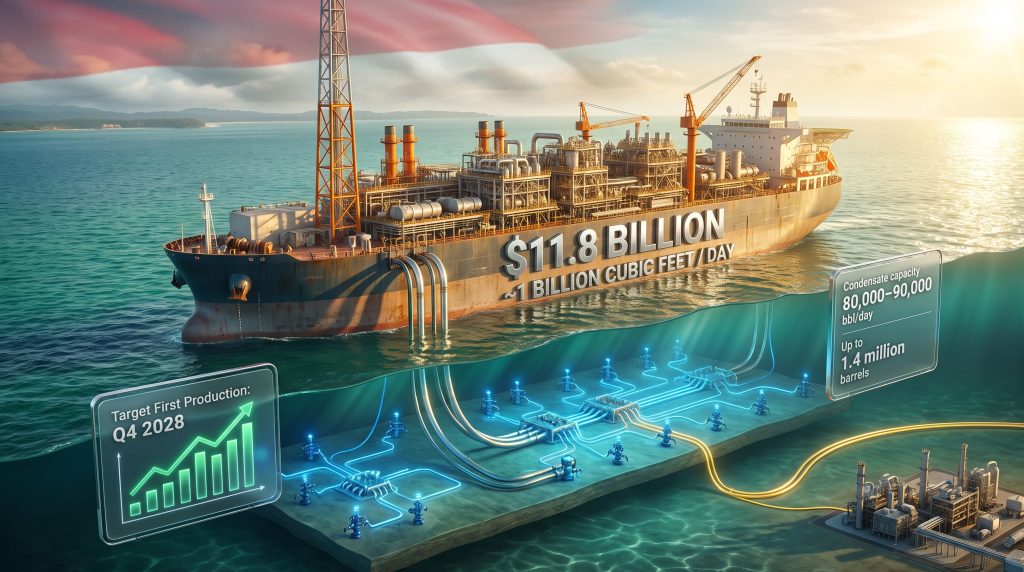
| Condensate Production Capacity | 80,000 to 90,000 barrels per day |
| FPSO Storage Capacity | Up to 1.4 million barrels |
| Wells Served | 16 wells across Geng North and Gehem fields |
| Construction Start | July 2026 (first steel cutting ceremony) |
| Target First Production | Q4 2028 |
The $2.9 billion FPSO allocation represents approximately 24.6% of the total $11.8 billion project budget, a proportion consistent with comparable deepwater floating facility developments globally. The vessel's gas processing capacity of approximately 1 billion cubic feet per day would position North Hub among the largest single offshore gas processing installations in the Southeast Asian region upon reaching plateau output.
From Steel Cutting to First Gas: The Construction Pathway
The first steel cutting ceremony, held in July 2026, formally initiated the FPSO fabrication process. In the offshore energy industry, steel cutting marks the point at which raw structural steel is shaped into the vessel's hull components, representing the transition from engineering and procurement phases into active physical construction.
A typical FPSO construction sequence for a vessel of this scale and complexity involves the following stages:
- Hull fabrication at a specialised shipyard, involving block-by-block construction of the vessel's main structure.
- Topside module fabrication, where processing equipment, including gas treatment trains, condensate separation systems, and utilities, is built separately and later integrated.
- System integration and commissioning at the fabrication yard, where mechanical and electrical systems are tested under controlled conditions.
- Offshore towout and installation, including connection to the mooring system and hookup of subsea risers and umbilicals.
- Offshore commissioning and first gas, marking the commencement of production.
The approximately 24 to 26 months between the July 2026 construction commencement and the Q4 2028 production target represents a tight but achievable timeline for a project of this complexity, provided fabrication milestones are maintained and offshore installation windows align with seasonal weather patterns in the Kutai Basin.
Construction Context: Regulatory compliance under Indonesian upstream law requires ongoing coordination with SKK Migas throughout the construction and commissioning process, adding a layer of procedural governance that distinguishes Indonesian deepwater projects from those developed in less heavily regulated jurisdictions.
Breaking Down the $11.8 Billion Capital Investment
Where the Capital Is Deployed
The total $11.8 billion North Hub investment encompasses far more than the FPSO vessel itself. The full capital expenditure structure spans multiple infrastructure categories:
- FPSO construction and commissioning: approximately $2.9 billion, covering vessel fabrication, topside processing modules, mooring systems, and offshore installation.
- Subsea infrastructure: wellheads, production manifolds, flowlines, flexible risers, and umbilicals connecting 16 wells across two fields to the FPSO.
- Export pipeline system: a dedicated subsea pipeline transporting processed gas from the FPSO to an onshore receiving terminal.
- Onshore receiving terminal: facilities for gas custody transfer, metering, and integration into Indonesia's broader domestic gas distribution network.
Each of these infrastructure layers carries its own engineering complexity and procurement lead times, consequently contributing to the project's multi-year execution timeline.
The Bontang LNG Connection
One of the less widely discussed but strategically important aspects of the North Hub gas export pathway is its integration with the Bontang LNG plant located in East Kalimantan. Bontang is Indonesia's largest and longest-operating LNG export facility, having been in continuous operation since 1977, and has historically been fed by production from the Mahakam block in the same Kutai Basin.
As legacy Mahakam field volumes decline, new deepwater developments like North Hub are expected to provide essential feed gas to sustain Bontang's processing and export capacity. This creates a dual-use export pathway for North Hub gas: volumes can flow into Indonesia's domestic gas grid or be directed to Bontang for liquefaction and LNG export to Asian markets. The LNG supply outlook for the region further underscores why new feed gas sources of this scale are strategically vital.
Supply Chain Note: The ability to direct gas volumes toward either domestic distribution or LNG export provides North Hub with meaningful commercial flexibility, allowing production to be allocated based on prevailing price differentials between domestic gas tariffs and international LNG spot prices.
North Hub in Indonesia's Broader Energy Landscape
Indonesia's Gas Production Challenge
Indonesia has experienced a sustained decline in gas production from its legacy shallow-water and onshore fields over the past two decades. Fields that once anchored the country's LNG export dominance in the 1980s and 1990s are now producing well below their historical peak capacities. This structural decline has reduced Indonesia's position in global LNG markets and created growing domestic gas supply pressure.
New deepwater developments represent the most credible pathway to reversing this trend. The North Hub project, with its targeted 1 billion cubic feet of gas per day at plateau, would represent a material addition to Indonesia's national gas production profile. Furthermore, this aligns directly with the broader challenges facing resource and energy exports across the wider Asia-Pacific region.
Comparing North Hub to Major Indonesian Offshore Gas Projects
| Project | Operator | Basin | Peak Capacity | Status |
|---|---|---|---|---|
| North Hub (Geng North + Gehem) | Searah (Eni + Petronas) | Kutai Basin | ~1 Bcf/day gas | Under construction |
| Tangguh LNG Train 3 | BP | Bintuni Bay | ~3.8 mtpa LNG | Operational |
| Masela (Abadi LNG) | Inpex and Shell | Arafura Sea | ~9.5 mtpa LNG | Development phase |
Comparative figures sourced from publicly available operator disclosures and Indonesian government energy data.
What the $11.8 Billion Commitment Signals to the Market
A capital commitment of this magnitude from two major international energy companies carries significant signalling value for Indonesia's upstream investment environment. It indicates that both Eni and Petronas view Indonesian regulatory stability, fiscal terms, and long-term gas demand fundamentals as sufficiently attractive to justify decade-spanning financial exposure.
Eni's involvement is particularly notable given its deepwater technical pedigree. The company has developed some of the world's most complex offshore gas fields, and its decision to commit a substantial portion of its Asian upstream portfolio to the Kutai Basin reflects a high degree of geological and commercial conviction. Petronas, meanwhile, deepens its upstream presence outside Malaysia in a basin it understands well, extending its regional influence beyond its domestic production base.
SKK Migas head Djoko Siswanto confirmed that approximately $2.9 billion of the total investment has been allocated specifically to FPSO development, providing the clearest public breakdown of the project's capital structure to date.
Production Economics and Timeline Risk
Revenue Potential at Plateau Output
At 1 billion cubic feet of gas per day, North Hub's gas revenue potential is directly tied to the price differential between long-term LNG contract prices and domestic gas tariff structures. The condensate production capacity of 80,000 to 90,000 barrels per day adds a significant liquid revenue stream that partially insulates project economics from gas price volatility, given that condensate typically prices close to global oil benchmarks.
For a project with an $11.8 billion capital base, breakeven economics depend heavily on sustained production at or near plateau capacity, long-term off-take agreement structures, and operating cost management across the FPSO and subsea infrastructure. Projects of this scale typically require multi-decade production lives to fully amortise their capital investment.
Key Timeline Risks
Several factors could affect the Q4 2028 production target:
- Fabrication schedule slippage at the FPSO shipyard, which is among the most common causes of delay in large floating facility projects.
- Subsea installation weather windows, given that the Kutai Basin experiences seasonal metocean conditions that constrain offshore heavy-lift and pipe-lay operations.
- Regulatory approval sequencing for offshore installation, commissioning, and first-gas operations under Indonesian upstream law.
- Supply chain constraints for specialist deepwater equipment, including subsea control systems, flexible risers, and mooring components.
Disclaimer: Forward-looking statements regarding production timelines, output targets, and financial projections are subject to material risks and uncertainties. This article does not constitute financial or investment advice.
The next major ASX story will hit our subscribers first
Technical Challenges Unique to the Kutai Basin Environment
Deepwater Engineering Complexity
The Kutai Basin presents a specific set of engineering challenges that distinguish it from more commonly referenced deepwater environments. The basin's seabed topography includes areas of irregular bathymetry that complicate subsea pipeline routing and require detailed geophysical survey work to identify optimal flowline corridors.
Metocean conditions in the region, including current profiles, wave climate, and wind loading patterns, directly influence FPSO mooring system design. Turret or spread mooring configurations must be engineered to manage dynamic loading across the vessel's operating life, typically 20 to 25 years for a facility of this scale.
Tropical deepwater environments also present specific corrosion challenges. The combination of warm water temperatures, biological fouling, and high humidity accelerates material degradation in subsea and topsides equipment, requiring rigorous material selection and corrosion allowance specifications during the engineering phase. Indeed, a major deepwater gas discovery in the broader Southeast Asian region further illustrates the scale of untapped potential that operators like Eni and Petronas are increasingly positioned to develop.
Frequently Asked Questions: Eni Petronas North Hub Floating Gas Facility in Indonesia
What is the North Hub project in Indonesia?
North Hub is an offshore gas development located in Indonesia's Kutai Basin, off the eastern coast of Borneo. It is operated by Searah, a joint venture between Eni of Italy and Petronas of Malaysia. The project centres on an FPSO vessel that will process gas from the Geng North and Gehem fields via 16 subsea wells, targeting approximately 1 billion cubic feet of gas per day and 80,000 to 90,000 barrels of condensate per day by Q4 2028.
Who owns the North Hub project?
The project is jointly owned through the Searah entity by Eni and Petronas. SKK Migas, Indonesia's upstream oil and gas regulator, oversees the development under the country's production sharing contract framework.
When will the North Hub FPSO begin production?
Production is targeted for the fourth quarter of 2028. FPSO construction formally commenced in July 2026 with the first steel cutting ceremony.
How much does the North Hub project cost?
Total project investment is $11.8 billion, with approximately $2.9 billion specifically allocated to the FPSO vessel's construction and commissioning.
What gas fields does the North Hub FPSO process?
The FPSO will process output from the Geng North and Gehem gas fields, both located within the Kutai Basin, served by a combined 16-well subsea development program.
How does North Hub gas reach the market?
Processed gas travels via an export pipeline from the FPSO to an onshore receiving terminal, from which it enters Indonesia's domestic gas distribution network and can also be directed to the Bontang LNG plant for export to Asian markets.
Key Takeaways: What the North Hub Development Signals for Southeast Asian Energy Markets
Summary of Critical Project Metrics
| Metric | Value |
|---|---|
| Total Project Investment | $11.8 billion |
| FPSO Capital Cost | ~$2.9 billion |
| Gas Processing Capacity | ~1 billion cubic feet per day |
| Condensate Capacity | 80,000 to 90,000 barrels per day |
| FPSO Storage | Up to 1.4 million barrels |
| Wells Integrated | 16 across Geng North and Gehem fields |
| Construction Start | July 2026 |
| Target First Production | Q4 2028 |
| Export Destination | Domestic grid and Bontang LNG |
Broader Implications for the Region
The North Hub development carries implications that extend well beyond its production metrics. For Indonesia, the project represents a concrete step toward arresting the decline in national gas output and sustaining LNG export capacity through the 2030s. For the broader Southeast Asian basin system, it establishes a reference point for how multinational partnerships can structure deepwater gas developments in complex regulatory environments.
The Searah JV model, combining the technical depth of a European deepwater operator with the regional presence of an Asian national oil company, may serve as a template for future offshore gas partnerships across the region. Understanding the crude oil price dynamics that influence condensate revenues will also be critical to the project's long-term commercial success.
As shallow-water reserves across the Indonesian archipelago continue to mature, the industry's centre of gravity will increasingly shift toward deepwater acreage requiring exactly the kind of technical and financial capacity that the Eni Petronas North Hub floating gas facility in Indonesia represents.
Indonesia's ambition to reassert itself as a leading LNG supplier in Asian energy markets now has one of its clearest expressions in the Kutai Basin. Whether that ambition is fully realised will depend, in no small measure, on whether the North Hub FPSO construction program delivers on its Q4 2028 production target. Monitoring current crude oil trends will, furthermore, remain essential for assessing the condensate revenues that underpin the project's broader financial viability.
Want to Stay Ahead of Major Resource Discoveries Like North Hub?
While large-scale developments such as the Eni Petronas North Hub demonstrate the transformative value of significant resource discoveries, the earliest and often most substantial returns frequently come from identifying junior ASX explorers at the moment of discovery — and Discovery Alert's proprietary Discovery IQ model delivers real-time alerts the moment significant mineral discoveries are announced on the ASX, turning complex data across more than 30 commodities into clear, actionable insights. Explore historic discovery returns to understand the scale of opportunity, then begin your 14-day free trial to position yourself ahead of the broader market.