
July 15, 2026
When Processing Infrastructure Becomes the Weakest Link in Uranium Supply
The uranium mining sector operates on a paradox that rarely surfaces in mainstream investment coverage: the most geologically exceptional deposits are not always the most operationally resilient. Grade alone does not determine production reliability. Infrastructure dependencies, processing logistics, and the physical constraints of remote northern operations can transform a world-class asset into a surprisingly fragile production node. Nowhere is this dynamic more visible than at Canada's Cigar Lake, where Cameco resumes mining at Cigar Lake following a two-week suspension that exposed the structural vulnerabilities buried within even the most impressive uranium operations on Earth.
When big ASX news breaks, our subscribers know first
Understanding Cigar Lake's Place in Global Uranium Production
The Geology Behind the Grade
Cigar Lake sits within northern Saskatchewan's Athabasca Basin, a geological formation widely regarded as the most significant uranium-bearing region on the planet. The deposit's average ore grade far exceeds anything found at conventional uranium operations globally, with grades historically cited at approximately 14.5% to 15% U₃O₈ in core zones, making it orders of magnitude richer than typical open-pit uranium mines that operate economically at grades below 0.1%.
This extraordinary grade concentration comes with equally extraordinary extraction complexity. The orebody sits beneath a zone of highly water-saturated, unconsolidated sandstone. Rather than conventional drill-and-blast techniques, Cigar Lake relies on jet boring technology combined with ground freezing to stabilise the ore zone before extraction. This method is unique among major uranium producers worldwide and represents one of the most technically demanding underground mining operations in any commodity sector.
The grade premium matters to uranium market dynamics in ways beyond simple volume arithmetic. High-grade ore from Cigar Lake produces uranium oxide concentrate at a lower cost per pound than most competing global sources, giving Cameco a structural cost advantage that persists through price cycles. When production is disrupted at this asset, the lost pounds cannot be replicated economically by lower-grade alternatives without significant cost escalation across the market.
Ownership, Operational Roles, and the Orano Dependency
Cameco holds a 57% interest in Cigar Lake, with Orano, a French nuclear fuel cycle company with extensive Canadian operations, holding the remainder. This cross-border, multi-stakeholder structure is common in the Athabasca Basin, where capital requirements and operational complexity have historically incentivised joint venture frameworks.
The critical operational constraint that defines Cigar Lake's risk profile is its exclusive reliance on Orano's McClean Lake mill as the sole downstream processing facility for its ore. There is no secondary processing option. The mine cannot divert ore to another facility, and its underground ore storage capacity is limited relative to the continuous output of an active mining operation. This single-point dependency is a structural feature of the asset that investors and analysts must treat as a permanent operating consideration rather than a fixable problem.
The operational architecture of Cigar Lake creates an asymmetric risk profile: the geological upside is exceptional, but the processing dependency compresses the mine's ability to buffer against downstream disruptions independently.
What Happened in July 2026: The Sulphuric Acid Plant Failure
The Technical Cascade From Mill to Mine
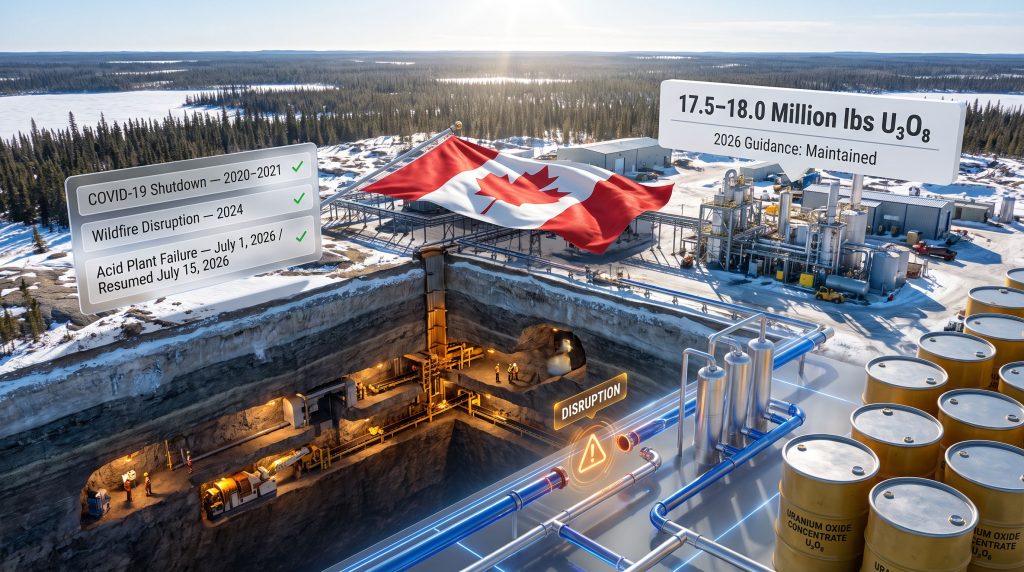
On July 1, 2026, operational issues at the McClean Lake mill's sulphuric acid plant triggered a complete production stoppage. The failure cascaded almost immediately into a full suspension of mining at Cigar Lake, with operations resuming on July 15, 2026, following the completion of repairs. Furthermore, Cameco's official operation update confirmed the timeline and scope of the disruption for stakeholders.
To understand why a chemical plant failure at a mill translates directly into a mining halt, it is necessary to understand the hydrometallurgical processing chain that uranium milling depends upon.
Sulphuric acid is the primary leaching agent in uranium ore processing. When crushed ore arrives at a conventional uranium mill, it enters an acid leach circuit where the acid dissolves uranium from the surrounding rock matrix, creating a uranium-bearing solution that is then purified through solvent extraction and precipitation stages before being dried and packaged as uranium oxide concentrate (U₃O₈). Without a functioning acid plant, this entire chain stops. The mill cannot accept ore, and Cigar Lake cannot deliver it.
| Event | Date | Operational Status |
|---|---|---|
| McClean Lake acid plant failure | July 1, 2026 | Mill halted, processing impossible |
| Cigar Lake mining suspension | July 1, 2026 | Mining stopped due to no processing outlet |
| Acid plant repairs completed | ~July 14-15, 2026 | Mill recommissioned |
| Cigar Lake mining resumed | July 15, 2026 | Full operations restored |
Why Limited Storage Made a Full Halt Unavoidable
A detail that receives insufficient attention in standard reporting is the role of ore storage capacity constraints in forcing a complete rather than partial suspension. Unlike base metals mines that may have extensive surface or underground stockpile areas, Cigar Lake's underground design and the logistical challenges of handling high-grade radioactive ore in a frozen ground environment mean that storage buffers are deliberately limited.
Continuing to mine with nowhere to send ore would have created a progressive accumulation problem with significant operational, safety, and regulatory implications. The decision to suspend mining in parallel with the mill stoppage reflects operational prudence rather than an absence of contingency options.
Historical Disruptions and the Pattern of Recovery
Investors new to Cameco's production history sometimes react to operational suspensions at Cigar Lake as anomalous events. However, the historical record tells a different story. In addition, considering the broader context of uranium supply challenges across the industry makes it clear that short-term disruptions at major producing assets are an enduring feature of the sector.
| Disruption | Period | Cause | Full Recovery |
|---|---|---|---|
| COVID-19 pandemic shutdown | 2020 to 2021 | Global health emergency protocols | Yes, operations restored 2021 |
| Wildfire-related halt | 2024 | Northern Saskatchewan fire threat | Yes, operations restored |
| Sulphuric acid plant failure | July 2026 | Downstream mill mechanical failure | Yes, operations restored July 15, 2026 |
Each disruption in this track record shares a common resolution: full operational restoration without permanent production impairment. This pattern provides a basis for assessing the probability-weighted operational risk at Cigar Lake, though past recovery does not guarantee future outcomes, and investors should consider each event independently based on its specific technical and logistical characteristics.
Cameco's ability to maintain full-year production guidance through successive short-term disruptions reflects not just geological endowment but the operational contingency depth that comes from managing a dual-asset Athabasca Basin production base.
2026 Production Guidance: Intact at 17.5 to 18 Million Pounds
Why Two Weeks Did Not Dent Annual Output
Cameco has confirmed its full-year 2026 uranium production target of 17.5 million to 18.0 million pounds of U₃O₈ remains unchanged despite the July suspension. Understanding why a two-week halt at one of the world's most significant uranium mines does not materially affect annual output requires appreciating several operational realities.
- A two-week suspension represents less than 4% of the annual operating calendar, limiting its proportional volume impact.
- Cameco's production portfolio includes the McArthur River/Key Lake operation, which provides a degree of portfolio-level production flexibility.
- Long-term supply contracts with nuclear utilities typically include delivery scheduling provisions that allow producers to manage minor timing deviations without triggering penalty clauses.
- Post-restart production optimisation at high-grade deposits can partially offset suspended output within the same reporting period.
Guidance as a Market Signal
The maintained guidance announcement carries significance beyond its numerical content. For Cameco's long-term contract counterparties, which include nuclear utilities operating on fuel planning cycles measured in years rather than quarters, a reaffirmed production outlook signals that the supply relationship remains on track.
For equity investors, it demonstrates that management assessed the disruption's scope accurately and communicated it transparently without waiting for the quarter-end reporting cycle.
Disclaimer: Production guidance figures represent management's current estimates and are subject to operational, geological, and market uncertainties. Forward-looking statements should not be treated as guarantees of future performance.
The McClean Lake Mill: Canada's Critical Uranium Processing Chokepoint
Processing Infrastructure as an Investment Variable
Most equity analysis of uranium producers focuses on deposit grade, mining cost, and uranium spot price. Fewer investors, however, systematically incorporate processing infrastructure risk as a distinct investment variable. The July 2026 event makes a compelling case for doing so.
The McClean Lake mill was purpose-built and expanded to handle Athabasca Basin ore, with its processing capacity and reagent systems calibrated specifically for the high-grade characteristics of Cigar Lake ore. This technical specialisation means there is no plug-in replacement option. An extended outage at McClean Lake would not be solvable by redirecting ore to any other existing Canadian uranium processing facility.
A further layer of complexity is the governance dimension: Cameco does not operate the McClean Lake mill. Repair timelines, maintenance scheduling, and operational decisions at the mill fall within Orano's operational governance framework. This third-party dependency is a structural feature of Cameco's Cigar Lake production chain that warrants explicit risk weighting in any investment thesis built around this asset.
The next major ASX story will hit our subscribers first
Uranium Market Context: Why Disruptions at Tier-One Assets Carry Outsized Signals
A Structurally Tightening Supply Landscape
The uranium market volatility entering the latter half of the 2020s is characterised by conditions that amplify the significance of any supply disruption at a major producing asset. Consequently, even short-lived halts at operations like Cigar Lake attract considerable attention from analysts and investors alike.
- Global nuclear capacity expansion is accelerating, driven by decarbonisation commitments across Europe, East Asia, and North America.
- Small modular reactor (SMR) development pipelines are creating longer-dated uranium demand visibility that utilities are increasingly seeking to lock in through term contracts.
- Secondary supply sources, including enrichment tails processing and government inventory releases, have declined structurally and no longer serve as a reliable demand buffer.
- New mine development timelines in Canada, Kazakhstan, and Africa continue to face permitting, financing, and geological challenges.
Against this backdrop, the uranium spot market remains structurally illiquid. Unlike copper or iron ore, where large volumes trade continuously through established exchange mechanisms, uranium spot transactions are comparatively infrequent. This illiquidity means that production signals from major producers carry disproportionate price influence, and even short suspensions at assets like Cigar Lake can attract speculative positioning in the spot and equities markets.
Cameco's Contractual Insulation and Long-Term Positioning
Cameco operates an extensive long-term contract book with nuclear utilities globally. This contract structure provides meaningful revenue insulation from short-term spot price volatility, and its delivery scheduling provisions create a natural buffer against minor production timing disruptions.
For investors evaluating uranium equities in the current environment, current uranium market trends reinforce the importance of production reliability as a differentiating factor. Cameco's dual-asset Athabasca Basin production base, transparent operational communication, and maintained 2026 guidance collectively reinforce the company's positioning as a production-reliable counterparty to long-dated nuclear fuel agreements. However, the McClean Lake processing dependency remains a structural risk factor that no amount of operational excellence at the mine level can fully eliminate.
This article is intended for informational purposes only and does not constitute financial or investment advice. Investors should conduct independent due diligence before making any investment decisions related to uranium equities or commodity markets.
Frequently Asked Questions
Why Did Cameco Suspend Mining at Cigar Lake in July 2026?
Mining was halted because operational failures at the McClean Lake mill's sulphuric acid plant made uranium ore processing impossible. Since Cigar Lake has limited ore storage capacity and no alternative processing outlet, mining could not continue independently of the mill. Reuters reported on the suspension, highlighting the immediate market implications of the stoppage.
Has Cameco Changed Its 2026 Uranium Production Forecast?
No. Cameco has confirmed its full-year 2026 production guidance of 17.5 to 18.0 million pounds of U₃O₈ remains intact, indicating the disruption falls within manageable operational variance.
What Makes Cigar Lake's Ore Grade Significant Compared to Other Uranium Mines?
Cigar Lake contains some of the highest-grade uranium ore on Earth, with deposit grades that vastly exceed global averages. This grade premium underpins Cameco's structural cost advantage but also necessitates specialised extraction technology, including ground freezing and jet boring methods not commonly used at the largest uranium mines elsewhere in the world.
Who Controls Operational Decisions at the McClean Lake Mill?
The McClean Lake mill is operated by Orano. Cameco does not directly govern maintenance or repair decisions at the facility, creating a third-party operational dependency within Cigar Lake's production chain.
Is This Suspension Unusual in the Context of Cigar Lake's Operational History?
No. Cigar Lake has experienced multiple operational suspensions, including a prolonged COVID-19 pandemic shutdown in 2020 to 2021 and a wildfire-related halt in 2024. In each case, operations were fully restored without permanent production impairment.
Want to Know When the Next Major Uranium Discovery Hits the ASX?
Discovery Alert's proprietary Discovery IQ model delivers real-time alerts on significant ASX mineral discoveries — including uranium — instantly cutting through complex data to surface actionable opportunities before the broader market reacts. Explore historic examples of exceptional discovery returns and start your 14-day free trial at Discovery Alert to position yourself ahead of the next major find.