July 13, 2026
The Uranium Supply Gap That Could Define India's Energy Future
The global nuclear fuel market operates on timelines that dwarf most commodity cycles. Uranium supply agreements are rarely signed and immediately activated. They are negotiated across years, ratified across political cycles, and operationalised only after layers of regulatory, diplomatic, and institutional groundwork have been laid. Understanding this reality is essential context for appreciating what the finalisation of Australian uranium exports to India in July 2026 actually represents — not as a sudden policy shift, but as the culmination of more than a decade of quiet, methodical groundwork.
For investors, energy analysts, and geopolitical strategists, the question worth asking is not simply what was signed. The more consequential question is what structural forces made this agreement not just possible, but arguably inevitable.
When big ASX news breaks, our subscribers know first
India's Nuclear Ambition and the Arithmetic of Scarcity
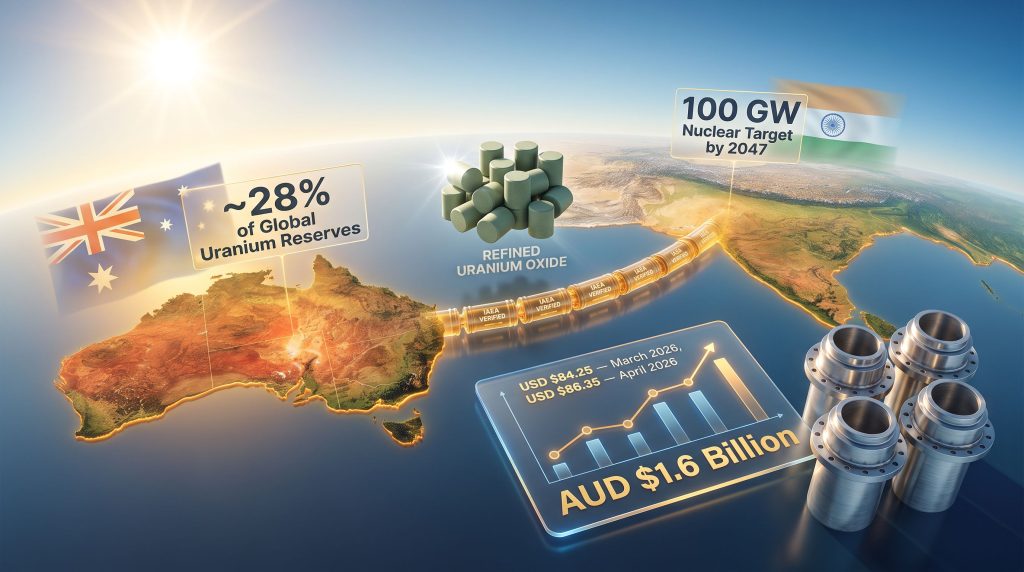
India's energy calculus is stark. The country currently operates 24 nuclear reactors across seven sites, with a combined installed capacity of 8.78 gigawatts. Against this baseline, the government has committed to reaching 100 GW of nuclear capacity by 2047, a target embedded in the Nuclear Energy Mission outlined in India's 2025-26 Union Budget. That is an expansion of more than eleven times current capacity within roughly two decades.
The ambition does not stop at capacity targets. India has 10 reactors under active construction and pre-project activities already underway for a further 10. Plans for additional reactors beyond these are in active discussion. Layered on top of this conventional reactor pipeline is a commitment to deploying at least five domestically designed small modular reactors by 2033.
The structural problem is straightforward: India's domestic uranium reserves are insufficient to fuel this buildout. Unlike thorium, which India possesses in significant quantities, uranium must largely be sourced internationally. This is not a short-term procurement challenge. It is a multi-decade supply dependency that shapes every aspect of India's nuclear expansion strategy. Furthermore, the critical minerals demand created by the global energy transition only intensifies competition for reliable supply sources.
India's government has described scaling nuclear capacity as not merely a strategic option but a fundamental necessity for long-term energy security and clean power transition. This framing is significant. It positions uranium imports not as a luxury of ambition but as a structural requirement of India's net-zero-by-2070 pathway.
From Agreement to Activation: Why the 12-Year Gap Matters
India and Australia signed a Civil Nuclear Cooperation Agreement in September 2014, which entered into force in November 2015. Yet more than a decade passed before the first tonne of Australian uranium was cleared for export. This delay is frequently misunderstood as bureaucratic inertia. In reality, it reflects the precise and non-negotiable architecture of nuclear diplomacy.
Australia's Joint Standing Committee on Treaties recommended that uranium sales not commence until India satisfied three specific categories of preconditions:
- Establishment of appropriate regulatory frameworks governing civilian nuclear operations
- Development of credible and independent inspection regimes capable of verifying safeguard compliance
- Implementation of formal decommissioning protocols for nuclear facilities
A test shipment occurred in 2017, which established certain precedents but did not trigger full commercial export flows. Australian authorities determined that India's compliance benchmarks had been fully met ahead of the Third India-Australia Annual Summit, held in Melbourne on July 9, 2026. The resulting Administrative Arrangement is the instrument that converts the 2015 treaty from a diplomatic framework into an operational export mechanism.
This distinction between a cooperation agreement and an administrative arrangement is subtle but critical. The former establishes intent and principles. The latter defines the actual terms, conditions, inspection access, and safeguards under which physical uranium transfers can proceed. Australia's uranium export policy provides the formal framework within which these operational arrangements must sit.
The Legislative Catalyst: India's SHANTI Act
One of the least-discussed but most consequential enabling conditions for this deal was India's passage of the Sustainable Harnessing and Advancement of Nuclear Energy for Transforming India Act, known as the SHANTI Act, in December 2025.
For decades, India's nuclear sector was a strictly government-controlled domain. The SHANTI Act fundamentally altered this by permitting private companies and joint ventures to build, own, and operate nuclear power plants for the first time. This is a paradigm shift in how India's nuclear expansion will be financed and executed.
The commercial logic is direct: reaching 100 GW of nuclear capacity by 2047 is impossible through public sector investment alone. The capital requirements are simply too large. Private developers and institutional investors must participate. However, private capital will not flow into nuclear projects without fuel supply certainty. The Administrative Arrangement establishing long-term Australian uranium exports to India addresses precisely this gap, providing the supply security that functions as a prerequisite for private sector bankability.
The SHANTI Act opened the door to private nuclear investment in India. The uranium supply arrangement from Australia helps ensure there is fuel waiting on the other side of that door.
Australia's Position in the Global Uranium Supply Chain
How Does Australia's Reserve Base Compare Globally?
To appreciate Australia's strategic value to India, the reserve mathematics are instructive. Australia holds an estimated 28% of global uranium reserves, ranking it as the world's fourth-largest uranium producer by output, behind Kazakhstan, Canada, and Namibia. Critically, the relevant metric for long-term supply relationships is not current production volume but reserve depth and geological longevity. For a deeper look at how these figures stack up internationally, global uranium reserves data reveals the scale of Australia's long-term advantage.
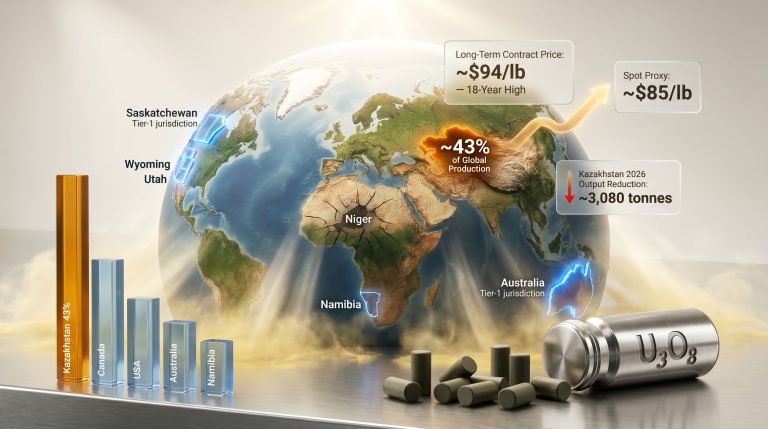
Kazakhstan uranium dominance of current spot market supply through its low-cost in-situ recovery operations introduces supply concentration risk for importing nations. Australia's reserve base offers something qualitatively different: geopolitical stability, rule-of-law operating environment, and long-duration supply potential across multi-decade timeframes.
The uranium market itself is in a period of notable recalibration. Key pricing data points provide useful context:
| Price Reference Point | USD per Pound |
|---|---|
| End-of-April 2026 spot price | $86.35 |
| End-of-March 2026 spot price | $84.25 |
| One year prior (approx.) | $94.28 |
| Estimated India import volume (initial) | Up to 300 tonnes/year |
| Estimated trade value (2025-26 FY) | AUD $1.6 billion |
The spot price moderation from the highs of approximately USD $94 per pound seen a year earlier reflects a market in transition rather than a market in distress. Indeed, uranium supply-demand volatility plays a central role in shaping how both buyers and sellers approach contract structures. It is important to note that the Australia-India uranium relationship will be governed primarily by long-term offtake agreements, not spot pricing. Long-term contract structures typically incorporate price floors, escalation clauses, and volume commitments that insulate both buyer and seller from short-term spot volatility.
Disclaimer: Commodity price projections and trade value estimates involve inherent uncertainty. The figures cited represent published estimates and market data as of mid-2026 and should not be construed as financial advice or guaranteed commercial outcomes.
Nonproliferation Architecture: The Safeguards Framework
Any serious analysis of Australian uranium exports to India must engage with the nonproliferation dimension. India is not a signatory to the Nuclear Non-Proliferation Treaty (NPT), which historically complicated its access to global nuclear materials and technology. The mechanism that bridges this gap is the International Atomic Energy Agency's safeguards verification system, applied specifically to India's civilian nuclear facilities under a facility-specific safeguards agreement.
The core condition governing Australian uranium exports is absolute: all material must remain within India's civilian nuclear program and cannot be diverted to military applications. The structural challenge this creates is considerable. India operates an integrated nuclear program in which civilian and military facilities coexist within the same institutional ecosystem. Maintaining verifiable separation of materials across these streams requires robust IAEA access and continuous monitoring.
Australia's historical caution regarding India's nuclear weapons status was a significant factor in the decade-long gap between agreement and activation. The Administrative Arrangement's safeguards provisions represent Australia's determination that adequate verification mechanisms are now in place.
A separate but related dimension involves the Nuclear Suppliers Group (NSG), the 48-nation body that coordinates export controls on nuclear materials and technologies for peaceful purposes. At the July 2026 summit, Australia formally reaffirmed its support for India's accession to NSG membership. India's admission to the NSG would represent a structural normalisation of its access to global nuclear supply chains, but this remains diplomatically contested. China has historically opposed India's NSG membership, citing India's non-NPT status, and this geopolitical friction has not been resolved by the bilateral Australia-India arrangement.
The Administrative Arrangement creates a workable operational framework for uranium exports, but it operates within a broader nonproliferation architecture that remains unresolved at the multilateral level. IAEA safeguards bridge the practical gap, while the NSG membership question remains a longer diplomatic horizon.
The next major ASX story will hit our subscribers first
India's Reactor Technology Mix and Fuel Cycle Implications
How Do Reactor Choices Shape Uranium Import Volumes?
A dimension that frequently escapes mainstream coverage is how India's technology choices shape its uranium import requirements over time. India's reactor fleet is predominantly comprised of Pressurised Heavy Water Reactors (PHWRs), which use natural unenriched uranium as fuel. This is significant because it means India's current and near-term reactor fleet does not require the enrichment services that dominate the fuel cycles of light water reactor fleets in the United States, Europe, and much of East Asia.
Natural uranium PHWRs consume uranium at higher rates per unit of electricity generated compared to enriched-fuel light water reactors, which actually increases India's near-term import volume requirements per gigawatt of installed capacity. This dynamic reinforces the strategic importance of securing long-term supply relationships at scale.
The SMR dimension adds further complexity. India's plan to deploy domestically designed SMRs by 2033 introduces different fuel specification requirements. Depending on the reactor design chosen, SMRs may require low-enriched uranium rather than natural uranium, potentially adding an enrichment services dimension to India's future fuel procurement strategy that does not exist in its current PHWR fleet.
Perhaps the most strategically significant long-term variable is India's Prototype Fast Breeder Reactor (PFBR), a 500 MWe sodium-cooled facility that achieved initial criticality in April 2026. Fast breeder technology is foundational to India's long-term three-stage nuclear program, which ultimately aims to utilise thorium as a primary fuel source.
The thorium transition pathway, if successfully commercialised, would progressively reduce India's long-term dependency on imported uranium. However, the timelines for achieving a mature fast breeder fleet are measured in decades, not years. The strategic window for maximum Australian uranium export volumes is widely assessed to be the 2026-2040 period, before breeder technology matures sufficiently to begin reducing conventional uranium demand.
Reactor Pipeline at a Glance
| Category | Count |
|---|---|
| Currently operational reactors | 24 |
| Under active construction | 10 |
| Pre-project activities underway | 10 |
| SMR target (domestically built, by 2033) | At least 5 |
| Long-term capacity target (by 2047) | 100 GW |
Australia's Trade Diversification Logic
The uranium export relationship with India fits within a broader strategic repositioning of Australia's resource export portfolio. Australia's trade exposure to China across multiple commodity categories, including iron ore, coal, and liquefied natural gas, has been a persistent source of concentration risk in trade policy discussions. Developing high-value, long-duration supply relationships with alternative partners across the Indo-Pacific represents a structural diversification of that risk.
India's trajectory toward becoming a top-five global economy, combined with its extraordinary nuclear expansion ambitions, positions it as one of the most consequential long-term uranium buyers in the world. Early positioning as a preferred, trusted supplier carries compounding strategic value that extends well beyond the initial AUD $1.6 billion annual trade estimate. In addition, the uranium market dynamics shaping the broader sector suggest that long-term bilateral supply arrangements will grow in strategic and commercial importance throughout this decade.
The uranium arrangement also sits within the broader framework of the India-Australia Economic Cooperation and Trade Agreement (ECTA), reinforcing a multi-domain partnership that spans goods, services, and strategic resource supply. As World Nuclear Association data confirms, Australia's uranium sector is well-positioned to service growing demand from across the Indo-Pacific.
For Australian uranium producers, the commercial implications are concrete: a new long-term demand channel of meaningful scale provides the supply certainty needed to justify production expansion, capital expenditure commitments, and greenfield exploration investment. The uranium mining sector operates on long capital cycles, and confirmed long-term offtake demand is the single most important variable in project financing decisions.
Scenario Analysis: Pathways and Risks
| Scenario | Key Trigger | Probable Outcome |
|---|---|---|
| Full implementation on schedule | IAEA inspections proceed smoothly; India's reactor pipeline advances | AUD $1.6B+ annual trade value; Australian producers expand capacity |
| Partial implementation | Regulatory friction or construction delays in India | Exports below 300 tonne ceiling; contract terms renegotiated |
| Geopolitical disruption | Deterioration in bilateral relations or NSG complications | Administrative Arrangement suspended; supply redirected elsewhere |
| Accelerated thorium transition | Fast breeder fleet scales faster than projected | Reduced uranium import volumes post-2035; contract renegotiation |
These scenarios are illustrative projections based on current conditions and should not be interpreted as predictions of future outcomes. Geopolitical, regulatory, and technological developments may materially alter these trajectories.
Frequently Asked Questions
What Exactly Is the Administrative Arrangement Signed in July 2026?
It is the operational framework that activates the 2015 Civil Nuclear Cooperation Agreement between Australia and India, establishing the specific terms, safeguards, and conditions governing the physical export of Australian uranium to India for civilian power generation.
Why Did Implementation Take More Than a Decade After the Original Agreement?
Australia's parliamentary treaty review process required India to satisfy specific benchmarks relating to nuclear regulatory infrastructure, independent inspection capacity, and decommissioning frameworks. Australian authorities determined these conditions were met ahead of the July 2026 summit.
Can Australian Uranium Be Used in India's Weapons Programme?
All exports are restricted by IAEA safeguards and a strict civilian-military separation requirement. Australian uranium is legally and contractually confined to India's civilian nuclear power programme, with IAEA verification providing the international oversight mechanism.
What Volumes Are Expected Under the Arrangement?
Early projections indicate up to 300 tonnes per year, with final volumes depending on India's reactor construction progress and the pace of its capacity expansion toward the 100 GW target.
What Does This Mean for Australian Uranium Producers?
The arrangement creates a new long-term demand channel that could support production planning, exploration investment, and capital expenditure decisions across Australia's uranium sector. The estimated trade value of AUD $1.6 billion in the 2025-26 financial year signals the scale of the commercial opportunity now accessible to Australian producers.
Want to Capitalise on the Uranium Opportunities Emerging From India's Nuclear Expansion?
Discovery Alert's proprietary Discovery IQ model delivers real-time alerts on significant ASX mineral discoveries — including uranium — instantly empowering subscribers to identify actionable opportunities ahead of the broader market. Explore historic examples of major discoveries and their market returns, then begin your 14-day free trial today to position yourself at the forefront of one of the most consequential resource stories of the decade.