July 11, 2026
The Uranium Supply Equation Driving India's Most Ambitious Energy Pivot
The global nuclear renaissance is not unfolding evenly. While Europe debates reactor lifetimes and the United States races to revive dormant capacity, the most structurally consequential nuclear buildout of the next two decades is taking shape in South Asia. India's trajectory is distinct in both scale and urgency, and the fuel supply challenge underpinning it is forcing a fundamental rethink of how sovereign energy security is engineered in the 21st century.
At the core of this rethink sits a deceptively simple problem: uranium. The entity now tasked with solving it at an industrial scale is NTPC, India's largest state-controlled power utility, which has formally initiated a search for NTPC overseas uranium mines as the foundation of a fuel strategy that will define Indian energy policy for a generation.
When big ASX news breaks, our subscribers know first
Why Domestic Uranium Can't Carry India's Nuclear Ambitions
India's uranium production landscape is remarkably narrow for a country with the world's third-largest nuclear programme. The Uranium Corporation of India Limited (UCIL) holds a complete domestic monopoly on uranium extraction, operating mines concentrated in Jharkhand and Andhra Pradesh. These operations, while strategically vital, have never been designed to supply the kind of sustained, high-volume fuel pipeline that a major capacity expansion demands.
The structural vulnerability here is not simply about tonnage. It is about the architecture of dependency. A single state-owned producer, constrained to two geographic clusters, represents a concentration risk that no serious long-range energy planner can ignore. UCIL's production levels have also failed to keep pace with India's expanding reactor ambitions, and the gap between what can be mined domestically and what future reactors will require is widening with each passing year. This foundational tension has driven NTPC toward international markets.
India's 100 GW Nuclear Target: The Numbers Behind the Ambition
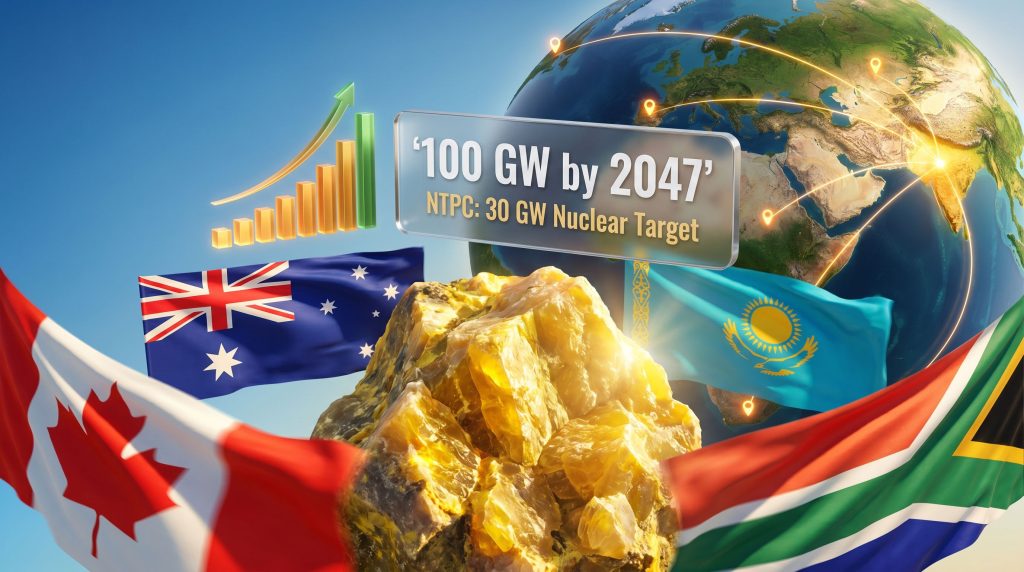
India has committed to reaching 100 gigawatts of nuclear power capacity by 2047, an undertaking without precedent in the country's energy history. To put this in perspective, India's current installed nuclear capacity sits at roughly 7.5 GW, meaning the national target represents a more than thirteenfold increase over current levels within approximately two decades.
NTPC's mandated contribution to this goal is approximately 30 GW, representing around 30% of the total national buildout. Measured against NTPC's current nuclear footprint, this is an elevenfold expansion within the company itself. The fuel arithmetic that follows from this target is staggering, and furthermore, the uranium supply-demand volatility affecting global markets makes early acquisition strategies even more critical:
- A single 1 GW pressurised water reactor typically requires between 150 and 200 tonnes of natural uranium per year at full operation
- A 30 GW fleet, even accounting for India's preference for pressurised heavy water reactors (PHWRs) which are more uranium-efficient, would require tens of thousands of tonnes of uranium annually at peak operation
- Long-lead procurement cycles for uranium, often spanning 5 to 10 years from contract to delivery at scale, mean NTPC must begin securing supply commitments now for capacity that won't be operational until the 2030s and 2040s
India's nuclear expansion is not simply an energy policy decision. It functions as a structural decarbonisation instrument for an economy where coal-fired generation currently dominates the power mix, and where the emissions intensity of electricity production remains one of the highest among major economies.
What NTPC's Consultant Tender Actually Reveals
On July 10, 2026, NTPC issued a formal tender to appoint specialist consultants to identify and evaluate overseas uranium mining assets. Bids from prospective consultants were due by July 16, 2026, a timeline so compressed it signals the urgency of the internal mandate rather than a relaxed exploratory exercise.
This tender marks NTPC's first formal institutional step toward independent overseas uranium asset ownership, a significant departure from India's historically import-centric uranium procurement model. The scope of work assigned to the appointed consultant is deliberately comprehensive, covering:
- Asset screening across greenfield, brownfield, and operating mine categories in target jurisdictions
- Strategic and geopolitical fit assessment of candidate assets, including resource quality evaluation
- Global Request for Proposal preparation to solicit expressions of interest from international uranium asset holders
- Techno-commercial analysis using internationally recognised valuation methodologies to assess financial and operational viability of shortlisted opportunities
What is particularly notable about the scope is the inclusion of greenfield assets alongside operating mines. Greenfield uranium development carries significantly higher execution risk and longer lead times, but can deliver superior resource quality and cost control once in production. That NTPC is not limiting its search to producing assets suggests a long-term ownership orientation rather than a purely transactional procurement mindset.
The Four Target Jurisdictions: A Strategic Anatomy
NTPC's consultant tender explicitly names four priority countries for uranium asset evaluation. Each carries a distinct risk-reward profile and strategic rationale.
| Country | Strategic Rationale | Current Status |
|---|---|---|
| Canada | World-class high-grade deposits; established regulatory frameworks | Cameco supply deal signed; shipments commencing 2027 |
| Australia | Large uranium reserves; recently formalised bilateral import agreement | Import deal signed during PM Modi's Melbourne visit in 2026 |
| Kazakhstan | World's largest uranium producer by volume; cost-competitive production | NAC Kazatomprom ranked first globally by output in 2024 |
| South Africa | Established mining infrastructure; uranium recovered as gold mining by-product | Diversification opportunity in the African region |
A critical and underappreciated aspect of this list is the uranium-as-by-product dynamic in South Africa. Much of South Africa's uranium has historically been extracted as a co-product of gold mining operations, particularly in the Witwatersrand Basin. This means uranium recovery costs can be partially offset by gold revenue, potentially making South African assets more cost-competitive than headline production figures suggest.
Kazakhstan uranium dominance in global output presents a different kind of complexity. NAC Kazatomprom, the state-owned entity that produced more uranium than any other single company globally in 2024, operates predominantly through in-situ recovery mining, a technique that pumps acidic or alkaline solution through uranium-bearing sandstone formations to dissolve and extract the mineral without conventional excavation. ISR is significantly cheaper and faster to bring into production than conventional mining, which is a key reason Kazakhstan dominates global output. However, the geopolitical proximity of Kazakhstan to Russian influence introduces supply chain considerations that Indian planners must weigh carefully.
Global Uranium Concentration: The Strategic Context
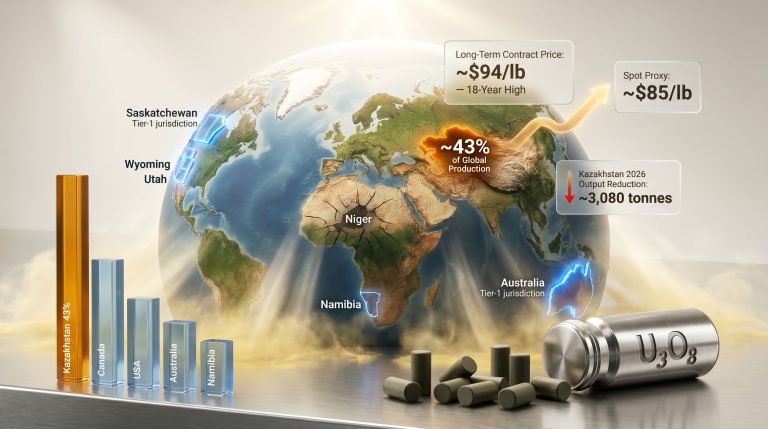
The World Nuclear Association's data for 2024 confirms that the top five uranium-producing nations controlled approximately 70% of global output. This level of concentration is unusual even by the standards of other strategic commodities and creates a structural dynamic where any new large-scale buyer must either compete directly for access to the same limited pool of producers or pursue equity ownership to secure priority access.
Reviewing the global uranium reserves data further underscores the challenge India faces:
- Kazakhstan held the top position globally in 2024 through Kazatomprom
- Canada ranked second, driven primarily by Cameco's operations in the Athabasca Basin, which hosts some of the highest-grade uranium deposits on Earth, with ore grades at sites like Cigar Lake running more than 100 times the global average
- Namibia, Australia, and Uzbekistan rounded out the top five
The Athabasca Basin in Saskatchewan deserves particular attention in the context of NTPC's acquisition strategy. Its deposits are not merely large; they are extraordinarily high-grade. Average uranium ore grades globally sit around 0.1% U3O8, while Athabasca Basin deposits can exceed 10% to 20% U3O8 in some zones. Higher grades mean lower processing costs per pound of uranium produced, a factor that materially affects long-term economics for an entity planning multi-decade fuel supply.
The next major ASX story will hit our subscribers first
India's Existing Uranium Supply Architecture
NTPC's overseas mine strategy does not emerge from a vacuum. India has been methodically building a multi-source uranium import framework over recent years, recognising that supply diversification at the contract level is a necessary but insufficient safeguard.
| Supply Partner | Arrangement Status | Notes |
|---|---|---|
| Uzbekistan | Active import relationship | Ongoing procurement |
| Russia | Active bilateral supply | Established arrangement |
| Australia | Newly formalised (2026) | Import agreement reached during PM Modi's Melbourne visit |
| Cameco (Canada) | Contracted | Physical shipments scheduled to begin in 2027 |
The progression from import contracts to equity mine ownership reflects a well-established principle in sovereign resource strategy: contracts provide supply access, but ownership provides supply control. Import agreements are subject to counterparty risk, price renegotiation, export licensing decisions, and geopolitical friction. An equity stake in a producing mine gives the holder direct participation in production volumes, pricing economics, and operational decisions.
This is the logic that China applied aggressively in uranium through CNNC and CGN, that France embedded through Orano's long-term mine positions in Niger and Kazakhstan, and that Japan pursued through JOGMEC's strategic investment programme following the post-Fukushima restructuring of its nuclear fuel policy. India is consequently following an established sovereign playbook, albeit two to three decades behind the leading practitioners.
The Legislative Unlock: December 2025 Atomic Energy Reforms
No analysis of NTPC's uranium strategy is complete without understanding the legal transformation that made it possible. In December 2025, the Indian Parliament passed landmark legislation that formally dismantled the decades-long state monopoly over nuclear power generation. The new law opened the sector to private participation for the first time and, critically, overhauled the nuclear liability framework that had functioned as a near-total deterrent to both domestic and foreign investment in Indian nuclear infrastructure.
The previous liability provisions, rooted in the Civil Liability for Nuclear Damage Act of 2010, had created supplier liability exposure that made global reactor vendors and nuclear fuel companies deeply reluctant to engage with the Indian market on commercial terms. The 2025 reforms addressed this structural impediment directly. Without this legislative change, NTPC overseas uranium mines programme would face significant obstacles in attracting international commercial partners and structuring the joint venture arrangements that equity mine ownership typically requires.
How NTPC's Strategy Benchmarks Against Global Peers
| Country | State Nuclear Entity | Overseas Uranium Ownership Approach |
|---|---|---|
| China | CNNC / CGN | Equity stakes across Africa, Central Asia, Canada |
| France | Orano (formerly Areva) | Long-term mine ownership in Niger, Kazakhstan, Canada |
| Japan | JAEA / JOGMEC | Strategic equity investments post-Fukushima restructuring |
| India (emerging) | NTPC | Consultant-led asset identification, four target jurisdictions |
India's current position in this landscape is best understood as early-stage institutional mobilisation. The consultant tender is a first-mover action in what will need to be a sustained, multi-year acquisition campaign. The risk of moving too slowly is real: uranium asset valuations have been rising in response to the global nuclear revival, and quality assets in stable jurisdictions are attracting competitive interest from multiple sovereign buyers simultaneously.
Key Risks NTPC Must Navigate
The strategic logic behind NTPC overseas uranium mines is compelling, however execution carries material risks that investors and policy analysts should weigh carefully:
- Permitting timelines in Canada and Australia can realistically span 10 to 20 years from discovery to first production. Even brownfield development or mine restarts in these jurisdictions face multi-year regulatory processes
- Kazakh supply chain dependencies introduce geopolitical exposure that Indian planners have historically sought to minimise, particularly given the evolving dynamics of Russian influence in Central Asia
- Capital intensity at the scale NTPC is contemplating requires not just government backing but sophisticated long-term financing structures, including potential export credit arrangements with host country governments
- Competitive acquisition pressure from Chinese, South Korean, and Japanese state entities that are already active in NTPC's target jurisdictions means first-mover advantage is eroding with each passing quarter
- Community and environmental opposition in democratic jurisdictions such as Canada and Australia has materially delayed multiple uranium projects in recent years, creating timeline risk for assets that appear commercially attractive on paper
Disclaimer: This article contains forward-looking analysis based on publicly available information and structural market assessments. It does not constitute financial or investment advice. Readers should conduct independent due diligence before making any investment decisions related to uranium markets or nuclear energy companies.
What India's Entry Means for Global Uranium Markets
The demand-side implications of India's nuclear buildout are significant and largely underappreciated in mainstream commodity market analysis. A 30 GW NTPC fleet, phased in over two decades, represents a sustained, multi-decade uranium demand commitment of a scale that very few new sovereign buyers have introduced to the market in the past 30 years.
Furthermore, current uranium market trends indicate that when combined with parallel nuclear expansion programmes in China, the United Kingdom, and the United States, India's entry as a large-scale sovereign buyer contributes to a structural supply-demand imbalance that many nuclear fuel analysts now project will manifest as a sustained uranium price environment through the late 2020s and into the 2030s.
For uranium-producing nations, the hierarchy of strategic opportunity from India's programme runs broadly as follows:
- Canada is positioned to benefit most immediately, given the existing Cameco supply relationship, the bilateral diplomatic framework, and the presence of globally significant high-grade deposits
- Australia gains relevance through the 2026 import agreement and its position as a holder of the world's largest identified uranium resources by tonnage
- Kazakhstan remains pivotal given production volume, though geopolitical considerations may moderate the depth of equity exposure India pursues there
- South Africa represents a longer-duration opportunity, with its by-product uranium economics potentially becoming more attractive as gold production costs evolve
India's nuclear fuel strategy is no longer a domestic planning exercise. Through the NTPC overseas uranium mines programme, it is becoming a structural force in global uranium markets, and the early stages of that transformation are already underway.
Want to Capitalise on the Uranium Discoveries Driving the Nuclear Renaissance?
Discovery Alert's proprietary Discovery IQ model delivers real-time alerts on significant ASX uranium and mineral discoveries, instantly transforming complex resource data into actionable investment insights — explore historic discoveries and their market returns to understand the opportunity, then begin your 14-day free trial at Discovery Alert to position yourself ahead of the next major find.