July 8, 2026
Why Processing Plant Design Has Become the Defining Variable in Hard Rock Lithium Economics
Across the global mining industry, a quiet but consequential rethink is underway. The assumption that a lithium project's viability is primarily determined by ore grade and resource size is being systematically challenged. Construction cost inflation since 2020 has pushed processing plant capital expenditure to levels that can render even high-grade deposits marginal, and developers are increasingly discovering that the processing flowsheet itself is where economic battles are won or lost.
This shift in emphasis has brought thermal processing technology into sharp focus. For hard rock lithium projects, the roasting stage sits at the heart of the processing plant both physically and economically. Getting that stage right, or wrong, can move the needle on project economics by hundreds of millions of dollars. It is within this context that testwork results from European Metals Holdings' Cinovec project in Czechia have attracted serious attention from project financiers, offtake partners, and lithium sector observers tracking Europe's ambitions to establish a domestic battery supply chain.
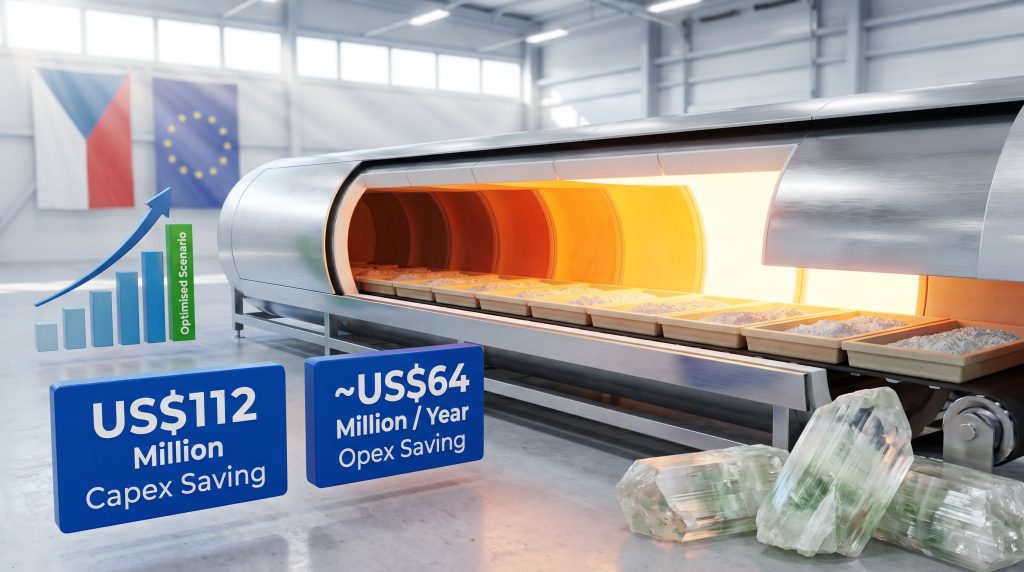
The potential for Cinovec tunnel kiln capex savings of approximately US$112 million compared to the rotary kiln baseline established in the project's definitive feasibility study represents one of the most material single-item optimisation outcomes reported by a European lithium developer in recent years.
When big ASX news breaks, our subscribers know first
Understanding the Roasting Problem in Spodumene Processing
To appreciate why kiln selection matters so profoundly, it helps to understand the chemistry that underpins hard rock lithium processing. The process of spodumene lithium extraction depends on converting lithium from a crystalline phase called alpha-spodumene, which is chemically stable and largely unreactive to standard acid leaching. Before lithium can be efficiently extracted, the ore must be thermally converted into beta-spodumene, a phase transformation that occurs at temperatures typically between 1,000 and 1,100 degrees Celsius.
This phase conversion, known in the industry as calcination or roasting, is deceptively simple in concept but technically demanding in practice. Two failure modes define the risk envelope:
- Under-roasting: Incomplete phase conversion leaves alpha-spodumene in the feed, reducing lithium recovery in the downstream leaching circuit.
- Over-roasting (vitrification): Excessive temperatures cause the spodumene to partially melt and re-solidify into a glass-like structure, also reducing acid-leachable lithium and typically requiring energy-intensive post-roast milling to restore surface area.
Temperature precision is therefore not a refinement; it is a core process requirement. This is where the architectural differences between rotary kilns and tunnel kilns become commercially significant.
Rotary Kiln vs. Tunnel Kiln: A Technical Comparison
| Feature | Rotary Kiln (DFS Baseline) | Tunnel Kiln (Optimisation Option) |
|---|---|---|
| Configuration | Multiple rotating cylindrical units | Single linear continuous-feed system |
| Component sourcing | Bespoke/engineered | Off-the-shelf modular |
| Temperature control | Higher overshoot risk | Precise zone-by-zone control |
| Post-roast milling | Required (vitrification risk) | Eliminated |
| Energy source flexibility | Gas-dependent | Gas or electric switchable |
| Installation complexity | High | Reduced |
A rotary kiln operates by tumbling material through a slowly rotating cylinder while hot gases pass through the unit. The continuous movement introduces variability in how individual ore particles experience the thermal profile, creating pockets of both under- and over-roasted material. Managing this variability typically requires conservative operating temperatures and, in many plant designs, a post-roast milling circuit to address vitrified particles.
A tunnel kiln, by contrast, moves material on kiln cars through a fixed series of temperature-controlled zones in a linear sequence. Each zone can be independently calibrated, allowing operators to precisely control the heating curve, peak temperature, and cooling rate that the material experiences. Because the thermal profile is applied consistently across the entire batch, the risk of localised over-roasting is substantially reduced, and the need for post-roast milling circuits is correspondingly diminished or eliminated entirely.
This is not a marginal process difference. Removing a post-roast milling circuit eliminates capital expenditure on grinding equipment, associated conveyors, dust management systems, and the operational footprint they require — all of which accumulate into meaningful cost reductions.
Breaking Down the US$112 Million Capex Saving at Cinovec
The headline figure from European Metals Holdings' testwork program reflects the combined effect of several interconnected cost reductions, not a single line-item swap. Understanding where the savings originate is essential for evaluating their credibility and durability.
The primary sources of the projected US$112 million reduction in upfront capital expenditure are:
- Replacement of multiple gas-fired rotary kiln units with a single gas/electric tunnel kiln system, reducing the total number of major rotating equipment items and their associated installation, civil, and structural requirements.
- Elimination of post-roast milling circuits, which removes a complete processing module including equipment, buildings, and electrical infrastructure.
- Modular, commercially available component procurement, which removes the bespoke engineering cost layer that inflates capital estimates for custom-designed rotary kiln systems and reduces contractor risk premiums.
- Reduced civil works complexity, as a single linear tunnel kiln system requires a different, and in many configurations less extensive, civil footprint than multiple rotary kiln installations.
The financial significance of this saving extends beyond the number itself. In the current credit environment, a US$112 million reduction in upfront capital directly improves a project's debt-to-equity ratio, potentially lowering the absolute quantum of equity financing required and reducing the dilution burden on existing shareholders.
For project financiers evaluating greenfield lithium development, the distinction between bespoke engineered equipment and commercially available modular systems carries additional weight. Lenders apply risk premiums to procurement categories with long lead times and single-source dependencies. A tunnel kiln using off-the-shelf components falls into a more favourable financing category than a custom rotary kiln configuration, which can translate into meaningfully better debt terms.
Annual Operating Cost Reductions: The Compounding Benefit
Capital expenditure savings generate a one-time improvement to project economics. Operating cost reductions compound across the full mine life, which makes the projected US$10 million per year in opex savings from the tunnel kiln substitution alone arguably more valuable over a multi-decade operating period.
The tunnel kiln's opex advantage flows from two sources:
- Lower thermal energy consumption: The precision heating profile of a tunnel kiln reduces the total energy input required to achieve complete phase conversion, since heat is applied more efficiently to the material rather than being distributed across a rotating system with inherent thermal losses.
- Energy source flexibility: The ability to switch between gas and electric operation provides genuine optionality in European energy markets, where gas price volatility since 2021 has been substantial. A processing plant that can pivot to electricity when gas prices spike, or when renewable electricity pricing makes electrification economically attractive, carries structural insurance against energy market disruption.
This dual-fuel capability also carries significance within EU sustainability frameworks. Processing operations that can demonstrate a credible pathway to full electrification are better positioned within European taxonomy classifications for sustainable economic activities, potentially unlocking access to green finance instruments with preferential terms. Furthermore, the conversion pathway from spodumene-to-lithium salts becomes more cost-competitive when upstream thermal processing operates with greater energy efficiency.
Combined Optimisation: The Full Savings Picture
The tunnel kiln testwork does not represent the entirety of European Metals Holdings' processing optimisation program. Parallel work on the Lithium Chemical Plant flowsheet has generated additional efficiency findings that, when aggregated with the kiln technology substitution, produce a combined savings profile of significant scale.
| Optimisation Lever | Capex Saving | Annual Opex Saving |
|---|---|---|
| Tunnel kiln substitution | Component of US$112M total | ~US$10M/year |
| LCP flowsheet optimisation | Component of US$112M total | Component of ~US$64M/year |
| Combined total | ~US$112 million | ~US$64 million/year |
An annual operating cost reduction of US$64 million, applied across a mine life measured in decades, represents a present value contribution that dwarfs the one-time capex saving, particularly when discounted at rates typical of project finance transactions.
Cinovec's Strategic Position in European Critical Mineral Development
The significance of these optimisation outcomes cannot be evaluated independently of where Cinovec sits in the European critical minerals landscape. The Cinovec project overview confirms it is widely recognised as Europe's largest hard rock lithium resource, positioned at a point in the Czech-German border region that offers both proximity to European battery manufacturing centres and access to established mining infrastructure.
The project's processing plant is planned for construction at the site of the former Prunéřov coal-fired power station, a location that provides pre-existing grid connections, land tenure, road and rail access, and water infrastructure. These site-specific advantages reduce capital requirements independently of kiln technology choices, and their interaction with a lower-capex processing plant design compounds the overall capital efficiency improvement.
For European battery manufacturers seeking to reduce dependence on non-European lithium supply chains, a project that combines Europe's largest hard rock lithium resource with a demonstrably lower-cost processing pathway carries commercial weight that extends well beyond the financial metrics alone. Consequently, the broader implications for the lithium carbonate market in Europe are considerable, particularly as domestic supply chains continue to develop.
The December Quarter Decision and What It Signals
The assessment of processing optimisation options at Cinovec, including the tunnel kiln pathway, is expected to culminate in a decision during the December quarter. This timeline is material for several reasons.
A positive decision in favour of the tunnel kiln configuration would likely trigger a process of updating the project's DFS-level cost estimates to reflect the new processing design. Any revised feasibility work incorporating the US$112 million capex reduction and US$64 million per year opex improvement would materially alter the project's published economic metrics, including net present value, internal rate of return, and capital payback period, creating a substantially revised investment case relative to existing DFS outputs.
Key considerations for the decision process include:
- The completeness and scale of testwork data supporting the tunnel kiln configuration at Cinovec's specific ore characteristics.
- The maturity of vendor relationships for commercial tunnel kiln supply into the scale required for a project of Cinovec's throughput.
- Integration requirements between the tunnel kiln system and adjacent processing circuits, particularly acid leaching and lithium chemical plant operations.
- Whether any residual technical questions can be resolved through additional bench-scale or pilot-scale work within the December quarter timeline.
The next major ASX story will hit our subscribers first
Why Thermal Processing Innovation Is Reshaping the Lithium Sector
The Cinovec tunnel kiln capex savings reflect a broader trend across hard rock lithium development globally. Many projects that advanced to feasibility study stage between 2018 and 2022 embedded rotary kiln assumptions that reflected both the technology preferences of that era and the cost environment of a period before construction inflation took hold.
Post-2022, the economics of those embedded assumptions have been stress-tested by a combination of higher equipment costs, longer procurement lead times, skilled labour shortages in major lithium-producing regions, and a lithium price correction that has compressed project margins. Developers revisiting their processing flowsheets are discovering, in some cases, that the technology decisions that appeared sound at US$70,000 per tonne lithium carbonate equivalent look substantially less attractive at current spot prices. In addition, advances in direct lithium extraction are further reshaping expectations around what constitutes best-practice processing design.
The tunnel kiln's emergence as a serious alternative to conventional rotary configurations benefits from several converging factors:
- Established commercial deployment in ceramics, refractory materials, and other high-temperature industrial processing applications, providing a proven equipment base and supply chain.
- Modular design principles that align with the construction industry's shift toward prefabricated and standardised processing plant components.
- Electrification compatibility that positions the technology favourably within the EU's industrial decarbonisation agenda.
- Temperature zone control capability that addresses the vitrification risk that has historically been managed through post-roast milling rather than upstream prevention.
For project developers willing to revisit processing assumptions established in earlier feasibility work, the potential rewards — as the Cinovec case illustrates — can be substantial. A US$112 million capex reduction is not a marginal efficiency gain; it represents a structural improvement to project economics that can shift a project from borderline to bankable in a depressed commodity price environment.
The broader lesson from the Cinovec tunnel kiln capex savings program may be that thermal processing technology, long treated as a settled question in hard rock lithium project development, deserves renewed scrutiny. For a sector where the difference between a funded project and a stalled one can come down to a few percentage points of IRR, the kiln sitting at the centre of the plant has rarely mattered more.
Readers seeking further coverage of the Cinovec lithium project and its ongoing processing optimisation program can access related reporting through Mining Magazine at miningmagazine.com.
Disclaimer: This article contains references to projected financial outcomes, optimisation targets, and feasibility-level economic estimates. Such projections are inherently speculative and subject to change based on the outcome of ongoing testwork, engineering assessments, commodity prices, and regulatory processes. Nothing in this article constitutes financial or investment advice. Readers should conduct their own due diligence before making any investment decisions.
Want to Stay Ahead of the Next Major ASX Mineral Discovery?
Discovery Alert's proprietary Discovery IQ model delivers real-time alerts on significant ASX mineral discoveries, instantly cutting through complex geological and financial data to surface actionable opportunities for both traders and long-term investors — explore the historic returns major discoveries have generated to understand the potential scale of such outcomes, then begin your 14-day free trial at Discovery Alert to position yourself ahead of the broader market.