July 8, 2026
Europe's Battery Supply Chain Reckoning: Why Domestic LFP Manufacturing Can No Longer Wait
For decades, European industrial policy treated battery manufacturing as someone else's problem. Asian suppliers, predominantly Chinese, filled the gap as demand for energy storage quietly compounded in the background. Now, with grid-scale storage deployments accelerating and electric mobility shifting from niche to mainstream, that dependency has become a structural vulnerability. The continent's response is arriving in waves, and the latest comes from an unlikely corner of southern Italy, where the Eni and SERI battery factory partnership has broken ground on a lithium iron phosphate gigafactory at Eni's existing industrial site in Brindisi, Puglia.
This is not simply another factory announcement. The Brindisi project represents a convergence of industrial logic, chemistry strategy, and regional economic ambition that sets it apart from many first-generation European gigafactory ventures.
When big ASX news breaks, our subscribers know first
Why LFP Chemistry Is Reshaping the European Storage Market
Before examining the project itself, it is worth understanding why lithium iron phosphate has emerged as the dominant chemistry for stationary energy storage across Europe. The battery chemistry landscape involves genuine trade-offs, and for much of the 2010s, nickel-manganese-cobalt (NMC) formulations held the performance advantage in energy density, making them the default choice for passenger EVs.
That calculus has shifted considerably. LFP batteries now offer a compelling combination of characteristics that make them particularly suited to grid-scale and commercial storage applications:
- Thermal stability: LFP cells do not experience the thermal runaway risks associated with NMC chemistries, reducing fire risk in large-scale installations
- Cycle life: LFP cells routinely achieve 3,000 to 6,000 full charge-discharge cycles before reaching 80% capacity, compared to roughly 1,000 to 2,000 cycles for standard NMC chemistries
- Cobalt-free formulation: eliminating cobalt removes both the supply chain risk associated with Democratic Republic of Congo sourcing and the ethical concerns surrounding artisanal mining
- Cost per kWh: LFP pack costs have fallen significantly, with BloombergNEF tracking LFP battery pack prices reaching historic lows in recent years, narrowing the gap with NMC on an energy-density-adjusted basis
- Calendar life: LFP batteries degrade more slowly over time at partial states of charge, a critical advantage for stationary storage systems that rarely operate at maximum capacity
Industry Insight: One underappreciated characteristic of LFP chemistry is its flat discharge voltage curve, which complicates state-of-charge estimation for battery management systems. This technical challenge has historically slowed LFP adoption in precision EV applications, but modern battery management software has largely resolved this limitation, opening EV markets that were previously considered unsuitable for LFP.
The Brindisi Gigafactory: Structure, Scope, and Strategic Design
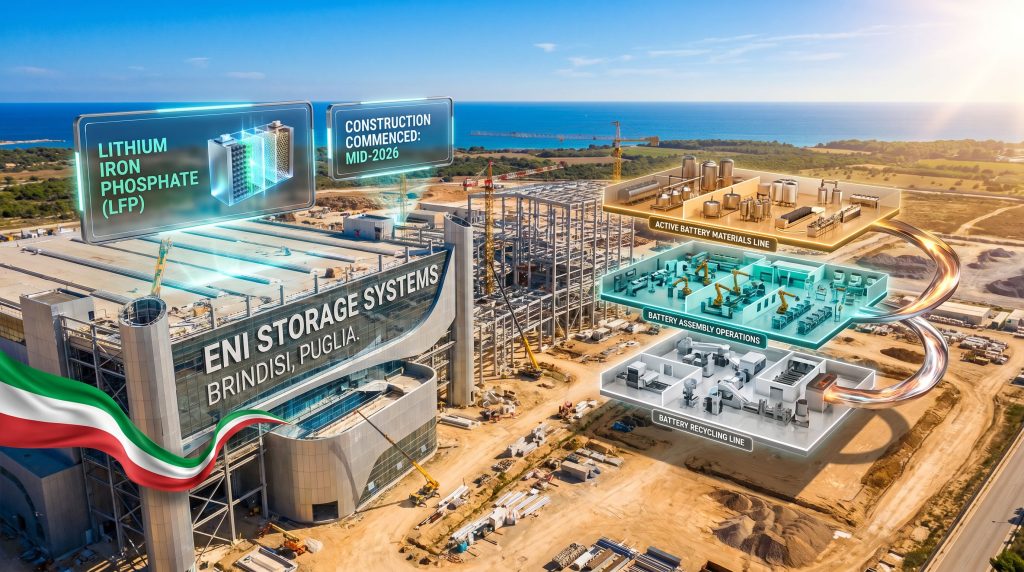
The joint venture operating the Brindisi facility is Eni Storage Systems, co-owned by Eni Industrial Evolution (Eni's clean technology commercialisation division) and FIB (Fabbrica Italiana Batterie), the manufacturing subsidiary of SERI Industrial. Construction commenced in mid-2026, approximately 20 months after the initial partnership was announced in October 2024.
The facility's design reflects a deliberate attempt to capture value across multiple stages of the battery production chain simultaneously, rather than focusing solely on cell assembly:
| Production Pillar | Function | Strategic Rationale |
|---|---|---|
| Active Battery Materials Line | LFP precursor and cathode active material production | Reduces upstream import reliance on Chinese cathode suppliers |
| Battery Assembly Operations | Cell and pack manufacturing for ESS and EV markets | Domestic value creation, supports Italian industrial employment |
| Battery Recycling Line | End-of-life cell processing and material recovery | Positions JV ahead of EU Battery Regulation recycled content mandates |
This three-pillar architecture is notably different from the approach taken by several early European gigafactories, which prioritised cell assembly capacity and treated recycling as a future consideration. At Brindisi, recycling infrastructure is embedded from inception, reflecting a more sophisticated understanding of how the EU Battery Regulation's mandatory recycled content thresholds, which take effect from 2031, will reshape upstream procurement economics over time.
The Caserta Connection: How a Dual-Site Model Creates Closed-Loop Advantage
SERI Industrial's existing FIB operations in the Caserta region of Campania complement the Brindisi facility rather than competing with it. The Caserta site handles research coordination, procurement functions, and battery recycling operations that have been running for several years, giving the joint venture a practical foundation in end-of-life battery processing that most European gigafactory entrants lack entirely.
The theoretical closed-loop potential is significant: recovered lithium compounds and iron phosphate materials from Caserta's recycling line could, over time, re-enter the active materials production process at Brindisi. Consequently, this reduces dependence on primary lithium carbonate supply dynamics from overseas imports. Italy has no domestic lithium production, so this circular economy pathway is not merely an environmental aspiration but a genuine cost management strategy.
SERI Industrial: The Vertically Integrated Specialist Most Europeans Haven't Heard Of
Founded in 1999 and headquartered in San Potito Sannitico in Campania, SERI Industrial occupies an unusual position in the European battery ecosystem. While the company lacks the name recognition of Northvolt or ACC, it has quietly developed one of the most complete battery value chains of any Italian industrial group, spanning active material production, cell assembly, and recycling.
FIB's role as SERI's manufacturing arm gives Eni Storage Systems an operational backbone with demonstrated experience, a contrast to joint ventures that pair energy majors with newly formed manufacturing entities. This experience differential matters considerably when scaling complex electrochemical manufacturing processes, where production yield, quality control, and formation cycling expertise directly determine commercial viability.
Italy's Place in Europe's Gigafactory Race
Italy enters the large-scale battery manufacturing arena later than several northern European peers. The competitive landscape as of mid-2026 reflects this timing gap:
| Country | Key Project | Chemistry Focus | Status |
|---|---|---|---|
| Sweden | Northvolt Ett | NMC / LFP | Operational (partial) |
| Germany | CATL Erfurt | LFP | Under construction |
| France | ACC Douvrin | NMC | Phased development |
| Spain | VW PowerCo Sagunto | NMC | Under construction |
| Italy | Eni-SERI Brindisi | LFP | Construction commenced 2026 |
However, Italy's later entry carries a structural advantage that is not always acknowledged in comparative analyses. First-generation gigafactories were designed during a period when NMC dominated projections for both EV and stationary storage markets. The subsequent and rapid global shift toward LFP means that several of these facilities now face chemistry transition challenges. The Eni and SERI battery factory in Italy, designed entirely around LFP from inception, avoids this retrofit problem entirely.
Speculative Perspective: If LFP's cost trajectory continues on its current path and energy density improvements narrow the gap with NMC further, late-movers who committed to LFP architecture from the outset may find themselves with a more competitive cost structure than gigafactories that must either retrofit chemistry lines or absorb higher NMC input costs. This is not yet a consensus view, but it is gaining traction among battery industry analysts.
The Southern Italy Industrial Logic: Beyond Political Optics
Choosing Brindisi over a northern Italian industrial hub is not purely a political gesture toward the historically underinvested Mezzogiorno region. Furthermore, several practical factors support the site selection:
- Brownfield advantage: Eni's existing Brindisi site provides established utilities infrastructure, reducing capital expenditure on site preparation and compressing permitting timelines relative to greenfield development
- Petrochemical workforce proximity: the Brindisi region has a legacy of chemical processing employment, providing a partially transferable skills base for electrochemical manufacturing roles
- Port infrastructure: Puglia's Adriatic and Ionian coastline provides logistics access for raw material imports and finished product distribution that inland sites cannot match
- EU cohesion funding eligibility: southern Italian industrial projects qualify for EU cohesion fund allocations under structural adjustment frameworks, though any specific funding commitments for this project had not been publicly confirmed as of early July 2026
The next major ASX story will hit our subscribers first
Risks That Deserve Honest Assessment
Several execution risks warrant clear-eyed consideration for anyone tracking this project's development.
Binding agreement status: As of mid-2026, the full commercial and legal structure of the Eni Storage Systems joint venture was still being finalised. Governance complications, financing disagreements, or regulatory conditions could introduce timeline uncertainty beyond what construction commencement suggests.
Lithium supply dependency: Italy produces no lithium domestically. LFP production at scale requires a reliable supply of battery raw materials, including lithium carbonate, which remains predominantly controlled by Chinese processing operations and South American producers. Without long-term offtake agreements or involvement in upstream lithium projects, the Brindisi facility will face input cost volatility.
Chinese cost competition: dominant Chinese LFP manufacturers, including CATL and BYD, operate at cost structures built on years of scale, integrated supply chains, and government-supported upstream material processing. European greenfield producers will face a significant cost gap in the near to medium term, making policy continuity in European battery manufacturing support critical for commercial viability.
Market demand timing: Italy's 2030 renewable energy targets under the PNIEC framework require substantial grid-scale storage deployment, creating a domestic demand foundation. However, the pace of actual procurement and installation will determine whether the Brindisi facility can ramp production volumes efficiently or carries underutilised capacity in its early years.
The LFP Production Process: From Precursor to Pack
Understanding what actually happens inside an LFP battery factory clarifies why the Brindisi facility's active materials line is such a commercially significant element of the project.
- Iron phosphate precursor synthesis – raw lithium carbonate and iron phosphate compounds undergo chemical processing to produce the intermediate precursor materials
- Cathode active material production – the value-intensive stage where precursor materials are calcined into finished LFP powder; controlling particle size distribution and carbon coating quality at this stage directly determines cell performance
- Electrode coating – LFP powder is mixed with binder and conductive additives, then coated onto aluminium current collector foil using precision slot-die or gravure coating equipment
- Calendering – electrodes are compressed to precise thickness tolerances, affecting energy density and ionic transport characteristics
- Cell assembly – coated electrodes are wound or stacked with polymer separator sheets, inserted into prismatic or cylindrical housings, and filled with electrolyte
- Formation cycling – newly assembled cells undergo carefully controlled initial charge-discharge sequences that activate the solid electrolyte interphase layer; yield management at this stage is a key determinant of production economics
- Module and pack integration – finished cells are assembled into modules with thermal management systems and battery management electronics for ESS or EV applications
- End-of-life processing – through hydrometallurgical processes, spent cells yield recoverable lithium, iron, and phosphate streams for re-entry into production
In addition, battery recycling breakthroughs in hydrometallurgical recovery efficiency are making this final stage increasingly economical, strengthening the case for the Brindisi facility's embedded recycling infrastructure.
What the Eni Transformation Signals About European Energy's Future
Eni's involvement in LFP battery manufacturing through its Industrial Evolution division represents something more structurally interesting than a simple portfolio addition. European integrated energy companies possess chemical engineering expertise, existing industrial sites, and complex logistics capabilities that are genuinely transferable to electrochemical manufacturing. The challenge has been organisational will and capital allocation priority.
TotalEnergies has pursued a comparable pathway through its Saft subsidiary, which focuses on specialised battery systems for industrial and defence applications. The Eni and SERI battery factory model differs in its explicit targeting of the mass-market stationary storage and EV battery segments, which carry higher volume potential but also more intense competitive pressure from Asian producers.
Europe's critical minerals supply chain pressures, moreover, make domestic production facilities like Brindisi strategically valuable beyond their immediate commercial returns. Whether the Brindisi gigafactory ultimately becomes a template for other European energy majors will depend substantially on its execution.
A successful ramp-up that demonstrates commercially viable LFP production at European cost structures would make a compelling case for replication. The variables that will determine this outcome, including formation cycling yields, cathode active material quality consistency, and the pace of the closed-loop recycling integration, are the unglamorous operational details that separate successful battery manufacturers from expensive industrial experiments. Advances in direct lithium extraction technology could, furthermore, eventually ease some of the upstream supply pressures facing European LFP producers, though commercial-scale deployment remains some years away.
Project Summary Snapshot
- JV Entity: Eni Storage Systems (Eni Industrial Evolution + FIB/SERI Industrial)
- Location: Brindisi, Puglia, southern Italy
- Chemistry: Lithium Iron Phosphate (LFP)
- Target Markets: Stationary energy storage + electric mobility
- Three Pillars: Active materials production, cell/pack assembly, recycling
- Complementary Site: Caserta, Campania (FIB recycling and R&D)
- Construction Start: Mid-2026
- Partnership Announced: October 2024
This article is informational in nature and does not constitute financial or investment advice. Projections regarding battery market dynamics, cost trajectories, and project timelines involve inherent uncertainty. Readers should conduct independent research before making any investment or commercial decisions related to companies or projects discussed.
Want to Track ASX Mineral Discoveries Powering the Battery Revolution?
Discovery Alert's proprietary Discovery IQ model delivers real-time alerts on significant ASX mineral discoveries — including lithium and other battery raw materials critical to the energy storage supply chain reshaping Europe and beyond — turning complex data into actionable investment insights for traders and long-term investors alike. Explore historic discoveries and their market returns, then begin your 14-day free trial at Discovery Alert to position yourself ahead of the next major find.