July 8, 2026
The Geological Anomaly That Changes Everything About US Critical Mineral Supply
Across the entire North American continent, only one deposit hosts lithium and boron in the same orebody. That geological fact alone would make Rhyolite Ridge noteworthy. What elevates it further is that this deposit, located in Nevada's Esmeralda County, is also one of only two such co-located lithium-boron reserves identified anywhere on Earth. The other is not in active development. Rhyolite Ridge is.
Understanding why the Ioneer Rhyolite Ridge lithium-boron project MOUs with KIND and Hyundai Engineering matter requires starting with that geological reality, because it explains the strategic logic behind every partnership decision that follows.
When big ASX news breaks, our subscribers know first
Why Co-Located Lithium and Boron Is a Fundamentally Different Value Proposition
Most lithium projects produce a single commodity. Rhyolite Ridge produces two, from the same ore, processed entirely on-site. This dual-commodity model is not merely a financial diversification feature. It reflects a deeper geological relationship between lithium and boron mineralisation that is extraordinarily rare in sedimentary lacustrine deposit systems.
The deposit type itself, known as a lithium-boron borate, formed through the evaporation of ancient lake systems in extensional basin environments. The co-precipitation of lithium and boron minerals under specific geochemical conditions means the two commodities are physically inseparable within the ore, which forces an integrated processing approach. That constraint becomes a competitive advantage: finished products leave the site rather than partially processed intermediates, removing a layer of offtake dependency that burdens many single-stage extraction projects.
What the Boron Co-Product Actually Means for Revenue Architecture
Boron is not a niche industrial mineral. It underpins a surprisingly broad range of critical supply chains. Furthermore, understanding how lithium mining works in these co-deposit environments helps clarify why the integrated processing model here is so commercially significant:
- Borosilicate glass and fibreglass used in construction, electronics, and wind turbine blades
- Agricultural micronutrients, where boron deficiency affects crop yields across major food-producing regions
- Semiconductor and electronics manufacturing, where boron is used in doping processes and specialty materials
- Advanced ceramics and armour composites with defence and aerospace applications
- Neodymium-iron-boron permanent magnets, which are central to EV motors and wind turbine generators
The United States currently has limited domestic boron production capacity relative to its industrial demand. This makes Rhyolite Ridge's boron output strategically significant beyond the EV battery narrative that tends to dominate coverage of the project.
Project Development Metrics: Where Rhyolite Ridge Actually Stands
One of the most persistent distortions in critical mineral investment analysis is conflating project stage with project readiness. Many assets described as being in advanced development are still navigating permitting, baseline environmental studies, or preliminary feasibility assessments. Rhyolite Ridge sits in a categorically different position.
| Development Milestone | Current Status |
|---|---|
| Environmental permitting | Fully permitted |
| Advanced engineering design | Over 70% complete |
| Construction readiness | Shovel-ready classification |
| Capital deployed since 2016 | Over US$220 million |
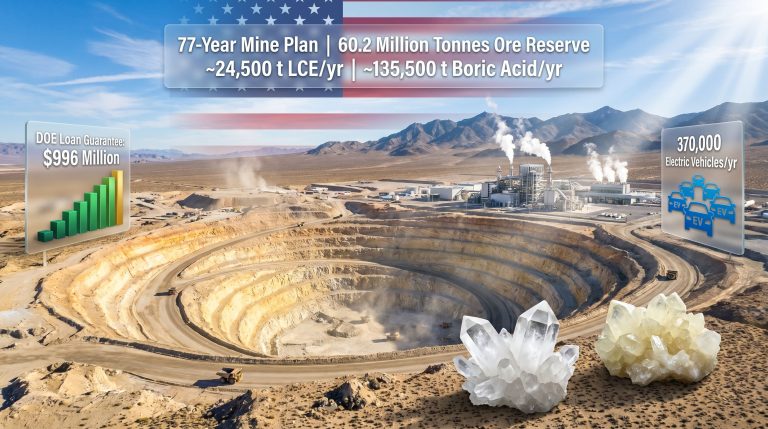
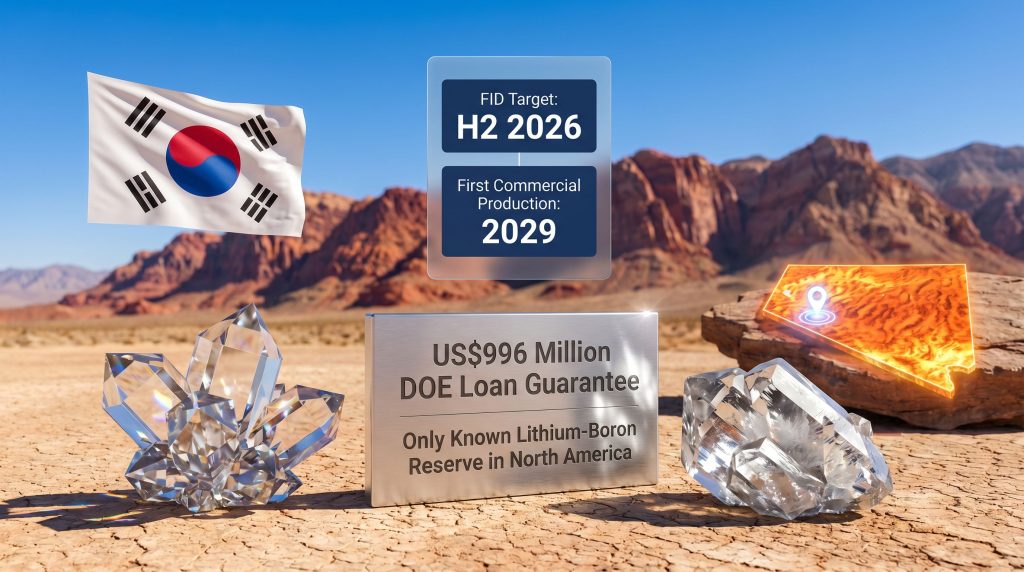
| US DOE Loan Guarantee | US$996 million (secured January 2025) |
| Target first commercial production | 2029 |
| Final Investment Decision target | Second half of 2026 |
The US$996 million loan guarantee from the Department of Energy, secured in January 2025, reflects the project's technical maturity and the federal interest in advancing domestic critical mineral production capacity. This is a project-specific financial instrument, not a policy aspiration. It represents a concrete, secured commitment that forms the backbone of the project's financing stack.
Over US$220 million has been invested in Rhyolite Ridge since 2016, funding the environmental baseline work, feasibility studies, permitting processes, and the advanced engineering design that now sits above the 70% completion threshold. That engineering investment is not sunk cost in the traditional sense. It is a construction acceleration asset. The closer a project gets to a complete engineering package, the lower the execution risk for any incoming EPC contractor.
What the KIND and Hyundai Engineering MOUs Actually Represent
In July 2026, Ioneer formalised Memorandums of Understanding with two distinct Korean entities, each serving a different function within the project's capital and execution architecture. These agreements upgraded earlier Letters of Intent signed in June 2026, representing a structured progression in the partnership development process.
KIND: The Equity Investment Dimension
KIND, the Korea Overseas Infrastructure and Urban Development Corporation, operates under the mandate of South Korea's Ministry of Land, Infrastructure, and Transport. Its institutional remit is explicitly oriented toward overseas infrastructure and resource investments that serve Korean national economic interests.
Under the MOU framework, KIND is evaluating an equity investment in the Rhyolite Ridge project. This is not a passive financial interest. South Korea's battery manufacturing sector, anchored by major producers with integrated supply chains across lithium-ion cell chemistry, faces acute structural exposure to lithium supply concentration.
The country imports the overwhelming majority of its lithium from processing facilities concentrated in a small number of geographic locations, creating supply chain fragility that Korean industrial policy is actively working to address. The growing critical minerals demand across Asian manufacturing hubs has made this diversification imperative increasingly urgent.
Rhyolite Ridge offers something rare: a lithium source located within a stable, fully regulated US jurisdiction, with advanced permitting already secured, and a financing structure that includes a near-billion-dollar federal loan guarantee. For a Korean government-mandated institution tasked with securing upstream resource access, the risk-adjusted profile of this asset is compelling.
Hyundai Engineering: The EPC Execution Dimension
Hyundai Engineering Co. Ltd. is assessing the provision of engineering, procurement, and design services for the project. This distinction matters enormously in project finance terms.
EPC contractors do not simply build what they are told. Their involvement in the engineering and procurement phases shapes cost certainty, timeline reliability, and lender confidence. When a project of Rhyolite Ridge's scale approaches its Final Investment Decision, the identity and credibility of the construction execution partner is a direct input into the bankability assessment that debt providers, including the DOE loan facility, require before funds are drawn.
Hyundai Engineering's track record in large-scale process plant execution is directly relevant to the on-site integrated processing infrastructure that Rhyolite Ridge requires. The company has delivered complex industrial facilities across petrochemicals, LNG, and minerals processing globally.
The Non-Binding Nature of the MOUs: A Critical Investor Caution
Both MOUs are explicitly non-binding instruments. They do not create legally enforceable obligations for either KIND or Hyundai Engineering to invest in, finance, or deliver services to the Rhyolite Ridge project. There is no certainty that binding commercial arrangements will ultimately be executed.
This disclosure is not procedural boilerplate. It is a material statement about the current state of the partnership framework. Investors and analysts assessing Ioneer's FID timeline should weigh this carefully. The conversion of MOUs into binding agreements is a necessary precondition for FID, not a post-FID administrative formality.
The Strategic Advisory Signal: Goldman Sachs and What It Means
Ioneer's engagement of Goldman Sachs to advise on the partner selection process following Sibanye-Stillwater's exit in February 2025 is worth examining beyond the headline.
Goldman Sachs does not manage small or speculative capital formation processes. Its involvement signals that Ioneer is structuring the Rhyolite Ridge capital raise to meet the due diligence standards of institutional-grade investors. The selection of KIND and Hyundai Engineering as MOU partners did not happen through informal industry networking.
It followed a structured, advisory-led process designed to identify partners with the financial capacity, institutional credibility, and strategic alignment to anchor a project of this complexity. This process architecture also explains the deliberate separation of equity capital (KIND) from engineering execution (Hyundai Engineering) within the MOU framework.
Rather than pursuing a single integrated partner to fill both roles, Ioneer disaggregated the capital stack from the construction delivery function. This reduces concentration risk and allows each partner to be evaluated, structured, and contracted on terms appropriate to their specific role.
The South Korea-United States Critical Minerals Alignment
The bilateral dimension of the KIND partnership extends beyond a straightforward investment transaction. South Korea and the United States share strategic interests in reducing collective dependence on geographically concentrated critical mineral supply chains. The Ioneer Rhyolite Ridge lithium-boron project MOUs with KIND and Hyundai Engineering represent a concrete expression of that alignment at the project level.
For Korean industrial capital, the US offers a combination of attributes that are difficult to replicate elsewhere:
- Regulatory stability with a mature permitting and environmental legal framework
- Judicial enforceability of commercial agreements and property rights
- Proximity to downstream demand in the US EV manufacturing and battery production sector
- Federal financing infrastructure including DOE loan programmes that de-risk the debt portion of project capital structures
In addition, US critical minerals policy has increasingly prioritised allied-nation co-investment frameworks, making this type of bilateral arrangement more strategically supported at the federal level than at any prior point. Rhyolite Ridge's deal structure, combining a US federal loan guarantee with South Korean institutional equity, may serve as a replicable template for other advanced-stage projects seeking to close financing gaps through geopolitically aligned capital.
The next major ASX story will hit our subscribers first
The Road to Final Investment Decision: Critical Path Analysis
Ioneer has publicly targeted a Final Investment Decision in the second half of 2026. The conditions that must be satisfied before that milestone can be reached represent a genuine execution challenge. Completing a definitive feasibility study to the required standard is one such condition that underpins lender confidence across the entire financing stack:
- Conversion of current MOUs into legally binding commercial agreements with KIND and Hyundai Engineering, or equivalent parties
- Closure of the full project financing stack, integrating the DOE loan guarantee with equity contributions from project partners
- Confirmation of offtake agreements providing sufficient revenue visibility to satisfy lender covenants
- Completion of remaining engineering design to a standard sufficient for construction contract execution
- Board-level FID approval by Ioneer's leadership team
Each of these conditions represents an independent workstream with its own negotiation timeline, legal complexity, and third-party dependencies. The progression from non-binding MOUs to binding agreements alone typically involves months of commercial, legal, and technical due diligence.
FID Scenario Outcomes
| Scenario | Key Conditions | Production Timeline Implication |
|---|---|---|
| FID achieved H2 2026 | MOUs convert to binding; financing closes | First production 2029 as targeted |
| FID delayed to H1 2027 | Commercial negotiations extend | Production timeline shifts toward 2030 |
| FID does not proceed in current cycle | Binding agreements not reached | Project re-enters capital formation phase |
The base case timeline is achievable but not guaranteed. The MOU announcements represent meaningful forward progress without constituting proof that FID will be reached on schedule.
Nevada's Role in US Critical Mineral Independence
Rhyolite Ridge's physical location in Nevada is not incidental to its strategic value. Nevada hosts some of the most significant lithium brine and hard rock lithium resources in the United States, and the state's regulatory environment has developed significant institutional experience with large-scale mineral extraction permitting.
Furthermore, advances in direct lithium extraction technology are increasingly relevant to how projects like Rhyolite Ridge optimise their on-site processing efficiency and reduce environmental impact relative to conventional evaporation pond approaches.
Once operational, Rhyolite Ridge is projected to create and sustain between 275 and 300 permanent positions in rural Nevada. That employment profile, anchored in value-added on-site processing rather than raw ore extraction, represents a qualitatively different economic contribution than conventional mining operations that ship partially processed material elsewhere for refining.
The fully integrated processing model also has supply chain security implications. A project that converts ore into finished lithium and boron products on-site removes dependency on third-party processing infrastructure, many of which are currently concentrated outside the United States. For a country actively seeking to build domestic critical mineral supply chains from mine to battery cell, that integration is a feature of direct strategic relevance.
Frequently Asked Questions
What is the Rhyolite Ridge Lithium-Boron Project?
Rhyolite Ridge is a fully permitted, construction-ready critical minerals project in Nevada, USA, developed by Ioneer Ltd. It contains the only known lithium-boron reserve in North America and one of only two such deposits identified globally. The project is designed to produce finished lithium and boron products entirely on-site.
What did Ioneer announce regarding KIND and Hyundai Engineering?
In July 2026, Ioneer signed non-binding Memorandums of Understanding with KIND, a South Korean government-mandated infrastructure and investment institution, and Hyundai Engineering Co. Ltd. KIND is evaluating an equity investment in the project, while Hyundai Engineering is assessing the provision of engineering, procurement, and design services.
Are these MOUs legally binding commitments?
No. Both MOUs are explicitly non-binding. They do not create enforceable legal obligations for either party to invest in or deliver services to the project. There is no guarantee that binding commercial arrangements will be finalised.
When is the Final Investment Decision expected?
Ioneer is targeting a Final Investment Decision in the second half of 2026, with first commercial production anticipated in 2029, subject to conversion of MOUs into binding agreements and finalisation of the project's full financing structure.
What happened to Sibanye-Stillwater's involvement?
Sibanye-Stillwater exited its joint venture position in Rhyolite Ridge in February 2025. Ioneer subsequently engaged Goldman Sachs to advise on identifying new strategic partners, a process that produced the current MOU framework with KIND and Hyundai Engineering. The Ioneer Rhyolite Ridge lithium-boron project MOUs with KIND and Hyundai Engineering are the direct outcome of that structured advisory process.
What is the US$996 million DOE loan guarantee?
In January 2025, the US Department of Energy issued a US$996 million loan guarantee in connection with the Rhyolite Ridge project. This forms a significant component of the project's anticipated financing structure and reflects the project's advanced development status.
Want to Track the Next Major Critical Mineral Discovery Before the Market Does?
Discovery Alert's proprietary Discovery IQ model scans ASX announcements in real time, instantly identifying significant mineral discoveries across lithium, boron, and 30+ other commodities — turning complex geological data into clear, actionable investment insights. Explore how historic discoveries have generated substantial returns on Discovery Alert's dedicated discoveries page, and begin your 14-day free trial today to position yourself ahead of the broader market.