August 12, 2026
The Geology That Changes Everything: Why Rhyolite Ridge Is Unlike Any Other Lithium Project in North America
Most lithium development stories begin the same way: a remote deposit, a promising drill result, and years of permitting uncertainty. The Ioneer Rhyolite Ridge lithium-boron project breaks from that narrative at almost every level. Its geology is singular, its processing approach is globally rare, and its position in the U.S. domestic critical minerals landscape is increasingly difficult to replicate. Understanding why requires looking beyond the headline numbers and into the structural characteristics that make this Nevada deposit categorically different from its peers.
When big ASX news breaks, our subscribers know first
What Makes Rhyolite Ridge Geologically Unique
Located in Esmeralda County, Nevada, approximately 20 kilometres northeast of Dyer in the Silver Peak Range, the Rhyolite Ridge deposit occupies a geological niche with no known commercial equivalent in North America. The key is a rare sodium borosilicate mineral called Searlesite, which serves as the primary host for both lithium and boron within the deposit. This mineralogical arrangement is not simply a geological curiosity; it fundamentally restructures the project's processing economics and environmental footprint.
Unlike spodumene extraction in hard rock operations across Western Australia or lithium brine extraction systems in the South American lithium triangle, Rhyolite Ridge does not fit neatly into either conventional lithium mining category. Searlesite's chemical properties allow for on-site production of high-purity chemical-grade lithium carbonate and boric acid without requiring the downstream refining infrastructure that adds significant cost and complexity to competing projects.
The deposit's scale, furthermore, reinforces its strategic weight. Key resource metrics include:
| Metric | Detail |
|---|---|
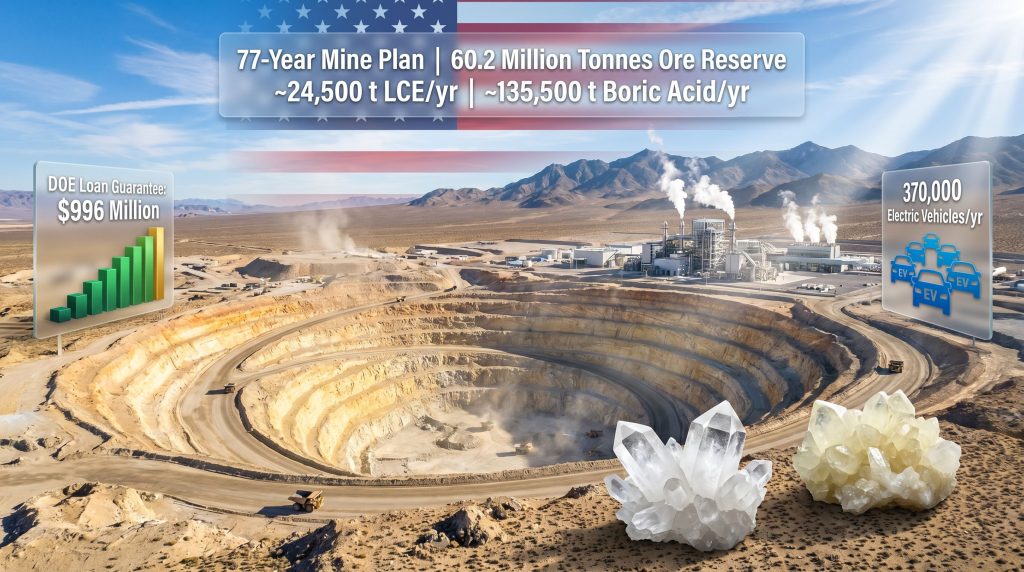
| Total Ore Reserves | 60.2 million tonnes |
| Lithium Grade | 1,797 ppm |
| Boron Grade | 15,418 ppm |
| Boric Acid Resource | 7.76 million tons |
| Lithium Carbonate Resource | 2.04 million tons |
| Mine Plan Duration | 77 years |
A 77-year mine plan is an extraordinary figure in an industry where 20 to 30-year resource lives are considered substantial. This longevity places the Ioneer Rhyolite Ridge lithium-boron project in a different strategic tier, offering multi-generational supply security that few development-stage projects globally can match.
A Processing Methodology With Distinct Structural Advantages
The project employs open-pit vat and heap leaching, a method that is genuinely uncommon in the context of lithium production. This approach delivers several structural advantages that differentiate the project from both brine and hard rock competitors:
- No tailings storage facilities are required, eliminating one of the most significant environmental liabilities in conventional mining operations.
- No evaporation ponds are needed, removing a major water consumption and potential contamination risk that characterises brine-based lithium systems like those in Chile and Argentina.
- On-site power generation is engineered into the project design, targeting zero reliance on the external electrical grid. This reduces operational risk and long-term energy cost exposure in a meaningful way.
- Final products, both lithium carbonate equivalent and boric acid, are processed entirely on-site, removing the need for intermediate concentrate shipping or third-party refining.
Annual production targets during the first 25 years of operation reflect the project's dual-commodity nature:
| Product | Annual Output (Years 1-25) |
|---|---|
| Lithium Carbonate Equivalent (LCE) | ~24,500 tons |
| Boric Acid | ~135,500 tons |
The projected boric acid output represents a 16% increase over prior Definitive Feasibility Study projections, a revision that materially improves the project's revenue diversification. Boron is not a minor co-product. It is a critical industrial input used in permanent magnets, semiconductors, fibreglass insulation, and military-grade composite materials, making Rhyolite Ridge strategically relevant across multiple supply chains simultaneously.
The Boron Dimension: An Underappreciated Strategic Asset
Much of the public attention around the Ioneer Rhyolite Ridge lithium-boron project focuses on lithium's role in electric vehicle batteries, and reasonably so. At full production, the project's lithium output is sufficient to supply batteries for approximately 370,000 electric vehicles per year, meaningfully reducing U.S. dependence on lithium imports from Chile, Argentina, and Australia.
However, the boron component carries strategic weight that is frequently underestimated by generalist investors. The United States currently imports the substantial majority of its boron supply, with Turkey and Argentina serving as the dominant global producers. A domestic boric acid supply of ~135,500 tons annually would represent a significant contribution to U.S. industrial self-sufficiency in a material that underpins everything from wind turbine blade manufacturing to next-generation semiconductor fabrication.
Boron's role in neodymium-iron-boron permanent magnets, the same magnets used in EV motors and wind turbines, creates a direct supply chain link between Rhyolite Ridge and the broader clean energy transition that extends well beyond lithium alone.
Permitting: A Fully Resolved Milestone That Sets Rhyolite Ridge Apart
In October 2024, the Bureau of Land Management issued its final Record of Decision, representing the last major federal permitting milestone for the project. This was preceded by a formal determination from the U.S. Fish and Wildlife Service that the project poses no jeopardy to Eriogonum tiehmii, commonly known as Tiehm's buckwheat, a rare wildflower endemic to the Rhyolite Ridge area that had become a central point of environmental scrutiny during the permitting process.
Achieving full federal permitting is genuinely rare among U.S. critical mineral projects. The combination of environmental review completion and BLM approval renders the project shovel-ready, a status that comparatively few domestic lithium developments have reached. For further context on the court support Ioneer secured during this process, the permitting journey is well documented.
The structural environmental advantages discussed above, particularly the absence of tailings facilities and evaporation ponds, contributed meaningfully to the project's ability to navigate the environmental review process. This is a non-trivial point for investors assessing regulatory risk: the Searlesite mineralogy that defines the deposit's geology also reduces its environmental footprint relative to conventional lithium mining approaches.
Financing Structure: The DOE Loan, the Sibanye Exit, and the South Korean MoUs
In January 2025, the U.S. Department of Energy issued a $996 million loan guarantee to Ioneer, one of the largest federal financing commitments directed at a single critical minerals project in U.S. history. Ioneer has independently deployed approximately $200 million of its own capital into the project to date, demonstrating meaningful equity commitment from the project owner.
The financing narrative, however, includes a significant inflection point. In September 2021, Sibanye-Stillwater agreed to a 50% joint venture valued at $490 million, providing what appeared to be the foundational equity partnership needed to advance to a Final Investment Decision. Sibanye-Stillwater withdrew from that agreement in February 2025, citing failure to meet internal hurdle rate requirements, leaving a material gap in the project's capital stack.
This is the context in which the recently announced MoUs with South Korea's Korea Overseas Infrastructure and Urban Development Corporation (KIND) and Hyundai Engineering carry particular significance. Under these non-binding agreements:
- KIND is evaluating an equity investment position in the project.
- Hyundai Engineering is assessing the provision of procurement-related activities covering engineering, procurement, and construction supply chain functions.
The agreements were executed at the U.S. Department of Energy offices in Washington, a venue choice that carried deliberate symbolic weight, reflecting the alignment between domestic critical mineral development objectives and the broader U.S.-South Korea strategic relationship on supply chain security.
Ioneer's executive chairperson James Calaway described the MoU signings as bringing the project one step closer to a Final Investment Decision, according to reporting by Reuters (July 2026). Both agreements remain non-binding, and Ioneer has acknowledged there can be no certainty that they will progress to legally binding commercial arrangements.
The next major ASX story will hit our subscribers first
The U.S.-South Korea Critical Minerals Alliance in Practice
The KIND and Hyundai Engineering MoUs are best understood within a broader geopolitical framework. South Korea's battery manufacturing and electronics industries are heavily exposed to lithium and boron supply chain risk. Korean battery manufacturers supply major global EV platforms, and their upstream raw material security is a genuine national economic concern.
For U.S. policymakers, attracting South Korean capital and engineering expertise into a domestically critical project like Rhyolite Ridge serves dual objectives: accelerating the financing of a strategically important deposit while deepening industrial alignment with a key Indo-Pacific partner.
This dynamic mirrors similar cross-border partnerships forming around critical minerals supply chains across Australia, Canada, and Japan, as allied nations increasingly coordinate on supply chain resilience outside of Chinese-controlled processing networks. Furthermore, innovations in direct lithium extraction are reshaping how projects across the region approach resource efficiency, adding another layer of strategic context to Rhyolite Ridge's positioning.
Construction Timeline and Path to Production
| Phase | Timeline |
|---|---|
| Groundwork / Early Construction | 2026 |
| Construction Period | 2-year build |
| Peak Construction Workforce | Up to 600 workers |
| First Production | 2028 |
| Permanent Operational Staff | 250-300 workers |
Before construction can mobilise at scale, several milestones remain:
- Finalise a replacement strategic equity partner to fill the vacancy created by Sibanye-Stillwater's withdrawal.
- Convert the KIND and Hyundai Engineering MoUs into binding commercial agreements.
- Achieve a Final Investment Decision.
- Mobilise construction workforce toward the 600-worker peak target.
Economic and Community Impact for Rural Nevada
Esmeralda County is one of the most sparsely populated counties in the United States, with limited large-scale employment infrastructure. The project's operational phase is projected to support 250 to 300 permanent positions, generating an estimated ~$125 million in annual wages across the mine's operational life. Annual tax contributions to state and local governments are projected at $13 to $35 million once full production is achieved.
These figures carry disproportionate per-capita significance in a region where industrial employment at this scale does not otherwise exist. The construction phase alone is expected to peak at 600 workers, providing a substantial near-term economic injection into the local economy.
How Rhyolite Ridge Compares to Other U.S. Lithium Projects
| Project | Location | Status | Key Differentiator |
|---|---|---|---|
| Rhyolite Ridge | Nevada | Fully permitted, FID pending | Only dual lithium-boron deposit in North America |
| Thacker Pass | Nevada | Under construction | Largest known lithium deposit in U.S. |
| Salton Sea | California | Early development | Geothermal brine extraction model |
| Smackover | Arkansas | Development stage | Direct lithium extraction from oilfield brines |
The dual-commodity structure of the Ioneer Rhyolite Ridge lithium-boron project is the defining competitive differentiator in this comparison. While other projects offer scale or processing innovation, none combines commercially viable lithium and boron production with fully resolved federal permitting and a 77-year resource life. In addition, the Thacker Pass lithium mine offers a useful point of contrast, as it represents the more conventional large-scale hard rock development pathway currently under construction in Nevada.
Frequently Asked Questions: Ioneer Rhyolite Ridge Lithium-Boron Project
What minerals does Rhyolite Ridge produce?
The project produces two primary saleable products: lithium carbonate equivalent and boric acid. It is the only known deposit in North America with commercial concentrations of both minerals in a single ore body.
When will Rhyolite Ridge begin production?
First production is scheduled for 2028, following a two-year construction period anticipated to begin in 2026, subject to a Final Investment Decision being reached.
What is the DOE loan guarantee for Rhyolite Ridge?
The U.S. Department of Energy issued a $996 million loan guarantee to Ioneer in January 2025 to support project financing.
What happened to the Sibanye-Stillwater joint venture?
Sibanye-Stillwater entered a 50% joint venture agreement in 2021 but withdrew in February 2025 after the project did not satisfy its internal investment return thresholds. Ioneer is actively seeking a replacement equity partner.
Is Rhyolite Ridge fully permitted?
Yes. The BLM issued its final Record of Decision in October 2024, and the USFWS confirmed no jeopardy to Tiehm's buckwheat. The project is considered shovel-ready pending a Final Investment Decision.
What are the MoUs with KIND and Hyundai Engineering?
These are non-binding memorandums of understanding signed at the U.S. Department of Energy in Washington. KIND is evaluating an equity stake in the project, while Hyundai Engineering is assessing procurement and construction supply chain services. There is no certainty either agreement will convert to a binding commitment.
Disclaimer: This article contains forward-looking statements, financial projections, and timeline estimates that are subject to change. Information presented reflects publicly available data and should not be construed as financial or investment advice. Readers should conduct independent due diligence before making any investment decisions.
Want To Be First When the Next Major Mineral Discovery Hits the ASX?
Discovery Alert's proprietary Discovery IQ model scans ASX announcements in real time, instantly translating complex mineral data into actionable opportunities across more than 30 commodities — explore historic discoveries and their returns, then begin your 14-day free trial at Discovery Alert to position yourself ahead of the broader market.