June 22, 2026
The manufacturing sector faces unprecedented pressure to transform traditional linear production models into sustainable, resource-efficient systems. Advanced materials industries, particularly those processing energy-intensive metals, must navigate complex strategic challenges that extend beyond conventional environmental compliance. The convergence of supply chain vulnerabilities, volatile energy costs, and evolving regulatory frameworks creates compelling economic drivers for fundamental operational restructuring. Within this landscape, the circular economy in aluminium industry represents a transformative approach to material flow management, positioning recycling-based production systems as both risk mitigation strategies and competitive advantages.
Understanding the Circular Economy Framework in Aluminium Manufacturing
The circular economy in aluminium industry operates through fundamentally different material flow principles compared to traditional linear production models. Unlike extractive approaches that convert raw materials into products destined for disposal, circular systems maintain materials within productive loops indefinitely. This framework proves particularly suited to aluminium processing due to the metal's unique molecular characteristics and processing requirements.
Aluminium maintains its structural properties through unlimited recycling cycles without material degradation, distinguishing it from polymers or paper products that experience quality reduction with each processing iteration. The International Aluminium Institute confirms that aluminium retains its fundamental properties indefinitely through recycling processes, enabling consistent performance specifications across multiple material cycles. This molecular stability creates the foundation for genuinely circular material flows rather than down-cycling approaches common in other industries.
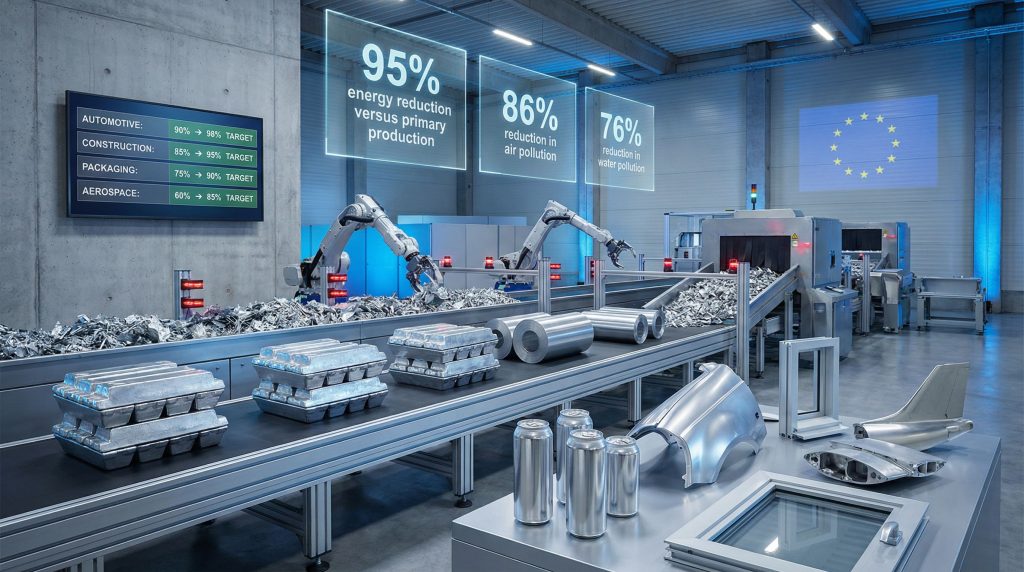
The energy efficiency metrics underlying circular aluminium systems demonstrate remarkable resource optimisation potential. Recycled aluminium production requires approximately 5% of the energy needed for primary electrolytic smelting, representing a 95% energy reduction compared to mining-based production. At European industrial electricity prices averaging €0.12 per kWh, this translates to energy cost savings of €1,350-1,740 per tonne of recycled material produced.
Furthermore, material retention rates across industrial applications vary significantly based on product lifecycles and collection infrastructure. Automotive components achieve retention rates exceeding 85% across vehicle lifecycles, while construction applications maintain similar performance levels. Beverage container recycling demonstrates collection rates of 76% in European markets, though global rates remain lower at 48% due to infrastructure limitations in emerging economies.
Technical Infrastructure for Material Recovery Systems
Modern circular systems depend on sophisticated sorting and processing technologies that enable precise alloy identification and contamination prevention. Advanced facilities employ multi-stage separation processes beginning with manual pre-sorting to segregate aluminium from ferrous materials and identify primary alloy families. Eddy-current separation systems achieve 98%+ success rates in removing non-magnetic ferrous contaminants from aluminium streams.
Infrared and laser spectroscopy technologies enable identification of specific aluminium alloys including 6061, 7075, and 5083 specifications, preventing cross-contamination that could compromise material properties. In addition, density-based separation provides final-stage purification, removing heavier metal contaminants that survived earlier processing stages.
Quality control mechanisms throughout circular processing maintain stringent standards equivalent to primary production specifications. Chemical composition analysis through spectrometry validates incoming scrap quality, while batch segregation prevents alloy mixing during thermal processing. In-process monitoring during melting and casting phases ensures consistent output quality, with final product testing confirming compliance with application-specific requirements.
The thermal processing requirements for recycled aluminium operate at 700-750°C, significantly lower than primary smelting temperatures of 960°C. This reduced processing temperature directly correlates with energy efficiency gains while maintaining alloy composition within required specifications. Modern recycling techniques achieve 99.7% purity when properly sorted materials are processed through dedicated remelting facilities.
When big ASX news breaks, our subscribers know first
Strategic Drivers Behind Circular Economy Adoption
European markets lead global circular economy implementation due to convergent strategic pressures that make recycling-based production both economically rational and strategically necessary. The continent's structural aluminium deficit creates fundamental supply vulnerabilities, with Europe importing approximately 40% of primary aluminium consumption due to limited domestic bauxite reserves and declining smelting capacity.
Geopolitical uncertainties surrounding raw material access compound these supply security concerns, driving industrial policy towards domestic resource independence. However, the International Energy Agency identifies Europe's aluminium sector as highly vulnerable to supply disruptions, creating strategic imperatives for alternative sourcing approaches that reduce import dependency.
Regulatory Frameworks and Carbon Pricing Mechanisms
The European Green Deal establishes binding greenhouse gas reduction targets of 55% by 2030 relative to 1990 levels, with aluminium recycling identified as a key lever for achieving industrial sector climate objectives. Extended Producer Responsibility directives mandate minimum recycling rates including 75% for packaging applications and 86% for automotive components.
The Carbon Border Adjustment Mechanism, effective since October 2023, imposes carbon tariffs on imported aluminium equivalent to EU Emissions Trading Scheme pricing. Current carbon prices averaging €70-90 per tonne CO₂ create direct economic incentives for domestic recycled production, which generates approximately 8-10 tonnes less CO₂ per tonne of output compared to primary smelting.
Consequently, these regulatory mechanisms transform circular economy implementation from voluntary environmental initiatives into mandatory business requirements. Companies developing circular capabilities position themselves advantageously under carbon-intensive trade restrictions while accessing monetisable carbon credit generation worth €50-90 per tonne of recycled aluminium produced.
Economic Incentives and Cost Structure Analysis
The economic fundamentals supporting circular aluminium models demonstrate compelling financial advantages independent of regulatory compliance requirements. Production cost analysis reveals systematic advantages for recycled material processing across multiple cost categories.
| Cost Component | Primary Production (€/tonne) | Recycled Production (€/tonne) | Savings |
|---|---|---|---|
| Raw Material | €180-220 (bauxite) | €400-600 (scrap) | Variable |
| Energy | €1,440-1,800 | €60-84 | €1,350-1,740 |
| Processing | €280-350 (refining) + €900-1,200 (electrolysis) | €200-280 (remelting) | €980-1,270 |
| Total | €2,300-2,600 | €1,200-1,500 | €1,100-1,100 |
The 45-50% cost savings achieved through recycled production create sustainable competitive advantages that persist across commodity price cycles. Energy cost differentials provide the largest individual savings component, particularly relevant given European industrial electricity pricing structures.
Infrastructure investment requirements for comprehensive secondary smelting facilities range from €150-250 million for 100,000 tonne annual capacity operations. Return on investment timelines typically span 7-12 years at current energy and scrap pricing, with carbon credit monetisation contributing 8-12% of total margin over facility operational lifespans.
Market Applications and Sector-Specific Implementation
Industrial sectors demonstrate varying adoption rates and implementation strategies for circular aluminium systems based on application requirements and material performance specifications. High-performance sectors including automotive and aerospace maintain stringent quality standards that influence recycling process design and material handling protocols.
The automotive sector achieves recycling rates exceeding 90% across vehicle components, with targets approaching 95% by 2030. Body panels, engine components, and structural elements benefit from closed-loop collection systems that capture end-of-life vehicles through established dismantling networks. Material property requirements for automotive applications align well with recycled aluminium capabilities, particularly for components requiring moderate strength specifications.
For instance, construction applications similarly demonstrate high recycling potential, with structural elements and facade components achieving 90%+ recycling rates. The construction sector's tolerance for mixed alloy compositions facilitates efficient scrap processing while maintaining adequate performance for building applications. Long product lifecycles in construction create steady material return flows that support predictable recycling operations.
Specialized Applications and Performance Requirements
Wire and cable applications represent growing market segments for recycled aluminium content, particularly in electrical conductivity applications where material purity directly impacts performance. Recycled aluminium maintains electrical conductivity specifications required for power transmission and distribution systems while offering significant cost advantages over primary material.
Mechanical property preservation through recycling processes enables expanded applications in automotive components requiring specific strength-to-weight ratios. Furthermore, advanced sorting and processing techniques maintain alloying elements including copper, magnesium, silicon, zinc, and manganese within specifications required for high-performance applications.
Welding applications benefit from consistent alloy compositions achievable through controlled recycling processes. Material traceability systems enable quality assurance protocols that meet aerospace and medical sector requirements for documented material provenance and performance characteristics.
Production facilities serving wire rod applications demonstrate the integration potential for circular systems within existing manufacturing infrastructure. Annual production capacity of 100,000 tonnes at specialised facilities indicates the scale at which circular models achieve operational efficiency while serving multiple industrial sectors including energy, automotive, transport, medical, and aerospace applications.
Regional Implementation Strategies and Policy Frameworks
Government initiatives across European markets create supportive policy environments for circular economy development through targeted incentive structures and regulatory requirements. The European Circular Aluminium Action Plan establishes aspirational targets including 80% recycling rates for beverage containers by 2030, supported by infrastructure development funding and technical assistance programs.
Investment priorities focus on expanding sorting and processing capabilities that enable efficient material recovery from mixed waste streams. Regional capacity assessments identify specific geographic areas requiring recycling infrastructure development to support circular material flows across integrated supply networks.
Supply Chain Transformation Strategies
Companies implementing circular economy models navigate complex supply chain restructuring that requires coordination between scrap collection, processing facilities, and end-user applications. Partnership development with specialised scrap processors creates reliable material supply chains while maintaining quality standards required for specific applications.
Customer engagement strategies involve education programs that facilitate material return systems and closed-loop collection protocols. Integration with existing recycling networks leverages established infrastructure while optimising material flows through geographically distributed processing capabilities.
Technology investment priorities emphasise sorting accuracy and processing efficiency that enable expanded recycled content utilisation across diverse applications. Advanced process control systems maintain consistent quality standards while accommodating varying scrap composition profiles typical of mixed collection streams.
Consequently, operational stability improvements through integrated recycling networks provide flexibility advantages during market volatility or supply disruptions. Distributed processing capabilities reduce transportation costs while improving material recovery rates through proximity to scrap generation sources.
Environmental Impact Assessment and Sustainability Metrics
Quantifiable environmental benefits from circular aluminium systems extend beyond energy savings to encompass comprehensive resource conservation and emission reduction impacts. Lifecycle analysis demonstrates systematic environmental advantages across multiple impact categories compared to primary production pathways.
Energy consumption reductions of 95% translate to proportional decreases in associated environmental impacts including greenhouse gas emissions, air pollution generation, and water consumption requirements. Recycled aluminium production achieves 86% reduction in air pollution and 40% decrease in water consumption relative to mining-based production systems.
Water pollution impacts decrease by 76% through elimination of bauxite processing and alumina refining stages that generate significant contaminated water streams. The simplified processing requirements for recycled material minimise chemical inputs and waste management solutions throughout production cycles.
Global Supply Chain Implications
Import dependency reduction strategies through expanded recycling capacity create structural changes in global aluminium trade flows. European capacity expansion from current 1.8 million tonnes annually to targeted 2.5+ million tonnes by 2030 could reduce import requirements by 12-15 percentage points.
Job creation in recycling and processing sectors provides economic development opportunities that offset employment transitions in primary smelting industries. Workforce transition data indicates net positive employment impacts as labour-intensive recycling operations expand relative to capital-intensive primary production facilities.
Furthermore, cost savings potential across integrated value chains creates competitive advantages for manufacturers utilising recycled content while contributing to broader economic resilience through reduced material import requirements. Regional supply chain development supports industrial policy objectives for strategic resource independence.
Technical Challenges and Implementation Solutions
Material quality management represents the primary technical challenge limiting full circular economy in aluminium industry adoption across high-performance applications. Alloy segregation complexity in mixed scrap streams requires sophisticated sorting technologies and quality control protocols that exceed capabilities of basic recycling facilities.
Contamination prevention becomes critical for applications requiring specific material properties, particularly in aerospace and medical sectors where performance specifications demand documented material provenance. Chain of custody tracking systems enable material traceability through multiple processing stages while maintaining quality assurance protocols.
Quality Control and Certification Systems
Recycled content verification protocols address market demands for documented sustainability performance while ensuring material quality consistency. Sustainability reporting frameworks integrate recycling metrics with broader environmental performance indicators required for corporate compliance and stakeholder communication.
Collection infrastructure development in emerging markets presents opportunities for expanded material recovery while requiring significant capital investment in sorting and processing capabilities. Technology transfer programmes support capacity building initiatives that extend circular economy implementation to global supply networks.
Advanced processing technologies including artificial intelligence-enhanced sorting systems improve material recovery efficiency while reducing contamination rates. Machine learning algorithms optimise alloy identification accuracy and processing parameter selection based on scrap composition analysis.
The next major ASX story will hit our subscribers first
Future Outlook and Strategic Opportunities
Technology advancement trajectories in sorting and processing capabilities will expand viable applications for recycled aluminium across increasingly demanding performance requirements. Integration with renewable energy integration creates synergistic opportunities where recycled aluminium supports clean energy deployment while benefiting from renewable electricity for processing operations.
Market expansion into emerging applications including electric vehicle components and energy storage systems creates growing demand segments that align with circular economy principles. Material lightweighting trends across transportation sectors increase aluminium utilisation while creating larger material return streams for future recycling operations.
Investment Priorities and Strategic Positioning
Companies positioning for circular economy leadership require systematic investment approaches that address technology development, supply chain integration, and market development simultaneously. Strategic partnership frameworks with scrap processors, technology providers, and end-user industries create comprehensive capabilities for circular operations.
Revenue model development for circular operations involves optimisation of material flows, processing efficiency, and market timing to maximise economic returns while achieving environmental objectives. Risk assessment frameworks address commodity price volatility, regulatory changes, and technology advancement impacts on circular business models.
However, performance measurement systems track material recovery rates, quality consistency, energy efficiency, and economic performance across integrated circular operations. Continuous improvement frameworks identify optimisation opportunities while maintaining operational reliability and product quality standards.
What Are the Key Implementation Steps for Circular Economy Transition?
Systematic implementation approaches require comprehensive assessment of current material flows and identification of optimisation opportunities within existing operations. Technology investment planning addresses sorting and processing capability requirements while considering integration with established manufacturing infrastructure.
Phase 1: Assessment and Planning
- Material flow analysis and waste stream characterisation
- Technology gap assessment and capability requirements
- Partnership identification for scrap supply and processing
- Financial modelling and investment prioritisation
Phase 2: Infrastructure Development
- Sorting and processing equipment installation
- Quality control system implementation
- Supply chain partnership formalisation
- Staff training and operational procedure development
Phase 3: Operations and Optimisation
- Material collection system activation
- Processing capability validation and quality verification
- Customer engagement and market development
- Performance monitoring and continuous improvement
Phase 4: Scale and Integration
- Capacity expansion based on market demand
- Advanced technology integration for improved efficiency
- Supply chain optimisation and cost reduction initiatives
- Strategic partnership expansion and market leadership development
How Do Decarbonisation Benefits Drive Implementation?
Financing considerations for circular economy transitions involve capital requirements assessment, revenue model validation, and risk management framework development. Investment analysis should account for regulatory compliance benefits, energy cost savings, and competitive positioning advantages that extend beyond direct financial returns.
The decarbonisation benefits achieved through circular aluminium systems demonstrate significant carbon footprint reductions compared to primary production. Companies implementing these systems position themselves advantageously under increasingly stringent carbon regulations while accessing carbon credit monetisation opportunities.
Integration with broader industry evolution and innovation trends demonstrates how circular economy adoption aligns with technological advancement trajectories. Furthermore, understanding energy transition impacts enables strategic positioning within evolving energy markets and supply chain configurations.
The Aluminium Association's recycling initiatives provide comprehensive frameworks for industry-wide implementation strategies and best practice development across various application sectors.
The circular economy in aluminium industry represents a fundamental shift from extractive production models towards regenerative systems that create economic value while reducing environmental impact. Success requires coordinated implementation of advanced technologies, strategic partnerships, and operational excellence that positions companies for sustainable competitive advantage in evolving market conditions.
This analysis is based on publicly available industry data and should not be considered investment advice. Readers should conduct independent research and consult qualified professionals before making business or investment decisions related to circular economy implementation strategies.
Ready to Capitalise on the Next Major Aluminium Discovery?
As the circular economy transforms aluminium production, smart investors are positioning themselves ahead of breakthrough discoveries in sustainable mining operations. Discovery Alert's proprietary Discovery IQ model delivers instant notifications on significant ASX mineral discoveries, helping subscribers identify actionable opportunities in emerging markets before broader market recognition drives share prices higher. Begin your 14-day free trial today to gain the market-leading edge needed for strategic positioning in tomorrow's sustainable resource economy.