
August 13, 2026
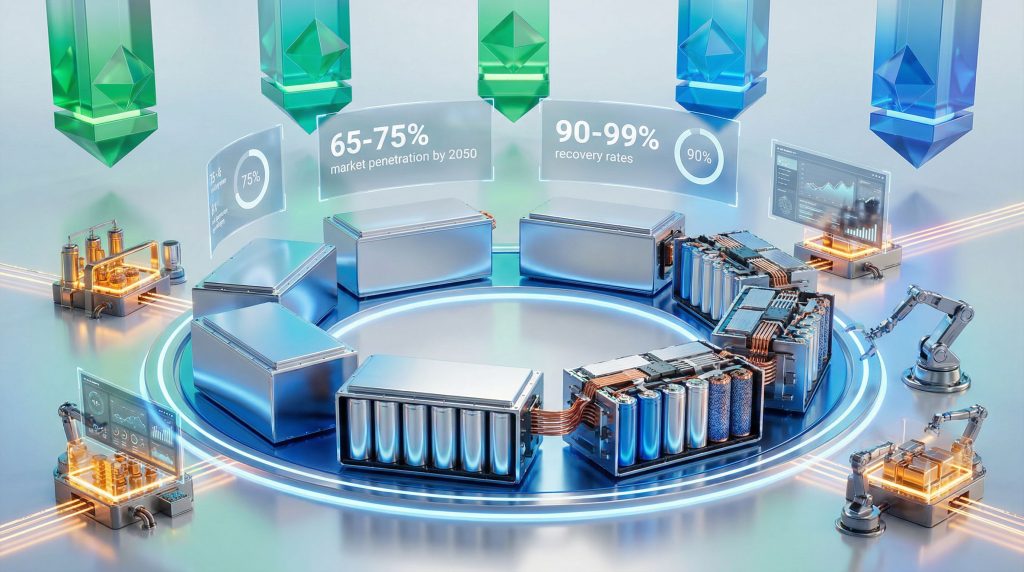
The global automotive sector stands at a critical juncture as electric vehicle penetration accelerates toward unprecedented levels. With projections indicating EVs will capture between 65% and 75% of worldwide car sales by 2050, according to recent analysis from the Ellen MacArthur Foundation, the industry faces mounting pressure to transform its fundamental approach to battery supply chains.
Current production models follow a linear extract-manufacture-dispose pattern that creates systemic vulnerabilities through mineral scarcity, price volatility, and concentrated geographic dependencies. These challenges threaten not only environmental sustainability but also economic viability as the industry scales to meet growing demand.
The strategic imperative for circular economy for electric vehicle batteries emerges from this convergence of market growth and resource constraints. Traditional linear systems prove inadequate when confronted with the massive material requirements projected for the coming decades, making circular approaches essential for maintaining industry momentum.
Critical mineral dependencies expose manufacturers to supply chain disruptions that can cascade through entire production networks. The fragility of current systems becomes particularly apparent when considering the concentrated geographic distribution of key materials and the political risks associated with these supply sources.
Industry leaders recognize that transitioning to circular battery systems represents both operational necessity and competitive opportunity. Furthermore, organisations implementing circular strategies position themselves advantageously as regulatory frameworks evolve and market dynamics shift toward sustainability-driven business models.
What Are the Five Core Pillars of Circular Battery Systems?
The transformation toward circular economy for electric vehicle batteries requires coordinated intervention across five fundamental pillars that function as an integrated system rather than independent initiatives.
Design-First Circularity Integration
Modern battery architecture demands end-of-life considerations from initial engineering phases. This encompasses modular cell configurations that facilitate disassembly, standardised connection protocols that enable component interchangeability, and material selection optimised for recovery processes.
Advanced design frameworks incorporate open-architecture data systems enabling comprehensive lifecycle tracking through embedded sensors and digital identification protocols. These systems support optimisation algorithms that enhance both performance during use and value extraction during end-of-life processing.
Key design principles include:
• Modular construction enabling component-level replacement and repair
• Standardised interfaces reducing complexity in refurbishment operations
• Material selection prioritising high-value, recoverable elements
• Digital integration supporting real-time performance monitoring
Service-Centric Business Model Evolution
Battery-as-a-Service frameworks fundamentally reposition energy storage units as long-term assets rather than consumable products. These models enable manufacturers to retain ownership throughout multiple use phases while optimising value extraction and maintaining quality control over refurbishment processes.
Service-centric approaches create recurring revenue streams that align manufacturer incentives with battery longevity and performance optimisation. This alignment drives investment in durability improvements and recovery technologies that enhance overall system economics.
Service model benefits encompass:
• Extended manufacturer responsibility driving quality improvements
• Predictable revenue streams supporting long-term planning
• Enhanced customer value through performance guarantees
• Reduced end-user capital requirements
Regional Infrastructure Development
Localised processing networks reduce transportation costs and environmental impacts while creating resilient supply chains that withstand global disruptions. Regional hubs integrate collection, testing, refurbishment, and recycling capabilities within geographic proximity to major automotive manufacturing centres.
These distributed networks enable rapid response to local market conditions while supporting regional economic development through high-value industrial activities. In addition, the infrastructure supports both second-life applications and material recovery operations within coordinated systems.
The latest battery recycling breakthrough demonstrates how advanced processing technologies can enhance regional capabilities while reducing dependence on international supply chains.
Circular Business Model Implementation
Successful circular systems require business models that capture value across multiple battery lifecycles while coordinating diverse stakeholders including manufacturers, fleet operators, recyclers, and grid operators.
These models create financial incentives for all participants to maximise battery longevity, optimise second-life applications, and ensure efficient material recovery. Revenue sharing mechanisms align stakeholder interests with circular economy objectives.
Operational System Integration
Circular battery systems depend on enabling infrastructure including data standards, tracking protocols, and regulatory frameworks that support seamless transitions between lifecycle phases.
Comprehensive data systems track battery performance, remaining capacity, and optimal applications throughout extended lifecycles. Standardised protocols enable interoperability across different manufacturers and applications while regulatory frameworks provide certainty for long-term investments.
When big ASX news breaks, our subscribers know first
How Do Second-Life Applications Maximise Battery Value Retention?
Second-life applications represent critical value retention mechanisms that extend battery utility beyond automotive applications while supporting grid modernisation and energy storage requirements.
| Application Category | Capacity Requirements | Economic Benefits | Technical Considerations |
|---|---|---|---|
| Residential Energy Storage | 70-80% original capacity | 40-60% cost reduction vs. new | Simplified thermal management |
| Commercial Grid Support | 60-70% original capacity | Revenue from grid services | Advanced monitoring systems |
| Industrial Backup Power | 50-60% original capacity | Extended asset depreciation | Modular scalability |
Residential Energy Storage Optimisation
Residential applications capitalise on batteries retaining 70-80% of original capacity to support home-level solar integration and backup power requirements. These systems achieve 40-60% cost reductions compared to equivalent new battery installations while providing homeowners with enhanced energy independence.
The simplified thermal management requirements for residential applications reduce system complexity and maintenance costs. Lower power density demands enable extended operational life even as capacity gradually declines over time.
Residential applications offer:
• Daily load shifting supporting solar energy optimisation
• Emergency backup power during grid outages
• Peak demand reduction lowering utility costs
• Grid stabilisation through distributed energy resources
Commercial Grid Support Services
Commercial applications utilising batteries at 60-70% capacity provide valuable grid services including frequency regulation, peak shaving, and renewable energy integration. These applications generate revenue streams through utility payments for grid stability services.
Advanced monitoring systems ensure reliable performance while managing integration complexity with existing grid infrastructure. The commercial scale enables sophisticated control systems that optimise multiple revenue streams simultaneously.
Industrial Backup Power Solutions
Industrial applications accept batteries operating at 50-60% capacity for backup power and load management applications. Modular scalability enables facilities to combine multiple second-life units meeting site-specific power requirements while extending asset depreciation schedules.
Battery electric vehicle units demonstrate superior second-life potential due to larger kWh capacity per unit compared to hybrid configurations. This capacity advantage enables more diverse repurposing opportunities across multiple application categories.
Industrial benefits include:
• Reduced capital costs for backup power systems
• Enhanced power quality and reliability
• Flexible capacity scaling as needs evolve
• Extended asset life supporting sustainability goals
Which Material Recovery Technologies Offer the Highest Value Proposition?
Material recovery technologies represent the final phase of circular economy for electric vehicle batteries, enabling extraction and refinement of critical minerals for reuse in new battery production.
Hydrometallurgical Processing Dominance
Chemical extraction methods achieve 90-99% recovery rates for high-value materials including nickel, cobalt, and lithium through controlled acid leaching processes. These systems optimise environmental impact while maintaining economic viability for commercial-scale operations.
Hydrometallurgical processes utilise controlled chemical reactions to selectively dissolve target materials from battery components. The technology demonstrates commercial maturity with established operational facilities processing significant volumes globally.
Modern battery recycling facility implementations showcase how hydrometallurgical processes can achieve commercial viability while maintaining environmental standards.
Process advantages encompass:
• High selectivity enabling pure material streams
• Scalable operations supporting industrial volumes
• Established commercial viability with proven economics
• Environmental compatibility through controlled chemical processes
Direct Recycling Innovation Potential
Electrode rejuvenation techniques preserve material integrity through specialised separation processes including froth flotation for graphite recovery and plasma treatment for cathode restoration. Despite experimental status, direct methods promise superior quality outputs with minimal energy consumption.
Froth flotation creates hydrophobic and hydrophilic surface differences enabling selective material separation without chemical degradation. Plasma treatment utilises high-energy ionised gases to restore cathode material properties while maintaining structural integrity.
These technologies remain in development phases but offer significant potential for improving recovery quality while reducing processing energy requirements compared to conventional chemical methods.
Pyrometallurgical Applications
High-temperature smelting provides bulk material recovery suitable for initial processing stages, though lithium losses and energy intensity limit standalone applications. Integration with other methods creates hybrid processing chains optimising overall recovery efficiency.
Pyrometallurgical processes excel at separating metallic components through controlled melting and slag formation. However, lithium volatilisation at high temperatures results in permanent value loss, necessitating alternative recovery methods for this critical material.
Hybrid processing optimisation strategies include:
• Pyrometallurgical preconcentration reducing downstream processing volumes
• Sequential hydrometallurgical refinement recovering volatilised materials
• Energy integration sharing thermal requirements across process stages
• Waste stream minimisation through comprehensive material recovery
What Economic Drivers Support Circular Battery Investment?
Multiple converging economic forces create compelling investment rationale for circular economy for electric vehicle batteries across regulatory, market, and technological dimensions.
Regulatory Compliance Mandates
Landfill restrictions and extended producer responsibility legislation create compliance costs favouring circular alternatives. European Union battery regulations exemplify policy frameworks driving industry transformation toward closed-loop systems through mandatory recycling targets and producer liability requirements.
Regulatory frameworks increasingly require manufacturers to demonstrate end-of-life responsibility for battery products while imposing financial penalties for inadequate recycling performance. These mandates create direct economic incentives for circular system investment.
Regulatory drivers include:
• Extended producer responsibility shifting end-of-life costs to manufacturers
• Mandatory recycling targets requiring specific material recovery rates
• Landfill restrictions eliminating disposal alternatives
• Carbon accounting requirements favouring circular approaches
Supply Chain Risk Mitigation
Mineral price volatility and geopolitical uncertainties make recycled material streams attractive for long-term cost stability. Critical material dependencies on concentrated geographic regions amplify the strategic value of domestic recovery capabilities.
Supply chain diversification through circular systems reduces exposure to single-source dependencies while creating hedge mechanisms against commodity price fluctuations. Domestic material recovery enhances supply security during geopolitical tensions or trade disruptions.
Development of a critical raw materials facility demonstrates how regional processing capabilities can reduce supply chain vulnerabilities while supporting domestic manufacturing objectives.
Risk mitigation benefits encompass:
• Reduced exposure to commodity price volatility
• Enhanced supply security through domestic sources
• Diversified supplier networks reducing concentration risk
• Predictable cost structures supporting long-term planning
Technology Scaling Economics
Advanced recycling facilities achieve profitability at scale through automated processing, artificial intelligence-optimised sorting, and integrated material flows. Investment in regional processing infrastructure creates competitive advantages for early adopters.
Technology scaling enables unit cost reductions while improving processing efficiency and material recovery rates. Automated systems reduce labour costs while enhancing safety and consistency in material recovery operations.
Scaling advantages include:
• Automated processing reducing operational costs
• AI optimisation maximising material recovery efficiency
• Integrated logistics minimising transportation expenses
• First-mover advantages in emerging markets
How Will Emerging Technologies Reshape Battery Circularity?
Advanced technologies promise to transform circular economy for electric vehicle batteries through enhanced processing capabilities, improved tracking systems, and next-generation battery designs optimised for circularity.
Solid-State Battery Integration
Next-generation solid-state technologies offer enhanced circularity through extended lifespans, reduced toxic materials, and simplified disassembly processes. These advances address current limitations in recycling efficiency while improving overall sustainability metrics.
Solid-state designs eliminate liquid electrolytes that complicate recycling processes while extending operational lifespans reducing replacement frequency. Simplified material compositions enable more efficient separation and recovery processes.
Solid-state advantages encompass:
• Extended lifespans reducing replacement frequency
• Simplified material compositions enabling efficient recycling
• Reduced toxic materials improving safety and environmental impact
• Enhanced performance maintaining value throughout extended lifecycles
AI-Driven Optimisation Systems
Machine learning algorithms optimise collection timing, processing methods, and material allocation across circular networks. Predictive analytics enable proactive maintenance scheduling and quality assessment for second-life applications.
Artificial intelligence systems analyse vast datasets encompassing battery performance, degradation patterns, and market conditions to optimise decision-making across circular networks. These systems enhance efficiency while reducing operational costs through predictive optimisation.
The implementation of data-driven mining operations illustrates how AI technologies can optimise resource extraction and processing while supporting circular economy objectives.
AI applications include:
• Predictive maintenance optimising battery longevity
• Quality assessment for second-life application matching
• Process optimisation maximising material recovery rates
• Market analysis supporting optimal value capture timing
Blockchain Material Tracking
Distributed ledger systems provide transparent material provenance tracking from initial production through multiple lifecycle phases. This capability supports regulatory compliance while enabling value optimisation across circular networks.
Blockchain technology creates immutable records of battery history including manufacturing details, usage patterns, maintenance records, and material composition. These records support quality assurance while enabling traceability for regulatory compliance.
Blockchain benefits include:
• Immutable material provenance records
• Regulatory compliance documentation
• Quality assurance through comprehensive history tracking
• Value optimisation through transparent performance data
What Challenges Must Industry Address for Successful Implementation?
Successful transformation toward circular battery systems requires coordinated solutions addressing technical standardisation, economic transition costs, and workforce development challenges.
Technical Standardisation Requirements
Diverse battery chemistries and form factors complicate universal processing approaches requiring industry coordination on design standards and data sharing protocols. Standardisation efforts must balance innovation flexibility with processing efficiency requirements.
Current battery diversity reflects rapid technological evolution and manufacturer differentiation strategies. However, this diversity creates processing complexity that increases costs and reduces recovery efficiency across circular systems.
Standardisation priorities include:
• Common disassembly procedures reducing processing complexity
• Standardised data formats enabling cross-manufacturer compatibility
• Material identification protocols supporting automated sorting
• Safety procedures ensuring worker protection across diverse chemistries
Economic Transition Costs
Initial infrastructure investments and technology development require significant capital commitments before achieving operational profitability. Public-private partnerships and policy incentives can accelerate adoption timelines while sharing financial risks.
Circular system development demands substantial upfront investment in processing facilities, collection networks, and technology development. These costs create barriers for individual companies while requiring coordinated industry investment.
Financial challenges encompass:
• High capital requirements for processing infrastructure
• Technology development costs for emerging processes
• Market development expenses for new applications
• Working capital needs during system scaling phases
Skills and Workforce Development
Circular battery systems demand specialised technical expertise in electrochemistry, materials science, and automated processing. Educational partnerships and training programmes must address emerging skill requirements while supporting workforce transition.
Current workforce skills reflect traditional linear manufacturing approaches requiring retraining for circular system operations. New competencies span technical processing knowledge and data management capabilities supporting integrated circular networks.
Workforce development needs include:
• Technical training for processing technologies
• Safety certification for handling diverse battery chemistries
• Data management skills for tracking and optimisation systems
• Cross-functional collaboration supporting integrated operations
The next major ASX story will hit our subscribers first
How Do Regional Strategies Differ Across Global Markets?
Geographic variations in regulatory frameworks, industrial capabilities, and market conditions drive distinct approaches to implementing circular battery systems across major global regions.
North American Approach
North American strategies emphasise domestic supply chain resilience through integrated mining, processing, and manufacturing capabilities. Policy focus on critical mineral security drives investment in comprehensive circular infrastructure supporting strategic independence objectives.
Regional advantages include abundant mineral resources, established automotive manufacturing, and growing renewable energy markets creating demand for second-life applications. Investment priorities target reducing import dependencies while building domestic processing capabilities.
Furthermore, the focus on decarbonisation mining benefits aligns with circular economy objectives while supporting regional economic development through sustainable resource extraction practices.
Regional characteristics include:
• Abundant domestic mineral resources supporting integrated supply chains
• Established automotive manufacturing providing collection infrastructure
• Growing renewable energy markets creating second-life demand
• Policy emphasis on supply chain security driving investment incentives
European Union Framework
European approaches prioritise regulatory-led transformation emphasising environmental standards and social responsibility. Extended producer responsibility mandates create strong incentives for manufacturer-led circular initiatives while supporting innovation through research funding.
Comprehensive regulatory frameworks drive industry transformation through mandatory targets and financial incentives. Advanced environmental standards create premium markets for sustainably produced materials while supporting technology development.
Framework elements encompass:
• Comprehensive regulatory mandates driving industry transformation
• Advanced environmental standards creating quality premiums
• Research funding supporting technology development
• Cross-border coordination enabling regional optimisation
Asia-Pacific Dynamics
Asia-Pacific strategies leverage existing industrial capabilities and supply chain networks while emphasising technology innovation and scale economics. Manufacturing-centric approaches capitalise on established production capabilities while developing export markets for circular services.
Regional advantages include large-scale manufacturing capabilities, growing EV markets, and established materials processing industries. Investment focuses on technology development and market expansion supporting global leadership objectives.
Regional advantages include:
• Large-scale manufacturing capabilities enabling cost-effective processing
• Rapidly growing EV markets providing material volumes
• Established materials processing supporting technology transfer
• Export market development creating global service opportunities
What Investment Opportunities Emerge from Circular Battery Trends?
The transformation toward circular battery systems creates diverse investment opportunities spanning infrastructure development, technology innovation, and service platform creation.
Infrastructure Development
Regional processing facilities require substantial capital investment supporting long-term return potential through material recovery and second-life application services. Automated sorting systems and specialised transportation networks represent additional infrastructure opportunities.
Infrastructure investment categories include:
• Processing facilities for material recovery operations
• Collection and logistics networks supporting material flows
• Testing and refurbishment facilities for second-life applications
• Digital infrastructure supporting data management and optimisation
Technology Innovation
Advanced separation techniques, AI optimisation systems, and novel material recovery methods offer high-growth investment opportunities for technology developers. Innovation focus areas span both processing efficiency improvements and new application development.
Technology investment opportunities encompass:
• Advanced processing technologies improving recovery rates
• AI and automation systems optimising operations
• Novel separation techniques reducing processing costs
• Digital platforms enabling circular network coordination
Service Platform Creation
Digital platforms enabling circular network coordination, material tracking, and optimisation services create scalable business opportunities with recurring revenue models. Platform approaches leverage network effects while supporting industry-wide coordination.
Platform opportunities include:
• Material tracking and provenance systems
• Marketplace platforms connecting suppliers and users
• Optimisation services maximising value across networks
• Financial services supporting circular transactions
Strategic Positioning for Circular Battery Future
The transition toward circular economy for electric vehicle batteries represents both necessity and opportunity for automotive and energy sectors requiring coordinated investment in technology, infrastructure, and regulatory frameworks supporting sustainable value creation.
Success demands integrated approaches spanning design innovation, business model transformation, and infrastructure development while addressing supply chain vulnerabilities through domestic material recovery capabilities. Moreover, organisations positioning themselves within circular networks today capture competitive advantages as market dynamics shift toward sustainability-driven business models.
Implementation requires collaboration across diverse stakeholders including manufacturers, recyclers, technology developers, and policy makers coordinating efforts to overcome standardisation challenges and scale emerging technologies. Early investment in circular capabilities creates first-mover advantages while supporting industry-wide transformation toward sustainable practices.
The economic case for circular battery systems strengthens as regulatory mandates expand and material costs increase driving adoption across global markets. Regional strategies reflect local conditions while contributing to integrated global networks supporting resilient supply chains and environmental sustainability objectives.
According to research from RMI's Battery Circular Economy Initiative, the circular approach could reduce the need for primary material extraction by up to 55% by 2040, while creating $18 billion in annual value by the same date.
Disclaimer: This article contains forward-looking projections and market analysis that involve inherent uncertainties and risks. Actual outcomes may differ materially from projections discussed. Investment decisions should be based on comprehensive due diligence and professional advice considering individual circumstances and risk tolerance.
Ready to Capitalise on the Next Battery Materials Discovery?
Discovery Alert instantly identifies significant ASX mineral discoveries in battery materials and critical minerals using its proprietary Discovery IQ model, providing subscribers with actionable insights ahead of the broader market. Begin your 14-day free trial today and explore why historic battery materials discoveries have generated exceptional returns for early investors positioning themselves in this transformational sector.