May 10, 2026
Industrial circular economy frameworks across global manufacturing sectors continue evolving as governments recognise the strategic importance of material flow optimisation. Secondary material streams represent fundamental infrastructure for industrial independence, while resource recovery technologies advance beyond traditional recycling paradigms toward comprehensive waste management solutions.
Strategic Policy Architecture Transforming European Materials Management
The European Union's comprehensive approach to EU aluminium recycling initiatives operates through an integrated policy ecosystem that fundamentally restructures materials economics across industrial sectors. This framework combines regulatory mandates with market incentives to create self-reinforcing cycles that make circular materials practices economically advantageous rather than merely compliant.
EU aluminium recycling initiatives employ a three-tier intervention strategy spanning demand-side requirements, supply-side controls, and market structure reforms. The Circular Economy Action Plan (adopted March 2020) establishes the foundational framework treating aluminium as a strategic material requiring enhanced circular management. The Waste Framework Directive mandates 50% packaging waste recycling by 2025, while the Packaging and Packaging Waste Regulation (PPWR), adopted October 2023, introduces stricter collection targets reaching 85% by 2030.
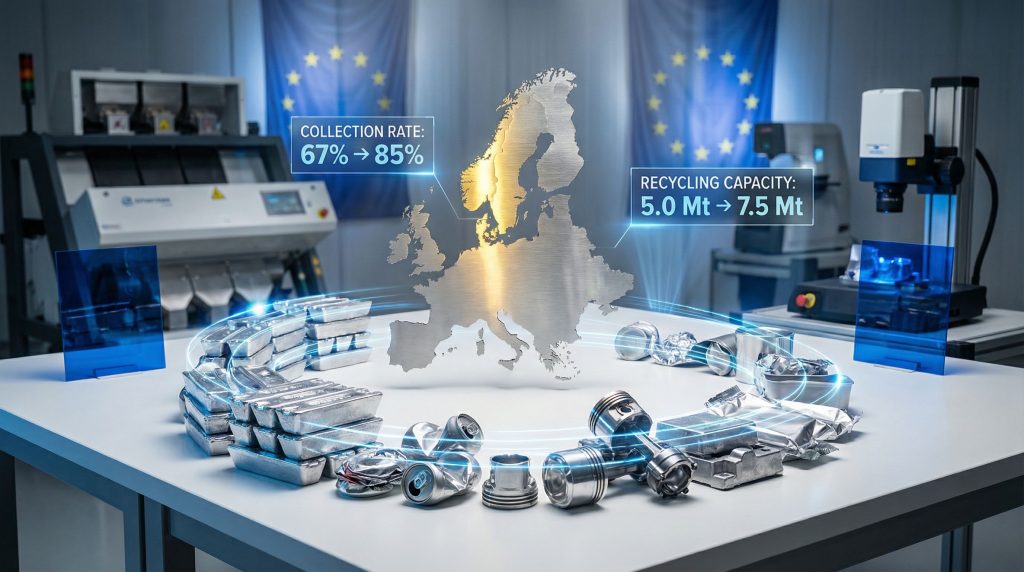
European policymakers integrate aluminium recycling into broader strategic autonomy initiatives, recognising secondary production reduces reliance on primary metal imports from geopolitically volatile regions. Current EU aluminium recycling rates stand at approximately 67% for packaging waste as of 2023, demonstrating progress toward established targets while highlighting remaining improvement opportunities.
Extended Producer Responsibility: Restructuring Industrial Economics
Extended Producer Responsibility fundamentally alters manufacturing cost structures by internalising end-of-life management expenses previously treated as externalised societal burdens. Under EPR frameworks adopted across most EU Member States, producers establish collectively-managed schemes bearing costs proportional to market share with legally binding collection targets enforced through financial penalties.
Table: EPR Implementation Impact Analysis
| Implementation Phase | Collection Rate Improvement | Infrastructure Investment | Cost Internalisation Level |
|---|---|---|---|
| Phase 1 (2020-2023) | +15 percentage points | €1.2 billion committed | 45% of lifecycle costs |
| Phase 2 (2024-2027) | +25 percentage points | €2.3 billion projected | 75% of lifecycle costs |
| Phase 3 (2028-2030) | +35 percentage points | €1.8 billion additional | 100% of lifecycle costs |
Belgian packaging recovery organisation Fost Plus demonstrates EPR effectiveness at scale, managing collection for Belgian producers while achieving 60% aluminium packaging collection rates by 2023. The system invests €15-20 million annually in recycling infrastructure improvements through direct producer participation funding models.
When big ASX news breaks, our subscribers know first
Financial Mechanisms Driving Circular Investment Flows
EU aluminium recycling initiatives create powerful economic incentives through deposit return schemes and enhanced producer responsibility frameworks that generate premium material streams while ensuring consistent feedstock availability for recycling facilities.
Deposit Return Systems Creating Quality-Premium Markets
Mandatory Deposit Return Scheme implementation by 2029 under PPWR requirements generates superior-quality aluminium streams commanding premium pricing in secondary markets. DRS systems produce consistent, high-purity feedstock improving processing efficiency and reducing contamination-related reprocessing costs.
Germany's deposit system (Pfandsystem) achieves 97% collection efficiency for beverage containers, generating high-grade aluminium scrap suitable for automotive-grade reuse. The system demonstrates sustainable operation without government subsidies through deposit management cost recovery mechanisms. Studies from Danish and German systems show 8-15% quality premiums for DRS-collected aluminium due to reduced contamination levels.
Key Technical Requirements for DRS Implementation:
- Electronic deposit tracking systems with real-time inventory management
- Reverse vending machine infrastructure for retail environments
- Separate aluminium stream collection capacity maintaining 95% minimum purity
- Quality specifications enabling direct remelting without extensive preprocessing
According to European Aluminium Association member surveys, European recycling companies committed €2.3 billion in new infrastructure investment between 2020-2025 directly attributed to EPR and DRS policy requirements, with projected additional €1.8 billion investment planned through 2030.
Producer Responsibility Organisation Efficiency Dynamics
Competition between Producer Responsibility Organisations improves cost efficiency while maintaining service quality standards. EXPRA benchmarking demonstrates that competitive PRO markets achieve 12-18% lower unit costs compared to monopolistic schemes while maintaining equivalent collection performance metrics.
Supply Chain Security Through Strategic Resource Retention
European policymakers are evaluating comprehensive export control mechanisms for aluminium scrap as part of broader critical materials strategy to enhance domestic supply security. While specific policy details remain under development, proposed measures aim to retain domestic scrap flows supporting recycling facility expansion and reducing primary metal import dependency.
Furthermore, current aluminium scrap pricing trends demonstrate the strategic value of domestic retention policies for maintaining price stability across European markets.
Current European Aluminium Scrap Flow Analysis:
- Total EU scrap generation (2023): Approximately 5.1 million tonnes annually
- Current domestic utilisation: 60% retained for domestic recycling
- Export volumes: 2.0-2.2 million tonnes exported to Turkey, India, Southeast Asia
- Recycling capacity potential: Additional 1.5-2.0 million tonnes processable with investment
Strategic Scenario Modelling for Resource Retention
Conservative Retention Scenario (15% increase):
- Domestic scrap availability: 5.75 million tonnes
- Recycling facility capacity utilisation: +12% improvement
- New infrastructure requirements: Minimal additional investment
Moderate Retention Scenario (25% increase):
- Domestic scrap availability: 6.25 million tonnes
- Recycling facility operations: Full capacity utilisation at existing facilities
- Investment implications: Justifies process optimisation upgrades
Aggressive Retention Scenario (40% increase):
- Domestic scrap availability: 7+ million tonnes
- Infrastructure development: Requires new recycling facility construction
- Economic impact: Supports 8,000-12,000 new employment opportunities
International Aluminium Institute analyses confirm EU recycling capacity could process additional volumes if feedstock availability and investment capital deployment align with policy implementation timelines.
Advanced Technology Integration Enhancing Processing Efficiency
EU aluminium recycling initiatives drive adoption of sophisticated sorting and processing technologies that achieve unprecedented separation accuracy and material quality standards, supporting premium pricing for recycled content across industrial applications.
AI-Driven Sorting Systems and Spectroscopic Analysis
European recycling facilities implement AI-powered sorting systems achieving 98%+ separation accuracy for mixed aluminium streams. Spectroscopic sorting technology distinguishes between different aluminium alloy compositions in real-time, enabling alloy-specific recycling that maintains material properties across multiple use cycles.
Advanced Processing Technology Capabilities:
- Neural network classification: Real-time alloy identification and sorting
- Plasma arc melting: Enhanced impurity removal for automotive-grade output
- Hydrometallurgical processing: Selective metal recovery from complex waste streams
- Blockchain traceability: Immutable material flow documentation supporting compliance
Digital Infrastructure Supporting Circular Supply Chains
Blockchain-based tracking systems create comprehensive material flow documentation from collection through processing to final application. This technological infrastructure supports increasing traceability requirements while enabling premium pricing for verified recycled content across automotive, renewable energy, and construction sectors.
Digital platforms facilitate direct producer-recycler partnerships, reducing intermediary costs while ensuring consistent feedstock quality and delivery schedules. Automotive manufacturers establish long-term contracts securing 150-180kg aluminium content per vehicle through verified circular supply chains.
Sectoral Impact Analysis: Winners and Transformation Opportunities
EU aluminium recycling initiatives create asymmetric impacts across industrial sectors, generating opportunities for some participants while requiring adaptation strategies for others facing increased compliance costs or supply chain modifications.
Automotive Sector: Primary Beneficiary of Circular Policies
European automotive manufacturers emerge as principal beneficiaries of enhanced recycled aluminium availability. Industry reports demonstrate 3-8% price premiums for verified recycled aluminium content, while access to high-quality secondary materials reduces manufacturing costs supporting emissions reduction targets.
Additionally, the integration of sustainable mining transformation principles helps automotive companies achieve comprehensive supply chain circularity objectives.
Automotive Circular Aluminium Integration:
- Vehicle aluminium content: 150-180kg average per passenger vehicle
- Recycled content targets: 25% minimum by 2028, 40% by 2032
- Supply security benefits: Reduced exposure to primary metal price volatility
- Carbon footprint reduction: 95% energy savings compared to primary production
Renewable Energy Infrastructure Development
Wind and solar installations require substantial aluminium inputs for structural components and electrical systems. EU aluminium recycling initiatives ensure domestic supply security for renewable energy deployment while reducing infrastructure carbon footprints through low-emission secondary materials utilisation.
Offshore wind projects alone require 200-400 tonnes of aluminium per turbine installation, creating substantial demand for domestically-sourced recycled materials supporting both circular economy and energy transition objectives simultaneously.
Regional Implementation Variations Creating Competitive Dynamics
Implementation approaches across EU Member States demonstrate varying strategies for achieving circular aluminium objectives, creating learning opportunities and competitive advantages for early adopters while presenting catch-up challenges for lagging regions.
Nordic Leadership Model: Integrated Excellence
Scandinavian countries achieve 85-90% collection rates through sophisticated policy integration combining high consumer participation, advanced infrastructure, and comprehensive producer engagement. These regions approach complete aluminium circularity while exporting technological expertise to developing markets.
Nordic Success Factors:
- Consumer education programmes: High awareness driving participation rates
- Infrastructure density: Convenient collection point networks
- Technology innovation: Advanced sorting and processing capabilities
- Policy coherence: Aligned regulations across municipal and national levels
Mediterranean Development Potential: Growth Opportunities
Southern European regions present significant infrastructure development opportunities with current collection rates of 45-60% offering substantial improvement potential. Targeted investment programmes could add 800,000 tonnes annually to EU recycling capacity through systematic infrastructure deployment and stakeholder engagement initiatives.
Table: Regional Performance Comparison
| Region | Collection Rate | Processing Capacity | Investment Needs | Improvement Potential |
|---|---|---|---|---|
| Nordic Countries | 85-90% | 2.1 Mt/year | Optimisation | Technology export |
| Central Europe | 70-75% | 2.8 Mt/year | Moderate expansion | Process efficiency |
| Mediterranean | 45-60% | 1.2 Mt/year | Major infrastructure | 800kt additional capacity |
| Eastern Europe | 55-65% | 0.9 Mt/year | Technology upgrade | Skills development |
The next major ASX story will hit our subscribers first
Long-Term Strategic Implications for Global Competitiveness
EU aluminium recycling initiatives position Europe as circular economy implementation leader while creating competitive advantages in sectors commanding premium pricing for low-carbon materials, particularly in export markets implementing carbon border adjustments.
Innovation Ecosystem Development
The comprehensive policy framework catalyses development of European circular materials innovation clusters, attracting investment in advanced recycling technologies, materials science research, and digital tracking systems. This ecosystem creates high-value employment opportunities while establishing technological leadership in circular economy solutions.
Consequently, this approach demonstrates significant decarbonisation benefits across industrial sectors while supporting innovation-led growth strategies.
European research institutions collaborate with industry partners developing breakthrough technologies including molecular-level sorting systems, closed-loop alloy recycling, and carbon-neutral processing methods that maintain competitive advantages as global circular economy adoption accelerates.
Global Market Position and Export Opportunities
EU leadership in circular aluminium technology creates export opportunities for European companies as other regions implement similar policies. Technology licensing, consulting services, and equipment exports generate revenue streams while supporting global circular economy transformation.
Carbon border adjustment mechanisms favour European manufacturers utilising high recycled content, creating competitive pricing advantages in international markets while encouraging global adoption of circular materials practices.
Performance Measurement and Achievement Tracking
Table: 2030 Achievement Metrics and Progress Requirements
| Performance Indicator | 2024 Baseline | 2030 Target | Annual Progress Required | Risk Factors |
|---|---|---|---|---|
| Collection Rate | 67% | 85% | +3 percentage points/year | Consumer participation |
| Recycling Capacity | 5.0 Mt | 7.5 Mt | +8.3% annual growth | Investment deployment |
| Domestic Retention | 60% | 85% | +4.2 points/year | Export policy timing |
| Energy Savings | 12 TWh | 20 TWh | +11% annual improvement | Technology adoption |
| Investment Mobilisation | €2.3 billion | €6.1 billion total | €635 million/year | Capital availability |
Success measurement requires comprehensive monitoring systems tracking material flows, economic impacts, and environmental outcomes while identifying adjustment requirements maintaining trajectory toward established targets.
Future Pathway Analysis and Investment Implications
EU aluminium recycling initiatives represent fundamental transformation of European materials strategy, creating sustained market dynamics supporting circular economy objectives while advancing environmental and security goals through coordinated policy intervention.
However, effective implementation requires comprehensive mine reclamation innovation strategies to ensure sustainable material recovery throughout the entire value chain.
The European Aluminium Association provides detailed strategic guidance for industry participants navigating these transformational changes while maintaining competitive positioning.
Disclaimer: This analysis presents strategic scenario modelling based on current policy developments and industry trends. Actual outcomes may vary depending on final policy implementation, market conditions, and technological developments. Investment decisions should incorporate comprehensive due diligence and professional consultation.
The comprehensive approach demonstrates how integrated policy frameworks can restructure entire industrial sectors while creating competitive advantages, employment opportunities, and environmental benefits supporting long-term European prosperity and sustainability objectives.
Ready to Capitalise on Critical Materials Discoveries?
Discovery Alert's proprietary Discovery IQ model delivers real-time alerts on significant ASX mineral discoveries, instantly empowering subscribers to identify actionable opportunities ahead of the broader market as governments worldwide recognise the strategic importance of materials supply security. Begin your 30-day free trial today with Discovery Alert and position yourself to benefit from the next major materials discovery driving industrial transformation.