June 10, 2026
The Strategic Imperative Behind Australia's Circular Mining Revolution
Industrial economies worldwide face mounting pressure to transition beyond traditional linear extraction models. For resource-dependent nations, this transformation represents both an existential challenge and unprecedented opportunity. Australia's mining sector, historically anchored in virgin material extraction, now confronts fundamental questions about long-term sustainability and competitive positioning in an increasingly circular global economy.
The concept of mine waste to wealth embodies this paradigm shift, where materials previously considered disposal liabilities become strategic assets for future economic growth. This transition reflects broader industrial recognition that traditional mining waste streams contain substantial untapped value, particularly in critical minerals essential for clean energy infrastructure and advanced manufacturing supply chains.
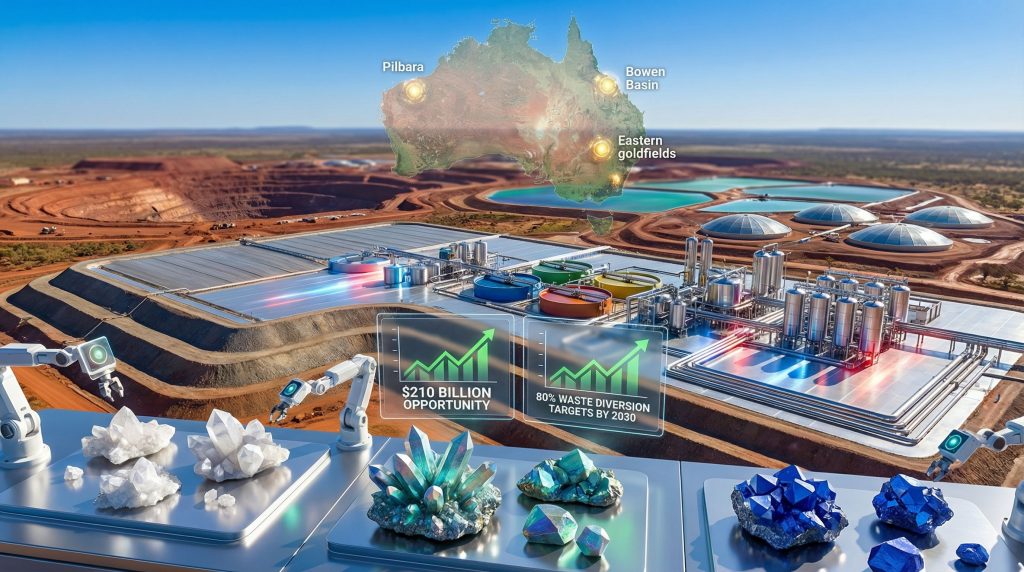
CSIRO research indicates that only 3.7% of Australia's current economic activity operates on circular principles, suggesting massive potential for transformation. The organisation projects a $210 billion economic opportunity through 2050 if Australia successfully implements comprehensive circular economy strategies, with mine waste valorisation representing a cornerstone of this transition.
When big ASX news breaks, our subscribers know first
Understanding the Circular Mining Economy Revolution
Defining Value Recovery in Modern Mining Operations
Modern value recovery transcends conventional extraction methodologies by reimagining waste streams as resource inputs for secondary processing chains. This fundamental shift requires mining operators to evaluate their operations through multiple value creation lenses simultaneously, considering not only primary commodity extraction but also the economic potential of historically discarded materials.
The transformation involves sophisticated material characterisation protocols that identify economically viable mineral concentrations within tailings and waste rock. Advanced analytical techniques enable operators to quantify recovery potential across multiple commodity categories, supporting investment decisions for secondary processing infrastructure. Furthermore, mining waste management solutions are becoming increasingly sophisticated to handle these complex processing requirements.
Regulatory frameworks increasingly support this transition through streamlined approval processes for waste-to-resource projects. Environmental agencies recognise that reducing waste volumes while creating additional economic value aligns with both sustainability objectives and regional economic development priorities.
The $210 Billion Opportunity: CSIRO's Circular Economy Projections
Australia's circular economy baseline of 3.7% represents significant untapped potential compared to leading international economies. The CSIRO projection of $210 billion in economic value through 2050 assumes systematic implementation of circular principles across multiple industrial sectors, with mining waste recovery contributing substantially to this opportunity.
The timeline for achieving 80% waste diversion from landfill by 2030 requires accelerated investment in processing technologies and infrastructure development. This target reflects national policy commitment to transforming waste streams into productive economic inputs, supporting both environmental objectives and industrial competitiveness.
Market potential analysis across resource recovery sectors indicates strongest growth opportunities in critical mineral extraction from existing waste streams. Battery metals, rare earth elements, and construction materials represent priority categories for commercial development, driven by supply chain security considerations and export market demand.
How Are Mining Companies Transforming Tailings Into Strategic Assets?
Advanced Mineral Recovery Technologies
Modern tailings processing employs sophisticated separation technologies that achieve mineral recovery rates previously considered commercially unviable. Hydrometallurgical processes enable selective extraction of target minerals through controlled chemical dissolution and precipitation, particularly effective for complex mineral assemblages in coal and metalliferous tailings.
Flotation and magnetic separation innovations allow simultaneous recovery of multiple mineral species from single waste streams. These technologies integrate advanced process control systems that optimise recovery efficiency whilst minimising environmental impact through reduced water consumption and energy utilisation. In addition, mine reclamation innovations are supporting these technological advances.
Artificial intelligence applications in mineral sorting employ hyperspectral imaging and machine learning algorithms to identify and separate valuable particles from waste material. These systems achieve sorting accuracy rates exceeding traditional manual or density-based separation methods, enabling economic processing of lower-grade waste streams.
Multi-Stream Value Creation Models
Contemporary waste valorisation strategies target simultaneous recovery of base metals, critical minerals, and industrial materials from single processing operations. This approach maximises economic returns whilst reducing per-unit processing costs through shared infrastructure and operational efficiencies.
Revenue diversification opportunities extend beyond mineral recovery to include agricultural soil enhancement products derived from processed tailings. These secondary products create additional income streams whilst addressing regional agricultural productivity challenges in mining-affected areas.
Carbon sequestration monetisation represents an emerging value stream where processed tailings serve as carbon dioxide storage media. This approach generates carbon credit revenue whilst contributing to climate change mitigation objectives, demonstrating the multi-dimensional value potential of integrated waste processing.
Which Critical Minerals Can Be Extracted From Australian Mine Waste?
High-Value Target Minerals in Tailings
Coal mine tailings across Queensland's Bowen Basin contain commercially significant concentrations of lithium compounds essential for battery manufacturing. Recent studies indicate these waste streams offer economically viable extraction opportunities, particularly when integrated with existing coal processing infrastructure. However, technological advances like the battery recycling breakthrough demonstrate the growing importance of critical mineral recovery across multiple sectors.
| Mineral Category | Recovery Potential | Market Value Driver | Primary Sources |
|---|---|---|---|
| Lithium compounds | High | Battery supply chains | Coal ash, hard rock tailings |
| Rare earth elements | Medium-High | Clean energy transition | Iron ore processing waste |
| Cobalt & Nickel | High | EV manufacturing | Copper mine tailings |
| Zinc & Lead | Medium | Infrastructure demand | Multi-metal processing waste |
Iron ore processing waste from the Pilbara region contains elevated concentrations of rare earth elements critical for permanent magnet production. These materials support wind turbine and electric vehicle manufacturing supply chains, where Australia maintains competitive advantages through established mining infrastructure and processing expertise.
Eastern goldfields legacy tailings demonstrate significant potential for cobalt and nickel recovery, supporting domestic electric vehicle manufacturing objectives. These waste streams offer dual benefits of environmental remediation and critical mineral supply chain development.
Geographic Distribution of Recovery Opportunities
The Bowen Basin's coal tailings represent Australia's largest concentrated opportunity for critical mineral recovery from mine waste. With over $1.5 million in Queensland Government funding supporting detailed studies, this region demonstrates commercial viability for integrated waste processing operations.
Pilbara iron ore waste streams contain substantial volumes of rare earth bearing materials currently considered processing byproducts. Geographic concentration of these resources enables shared processing infrastructure development, reducing capital investment requirements for individual operators. Consequently, these developments support Australia's green metals leadership position globally.
Legacy mining areas across Australia's eastern goldfields present brownfield development opportunities where existing infrastructure can be adapted for tailings reprocessing. These locations offer established transportation networks, power supply, and workforce availability that support project economics.
What Are the Economic Models Driving Waste Valorisation?
Investment Return Scenarios
Capital expenditure requirements for tailings processing facilities vary significantly based on target mineral categories and required processing complexity. Projects targeting single commodity recovery typically require lower initial investment but offer reduced revenue diversification compared to multi-mineral processing operations.
Operating cost advantages of waste processing versus virgin mining include elimination of exploration costs, reduced mining equipment requirements, and simplified material handling systems. These factors often result in lower cash operating costs per unit of recovered mineral, particularly for high-value critical minerals.
Break-even analysis for tailings processing depends critically on mineral concentrations, processing recovery rates, and commodity pricing. Current market conditions for battery metals and rare earth elements support commercial viability for many Australian tailings processing opportunities.
Regional Economic Impact Projections
Job creation multipliers in mining communities typically range from 2.5 to 4.0 indirect jobs per direct processing position, supporting regional economic stability through diversified employment opportunities. Tailings processing operations often provide long-term employment compared to finite mining operations.
Supply chain development opportunities include equipment manufacturing, maintenance services, and logistics support that benefit regional economies beyond direct processing operations. These activities create sustainable economic foundations for communities transitioning from traditional mining dependence. Moreover, sustainable production advances are creating new opportunities across the sector.
Export revenue potential from recovered critical minerals strengthens Australia's position in global supply chains whilst reducing import dependence for strategic materials. This dual benefit supports both international competitiveness and domestic industrial development objectives.
How Do Environmental Benefits Translate to Business Value?
Risk Mitigation Through Tailings Reduction
Tailings storage facility liability reduction represents significant financial value for mining operators managing long-term environmental obligations. Processing existing tailings reduces storage volumes and associated monitoring requirements, creating measurable cost avoidance benefits.
Environmental compliance cost savings accumulate through reduced rehabilitation bonding requirements and simplified closure planning. These benefits often exceed direct processing revenues in long-term financial analysis, particularly for operations with substantial legacy tailings inventories.
Insurance premium impacts from reduced environmental exposure create additional value through lower operational risk profiles. Mining operators demonstrate measurable environmental improvement through tailings volume reduction, supporting access to favourable insurance rates and financing terms.
Carbon Credit and ESG Value Creation
Scope 3 emissions reduction through waste processing contributes to corporate carbon neutrality objectives whilst generating tradeable carbon credits. This dual benefit supports both environmental targets and revenue generation from carbon market participation.
ESG rating improvements for mining operators reflect measurable environmental stewardship through circular economy implementation. These improvements support access to green financing markets where interest rate differentials can exceed 100 basis points for qualified projects.
Green financing accessibility enables tailings processing projects to access specialised funding sources designed for environmental improvement initiatives. These funding mechanisms often provide favourable terms compared to traditional project finance, improving overall project economics.
The next major ASX story will hit our subscribers first
What Regulatory Frameworks Support Mine Waste Recovery?
Federal and State Policy Alignment
Australia's Critical Minerals Strategy provides policy framework supporting domestic processing capability development through regulatory streamlining and targeted investment incentives. State governments align with federal objectives through complementary funding programs and simplified approval processes.
Queensland's $1.5 million investment in Coreo's tailings valorisation study demonstrates active government support for commercial development of waste recovery technologies. Minister Dale Last emphasised that this collaboration represents Queensland's commitment to resource sector innovation and long-term competitiveness.
Circular economy policy incentives include accelerated depreciation allowances for waste processing equipment and priority consideration for infrastructure development grants. These mechanisms reduce project development costs whilst supporting broader economic transformation objectives.
International Competitive Positioning
Australia's regulatory environment provides competitive advantages through established mining law frameworks adapted for waste processing applications. Clear legal precedents and predictable approval processes attract international investment in tailings valorisation projects.
Trade policy implications for recovered mineral exports include potential preferential access agreements and reduced tariff barriers for processed materials compared to raw commodities. These advantages support value-added processing development within Australia.
Technology transfer and intellectual property considerations enable Australian companies to develop exportable expertise in tailings processing methodologies. This capability creates additional revenue opportunities through international consulting and technology licensing arrangements.
Which Technologies Are Scaling Mine Waste Processing?
Emerging Processing Innovations
Bioleaching applications for low-grade waste streams employ microorganisms to extract metals through controlled biological processes. These technologies offer environmental advantages through reduced chemical inputs whilst achieving comparable recovery rates to traditional hydrometallurgical methods.
Membrane separation technologies enable selective recovery of target minerals through controlled filtration processes that minimise energy consumption and waste generation. Advanced membrane materials achieve high selectivity for specific metal ions, improving recovery efficiency and product purity.
Automated sorting using hyperspectral imaging integrates artificial intelligence algorithms that identify valuable particles at processing speeds exceeding traditional manual sorting by orders of magnitude. These systems enable economic processing of lower-grade waste streams previously considered unviable.
Integration with Existing Mining Operations
Retrofit opportunities for active mine sites involve installing secondary processing equipment within existing infrastructure frameworks, minimising additional capital requirements whilst maximising operational synergies. Shared utilities, transportation, and workforce reduce implementation costs significantly.
Brownfield development strategies for closed operations leverage existing infrastructure and established environmental approvals to accelerate project development timelines. These approaches often achieve faster permitting and construction schedules compared to greenfield alternatives.
Shared infrastructure optimisation models enable multiple operators to collaborate on processing facility development, distributing costs whilst achieving economies of scale. Regional processing hubs serve multiple mine sites, improving project economics for smaller operators.
What Are the Investment Opportunities in Waste Valorisation?
Public-Private Partnership Models
Government co-investment structures combine public funding with private sector expertise to accelerate technology development and commercial deployment. The Queensland Government's collaboration with Coreo demonstrates effective partnership models that share development risks whilst maintaining commercial incentives.
Research institution collaboration frameworks integrate university expertise and government research capabilities with private sector implementation capacity. These partnerships often access additional funding sources whilst accelerating technology transfer from research to commercial application.
Technology commercialisation pathways provide structured approaches for transitioning laboratory-scale innovations to industrial applications through staged development and validation processes. These frameworks reduce investment risks whilst supporting systematic technology advancement.
Market Entry Strategies for New Players
Specialist waste processing company development opportunities exist for organisations focused exclusively on tailings valorisation rather than traditional mining operations. These companies often achieve superior processing efficiency through specialised expertise and dedicated equipment.
Joint venture opportunities with established miners provide new entrants access to waste streams and existing infrastructure whilst offering mining companies access to specialised processing technologies. These arrangements distribute risks whilst leveraging complementary capabilities.
Technology licensing and equipment supply chains create revenue opportunities for companies developing innovative processing technologies without direct operational involvement. Licensing arrangements enable rapid technology deployment across multiple projects whilst generating ongoing revenue streams.
How Will Mine Waste Recovery Shape Australia's Mining Future?
Long-Term Industry Transformation Scenarios
Integration with renewable energy infrastructure positions mining operations as anchor customers for clean energy projects whilst providing power for energy-intensive processing operations. This alignment supports both cost reduction and environmental objectives through strategic infrastructure development.
Circular supply chain development creates interconnected industrial networks where waste from one operation serves as input material for another. These systems achieve superior resource efficiency whilst reducing transportation costs and environmental impacts. For instance, understanding the economic potential of these integrated approaches is crucial for long-term planning.
Skills and workforce evolution requirements involve transitioning traditional mining expertise toward advanced processing technologies and environmental management. Training programs and education initiatives support workforce development whilst maintaining employment levels in mining regions.
Global Competitiveness Implications
Australia's position in critical mineral supply chains strengthens through domestic processing capability development that reduces dependence on overseas processing whilst capturing additional value within Australian operations. This positioning supports long-term industrial competitiveness and strategic resource security.
Technology export potential for waste processing systems creates additional revenue opportunities as Australian companies develop exportable expertise and equipment for international markets. Early market entry advantages support premium pricing and market share capture.
Strategic resource security through domestic recovery reduces import dependence for critical materials whilst strengthening supply chain resilience. This capability supports both economic and national security objectives through reduced exposure to international supply disruptions.
Frequently Asked Questions About Mine Waste Valorisation
Technical and Commercial Considerations
What mineral concentrations make waste processing economically viable?
Economic viability depends on multiple factors including target mineral types, processing complexity, and market pricing. Generally, critical mineral concentrations above 0.1% support commercial processing, whilst base metals require higher concentrations for viability.
How do processing costs compare between different waste types?
Coal tailings typically offer lower processing costs due to reduced hardness and simplified mineral assemblages compared to hard rock tailings. However, hard rock tailings often contain higher value mineral concentrations that offset processing cost disadvantages. Furthermore, comprehensive research on tailings value demonstrates varying economic potential across different waste types.
What are typical project development timelines?
Retrofit projects at existing operations typically require 18-24 months from feasibility study to production, whilst greenfield developments may require 3-5 years including permitting and construction phases.
Environmental and Regulatory Questions
What environmental approvals are required for waste processing facilities?
Processing facility approvals typically require environmental impact assessments, water use permits, and air quality compliance certificates. Existing mining operations often have streamlined approval processes for additional processing equipment.
How does waste processing impact existing mine closure obligations?
Tailings volume reduction through processing generally reduces long-term monitoring and maintenance obligations whilst potentially accelerating closure timelines. This often results in reduced closure bonding requirements and associated financial benefits.
What are water and energy requirements for different recovery methods?
Hydrometallurgical processes typically require 2-5 cubic metres of water per tonne of processed material, whilst physical separation methods use 0.5-2 cubic metres per tonne. Energy requirements vary from 50-200 kWh per tonne depending on processing complexity.
Strategic Recommendations for Stakeholders
For Mining Companies
Waste stream characterisation and value assessment protocols should be implemented systematically across all operations to identify highest-value recovery opportunities. Comprehensive analysis enables prioritised investment allocation and maximised return potential.
Technology partnership evaluation frameworks help mining companies assess collaboration opportunities with specialised processing technology providers. These partnerships often provide faster implementation timelines and reduced technical risks compared to internal technology development.
Integration planning with existing operations requires careful consideration of processing capacity, infrastructure requirements, and operational synergies. Successful integration maximises shared cost benefits whilst minimising operational disruptions.
For Investors and Government
Risk-return analysis for waste valorisation investments should consider both direct processing revenues and indirect benefits including liability reduction and environmental compliance cost savings. Comprehensive financial modelling captures full project value potential.
Policy development priorities for circular economy acceleration include regulatory streamlining, investment incentives, and research funding that support commercial technology deployment. Coordinated policy frameworks maximise economic transformation effectiveness.
Infrastructure development requirements for industry scaling include shared processing facilities, transportation networks, and skilled workforce development programs. Strategic infrastructure investment amplifies private sector investment effectiveness whilst supporting regional economic development. In this context, the mine waste to wealth transition represents a fundamental shift toward sustainable resource utilisation.
Disclaimer: This analysis includes projections and forecasts based on current market conditions and government policy frameworks. Actual results may vary due to changes in commodity pricing, regulatory requirements, and technological developments. Investment decisions should be based on comprehensive due diligence and professional financial advice.
Want to Stay Ahead of Australia's Mining Transformation?
Discovery Alert's proprietary Discovery IQ model delivers instant notifications on significant ASX mineral discoveries, including companies pioneering mine waste valorisation and circular economy initiatives. Explore how historic discoveries have generated exceptional returns and begin your 30-day free trial today to position yourself ahead of this revolutionary shift in Australia's mining sector.