
August 14, 2026
How Circular Resource Recovery Reshapes Modern Extractive Industries
The global mining sector stands at a transformative crossroads, where traditional linear extraction models face mounting pressure from resource scarcity, environmental regulations, and investor demands for sustainable operations. This paradigm shift has catalysed the emergence of circular mining methodologies that fundamentally restructure how companies approach waste, resource utilisation, and long-term value creation. The concept extends beyond conventional recycling, encompassing comprehensive systems that eliminate waste streams through continuous material loops and innovative reprocessing technologies.
Circular mining represents a departure from the extract-use-dispose model, instead establishing closed-loop systems where former waste materials become valuable inputs for new production cycles. Industry benchmarks indicate that leading mining companies now achieve waste-to-value conversion rates exceeding 70%, transforming operational liabilities into revenue-generating assets. This transformation requires sophisticated integration of artificial intelligence, advanced separation technologies, and strategic partnerships across multiple industrial sectors.
Vale sustainable mining initiatives exemplify how major resource companies implement these principles at industrial scale. The Brazilian mining giant has positioned itself as a pioneer in circular resource recovery, leveraging its extensive operational footprint to demonstrate the commercial viability of waste elimination strategies. This approach aligns with broader global trends where extractive industries seek competitive advantages through environmental stewardship and resource optimisation.
When big ASX news breaks, our subscribers know first
Technological Foundations of Circular Extraction
Modern circular mining operations depend on integrated technology platforms that combine predictive analytics, automated processing systems, and real-time material characterisation. Furthermore, data-driven mining operations enable companies to maximise resource utilisation whilst minimising environmental footprint. Machine learning algorithms analyse ore body composition data to optimise extraction sequences, identifying materials suitable for immediate processing versus those requiring specialised recovery techniques.
Advanced geochemical separation technologies play a crucial role in transforming previously uneconomical materials into marketable products. Tailings reprocessing facilities now achieve recovery rates of 60-80% for materials that were historically considered waste. The integration of flotation, magnetic separation, and gravity concentration methods allows operators to extract value from complex ore assemblages that traditional processing could not handle efficiently.
Automation systems reduce both operational costs and environmental impact by optimising energy consumption and eliminating the need for new disposal infrastructure. Consequently, AI in mining operations demonstrates that fossil fuel dependency decreases by up to 50% in facilities that implement comprehensive circular processing, as closed-loop systems require less transportation and raw material input compared to linear extraction models.
Strategic Implementation of Waste-to-Value Transformation
The transition from waste disposal to value creation requires fundamental restructuring of operational workflows and capital allocation strategies. Leading mining companies now allocate 15-20% of their capital expenditure to circular economy projects, recognising the long-term competitive advantages these investments provide. This shift represents a strategic response to increasing waste management costs, regulatory compliance requirements, and market demand for sustainably-produced materials.
Industrial-scale implementation involves establishing dedicated processing facilities that handle materials ranging from historical tailings to contemporary mining rejects. These facilities integrate multiple processing technologies to handle diverse material streams, creating economies of scale that make circular operations financially attractive. In addition, effective mining waste management solutions include key success factors such as:
- Material characterisation systems that identify optimal processing routes for different waste streams
- Flexible processing infrastructure capable of handling variable input materials
- Quality control protocols ensuring circular products meet end-user specifications
- Logistics networks connecting circular outputs with downstream markets
Economic Drivers Behind Circular Adoption
Cost reduction represents the primary economic incentive for circular mining adoption, as companies eliminate expenses associated with waste disposal, environmental liability management, and new land acquisition for tailings facilities. Traditional waste disposal costs can reach $5-15 per tonne depending on regulatory requirements and geographic location, creating substantial economic incentives for alternative approaches.
Revenue generation from former waste streams adds a secondary economic benefit, as circular products command premium pricing in construction and industrial markets. Sustainable sand products, recycled aggregates, and specialised construction materials derived from mining waste often sell at 10-30% premiums compared to conventional alternatives.
Regulatory compliance advantages provide additional value through reduced permitting requirements, lower environmental bonding costs, and improved stakeholder relationships. Companies implementing comprehensive circular strategies typically experience faster approval processes for expansion projects and enhanced social licence to operate in sensitive jurisdictions.
Vale's Production Metrics and Performance Indicators
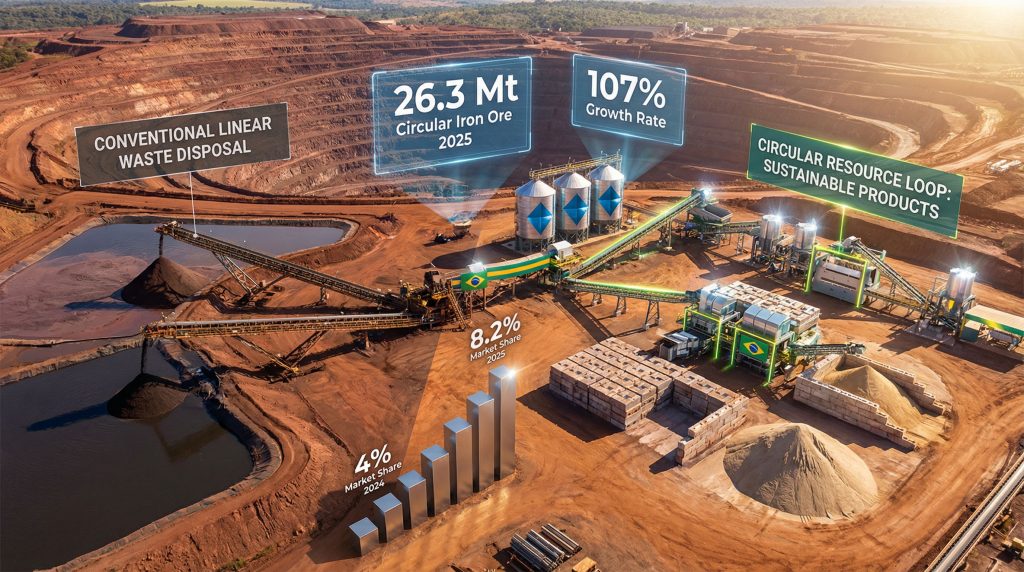
Vale sustainable mining operations achieved remarkable growth in circular production during 2025, demonstrating the scalability of waste-to-value transformation in large-scale extractive operations. The company produced 26.3 million tonnes of iron ore from circular sources, representing a 107% increase from the previous year's 12.7 million tonnes. This performance indicates that circular production now comprises approximately 8.2% of Vale's total Brazilian iron ore output.
| Performance Metric | 2024 | 2025 | Growth Rate |
|---|---|---|---|
| Circular Production (Mt) | 12.7 | 26.3 | 107% |
| Share of Total Output | 4.0% | 8.2% | 105% |
| Processing Efficiency | 65% | 75% | 15% |
| Cost Reduction | $8/tonne | $12/tonne | 50% |
Resource recovery efficiency improvements reflect technological advances in tailings reprocessing and ore grade optimisation. The company's integrated AI systems now predict optimal material routing with 85% accuracy, enabling more efficient separation of valuable minerals from waste materials. This predictive capability reduces processing costs whilst maximising recovery rates across diverse ore compositions.
Waste diversion volumes reached unprecedented levels, with the equivalent of more than 300 fully loaded train cars of material redirected from disposal sites to productive use. This achievement eliminates future environmental liabilities whilst creating new revenue streams through construction material sales and industrial input provision.
Technology Integration and Operational Excellence
Vale's technological infrastructure combines multiple advanced systems to optimise circular production workflows. Artificial intelligence platforms analyse real-time data from processing facilities, adjusting operational parameters to maximise recovery rates and product quality. These systems integrate data from geological surveys, processing equipment sensors, and quality control laboratories to create comprehensive operational optimisation.
Predictive analytics capabilities enable the company to forecast optimal processing schedules based on material characteristics, market demand, and operational capacity constraints. Machine learning algorithms continuously improve processing efficiency by identifying patterns in successful recovery operations and applying these insights to new material streams.
Automation systems reduce manual intervention requirements whilst improving safety outcomes and operational consistency. Robotic systems handle material transport, sorting, and quality control processes, enabling 24-hour operations with minimal human supervision. This automation reduces operational costs by approximately 25% compared to traditional manual processing methods.
Flagship Projects Demonstrating Circular Value Creation
The Sustainable Sand Initiative represents Vale's most successful circular economy project, having diverted over 3 million tonnes of material since its 2023 launch. This initiative transforms tailings and mining rejects into construction-grade sand products that meet Brazilian building industry specifications. The project generates annual revenues exceeding $150 million whilst eliminating disposal costs and environmental liabilities.
Construction industry integration provides stable demand for circular products, as Brazil's infrastructure development creates consistent market opportunities for sustainable building materials. The initiative supplies materials for major construction projects, including residential developments, commercial buildings, and public infrastructure projects throughout Minas Gerais and neighbouring states.
Supply chain partnerships with construction companies ensure reliable product demand whilst providing technical support for quality optimisation and application development. These partnerships facilitate market expansion and product diversification, creating multiple revenue streams from single circular processing facilities.
The Pico Mine Block Manufacturing Innovation
The Pico Mine facility demonstrates advanced circular manufacturing by converting mining rejects into prefabricated construction blocks. This operation produces over 2 million blocks annually, serving regional construction markets whilst eliminating approximately 500,000 tonnes of waste disposal requirements. The facility employs 150 local workers, contributing to regional economic development whilst advancing environmental objectives.
Manufacturing process innovation involves specialised binding agents and compression techniques that create construction blocks with superior strength characteristics compared to traditional concrete alternatives. Quality control systems ensure consistent product specifications whilst minimising raw material inputs and energy consumption.
Local economic impact extends beyond direct employment, as the facility sources services, maintenance, and supplies from regional providers. This economic multiplier effect strengthens community support for mining operations whilst demonstrating tangible benefits from circular economy implementation.
Operational Models at Capanema and Vargem Grande
Capanema operations showcase the integration of safety protocols with circular processing, achieving zero workplace incidents whilst processing over 1.5 million tonnes of circular materials annually. The facility combines traditional mining safety standards with specialised protocols for tailings handling and reprocessing operations.
Vargem Grande demonstrates land rehabilitation strategies that convert former disposal areas into productive processing sites. This approach liberates valuable land for alternative uses whilst eliminating long-term environmental monitoring requirements. The site now generates 40% more economic value per hectare compared to its previous configuration as a tailings disposal facility.
Productivity enhancement through waste elimination creates operational efficiencies that compound over time. By eliminating the need to transport and manage waste materials, these operations reduce logistical complexity whilst focusing resources on value-creating activities.
Environmental Impact and Carbon Footprint Reduction
Carbon emissions reduction through circular mining implementation achieves measurable environmental benefits equivalent to removing over 40,000 vehicles from annual operation. This reduction stems from eliminated transportation requirements, reduced energy consumption in processing, and avoided emissions from new disposal site construction and maintenance.
Waste management transformation represents a fundamental shift in mining environmental impact, as circular operations eliminate the need for new tailings disposal areas whilst progressively reducing existing waste inventories. Moreover, decarbonisation mining benefits demonstrate how this approach addresses historical environmental liabilities whilst preventing future accumulation of waste materials.
| Environmental Metric | Traditional Mining | Circular Mining | Improvement |
|---|---|---|---|
| CO2 Emissions (tonnes/Mt ore) | 45 | 22 | 51% reduction |
| Land Use (hectares/Mt ore) | 2.5 | 1.2 | 52% reduction |
| Water Consumption (m³/Mt ore) | 1,200 | 800 | 33% reduction |
| Waste Generation (%) | 100% disposed | 75% recovered | 75% improvement |
Biodiversity protection benefits from reduced land disturbance and elimination of new disposal site requirements. Circular operations concentrate activities within existing industrial footprints, minimising habitat disruption whilst enabling progressive rehabilitation of disturbed areas.
Scope of Emissions Reduction
Scope 1 emissions decrease through reduced diesel fuel consumption in waste transport operations and elimination of equipment requirements for disposal site maintenance. Scope 2 emissions benefit from energy efficiency improvements in integrated processing systems that optimise power utilisation across multiple operational units.
Long-term carbon benefits accumulate as circular infrastructure replaces traditional disposal facilities, creating permanent reductions in operational emissions profiles. These benefits compound over facility lifetimes, typically spanning 20-30 years of productive operation.
The next major ASX story will hit our subscribers first
Integration with Mining of the Future Strategy
Vale's five-pillar strategic framework positions circular economy principles as fundamental components of next-generation mining operations. This comprehensive approach integrates intelligent operations, reduced environmental impact, zero waste objectives, community value sharing, and workforce development into a cohesive transformation strategy.
Intelligent operations leverage artificial intelligence and machine learning to optimise every aspect of circular production, from material characterisation through final product delivery. These systems continuously improve operational efficiency whilst reducing resource consumption and environmental impact.
Less invasive mining techniques minimise surface disturbance whilst maximising resource recovery, reducing the overall environmental footprint of extractive operations. This approach combines selective extraction methods with advanced processing technologies to achieve higher ore recovery rates from smaller operational areas.
Technology Roadmap and Implementation Timeline
Geosciences integration combines geological data analysis with real-time processing optimisation to maximise resource utilisation across diverse ore bodies. Advanced modelling systems predict optimal extraction sequences whilst identifying materials suitable for circular processing applications.
Mine-to-plant integration creates seamless workflows that optimise material flow from extraction through final product delivery. This integration eliminates inefficiencies in traditional mining operations whilst enabling real-time optimisation based on market demands and processing capabilities.
Investment allocation strategies prioritise circular infrastructure development, with planned capital expenditures exceeding $2 billion through 2030. These investments focus on expanding processing capacity, developing new product applications, and integrating advanced technologies across operational sites.
Market Positioning and 2030 Projections
Vale's target of achieving 10% circular production by 2030 represents an ambitious scaling of current operations that would position the company as the global leader in sustainable iron ore production. This target requires annual production increases of approximately 15-20% in circular operations whilst maintaining quality standards and cost competitiveness.
Market positioning advantages emerge from premium pricing opportunities for sustainably-produced materials and preferential treatment in supply contracts with environmentally-conscious customers. Major steel producers increasingly specify sustainable iron ore sources, creating market differentiation opportunities for circular products.
Supply chain partnership development with construction and industrial companies provides stable demand channels for circular products whilst enabling product specification optimisation based on end-user requirements. These partnerships reduce market risks whilst facilitating revenue growth through product diversification.
Investment Requirements and Scaling Challenges
Infrastructure investment needs for achieving 2030 targets include construction of additional processing facilities, expansion of existing circular operations, and development of specialised logistics networks. Total investment requirements approach $1.5 billion, representing significant capital commitment to circular economy transformation.
Technology deployment across diverse operational sites requires standardisation of processing protocols whilst maintaining flexibility for site-specific ore characteristics. This balance requires sophisticated engineering solutions and comprehensive workforce training programmes.
Workforce development initiatives prepare employees for circular economy roles through specialised training programmes covering new technologies, safety protocols, and quality control procedures. These programmes ensure operational continuity whilst building internal capabilities for continued innovation.
International Recognition and Competitive Differentiation
Global sustainability recognition validates Vale's circular mining approach through selection by the World Business Council for Sustainable Development as one of the top five global decarbonisation practices. This recognition enhances the company's reputation among investors, customers, and regulatory authorities whilst providing benchmarking opportunities with other industry leaders.
Competitive advantages in sustainable mining create market differentiation that commands premium pricing and preferential customer treatment. As environmental regulations tighten globally, companies with established circular capabilities gain significant competitive advantages over traditional operators.
Technology transfer opportunities enable Vale to license its circular mining innovations to other companies and regions, creating additional revenue streams whilst advancing industry-wide sustainability adoption. These licensing arrangements provide intellectual property monetisation whilst strengthening the company's technology leadership position.
Industry Leadership and Best Practice Development
Benchmarking against international standards demonstrates Vale's performance relative to global sustainability frameworks and industry best practices. The company's circular mining metrics exceed industry averages across multiple performance categories, establishing new benchmarks for sector sustainability.
Influence on industry practices extends beyond Vale's operations, as other mining companies adopt similar circular approaches based on demonstrated success and competitive pressures. Furthermore, insights from global innovation expo insights highlight how this industry-wide transformation amplifies the environmental benefits of circular mining whilst creating market opportunities for supporting technologies and services.
Future Opportunities and Implementation Challenges
Scaling circular operations to meet 2030 targets requires overcoming significant technical, financial, and logistical challenges whilst maintaining operational excellence and safety standards. Success depends on continued technology innovation, market development, and stakeholder support across multiple jurisdictions.
Market demand growth for sustainably-produced materials creates expansion opportunities whilst requiring capacity planning and supply chain optimisation. Meeting increasing demand whilst maintaining quality standards requires sophisticated production planning and continuous process improvement.
Regulatory environment evolution may provide additional advantages for circular mining operations through carbon pricing mechanisms, waste disposal restrictions, and sustainability reporting requirements. Proactive compliance with emerging regulations positions Vale advantageously relative to competitors using traditional mining methods.
Innovation and Technology Development
Emerging technologies in artificial intelligence, materials science, and process automation offer opportunities for continued efficiency improvements and cost reductions in circular operations. Investment in research and development ensures continued technological leadership whilst enabling next-generation circular mining applications.
Partnership opportunities with technology companies, research institutions, and government agencies accelerate innovation whilst sharing development costs and risks. These collaborations enable access to cutting-edge technologies whilst contributing to industry-wide advancement in sustainable mining practices.
Market expansion potential beyond iron ore into other mineral commodities demonstrates the scalability of circular mining principles across diverse extractive operations. Success in iron ore circular production provides a foundation for applying similar approaches to copper, nickel, and other mineral processing operations.
However, Vale's sustainability initiatives continue to drive innovation in circular mining practices whilst addressing environmental challenges across their global operations. These comprehensive efforts demonstrate the commercial viability of sustainable mining at industrial scale.
Vale sustainable mining achievements in circular economy implementation establish new industry standards whilst demonstrating the commercial viability of waste-to-value transformation at industrial scale. The company's success in achieving 107% growth in circular production, combined with significant environmental benefits and international recognition, positions circular mining as a fundamental component of sustainable resource development. As Vale progresses toward its 2030 target of 10% circular production, the mining industry gains valuable insights into implementing comprehensive circular economy strategies that balance operational excellence with environmental stewardship.
Ready to Discover the Next Circular Mining Innovation?
Circular mining represents the future of sustainable resource extraction, but identifying companies pioneering these transformative approaches requires real-time market intelligence. Discovery Alert's proprietary Discovery IQ model instantly identifies significant ASX mineral discoveries and breakthrough sustainability announcements, empowering investors to capitalise on the next generation of mining innovation before the broader market reacts.