August 1, 2026
When Mining Revenue Grows But Profits Collapse: Understanding Equity-Method Earnings Volatility
There is a category of listed mining company that defies the conventional relationship between revenue growth and profit expansion. These are businesses that have moved beyond pure extraction, deploying capital into downstream processing ventures through equity stakes accounted for in a way that creates a direct, often amplified, link between a joint venture partner's profitability and the investor's own reported earnings. Understanding this structural dynamic is essential before interpreting the first-half 2026 results of PT Cita Mineral Investindo Tbk — a case study in how Cita Mineral H1 profit falls on weaker WHWAR alumina JV earnings, even as underlying operations strengthen.
When big ASX news breaks, our subscribers know first
Why Did Cita Mineral H1 Profit Fall Despite Strong Revenue Growth?
The Revenue-Profit Disconnect Explained
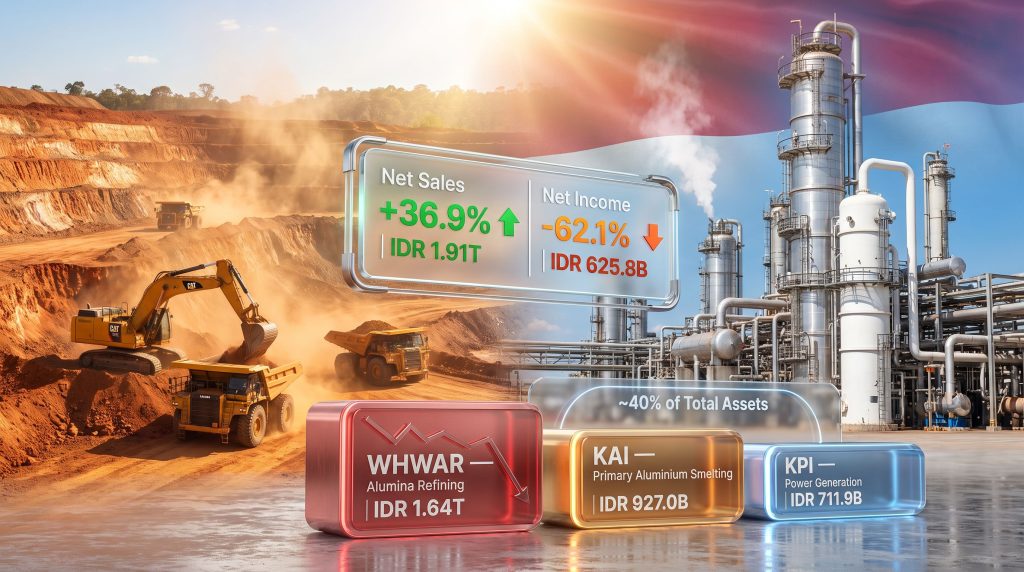
On the surface, Cita Mineral's first-half 2026 numbers appear contradictory. Net sales grew by a substantial 36.9% to IDR 1.91 trillion (USD 106.1 million), gross profit nudged higher, and operating cash flow improved by 33.1% year on year. Yet net income attributable to shareholders collapsed by 62.1% to IDR 625.8 billion (USD 34.8 million), and earnings per share fell from IDR 417 to IDR 158.
The explanation does not lie in the mining business itself. It lies in the behaviour of a single equity-accounted investment: the company's 12.5% stake in PT Well Harvest Winning Alumina Refinery (WHWAR). When that investment's earnings contribution declined by approximately IDR 1.06 trillion (USD 58.9 million) year on year, no amount of top-line growth from bauxite sales could compensate.
How Equity-Method Accounting Amplifies JV Earnings Volatility
The equity method is a standard accounting treatment applied when an investor holds significant influence over, but not full control of, another entity. Under this framework, the investor recognises its proportionate share of the investee's net profit or loss directly within its own income statement, regardless of whether any cash dividend is actually received.
This structure creates a critical asymmetry: an investor's reported profit can fall sharply even when its own operations are generating higher revenues, simply because a jointly-held entity experienced a weaker period. The income statement impact is mechanical and immediate, not discretionary.
For Cita Mineral, this means that fluctuations in WHWAR's refining margins, operational throughput, and cost structure are transmitted directly into the consolidated income statement. It is a form of earnings leverage that works powerfully in both directions, and it is central to understanding how mining company performance can diverge so sharply from surface-level revenue trends.
Key Financial Metrics at a Glance: H1 2026 vs. H1 2025
| Financial Metric | H1 2026 | H1 2025 | Change |
|---|---|---|---|
| Net Sales | IDR 1.91T (USD 106.1M) | IDR 1.39T (USD 77.2M) | +36.9% |
| Gross Profit | IDR 612.4B (USD 34.0M) | IDR 595.1B (USD 33.1M) | +2.9% |
| Net Income (Attributable) | IDR 625.8B (USD 34.8M) | IDR 1.65T (USD 91.7M) | -62.1% |
| Earnings Per Share | IDR 158 | IDR 417 | -62.1% |
| Share of WHWAR Earnings | IDR 275.5B (USD 15.3M) | IDR 1.34T (USD 74.4M) | -79.4% |
| Operating Cash Flow | IDR 428.0B (USD 23.8M) | IDR 321.6B (USD 17.9M) | +33.1% |
The table above captures the central paradox of Cita Mineral's H1 2026 results: almost every operational metric improved, yet the bottom line deteriorated sharply due to a single line item driven by an externally-determined variable.
Understanding the WHWAR Alumina JV: What Is It and Why Does It Matter?
What Is PT Well Harvest Winning Alumina Refinery?
PT Well Harvest Winning Alumina Refinery is one of Indonesia's most significant downstream aluminium processing facilities, situated within the broader Kalimantan industrial corridor. It converts bauxite ore into alumina, the intermediate product subsequently smelted into primary aluminium metal. The refinery sits at a strategically important position in the global aluminium supply chain, particularly given Indonesia's role as one of the world's largest bauxite producers — a market shaped by the bauxite market dynamics that have emerged from the country's export restriction policies.
Indonesia's downstream processing push has been shaped significantly by its 2014 mineral export ban and subsequent regulatory tightening, which progressively restricted raw ore exports to incentivise in-country value addition. WHWAR is one of the direct commercial outcomes of that policy environment, bringing foreign capital and technical expertise into Indonesia's bauxite-to-alumina conversion sector.
Who Are the Joint Venture Partners?
WHWAR's ownership structure reflects the concentration of capital and expertise within the global aluminium industry:
-
China Hongqiao Group is the world's largest primary aluminium producer by output, with an annual production capacity exceeding 6 million tonnes. Its participation in WHWAR provides both technical refining expertise and a natural demand outlet for alumina production.
-
Winning Investment (HK) is affiliated with the Winning International Group, a major commodity trader and logistics operator with deep roots in West African and Asian bauxite supply chains. Its involvement brings trading infrastructure and offtake capabilities to the joint venture.
-
Cita Mineral, through its 12.5% stake, provides upstream bauxite supply from its West Kalimantan operations, creating a vertically integrated feed relationship with the refinery.
This partnership structure is notable because it places Cita Mineral in a position where its single largest revenue customer and its single most important earnings contributor are the same entity. That duality has profound implications for financial analysis, and it is a structure broadly familiar to global aluminium miners pursuing downstream integration strategies.
Why Did WHWAR's Contribution Fall So Sharply in H1 2026?
The precise internal drivers of WHWAR's reduced profitability during H1 2026 are not fully disclosed in Cita Mineral's financial statements, consistent with the limited transparency that equity-method accounting typically provides over an investee's operations. However, several industry-level factors are relevant context:
-
Global alumina prices experienced significant volatility in late 2024 and into 2025, with spot prices at times spiking sharply before retreating. Alcoa's Alumar refinery suspension in Brazil and supply disruptions in Guinea drove benchmark alumina spot prices to multi-year highs above USD 700 per tonne in late 2024. A normalisation from those elevated levels into 2026 would mechanically compress refinery margins and JV earnings.
-
Refinery operating costs, including energy and caustic soda inputs, remain structurally significant. Any increase in these input costs without a corresponding rise in alumina realisation prices will compress net margins at the refinery level, flowing through proportionately to equity-method investors like Cita Mineral.
-
Key figures from the H1 2026 report:
-
WHWAR earnings attributed to Cita Mineral's 12.5% stake: IDR 275.5B (USD 15.3M) vs. IDR 1.34T (USD 74.4M) in H1 2025
-
Year-on-year shortfall: approximately IDR 1.06 trillion (USD 58.9M)
-
Dividends received from WHWAR: IDR 419.5B (USD 23.3M) vs. IDR 595.0B (USD 33.1M) in H1 2025
-
What Does the Q1 2026 Trend Reveal About the Earnings Trajectory?
Q1 2026 Profit Decline: An Early Warning Signal
The H1 2026 outcome was not entirely unexpected for those monitoring the quarterly trajectory. Q1 2026 had already demonstrated the severity of the WHWAR earnings contraction — indeed, Cita Mineral's strong Q1 profit growth in the prior comparable period set a particularly demanding base for comparison:
-
Q1 2026 net profit fell 72.1% year on year to IDR 288.0 billion from IDR 1.03 trillion in Q1 2025
-
Q1 2026 revenue increased to IDR 847.5 billion from IDR 670.6 billion, confirming that top-line resilience persisted even as JV income collapsed
-
The pattern of strong revenue growth combined with devastating profit compression was consistent across both Q1 and the full H1 period
Comparing Q1 vs. H1 2026 Profit Compression
| Period | Net Profit | YoY Change | Revenue Growth |
|---|---|---|---|
| Q1 2026 | IDR 288.0B | -72.1% | Positive |
| H1 2026 | IDR 625.8B | -62.1% | +36.9% |
The slight moderation in the year-on-year decline rate between Q1 and H1 suggests that Q2 2026 saw some partial stabilisation in WHWAR's earnings contribution. The sequential improvement implies the worst of the contraction may have occurred in Q1, though H1 earnings as a whole remain materially below the prior year.
How Is Cita Mineral Expanding Its Downstream Aluminium Footprint?
Three Downstream Investments Reshaping the Asset Base
Cita Mineral's downstream strategy extends well beyond its WHWAR participation. The company has committed capital across three interconnected investments that collectively span alumina refining, primary aluminium smelting, and dedicated power generation, forming a vertically integrated chain from ore to metal. Furthermore, this approach broadly aligns with the push towards green iron production and wider industrial decarbonisation trends reshaping how resource-linked nations think about downstream value capture.
1. PT Well Harvest Winning Alumina Refinery (WHWAR) — Alumina Refining
-
Stake: 12.5%
-
Carrying value as at 30 June 2026: IDR 1.64T (USD 91.1M)
-
Additional capital injected in April 2026: IDR 99.1B (USD 5.5M) to maintain ownership percentage
-
Advance for investment held separately: USD 15M (IDR 184.2B)
2. PT Kalimantan Aluminium Industry (KAI) — Primary Aluminium Smelting
-
Stake: 16.00%
-
Carrying value: IDR 927.0B (USD 51.5M)
-
Capital injection history:
-
December 2022: IDR 330.6B (USD 18.4M)
-
November 2024: IDR 177.3B (USD 9.9M)
-
June to August 2025: IDR 419.1B (USD 23.3M)
-
KAI represents the logical next step in the aluminium value chain beyond WHWAR. Once operational, it will convert alumina into primary aluminium metal, adding a further layer of value capture within Indonesia. The smelting process is extremely energy-intensive, typically consuming between 13,000 and 15,000 kilowatt-hours of electricity per tonne of aluminium produced, which is why the associated power project below is not a peripheral investment but a prerequisite for KAI's commercial viability.
3. PT Kaltara Power Indonesia (KPI) — Dedicated Power Supply
-
Stake: 16.00%
-
Carrying value: IDR 711.9B (USD 39.6M), up from IDR 612.8B (USD 34.0M) at end-2025
-
April 2026 capital injection: IDR 99.1B (USD 5.5M)
KPI is designed to supply dedicated power for the KAI smelter, located in North Kalimantan (Kaltara). The strategic logic is compelling: aluminium smelters that rely on dedicated, contracted power rather than grid electricity can better control their single largest operating cost, improving competitiveness and long-term margin stability. This integrated power model mirrors the approach adopted by leading smelter operators globally.
The Combined Downstream Portfolio: Scale and Strategic Weight
| Investment | Stake | Carrying Value (June 2026) | Role in Value Chain |
|---|---|---|---|
| WHWAR | 12.5% | IDR 1.64T (USD 91.1M) | Alumina refining |
| KAI | 16.0% | IDR 927.0B (USD 51.5M) | Primary aluminium smelting |
| KPI | 16.0% | IDR 711.9B (USD 39.6M) | Power generation for smelting |
| Total | — | ~IDR 3.28T (USD 182.2M) | ~40% of total assets |
Downstream investments now represent approximately 40% of Cita Mineral's total asset base. This single statistic reframes the entire company. What was once a straightforward bauxite extraction business has evolved into a diversified participant across the full upstream-to-metal aluminium processing chain within Indonesia.
What Is the State of Cita Mineral's Balance Sheet and Liquidity?
Asset Contraction and Equity Reduction
The balance sheet as at 30 June 2026 reflects both the dividend distribution and the weaker earnings period:
-
Total assets declined to IDR 8.54T (USD 474.4M) from IDR 9.13T (USD 507.2M) at end-2025
-
Total equity fell to IDR 8.10T (USD 450.0M) from IDR 8.77T (USD 487.2M)
Cash Position: Dividend Payout as the Primary Driver of Decline
The most striking balance sheet movement is the cash and bank balance reduction:
-
Cash and bank balances: IDR 795.4B (USD 44.2M) vs. IDR 1.42T (USD 78.9M) at end-2025
-
Cash dividend paid in June 2026: IDR 1.39T (USD 77.2M), equivalent to IDR 351 per share
-
Prior year dividend: IDR 328 per share, representing a year-on-year increase in per-share shareholder returns despite significantly weaker earnings
Important context for investors: the fall in cash reserves is primarily a distribution decision, not evidence of operational cash generation weakness. Operating cash flow actually improved substantially during the same period, which is a materially different signal than a cash decline driven by operational deterioration.
Operating Cash Flow Resilience
The divergence between reported profit and cash generation is a critical analytical insight in this set of results:
-
Net cash from operations: IDR 428.0B (USD 23.8M) vs. IDR 321.6B (USD 17.9M) in H1 2025, a +33.1% improvement
-
This improvement was driven by higher cash receipts from bauxite customers, consistent with the revenue growth trajectory
-
Operating cash generation was substantially higher than in the prior year, even as reported net profit collapsed, because equity-method earnings from WHWAR are a non-cash income item on the cash flow statement. This distinction is frequently misunderstood in market analysis of companies using equity accounting.
The next major ASX story will hit our subscribers first
How Dependent Is Cita Mineral on Related-Party Revenue?
WHWAR as Both an Earnings Source and a Major Customer
Approximately 77% of H1 2026 revenue was derived from sales to related-party WHWAR. This statistic reveals a concentration dynamic that operates at two levels simultaneously:
-
WHWAR is Cita Mineral's dominant bauxite customer, providing the revenue growth that drove the 36.9% top-line increase
-
WHWAR is simultaneously Cita Mineral's largest equity-accounted investee, whose profitability determines the majority of the company's reported net income
What Does Related-Party Revenue Concentration Mean for Investors?
When a single related party accounts for approximately 77% of revenue and simultaneously drives the largest component of associate income, any disruption at that entity creates a compounding financial effect. A deterioration in WHWAR's operational performance reduces Cita Mineral's top line, compresses gross profit, and eliminates equity-method income all at once. This is a concentrated risk profile that warrants careful consideration in any investment analysis.
This dual exposure is not necessarily negative in favourable market conditions. When WHWAR performs strongly, the amplification works in Cita Mineral's favour, as demonstrated by the H1 2025 result of IDR 1.65 trillion in net income. The H1 2026 experience represents the downside of that same structural leverage.
Where Does Cita Mineral's Core Bauxite Mining Business Stand?
West Kalimantan Operations: The Foundation of Revenue Growth
Cita Mineral's mining operations are conducted primarily through PT Harita Prima Abadi Mineral and associated subsidiaries, centred in the Ketapang region of West Kalimantan. This corridor is Indonesia's most productive bauxite-producing zone, benefiting from thick lateritic bauxite deposits formed through prolonged tropical weathering of aluminium-rich parent rocks.
Indonesian bauxite is predominantly gibbsitic in mineralogy, meaning the aluminium hydroxide is predominantly present in the gibbsite form. This characteristic makes it well-suited for processing via the Bayer Process without the higher-temperature digestion conditions required for boehmitic or diasporic bauxite types. Consequently, the cut-off grade economics that govern which ore is economically viable to mine are relatively favourable for Kalimantan's gibbsitic deposits, supporting WHWAR's processing efficiency and feed compatibility.
Cost Structure Expansion Alongside Revenue Growth
Higher revenue has come with increased operating costs, which is a normal feature of a scaling business but worth monitoring for margin trajectory:
-
Selling expenses rose to IDR 166.4B (USD 9.2M) from IDR 104.6B (USD 5.8M), an increase of approximately 59%
-
General and administrative expenses increased to IDR 92.1B (USD 5.1M) from IDR 74.5B (USD 4.1M), up approximately 24%
-
A net foreign exchange gain of IDR 86.8B (USD 4.8M) provided a partial earnings offset, compared with a loss of IDR 0.9B in H1 2025
-
Interest income declined to IDR 29.7B (USD 1.7M) from IDR 43.1B (USD 2.4M), consistent with the lower average cash balance during the period
What Are the Key Risks and Outlook Factors for H2 2026?
Three Variables That Will Determine the H2 Recovery
-
WHWAR earnings recovery: Whether alumina refining margins and operational throughput normalise in the second half will be the single most consequential factor for Cita Mineral's full-year profit. Alumina spot prices, Chinese smelter operating rates, and energy cost movements at the refinery will all feed into this outcome.
-
KAI smelter commissioning timeline: As the primary aluminium smelter progresses toward operational status, its future earnings contribution will begin to diversify Cita Mineral's downstream income sources beyond exclusive dependence on WHWAR. The timing and scale of first production will be a closely watched milestone.
-
KPI power project progress: Reliable, cost-efficient power supply is a prerequisite for KAI's operational viability and long-term competitiveness within the global aluminium smelting cost curve. Any delays in KPI's commissioning directly affect the timeline for KAI's commercial ramp-up.
Alumina Market Dynamics as a Structural Earnings Driver
The alumina market operates on dynamics that are distinct from aluminium metal pricing, and understanding this distinction is important for interpreting Cita Mineral's earnings outlook. Alumina is priced partly as a percentage of the London Metal Exchange aluminium price and partly on spot market terms. The spot-to-index ratio has shifted materially in recent years as Chinese and Southeast Asian refinery capacity has expanded.
China's aluminium output, which accounts for over 55% of global primary production, is the dominant demand driver for alumina globally. Any policy-driven changes to Chinese smelter capacity utilisation — including power rationing measures or environmental restrictions in key producing provinces such as Yunnan and Inner Mongolia — will directly influence global alumina demand and refinery margins at facilities like WHWAR.
Scenario Analysis: What Happens If WHWAR Earnings Recover?
| Scenario | WHWAR H2 Contribution | Implied Full-Year Net Profit Direction |
|---|---|---|
| Strong recovery (returns to H1 2025 levels) | ~IDR 1.3T+ | Significant full-year rebound |
| Partial recovery (50% of prior year) | ~IDR 650B | Moderate improvement from H1 base |
| Continued weakness (flat to H1 2026) | ~IDR 275B | Full-year profit remains substantially below 2025 |
Frequently Asked Questions: Cita Mineral H1 2026 Results
What caused Cita Mineral's H1 2026 net profit to fall 62%?
The primary driver was a sharp reduction in earnings from its 12.5% stake in the WHWAR alumina refinery, which fell from IDR 1.34 trillion to IDR 275.5 billion year on year under equity-method accounting. This single line item decline of approximately IDR 1.06 trillion overwhelmed improvements across all other areas of the business.
Did Cita Mineral's revenue grow in H1 2026?
Yes. Net sales increased 36.9% to IDR 1.91 trillion (USD 106.1M), driven by stronger bauxite volumes from its West Kalimantan operations, predominantly sold to WHWAR under related-party arrangements.
Why did Cita Mineral's cash balance fall so sharply?
The company paid a cash dividend of IDR 1.39 trillion (IDR 351 per share) in June 2026, approved at the Annual General Meeting in May 2026. This distribution was the dominant cause of the decline in cash reserves from IDR 1.42 trillion to IDR 795.4 billion, not any deterioration in operational cash generation.
What is WHWAR and why is it so important to Cita Mineral?
PT Well Harvest Winning Alumina Refinery is an alumina refining joint venture in which Cita Mineral holds a 12.5% stake alongside China Hongqiao Group and Winning Investment. It functions simultaneously as the company's largest downstream investment and its primary bauxite customer, accounting for approximately 77% of H1 2026 revenue.
How does equity-method accounting affect Cita Mineral's reported profits?
Under the equity method, Cita Mineral records its 12.5% share of WHWAR's net profit directly on its own income statement. This means reported earnings rise and fall with WHWAR's performance regardless of cash dividends received, creating a non-cash earnings component that can be dramatically larger than the company's own mining income in high-performing periods, and devastatingly absent in weaker ones.
What is PT Kalimantan Aluminium Industry (KAI)?
KAI is a primary aluminium smelter project in which Cita Mineral holds a 16% stake, valued at IDR 927.0 billion as of June 2026. It represents the next stage of the company's downstream integration strategy, converting the alumina produced by WHWAR into primary aluminium metal.
A Company in Structural Transition
From Bauxite Miner to Integrated Aluminium Value Chain Participant
Cita Mineral's H1 2026 results are best understood not as a report of operational failure but as a snapshot of a company mid-transition. The situation whereby Cita Mineral H1 profit falls on weaker WHWAR alumina JV earnings is, however, consistent with the broader earnings volatility patterns observed across vertically integrating resource companies during periods of commodity price normalisation. The mining business itself is performing well: revenue is growing, cash generation has improved, and the bauxite operations in West Kalimantan continue to scale.
The Central Trade-Off: Earnings Volatility vs. Long-Term Value Creation
The decision to deploy nearly 40% of total assets into downstream processing ventures creates a trade-off that is characteristic of resource companies pursuing vertical integration. Near-term earnings become more volatile and harder to predict, tied to commodity processing margins and joint venture accounting rather than simply ore volumes and prices. In return, the long-term asset base is diversified up the value chain, potentially capturing a larger share of the economics embedded in each tonne of bauxite mined.
The critical question for the remainder of 2026 is not whether the mining business can grow — because it demonstrably can. The question is whether WHWAR's earnings trajectory can recover sufficiently to validate the substantial downstream capital already committed, and whether KAI and KPI can begin contributing to earnings before investor patience with earnings volatility becomes a concern.
Disclaimer: This article is intended for informational purposes only and does not constitute financial advice. Forward-looking statements, scenario projections, and earnings forecasts are inherently uncertain and should not be relied upon as predictions of future performance. Investors should conduct their own independent research and seek professional financial advice before making any investment decisions. All financial figures are drawn from publicly available unaudited financial statements for the six months ended 30 June 2026.
Want to Identify the Next Major ASX Mineral Discovery Before the Market Does?
Discovery Alert's proprietary Discovery IQ model delivers real-time alerts on significant ASX mineral discoveries, instantly translating complex mineral data into actionable investment insights for both short-term traders and long-term investors. Explore how major mineral discoveries have historically generated substantial returns by visiting Discovery Alert's dedicated discoveries page, and begin your 14-day free trial today to position yourself ahead of the market.