July 14, 2026
The Permitting Illusion: Why Construction-Ready Status Is Now the Scarcest Asset in Gold Mining
Across the North American gold development landscape, a quiet but consequential shift is underway. For decades, investors measured the quality of a mining project almost exclusively by the size of its resource base. Ounces in the ground were the currency of ambition, and management teams competed to announce ever-larger estimates. Yet as the pipeline of truly buildable projects has thinned dramatically, a different kind of scarcity has emerged: projects that have cleared every regulatory hurdle, completed rigorous feasibility engineering, and can begin moving dirt without facing years of additional bureaucratic or legal delay.
This is the context in which the CK Gold Project, the flagship development asset of US Gold Corp (Nasdaq: USAU), deserves to be examined. Its investment thesis is not primarily about resource scale. It is about the rarity of genuine construction readiness in 2026, and the valuation discount that persists when markets misread the difference between a project that claims to be permitted and one that actually is.
When big ASX news breaks, our subscribers know first
Why "Fully Permitted" Means Almost Nothing Without Context
The phrase "fully permitted" is among the most abused in junior mining communications. Investors encountering it for the first time often assume it signals a clean path to construction. In practice, the term can obscure enormous variation in regulatory exposure depending on land ownership, applicable law, and which objection mechanisms remain available to third parties. Understanding permitting in mining is therefore critical before drawing any conclusions from a company's press releases.
In the United States, the critical distinction is whether a project sits on federal land and therefore triggers the National Environmental Policy Act (NEPA) review process. Federal NEPA exposure introduces multi-agency coordination requirements, environmental impact statement obligations, and critically, an ongoing window for legal challenge that can extend through the construction phase itself. Litigation filed under NEPA has delayed or permanently derailed numerous projects across the American West.
The CK Gold Project is located on approximately 1,600 acres (453 hectares) of Wyoming state land leased from the Wyoming Office of State Lands and Investments. Because no federal land is involved, no NEPA trigger applies. Permitting was handled entirely within Wyoming's single-tier state framework, and crucially, Wyoming law closes the public objection period at the point the state issues a mining permit. Once that window shuts, the legal architecture that enables mid-construction challenges on federal ground simply does not exist.
Wyoming has hosted large-scale coal, trona, and uranium extraction for generations, embedding deep regulatory familiarity with industrial mining into state governance. The CK Gold Project is, however, understood to be the first fully permitted hard-rock mining operation in Wyoming in approximately 100 years, a distinction that underscores how genuinely unusual this combination of asset type and permitting status is within the state.
For sophisticated project-level investors, this structural feature eliminates a category of risk that has quietly destroyed value in competing development stories. Many peer projects that present themselves as construction-adjacent carry unresolved permitting exposure that can introduce multi-year delays or force costly project redesigns. The CK Gold permitting position has moved past that risk entirely.
CK Gold Project: Location, Infrastructure, and Strategic Positioning
The CK Gold Project sits within the Silver Crown mining district of Laramie County in southeast Wyoming, approximately 20 miles west of Cheyenne and within a 90-minute drive of Denver. The site's history stretches back to 1881 when it was first worked as the Copper King mine. US Gold Corp acquired the asset from Energy Fuels in 2014 and has since advanced it through successive technical studies to the definitive feasibility stage.
What makes the location strategically significant is not just the geology but the infrastructure profile. Many development-stage gold projects require substantial capital outlays to build access roads, power connections, and accommodation camps before a single tonne of ore is processed. CK Gold sidesteps these costs almost entirely:
- Grid-connected power is available at approximately $0.072 per kilowatt-hour
- Rail access exists within 3 miles of the project boundary
- Interstate 80 connectivity sits approximately 3 miles to the south
- Paved road access is already in place
- Proximity to Cheyenne eliminates the need for a remote workforce camp, allowing the project to draw from an established regional labour pool
This infrastructure profile has direct implications for capital cost certainty. The further a project sits from existing roads, power grids, and labour markets, the more its construction budget carries embedded uncertainty. CK Gold's location compresses that uncertainty considerably.
Decoding the Definitive Feasibility Study: What the Numbers Actually Mean
The S-K 1300 definitive feasibility study, completed by Halyard-Micon International in March 2026, represents the most rigorous level of technical and economic validation available for a pre-construction mining project. S-K 1300 is the US Securities and Exchange Commission's disclosure standard for mining properties, and DFS-level studies are expected to carry accuracy ranges of roughly plus or minus 15 to 25 percent on capital and operating cost estimates.
CK Gold Project Economics at a Glance
| Metric | Value |
|---|---|
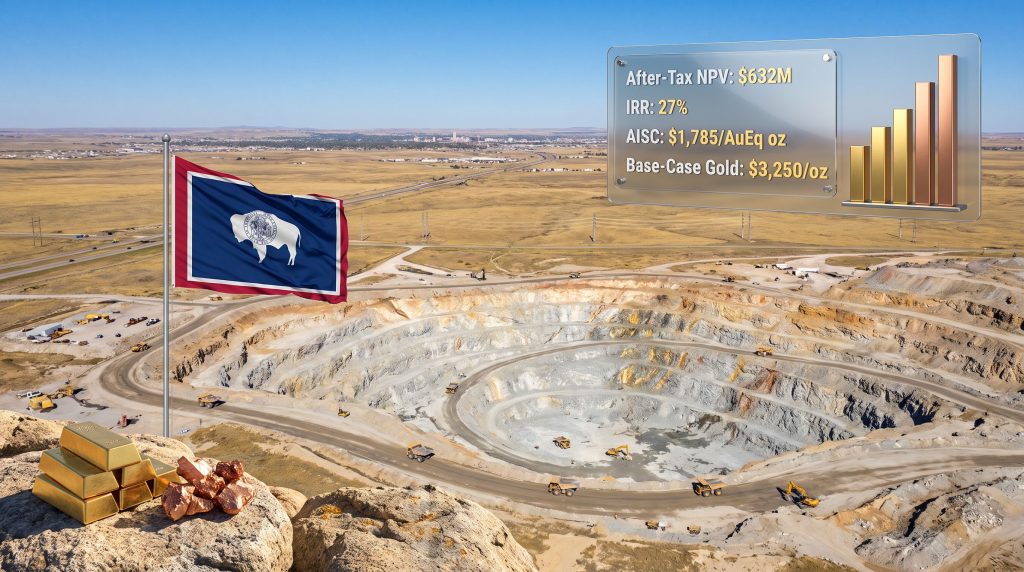
| After-Tax NPV (5% Discount Rate) | $632 million |
| After-Tax IRR | 27% |
| Initial Capital Estimate | $394 million |
| Payback Period | ~2.5 years |
| All-In Sustaining Cost | $1,785/AuEq oz |
| Mine Life | 11 years |
| Average Annual Production | ~85,000 AuEq oz/year |
| Base-Case Gold Price | $3,250/oz |
| Base-Case Copper Price | $4.50/lb |
| Base-Case Silver Price | $40/oz |
Several features of these numbers merit deeper analysis.
First, the base-case gold price of $3,250 per ounce sits materially below the prevailing spot price environment near $3,800 per ounce as of mid-2026. Feasibility studies are intentionally designed with conservative commodity assumptions to give lenders and investors a defensible downside scenario. The practical consequence here is that the published NPV of $632 million and IRR of 27% likely understate the project's economics at actual current market prices. The current gold price outlook suggests every $100 per ounce improvement in realised gold above the base case generates meaningful upside to both figures.
Second, the 2.5-year payback period is exceptionally short for a project of this scale and capital requirement. Conventional project finance lenders typically require payback periods of five years or less to underwrite debt facilities, meaning CK Gold's payback profile comfortably satisfies standard debt serviceability thresholds. This has direct implications for the financing strategy discussed later.
Third, the AISC of $1,785 per AuEq ounce positions CK Gold in the lower half of the North American cost curve for new-build projects, particularly given the cyanide-free processing design, which avoids the regulatory complexity and environmental liability associated with cyanide tailings management.
One important nuance worth flagging for investors: NPV figures are sensitive to both the discount rate applied and the commodity price assumptions used. The published $632 million NPV uses a 5% discount rate, which reflects relatively low-risk financing assumptions. Projects with higher perceived risk or in jurisdictions requiring higher return thresholds would apply steeper discount rates, compressing the NPV figure accordingly. CK Gold's permitting certainty and infrastructure access are precisely the factors that justify applying a lower discount rate.
Mineral Reserves, Resources, and the Geometry of Upside
The confirmed reserve base provides the foundation for the 11-year mine plan. Total proven and probable mineral reserves stand at 74.5 million tonnes, grading 0.01 oz/st gold, 0.17% copper, and 0.40 oz/st silver. In aggregate, these reserves contain:
- 1.022 million ounces of gold
- 259.7 million pounds of copper
- 3.008 million ounces of silver
- 1.672 million AuEq ounces in total
Beyond the reserve boundary, the project carries approximately 1.27 million additional AuEq ounces in measured, indicated, and inferred resource categories. The geological basis for potential reserve growth is compelling: roughly 80% of historical drill holes show continued mineralisation beyond the limits of the current modelled pit. This pattern suggests that the reserve boundary reflects economic modelling constraints rather than geological limits on the deposit.
A drilling programme launched in June 2026 is specifically targeting depth extensions and outside-pit zones with the objective of converting a portion of this resource inventory into reserves. Furthermore, interpreting drill results from this programme will be critical for investors assessing whether mine life can be extended meaningfully beyond the current 11-year plan.
One particularly unusual element of the CK Gold resource story is the waste rock revenue potential. The non-mineralised rock at the site is geologically equivalent in grade and quality to granite currently sold commercially in the region by Martin Marietta for between $20 and $25 per tonne. This value stream has not been incorporated into the base-case DFS economics, representing genuine unmodelled upside that a vertically integrated development plan could potentially capture.
Mining Method, Processing Technology, and the Significance of Cyanide-Free Design
How CK Gold Will Be Mined and Processed
The project will use conventional open-pit truck-and-shovel mining at a throughput rate of approximately 20,000 short tons per day. The strip ratio of 0.89:1 is notably low for an open-pit gold-copper operation. Many comparable North American open-pit projects operate at strip ratios of 2:1 to 5:1 or higher, meaning significantly more waste rock must be moved per tonne of ore processed. A lower strip ratio directly reduces mining operating costs and improves project economics in the early years of operation.
Processing uses froth flotation technology rather than cyanide heap leaching or conventional milling with cyanide leaching. Flotation separates valuable sulphide minerals from gangue by exploiting differences in surface chemistry, producing a high-grade concentrate rather than a finished metal product. The CK Gold concentrate specification targets a grade of 17% or greater copper content alongside approximately 41 grams per short ton of gold. This concentrate is dried onsite and then transported to a third-party smelter, eliminating the capital and operating complexity of onsite smelting infrastructure.
Why Glencore's Jameson Cell Technology Matters
The selection of Glencore Technology's Jameson Cell flotation system over conventional flotation circuits reflects a deliberate effort to optimise both metallurgical recovery and capital efficiency. The Jameson Cell is a high-intensity flotation device that operates using a downcomer mechanism to generate very fine bubbles, improving the probability of mineral-bubble attachment and therefore recovery rates, particularly for fine-grained particles that conventional flotation cells sometimes struggle to capture effectively.
From a capital cost perspective, Jameson Cells typically have a smaller physical footprint than equivalent conventional flotation banks, which can reduce civil and structural costs within the processing plant. For a project where initial capital is a key financing variable, these marginal savings contribute to the overall cost discipline that the DFS reflects.
The tailings management design also warrants specific mention. Wyoming's Department of Environmental Quality required a synthetic liner for the tailings storage facility, representing a regulatory upgrade from a clay-based containment design originally proposed. This requirement has been fully incorporated into the $394 million capital estimate, meaning it does not represent an unbudgeted cost exposure.
The next major ASX story will hit our subscribers first
Wyoming's Permitting Architecture Versus Competing Jurisdictions
| Permitting Dimension | CK Gold (Wyoming) | Federal NEPA Process | Typical Canadian Jurisdiction |
|---|---|---|---|
| Approval Tier | Single-tier (state only) | Multi-tier (federal + state) | Multi-tier (federal + provincial) |
| Public Objection Window | Closes at permit issuance | Remains open through construction | Varies; often open through construction |
| Mid-Construction Legal Challenge Risk | Eliminated | High | Moderate to High |
| Land Ownership | State land | Federal land | Crown land |
| Hard Rock Mining Precedent | First in approximately 100 years | Common | Common |
This comparison highlights a structural differentiator that is frequently underappreciated in market valuations of junior mining companies. The risk of mid-construction legal injunctions is not a theoretical concern; it has materially affected project timelines and financing costs across the North American gold development sector. Removing that risk category entirely changes the risk-adjusted return profile for potential project financiers and strategic acquirers alike.
Capital Structure, Financing Strategy, and the Valuation Disconnect
What the Share Structure Signals About Management Priorities
US Gold Corp currently has approximately 16.5 million shares outstanding, an unusually tight float for a development-stage company with a project of this scale. Most North American gold developers at a comparable stage carry share counts of 100 million to 500 million or more, often the cumulative result of repeated equity raises to fund exploration and feasibility work. The compressed share count at US Gold Corp reflects a deliberate anti-dilution philosophy, with management holding shares directly and therefore bearing the same economic consequences as external shareholders from any dilutive financing decision.
Management has stated a strong preference for debt-heavy financing to fund CK Gold's construction, citing the project's 2.5-year payback period as the core justification. With a payback profile that comfortably satisfies standard project finance debt serviceability requirements, the logic is straightforward: why dilute existing shareholders by issuing equity when the project's cash generation capacity supports debt repayment within a short operating window?
Financing resolution has been targeted within approximately three months of mid-2026, making this the single most important near-term catalyst for the stock.
The Valuation Gap in Quantitative Terms
With shares trading near $15 and a 52-week high of $23.75, the implied market capitalisation sits at approximately $266.7 million. Against a DFS-confirmed after-tax NPV of $632 million, this represents a discount of roughly 58% to net present value, or approximately 42 cents on the NPV dollar.
For context, comparable producing gold-copper assets have historically attracted acquisition valuations of $1.5 billion or more, suggesting the current market pricing reflects development-stage risk rather than any fundamental deficiency in the project itself. The specific risk factor that appears to be suppressing the valuation is financing uncertainty, not permitting risk, not geological risk, and not processing technology risk.
This creates an interesting asymmetry. However, if financing is resolved on the terms management has described, the primary technical discount to NPV should compress substantially. The additional catalysts below could accelerate that re-rating further. Understanding cut-off grade economics is also relevant here, as the project's reserve calculation methodology underpins the entire NPV model.
Near-Term Catalysts and the Case for Re-Rating
The pathway from current valuation to a price that more accurately reflects the project's DFS-confirmed economics depends on a sequenced set of developments:
- Financing announcement – debt structure finalisation represents the most significant single re-rating trigger, removing the primary risk factor the market appears to be pricing
- Drill results from the June 2026 programme – resource expansion drilling targeting depth extensions and outside-pit zones; positive results could add material ounces to the reserve inventory
- Reserve conversion – successful conversion of the approximately 1.27 million additional AuEq ounces from resource to reserve categories would extend mine life and improve long-term economics
- Construction commencement – targeted for 2026, with first concentrate production expected in the late 2027 to 2028 timeframe
- Sustained commodity price environment – with base-case gold at $3,250/oz versus a prevailing spot price near $3,800/oz, the published DFS economics are materially conservative relative to current conditions
The copper component of CK Gold's production profile adds a dimension of resilience that pure gold projects lack. With approximately 259.7 million pounds of copper in the reserve base, the project has meaningful exposure to copper demand dynamics, providing a partial hedge against any softening in the gold price environment.
How CK Gold Compares to Peer North American Gold-Copper Developers
| Attribute | CK Gold (US Gold Corp) | Typical NA Gold Developer |
|---|---|---|
| Permitting Status | Fully permitted (state level) | Partial or pending |
| Feasibility Study | DFS complete (March 2026) | PEA or PFS stage |
| Construction Timeline | 2026 start targeted | 2 to 5+ years away |
| Mid-Construction Legal Risk | Eliminated | Present |
| Strip Ratio | 0.89:1 | Often 2:1 to 5:1+ |
| Processing Method | Cyanide-free flotation | Often cyanide-dependent |
| Infrastructure | Fully existing | Often requires new build |
| Shares Outstanding | ~16.5 million | Often 100M to 500M+ |
The cumulative picture this table presents is of a project that has systematically de-risked itself across multiple dimensions simultaneously. Each individual advantage — permitting certainty, infrastructure access, cyanide-free processing, low strip ratio, completed DFS — is meaningful on its own. Their combination within a single asset is genuinely rare in the current North American gold development pipeline. For a deeper technical breakdown, the CK Gold mine project page offers additional engineering context worth reviewing.
Frequently Asked Questions About the CK Gold Project
What is the CK Gold Project?
The CK Gold Project is a fully permitted, open-pit gold-copper-silver development asset located in the Silver Crown mining district of Laramie County, Wyoming, approximately 20 miles west of Cheyenne. It is the flagship asset of US Gold Corp (Nasdaq: USAU).
What are the confirmed project economics?
The March 2026 S-K 1300 Definitive Feasibility Study confirms an after-tax NPV of $632 million at a 5% discount rate and an IRR of 27%, using base-case assumptions of $3,250/oz gold, $4.50/lb copper, and $40/oz silver. Initial capital is estimated at $394 million with a 2.5-year payback period.
Why is CK Gold considered fully permitted?
The project has completed Wyoming's single-tier state permitting process. No federal land is involved, meaning there is no NEPA trigger. Wyoming law closes the public objection window at the point of permit issuance, which means legal challenges cannot be filed once construction begins.
What is the mine life and production profile?
CK Gold is designed for an 11-year mine life, producing an average of approximately 85,000 AuEq ounces per year across the mine's operational lifespan.
How does US Gold Corp plan to fund construction?
Management has indicated a strong preference for debt financing over equity issuance, citing the project's 2.5-year payback period as supportive of debt serviceability. Financing resolution has been targeted within approximately three months of mid-2026.
What additional resource upside exists?
Approximately 1.27 million AuEq ounces in measured, indicated, and inferred resource categories sit outside the current reserve boundary. Around 80% of historical drill holes show continued mineralisation beyond the modelled pit limits. Furthermore, waste rock at the site is geologically equivalent to granite sold commercially in the region for $20 to $25 per tonne, a revenue stream not yet captured in the base-case DFS economics.
Disclaimer: This article is for informational purposes only and does not constitute financial advice or a solicitation to buy or sell any securities. All forward-looking statements, including projections of project economics, production timelines, and financing outcomes, are subject to material risks and uncertainties. Feasibility study metrics are based on specific commodity price assumptions and engineering estimates that may differ materially from actual outcomes. Investors should conduct their own due diligence and consult a licensed financial advisor before making any investment decisions.
Want to Be First When the Next Major Gold Discovery Hits the ASX?
Discovery Alert's proprietary Discovery IQ model scans ASX announcements in real time, instantly identifying significant mineral discoveries — including gold and copper — and delivering actionable alerts before the broader market has a chance to react. Explore historic discovery returns to understand the potential upside, and begin your 14-day free trial at Discovery Alert to position yourself ahead of the next major find.