July 14, 2026
When Scale Becomes Strategy: The Forces Driving Australia's Gold Consolidation Wave
The Australian gold sector has entered a phase that veteran mining analysts describe as a structural reset. When sustained commodity price strength collides with a finite supply of development-ready, tier-one assets, the arithmetic of organic growth begins to break down. Building new processing infrastructure from scratch in established gold districts now carries capital cost burdens that can exceed half a billion dollars before a single ounce is poured. In that environment, acquisition becomes not merely opportunistic but operationally rational, and the companies that move with conviction tend to define the competitive hierarchy for the decade that follows.
That is precisely the backdrop against which the Genesis Vault merger has emerged as the most consequential corporate event in Australian gold in recent memory. Furthermore, the broader context of Australian gold M&A activity in recent years makes this deal even more significant for investors and analysts alike.
When big ASX news breaks, our subscribers know first
Why the Genesis–Vault Deal Reshapes the Australian Gold Landscape
The Strategic Context Behind a $12.6 Billion Consolidation Play
Australia's gold M&A environment in 2026 has been shaped by a convergence of forces that rarely align simultaneously. The presence of record gold prices has expanded producer margins, strengthened balance sheets, and given boards the financial firepower to pursue transformative transactions. Yet that same price strength has made target assets more expensive and compressed the window during which a deal can be structured at a valuation that still delivers long-term accretion to the acquirer's shareholders.
The Leonora-Laverton corridor in Western Australia sits at the epicentre of this dynamic. The region has long been recognised as one of Australia's premier gold jurisdictions, hosting a concentration of mineralised systems, established processing infrastructure, and well-understood geology that reduces the exploration risk premium typically embedded in frontier assets. When two significant operators within the same corridor consider combining, the rationale extends well beyond simple scale, reaching into genuine operational integration that only geographic proximity can unlock.
How Does the Genesis Vault Merger Compare to Other Major ASX Gold Deals?
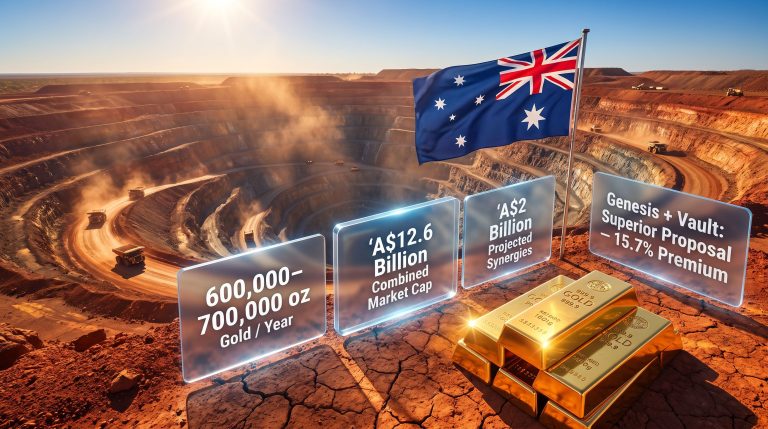
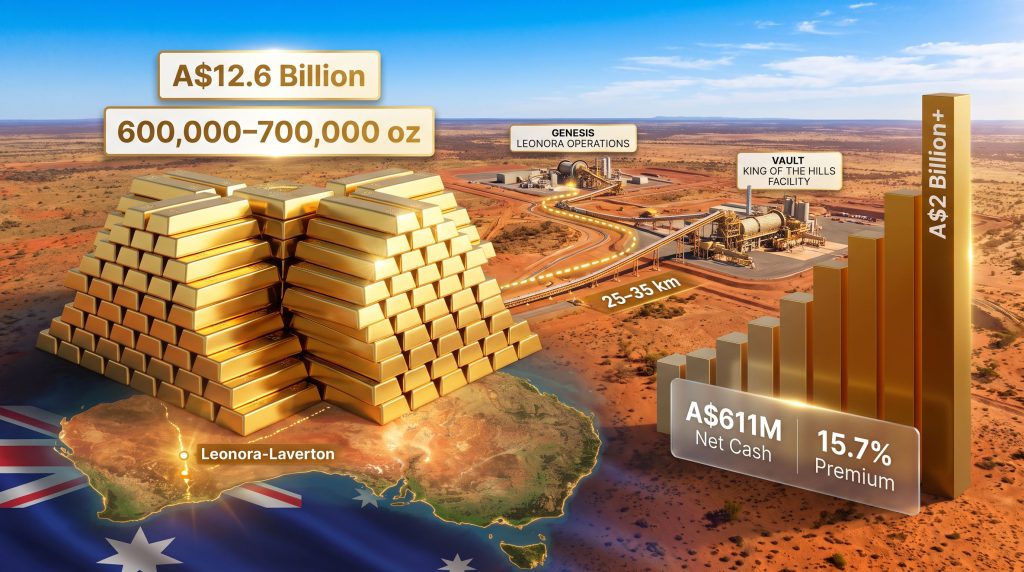
At a combined market capitalisation of approximately A$12.6 billion (roughly US$8.8 billion at prevailing exchange rates), the Genesis Vault merger would rank among the largest gold producer consolidations in Australian corporate history. The deal's financial architecture reflects the ambition of the strategic thesis underpinning it.
| Metric | Genesis–Vault Combined Entity |
|---|---|
| Combined Market Capitalisation | A$12.6 billion (approx. US$8.8B) |
| Projected Annual Gold Output | 600,000–700,000 oz |
| Net Cash Position | A$611 million |
| Estimated Post-Tax Synergies | A$2 billion+ (10-year horizon) |
| Capital Expenditure Avoided | ~A$500 million (new mill not required) |
| Vault Share Premium to Pre-Deal Price | 15.7% |
| Premium Over Regis Implied Value | 14.5% |
The A$611 million net cash position of the combined entity is particularly significant. In a sector where integration typically introduces near-term cash consumption pressures, entering a merger with that level of liquidity provides material insulation against execution risk and preserves strategic flexibility for capital allocation decisions post-close.
Understanding the Three-Way M&A Contest: Genesis, Vault, and Regis
How Did Regis Resources Factor Into the Vault Acquisition Battle?
To understand how the Genesis Vault merger reached its current form, it is necessary to trace the competitive sequence from its origin. Regis Resources (ASX: REG) had negotiated and executed an all-stock merger agreement with Vault Minerals (ASX: VAU) in May 2026, valued at approximately A$4.5 billion. That transaction was structured as a merger of equals, with balanced governance arrangements reflecting the comparable scale of the two businesses at the time of agreement.
Genesis Minerals (ASX: GMD) subsequently entered the contest as an uninvited competing bidder, presenting Vault's board with a cash-and-scrip proposal that offered superior headline value. Under Australian M&A law governing scheme of arrangement transactions, the existence of an agreed deal between two parties does not preclude a competing offeror from emerging. The mechanics of the process are governed by a right-to-match mechanism, which requires the original bidder to be given a defined period to assess whether it can improve its terms to match or exceed the competing proposal. Regis was afforded that opportunity but ultimately chose not to exercise it. According to reporting by The Motley Fool Australia, Genesis's proposal was structured to create a genuine gold powerhouse with compelling long-term credentials.
Why Did Regis Resources Walk Away From the Bidding Contest?
Regis's formal communication to shareholders confirmed that its board had determined the financial terms required to match Genesis's proposal could not satisfy the internal value and return thresholds the company applies to all growth opportunities. In plain terms, Regis concluded it would need to overpay in order to win, and its board judged that outcome to be worse than withdrawing from the process entirely.
This decision reflects a broader discipline that sophisticated resource sector boards increasingly apply in competitive M&A environments. In a high-gold-price context, the temptation to pursue transformative acquisitions at any cost is real, however overpaying for assets during commodity price peaks has historically been one of the most reliable pathways to long-term shareholder value destruction.
Regis's withdrawal from the bidding process illustrates a principle that rarely receives adequate attention in M&A commentary: the decision not to bid is itself a strategic act, and in competitive auction environments, disciplined restraint often protects more shareholder value than the deal that was never done.
What Regis's exit also signals is that the company now faces its own strategic recalibration. With its planned merger pathway closed, the market will closely monitor how Regis allocates capital and pursues growth from its current standalone position.
Dissecting the Merger Terms: What Vault Shareholders Actually Receive
Breaking Down the Genesis Offer Structure
The financial terms of the Genesis proposal to Vault shareholders are structured as a blended cash-and-scrip consideration, a design that serves multiple objectives simultaneously. The specific components are:
- Cash component: A$0.475 per Vault share held
- Scrip component: 0.7629 new Genesis Minerals shares issued per Vault share
- Implied per-share value: approximately A$5.274, based on Genesis's share price at the time of the announcement
- Premium to Vault's pre-announcement closing price: 15.7%
- Premium to the implied value of the Regis merger terms: 14.5%
The cash component provides Vault shareholders with immediate liquidity and certainty, while the scrip element retains their participation in the upside of the combined entity. For Genesis, the cash-and-scrip structure avoids the balance sheet dilution of a pure cash bid while preserving enough of its net cash position to fund post-merger integration.
What Does a 15.7% Premium Signal in the Current Gold M&A Market?
Control premiums in Australian resources sector transactions have historically clustered in the 20–35% range, reflecting the scarcity value of quality assets and the competitive tension inherent in contested processes. A 15.7% premium to the undisturbed share price sits at the lower end of that historical range, which might initially appear modest. However, the more analytically relevant premium is the 14.5% margin Genesis's terms carried over the Regis implied value, because that was the threshold Vault's board needed to declare the Genesis proposal a Superior Proposal under the terms of its agreement with Regis.
The fact that this threshold was met and Vault's board moved to recommend Genesis's offer signals that the independent expert process and board deliberation concluded the improved terms were genuinely superior, not merely marginally better. Vault shareholders will ultimately determine whether the deal proceeds, with a minimum 75% approval threshold required at the shareholder vote under scheme of arrangement rules, alongside formal court sanction.
The Operational Logic: Why This Merger Creates Genuine Synergy Value
How Does Geographic Proximity Drive the A$2 Billion Synergy Case?
The A$2 billion post-tax synergy estimate projected over a 10-year horizon is the number that commands the most scrutiny in any analytical assessment of the Genesis Vault merger. Synergy cases in resource sector M&A are frequently constructed on optimistic assumptions that later prove difficult to realise on time and within budget. What distinguishes this deal's synergy thesis is that its primary driver is not cost reduction through headcount elimination or procurement leverage, but rather a specific piece of physical infrastructure planning logic.
Genesis's Tower Hill project and Vault's King of the Hills processing facility sit approximately 25 to 35 kilometres apart within the same geological corridor. That proximity means Genesis ore from Tower Hill can theoretically be trucked to King of the Hills for processing rather than requiring the construction of a standalone mill. The capital expenditure avoided through this routing decision is estimated at approximately A$500 million, a saving that is concrete, verifiable, and front-loaded rather than speculative and long-dated.
The infrastructure sharing thesis at the core of this merger is unusually tangible. Most synergy cases in mining M&A rely on overhead consolidation projections that take years to materialise. Eliminating a half-billion-dollar capex line item has an immediate and quantifiable impact on the combined group's risk profile and funding requirements.
Step-by-Step: How the Synergy Value Accumulates Over 10 Years
Understanding how the full A$2 billion synergy case builds across a decade requires examining each contributing layer:
- Infrastructure sharing — eliminating the need for duplicate processing and haulage infrastructure across tenements that are geographically adjacent, with King of the Hills mill handling ore flows from both legacy asset bases
- Operational overhead reduction — consolidation of corporate functions, technical services, and administrative cost centres across the merged group, reducing duplication at the management and support levels
- Exploration portfolio rationalisation — prioritising the highest-return drill targets across a substantially larger combined landholding, improving exploration capital efficiency by concentrating expenditure on the most prospective ground
- Regional supply chain leverage — the expanded operational footprint in the Leonora-Laverton district creates greater purchasing power with contractors, consumables suppliers, and service providers, improving per-unit cost structures across the business
- Long-term reserve conversion — the combined resource base supports a materially longer mine life, improving the return on capital invested in processing infrastructure upgrades and underpinning the business case for further development spending
Projected Production Scale: What 600,000–700,000 Ounces Means Competitively
Annual gold output of 600,000 to 700,000 ounces would firmly position the merged entity within the upper tier of ASX-listed gold producers. To contextualise the scale: this output range places the combined Genesis-Vault group in a category that commands meaningfully higher institutional interest, greater index weight, and more favourable capital markets access than mid-tier producers operating at half that volume.
At prevailing gold prices, a production profile of this magnitude generates substantial operating cash flow, providing the combined group with both the means to fund integration costs and the optionality to pursue further acquisitions, debt reduction, or capital returns to shareholders. The operating leverage embedded in this production scale means that a 10% movement in the gold price translates into a disproportionately large change in free cash flow, amplifying both the upside and the downside sensitivity of the investment case. Consequently, understanding the gold price impact on miners is essential context for evaluating the combined entity's long-term investment case.
Governance Architecture: Who Controls the New Entity?
How Is Ownership Structured Between Genesis and Vault Shareholders?
Post-merger completion, Genesis Minerals shareholders would hold approximately 60% of the combined entity, with Vault shareholders holding the remaining 40%. This ownership structure reflects the relative market capitalisations of the two businesses and the terms of the scrip component of the consideration.
Board composition follows a similar logic. Genesis secures four of the seven board seats, establishing clear operational control and ensuring that governance of the merged group reflects the acquirer's strategic priorities. This contrasts sharply with the original Regis-Vault merger structure, which was designed as a more balanced arrangement with neither party holding dominant board representation. The governance asymmetry in the Genesis deal reflects the reality that this is an acquisition rather than a merger of equals, even though the terminology of merger is used in public communications.
What Approvals Are Required Before the Merger Can Proceed?
The path to completion involves several mandatory regulatory and shareholder approval steps:
- Vault shareholder vote: A minimum 75% approval threshold is required for the scheme to pass, meaning the deal can be defeated by a relatively concentrated group of dissenting shareholders
- Court approval: As a scheme of arrangement, the transaction requires judicial sanction from the Federal Court of Australia, which independently assesses whether the process has been conducted properly
- Independent expert sign-off: A formally appointed expert must provide a fairness and reasonableness determination, confirming that the scheme is in the best interests of Vault shareholders in the absence of a superior proposal
- ASX continuous disclosure obligations: Both parties remain subject to ongoing disclosure requirements throughout the approval process, meaning material developments must be communicated to the market promptly
The next major ASX story will hit our subscribers first
Scenario Modelling: What Happens Next for Each Party?
Scenario 1: Merger Proceeds as Planned
If all regulatory and shareholder approvals are secured on schedule, Genesis and Vault would begin the complex process of integrating operations across the Leonora-Laverton corridor. Production ramp toward the targeted 600,000 to 700,000 ounce annual range would commence, with synergy realisation phased across the medium term as infrastructure sharing arrangements are operationalised. The combined entity's A$12.6 billion market capitalisation would establish it as a dominant force in Australian gold and a natural candidate for inclusion in major equity indices, broadening the institutional investor base organically.
Scenario 2: Regulatory or Shareholder Resistance Emerges
The 75% approval threshold for scheme of arrangement votes is deliberately high, and history shows that a motivated minority can defeat transactions that appear to have strong board and institutional support. If the scheme lapses, both companies revert to standalone strategies. Genesis would face pressure to articulate an alternative growth pathway, while Vault would need to reassess its strategic options, potentially reopening dialogue with third parties or pursuing its own development programme independently.
Scenario 3: A New Competing Bidder Enters
With Regis having withdrawn, the probability of a third-party competing offer has diminished considerably. Any new entrant would need to offer a premium above Genesis's already-elevated A$5.274 per share implied value, a bar that raises the capital cost and financing risk of a counter-proposal substantially. The combined entity's A$12.6 billion scale may itself act as a deterrent, given that mounting a credible competing bid at that valuation is beyond the financial capacity of most ASX-listed mid-tier gold producers.
What Does the Genesis Vault Merger Signal for ASX Gold M&A in 2026?
Is Consolidation Becoming the Dominant Strategy for Mid-Tier Australian Gold Producers?
The structural forces accelerating consolidation in Australian gold are not temporary. The scarcity of tier-one assets in established, low-sovereign-risk jurisdictions is a long-term reality. Development costs for new processing infrastructure continue to escalate, driven by labour market pressures in Western Australia's resources industry, equipment lead times, and energy cost inflation. Against that backdrop, the organic growth model, once the default strategy for mid-tier producers, increasingly struggles to deliver the returns that institutional capital demands.
Scale matters in another critical dimension: the competition for institutional investment. Large global resources funds operate minimum investment threshold requirements, meaning that producers below a certain market capitalisation are simply ineligible for consideration regardless of the quality of their asset base. The Genesis Vault merger pushes the combined entity firmly into a size bracket that opens access to a meaningfully broader and deeper pool of institutional capital. In addition, deals such as the Gold Fields takeover offer for Gold Road Resources and the subsequent Gold Road bid rejection demonstrate that target boards are increasingly willing to hold firm on valuation discipline even in the face of well-capitalised international acquirers.
Key Themes Investors Should Monitor Following This Deal
- Integration execution risk: The A$2 billion synergy case is operationally grounded, but delivering it on schedule and within projected cost parameters will require disciplined programme management across a geographically dispersed asset base
- Gold price sensitivity: The revenue and valuation assumptions underpinning the merger rationale are calibrated to prevailing gold prices; a sustained price correction would reduce the financial headroom available for integration investment and could pressure the combined group's free cash flow
- Regulatory timeline: The pace at which court and shareholder approvals are obtained will determine when production integration can practically begin, and any delays extend the period of combined operational uncertainty
- Regis Resources' next move: The market will watch closely for how Regis deploys its capital and articulates its growth strategy following the closure of the Vault pathway, with M&A appetite and balance sheet deployment remaining live questions
- Institutional index rebalancing: A combined entity at A$12.6 billion in market capitalisation may trigger passive fund rebalancing and index inclusion events that affect the share price of both Genesis and other mid-tier ASX gold producers
Frequently Asked Questions: Genesis Vault Merger
What is the Genesis Vault merger?
The Genesis Vault merger is a proposed combination of Genesis Minerals (ASX: GMD) and Vault Minerals (ASX: VAU) that would create a combined entity with a market capitalisation of approximately A$12.6 billion and projected annual gold production of 600,000 to 700,000 ounces, positioning it among Australia's largest gold producers.
How much are Vault shareholders being offered per share?
Each Vault share is valued at approximately A$5.274 under the Genesis proposal, comprising 0.7629 new Genesis Minerals shares plus A$0.475 in cash, representing a 15.7% premium to Vault's pre-announcement closing price.
Why did Regis Resources withdraw from the bidding process?
Regis's board determined that matching Genesis's financial terms would require paying a price that could not meet the company's internal value and return thresholds across its growth investment criteria, and it chose not to exercise its contractual right to match. For further detail on how this 5.6 billion merger proposal unfolded competitively, Stockhead's coverage provides useful context on where Genesis leapfrogged Regis in the bidding sequence.
What synergies does the merger unlock?
The combined entity is forecast to generate over A$2 billion in post-tax synergies across a 10-year period, anchored by infrastructure sharing across the Leonora-Laverton corridor and the avoidance of approximately A$500 million in capital expenditure through the use of Vault's existing King of the Hills processing facility rather than constructing a new standalone mill.
What approvals are needed for the Genesis Vault merger to proceed?
The transaction requires a minimum 75% approval vote from Vault shareholders, Federal Court sanction under scheme of arrangement procedures, and a formal independent expert determination confirming the deal is fair and reasonable for Vault shareholders.
Who will control the merged company?
Genesis Minerals will hold approximately 60% of the combined entity and will occupy four of the seven board seats, giving it clear operational and governance authority over the merged group.
Key Takeaways: The Strategic Significance of the Genesis Vault Merger
- The Genesis Vault merger represents one of the most significant gold sector consolidations in Australian corporate history by market capitalisation, with a combined value of approximately A$12.6 billion
- The A$2 billion synergy case is underpinned by concrete infrastructure logic rather than speculative overhead assumptions, with the avoidance of a ~A$500 million processing facility representing the most quantifiable element
- Regis Resources' disciplined exit from the bidding process reflects a growing emphasis on valuation rigour among mid-tier producers navigating a high-gold-price M&A environment
- The combined entity's A$611 million net cash position provides meaningful financial resilience during the integration phase and preserves optionality for future capital allocation decisions
- The 75% shareholder approval threshold remains the most immediate execution risk, and the outcome of the Vault shareholder vote will be closely watched as a barometer of investor confidence in the deal's strategic logic
- The deal's completion would serve as a defining reference point for how scale, geographic integration, and governance structure are weighted in future ASX gold sector consolidation, potentially triggering a new wave of mid-tier consolidation activity across Western Australia's established gold districts
This article is intended for informational purposes only and does not constitute financial or investment advice. Readers should conduct their own research and consult a licensed financial adviser before making any investment decisions. Forward-looking statements, including synergy projections and production forecasts, are subject to material risks and uncertainties and should not be relied upon as guarantees of future performance.
Readers seeking further coverage of Australian gold sector M&A dynamics and ASX mining developments can explore ongoing market analysis at The Market Online, which provides continuous reporting on resource sector corporate activity and ASX materials news.
Want to Capitalise on the Next Major ASX Gold Discovery Before the Market Moves?
Discovery Alert's proprietary Discovery IQ model delivers real-time alerts on significant ASX mineral discoveries, transforming complex geological and market data into actionable investment insights the moment they hit the exchange — explore historic examples of major discovery returns to understand the scale of opportunity, then begin your 14-day free trial at Discovery Alert to position yourself ahead of the next wave of Australian gold sector consolidation.