July 3, 2026
Global capital markets are witnessing a significant new funding round for clean energy projects as institutional investors recognise the maturation of clean technology solutions. This transformation reflects broader macroeconomic forces driving energy security concerns, climate policy implementation, and technological readiness convergence across multiple sectors. The emergence of firm power solutions, grid integration technologies, and mining sector electrification represents a fundamental departure from earlier renewable energy investment patterns focused primarily on intermittent generation capacity.
What Drives the Current Wave of Clean Energy Investment Opportunities?
Global Capital Allocation Trends in Clean Technology
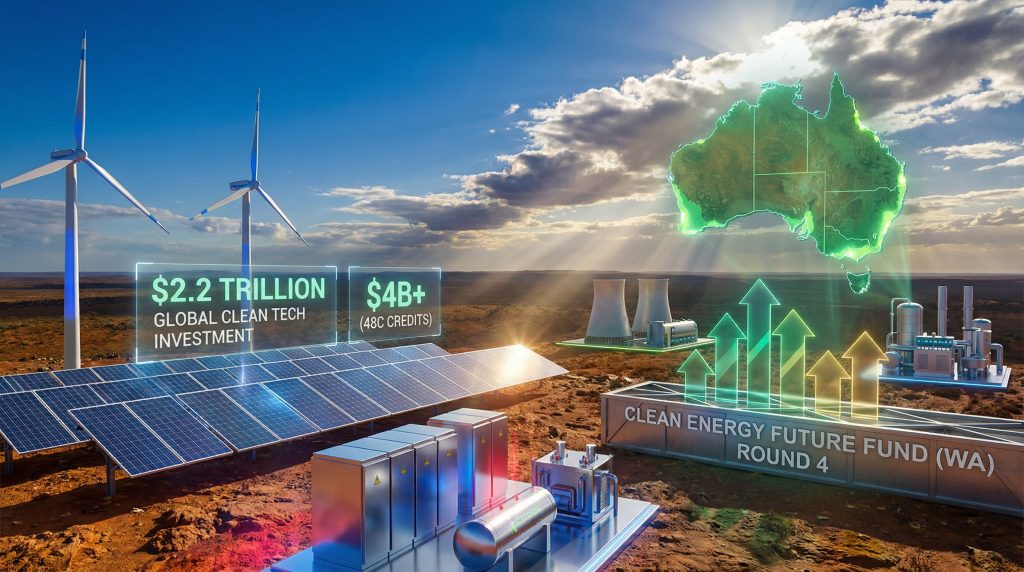
International energy agencies project annual clean energy investment requirements approaching $2 trillion globally by 2030, reflecting the scale of infrastructure transformation needed to achieve net-zero emissions targets. This capital deployment spans diverse technology categories, with particular emphasis on firm power solutions, long-duration energy storage systems, and industrial decarbonisation applications.
Australia's clean energy funding landscape demonstrates this global trend through targeted government programs. Western Australia's Clean Energy Future Fund (CEFF) Round 4 exemplifies strategic capital allocation, offering $9 million in grants ranging from $100,000 to $4 million per project. Since its establishment in 2020, CEFF has deployed $37 million across demonstration and pilot projects, creating a portfolio approach that balances early-stage technology development with commercial readiness initiatives.
Geographic investment patterns reveal institutional capital concentrating in regions with strong regulatory frameworks and government backing mechanisms. Australia's federal and state-level programs provide risk mitigation through tax incentives, direct grants, and revenue certainty mechanisms that reduce investor exposure to technology and market adoption uncertainties.
Risk-Return Profiles Attracting Institutional Capital
Government-backed clean energy projects offer infrastructure-grade return profiles while maintaining exposure to growth sectors experiencing rapid technological advancement. The CEFF model demonstrates this principle through its focus on pilot and demonstration projects that bridge the commercialisation gap between research and deployment.
Minister Amber-Jade Sanderson emphasises that government funding serves as a critical catalyst for translating innovative concepts into deployable technologies. This approach reflects recognition that clean energy technologies require public sector support to overcome early-stage commercial viability challenges, particularly for capital-intensive demonstration projects with uncertain return timelines.
Long-term contracted revenue models increasingly attract institutional investors seeking predictable returns. Power purchase agreements, capacity contracts, and government-backed revenue guarantees provide cash flow certainty that enables project financing at competitive rates. These mechanisms transform clean energy investments from speculative technology ventures into infrastructure assets suitable for pension funds and insurance companies.
When big ASX news breaks, our subscribers know first
Which Clean Energy Technologies Command Premium Valuations?
Firm Power Solutions Leading Investment Flows
Investment capital flows increasingly favour clean energy technologies providing firm power characteristics, addressing grid reliability concerns whilst delivering decarbonisation outcomes. Long-duration energy storage systems, geothermal projects, and advanced nuclear technologies attract premium valuations due to their dispatchable generation capabilities.
Battery-electric mining equipment represents a particularly attractive investment category, combining industrial decarbonisation with proven commercial applications. Electric vehicles mining applications, such as Electric Power Conversions Australia's successful retrofit of a diesel mining haul truck to full battery-electric operation, demonstrate technology readiness levels approaching commercial deployment.
| Technology Category | Maturity Level | Key Attractions | Investment Focus |
|---|---|---|---|
| Mining Electrification | TRL 7-8 | Proven commercial applications | Equipment retrofits, battery systems |
| Long-Duration Storage | TRL 6-7 | Grid services revenue | System integration, manufacturing |
| Geothermal Systems | TRL 6-8 | High capacity factors | Resource exploration, development |
| Advanced Nuclear | TRL 4-6 | Firm power generation | Technology development, demonstration |
Grid Integration and Reliability Technologies
Energy storage systems enabling renewable penetration command significant valuations due to their essential role in grid stability and energy security. These technologies provide multiple revenue streams through frequency regulation, peak shaving, and renewable integration services, creating diversified income profiles attractive to institutional investors.
Hybrid project configurations combining renewable generation with storage capacity attract safe-harbour tax credits and other government incentives, improving project economics whilst reducing grid integration challenges. This integrated approach addresses intermittency concerns whilst maximising available policy support mechanisms.
Smart grid infrastructure investments focus on technologies enabling bidirectional power flows, demand response capabilities, and distributed energy resource management. These systems become increasingly valuable as renewable penetration levels rise and grid complexity increases.
How Are Government Funding Mechanisms Evolving?
Federal Program Architecture and Allocation Strategies
Government funding mechanisms demonstrate sophisticated approaches to clean energy investment, balancing technology development support with commercial deployment incentives. CEFF's tiered grant structure exemplifies this strategy, providing smaller allocations ($100,000-$500,000) for early-stage pilots alongside larger grants ($2-4 million) for demonstration projects approaching commercial readiness.
Priority sector targeting reflects policy makers' understanding of industrial decarbonisation requirements and economic development opportunities. CEFF Round 4 explicitly emphasises:
- Mining sector electrification through haul truck conversion and diesel generator replacement
- First Nations economic participation and benefit-sharing mechanisms
- Export-oriented clean technology manufacturing capabilities
- Grid infrastructure resilience and long-duration energy storage deployment
This evolution represents progression from basic renewable capacity addition toward integrated systems combining generation, storage, and industrial applications. Furthermore, the renewable energy mining transformation demonstrates how targeted funding accelerates sector-wide adoption.
State-Level Innovation Frameworks
Western Australia's approach demonstrates how regional governments can catalyse clean energy investment through targeted funding programs. The Department of Water and Environmental Regulation administers CEFF with support from Energy Policy WA, creating streamlined application processes and technical evaluation frameworks.
Historical CEFF-supported projects illustrate technology diversification strategies including battery-electric haul truck retrofits reducing mining operation emissions, diesel generator replacement systems using battery storage for remote operations, pumped hydroelectric storage providing long-duration grid services, and modular solar power plants enabling flexible renewable capacity deployment.
Each project category addresses specific market segments whilst contributing to broader decarbonisation objectives, creating portfolio effects that reduce overall program risk. The Australian Renewable Energy Agency's comprehensive funding programs provide additional support for innovative clean energy projects across multiple technology categories.
What Investment Strategies Are Emerging for Clean Energy Projects?
Portfolio Construction Approaches
Sophisticated investors increasingly adopt diversified clean energy strategies spanning multiple technology categories, development stages, and geographic regions. This approach recognises that different clean energy technologies present distinct risk profiles requiring balanced portfolio allocation.
Technology diversification rationale:
- Geothermal systems: High exploration risk but excellent capacity factors once confirmed
- Nuclear technologies: Extended development timelines but very high reliability profiles
- Storage systems: Chemistry-dependent performance but essential grid service applications
- Mining electrification: Proven operational benefits with clear commercial pathways
Geographic risk distribution strategies reduce exposure to single-jurisdiction regulatory changes or resource constraints. Development stage allocation balances high-risk venture investments against lower-risk commercial deployments, optimising risk-adjusted returns across technology maturity levels.
Due Diligence Evolution in Clean Energy Deals
Investment evaluation frameworks increasingly emphasise technical risk assessment, regulatory pathway analysis, and market adoption timeline modelling. Battery-electric mining equipment investments exemplify this evolution, requiring evaluation of integration complexity with existing mine power infrastructure, thermal management capabilities in remote operational environments, supply chain development for replacement components and maintenance services, and total cost of ownership comparisons against incumbent diesel systems.
Due diligence processes now incorporate Technology Readiness Level (TRL) assessments, mapping funding requirements against development milestones and commercial deployment timelines. In addition, investment strategy approaches must consider technological maturity alongside market readiness factors.
How Do Mining Sector Electrification Projects Access Capital?
Industrial Decarbonisation Investment Thesis
Mining sector electrification represents a compelling investment category combining proven operational benefits with substantial decarbonisation impact. Electric Power Conversions Australia's completed haul truck retrofit demonstrates commercial viability pathways that reduce investor perceptions of technology risk.
Key investment drivers include:
- Operational cost reductions through improved energy efficiency and reduced maintenance requirements
- Productivity enhancements via electric drivetrain performance characteristics
- Environmental compliance meeting increasingly stringent emissions regulations
- Energy security improvements reducing dependence on diesel fuel supply chains
Total cost of ownership analysis increasingly favours electric systems when accounting for diesel price volatility, maintenance cost differentials, and productivity improvements. Mining companies recognise these economic benefits whilst achieving decarbonisation objectives required for social licence to operate.
Sector-Specific Funding Mechanisms
Government programs specifically targeting energy-intensive industries provide additional capital sources for mining electrification projects. CEFF's emphasis on mining applications reflects recognition that industrial decarbonisation requires targeted support due to capital intensity and operational complexity considerations.
Demonstration project funding creates pathways for technology scaling, enabling initial deployments that validate performance assumptions and reduce perceived risk for follow-on commercial investments. This staged approach allows mining companies to evaluate electric systems performance before committing to fleet-wide conversions.
Corporate partnership structures between mining operators, technology providers, and financial institutions enable risk sharing whilst providing access to specialised expertise. These arrangements often include performance guarantees and technical support services that further reduce adoption barriers.
Which Market Dynamics Will Shape 2026 Clean Energy Funding?
Technology Maturation and Commercial Readiness
Clean energy investment patterns reflect accelerating technology maturation across multiple sectors. Battery storage chemistry improvements, geothermal drilling advances, and nuclear reactor design evolution create expanding opportunities for institutional capital deployment.
However, the mining industry evolution indicates particular readiness for scaled deployment, with successful demonstration projects providing proof-of-concept validation for broader industry adoption. This maturation reduces technology risk whilst expanding addressable market opportunities.
Investment Outlook: Technology progression in geothermal systems, advanced nuclear designs, and sodium-ion battery storage indicates potential for significant capital deployment as these technologies achieve commercial readiness milestones.
Policy Environment Impact Assessment
Regulatory stability requirements for long-term clean energy projects influence investment decision-making processes. Government program continuity, such as CEFF's five-year operational history with consistent funding levels, provides investor confidence necessary for capital commitment.
International climate commitments increasingly influence domestic funding priorities, creating alignment between policy objectives and investment opportunities. Carbon pricing mechanisms, where implemented, improve project economics by monetising emissions reductions.
Critical policy factors affecting investment include:
- Program longevity and funding predictability across political cycles
- Regulatory pathway clarity for emerging technologies seeking commercial deployment
- Grid integration standards enabling storage and renewable technology interconnection
- Environmental approval processes affecting project development timelines
The federal government's commitment to supporting clean energy transitions demonstrates ongoing policy alignment with investment requirements.
The next major ASX story will hit our subscribers first
What Are the Critical Success Factors for Clean Energy Funding Applications?
Technical and Commercial Viability Demonstration
Successful funding applications increasingly require comprehensive demonstration of technology readiness and commercial pathway clarity. CEFF-supported projects exemplify this requirement through emphasis on pilot and demonstration phases that validate technical performance assumptions.
Key evaluation criteria include:
- Technology Readiness Level progression with clear development milestones
- Market adoption pathway analysis identifying target customers and deployment strategies
- Financial model validation demonstrating revenue sustainability and growth potential
- Risk mitigation strategies addressing technical, market, and regulatory uncertainties
Project scaling potential becomes increasingly important as funding programs seek maximum impact from limited capital allocations. Technologies demonstrating clear pathways from demonstration to commercial deployment receive preference in competitive selection processes.
Stakeholder Engagement and Community Benefit Integration
First Nations partnership development and community benefit integration represent critical success factors for clean energy project funding. CEFF Round 4's explicit emphasis on First Nations benefits reflects policy maker recognition that social licence requirements affect project viability.
Community engagement strategies must address:
- Economic participation opportunities for local communities and Indigenous groups
- Environmental impact mitigation and monitoring frameworks
- Workforce development and training program integration
- Revenue sharing mechanisms ensuring community benefits from project success
Environmental and social governance (ESG) compliance frameworks increasingly influence funding decisions as institutional investors adopt sustainability screening criteria. Projects demonstrating comprehensive stakeholder engagement and community benefit delivery gain competitive advantages in funding allocation processes.
How Should Investors Evaluate Clean Energy Funding Opportunities?
Financial Performance Benchmarking
Clean energy investment evaluation requires sophisticated understanding of revenue model sustainability across different technology categories. Mining electrification projects offer particularly attractive risk-return profiles due to proven operational benefits and clear commercial pathways.
Performance metrics for investment evaluation:
- Capital efficiency ratios comparing investment requirements to capacity deployment
- Revenue predictability through contracted sales or operational cost savings
- Technology risk assessment based on development stage and commercial precedents
- Market penetration potential considering addressable market size and growth rates
Exit strategy optionality becomes increasingly important as clean energy markets mature. Technologies approaching commercial deployment offer multiple exit pathways through strategic acquisition, public market listing, or project refinancing opportunities.
Risk Mitigation Through Portfolio Diversification
Institutional investors increasingly adopt portfolio approaches balancing technology types, development stages, and geographic exposure. This diversification strategies approach reduces concentration risk whilst maintaining exposure to clean energy sector growth.
Portfolio construction principles:
- Technology diversification across storage, generation, and industrial applications
- Development stage balance between early venture and commercial deployment investments
- Geographic distribution reducing regulatory and resource concentration risks
- Market segment exposure spanning utility-scale, commercial, and industrial applications
CEFF's approach provides a model for institutional portfolio construction, combining small-scale pilot funding with larger demonstration project investments across multiple technology categories and market applications. Consequently, this creates opportunities for another new funding round for clean energy projects as successful demonstrations attract follow-on investment.
The evolving landscape of clean energy funding reflects technological maturation, policy alignment, and institutional capital recognition of infrastructure-grade return potential. For instance, mining sector electrification demonstrates how targeted government support accelerates commercial adoption whilst creating attractive investment opportunities.
Furthermore, a new funding round for clean energy projects becomes increasingly accessible as demonstrated technologies reduce perceived risk and government programs provide capital bridging mechanisms. This convergence of factors positions 2026 as a pivotal year for scaled clean energy investment deployment across multiple technology categories and market segments.
Investors seeking additional information about Australia's evolving clean energy funding landscape can explore resources provided by state energy agencies and federal climate policy initiatives, which offer detailed guidance on application processes and program specifications.
Want to Capitalise on Australia's Clean Energy Investment Boom?
Discovery Alert's proprietary Discovery IQ model delivers instant notifications on significant ASX mineral discoveries, including critical minerals powering the clean energy transition, helping investors identify actionable opportunities before the broader market reacts. Begin your 30-day free trial today and explore historic examples of exceptional returns from major mineral discoveries that have transformed investor portfolios.