May 20, 2026
Climate Adaptation Challenges in Australian Mining Operations
Australia's mining sector faces mounting pressure to develop resilient operational frameworks as extreme weather patterns intensify across the continent. The intersection of workplace safety legislation, operational continuity requirements, and environmental risk management creates a complex regulatory landscape that mining companies must navigate with increasing sophistication. Furthermore, understanding how these frameworks evolve under extreme conditions reveals critical insights into the future of industrial safety management.
The mining industry evolution demonstrates that thermal stress challenges extend far beyond simple temperature monitoring, encompassing comprehensive risk assessment protocols, technological adaptations, and workforce management strategies that collectively define modern mining safety standards.
When big ASX news breaks, our subscribers know first
Regulatory Framework Evolution in Extreme Weather Management
Western Australia's mining regulatory landscape operates under the Work Health and Safety Act 2020 (WA), establishing comprehensive obligations for managing thermal stress in industrial operations. This legislative framework requires duty holders to ensure worker health and safety through reasonably practicable measures, creating a foundation for adaptive safety protocols during extreme weather events.
The regulatory approach emphasises prevention through systematic risk management rather than reactive measures. Under Section 36-39 of the Act, employers must conduct formal risk assessments when environmental conditions pose potential thermal hazards, implementing control measures according to established safety hierarchies.
International Comparative Analysis
United States Framework: The Mine Safety and Health Administration (MSHA) operates without specific mandatory heat stress standards, relying instead on general duty clauses and OSHA guideline references. This approach provides flexibility but lacks the prescriptive requirements found in Australian regulations.
Canadian Provincial Models: Alberta's Occupational Health and Safety Code requires employers to implement comprehensive thermal stress management programs. In addition, British Columbia's WorkSafeBC provides detailed guidelines recommending work limitations at various heat index levels.
Australian Standards: The national framework through Safe Work Australia provides guidance that individual states adapt to their specific industrial contexts. Consequently, Western Australia's implementation reflects the unique challenges of resource extraction in arid environments.
Critical Temperature Thresholds and Operational Triggers
The intense heatwave in WA mining hubs demonstrates the practical application of thermal risk management protocols. Recent heatwave warnings for the Pilbara, Gascoyne, and north interior regions forecast maximum temperatures reaching the high 40s, with some areas potentially approaching 50°C.
This extreme forecast recalls the January 13, 2022 event when Onslow reached 50.7°C at 2:26 PM local time, equalling Australia's all-time temperature record and providing crucial data for operational response planning. For instance, this event highlighted the critical importance of emergency protocols during unprecedented thermal conditions.
Heat Risk Classification Framework
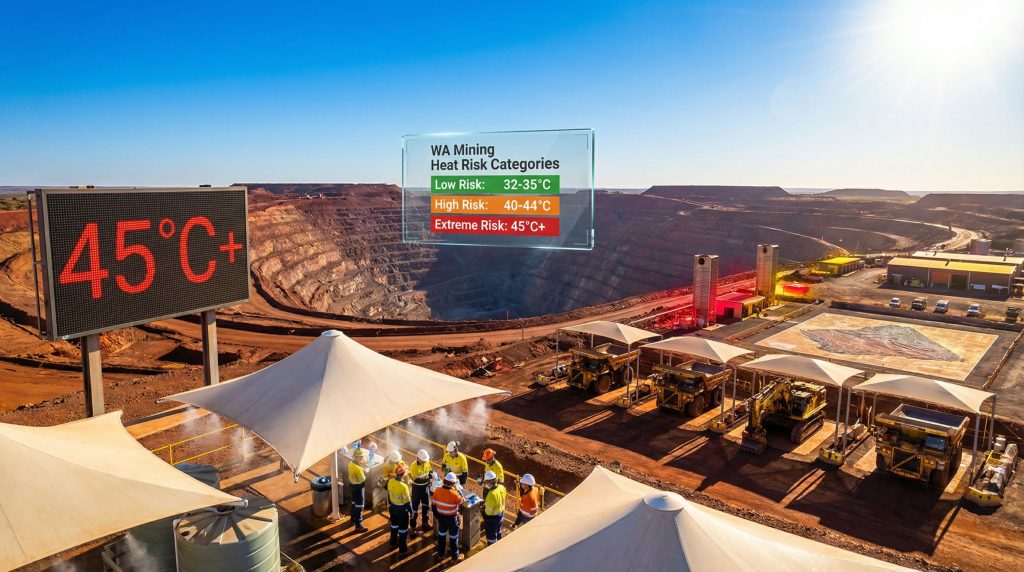
| Temperature Range | Risk Category | Required Controls |
|---|---|---|
| 32-35°C | Low Risk | Enhanced hydration protocols, standard operations |
| 36-39°C | Moderate Risk | Increased break frequency, PPE modifications |
| 40-44°C | High Risk | Work schedule adjustments, mandatory cooling stations |
| 45°C+ | Extreme Risk | Potential operation suspension, emergency protocols |
The distinction between ambient temperature and heat index calculations proves critical for accurate risk assessment. However, a 40°C ambient temperature in low humidity environments poses different physiological stress than the same temperature with high humidity, requiring sophisticated monitoring beyond simple thermometer readings.
Comprehensive Heat Control Hierarchies
Mining operations implement structured control measures following established safety hierarchies, with engineering controls taking precedence over administrative measures and personal protective equipment.
Engineering Controls (Primary Prevention)
• Ventilation systems and air conditioning for enclosed operational spaces
• Shade structures strategically positioned across outdoor work areas
• Reflective insulation installed on equipment and structural components
• Water cooling systems integrated into vehicles and heavy machinery
• Air-conditioned rest areas maintained at optimal temperatures (20-24°C)
Administrative Controls (Secondary Prevention)
• Modified work schedules shifting operations to cooler periods (5:00 AM – 2:00 PM)
• Task rotation systems limiting individual thermal exposure duration
• Enhanced hydration programs requiring 200-300mL fluid intake every 15-20 minutes
• Remote worker monitoring with check-ins every 30 minutes during extreme conditions
• Two-hour break periods during peak afternoon heat (2:00 PM – 4:00 PM)
Personal Protective Equipment (Tertiary Prevention)
• Cooling vests utilising phase-change materials or evaporative designs
• Reflective, loose-fitting clothing in light colours to minimise heat absorption
• Heat-resistant materials for specific high-temperature task protection
• Electrolyte replacement systems for extended exposure periods exceeding two hours
Economic Impact Assessment and Production Considerations
Western Australia's mining sector contributes approximately 54% of Australia's total mineral exports and 45% of national mineral production value, making thermal disruptions economically significant beyond individual operations.
Production Efficiency Analysis
Pilbara Iron Ore Operations: With annual production exceeding 900 million tonnes (representing ~95% of Australian iron ore production), daily output reaches approximately 2.47 million tonnes.
Efficiency Reduction Calculations:
• At 40-42°C: 15-25% efficiency reduction = ~617,000 tonnes daily production loss
• At 43-45°C: 35-50% efficiency reduction = ~864,000-1,235,000 tonnes daily loss
• At 46°C+: Potential full suspension of outdoor operations
At current iron ore pricing (approximately USD $95-110 per tonne), a 25% efficiency loss translates to USD $58-68 million daily potential revenue impact across the region.
Financial Risk Management Strategies
Force Majeure Provisions: Mining contracts typically include clauses allowing performance suspension during extraordinary events, with specific temperature thresholds (commonly 45°C+) triggering activation.
Insurance Coverage Categories:
• Business Interruption Insurance covering income loss from covered thermal events
• Equipment Damage Coverage protecting cooling systems and ventilation infrastructure
• Liability Protection addressing worker thermal stress injury claims
Supply Chain Disruption Costs: Industry research indicates downstream manufacturing impacts in steel production typically reach 2-3 times the direct mining production loss value.
Regional Coordination and Infrastructure Resilience
The Pilbara region's mining operations implement coordinated response frameworks addressing the unique challenges of remote, high-temperature industrial activities. Furthermore, these frameworks incorporate lessons learned from temperature records that approach the threshold of operational feasibility.
Inter-Company Collaborative Protocols
Emergency Resource Sharing: Formal agreements between major operators for medical facility access, cooling equipment, and transportation during extreme events.
Coordinated FIFO Scheduling: Modified fly-in/fly-out rosters accounting for airport operational limitations during extreme heat periods.
Shared Meteorological Monitoring: Regional early warning systems providing real-time thermal risk assessments across multiple operational sites.
Medical Capacity Planning: Coordinated healthcare facility preparation for increased thermal stress incidents across the mining hub.
Infrastructure Requirements
Power Grid Stability: Enhanced electrical system capacity to support increased cooling demand during peak thermal periods.
Water Supply Security: Redundant hydration supply systems ensuring continuous availability during extended extreme weather events.
Transportation Network Resilience: Road and rail infrastructure specifications accounting for extreme temperature operational requirements.
The next major ASX story will hit our subscribers first
Technological Innovation and Adaptation Strategies
Modern mining operations increasingly integrate advanced technologies for thermal stress management, moving beyond traditional cooling approaches toward comprehensive environmental monitoring systems. Moreover, AI mining advancements are revolutionising how operations respond to extreme weather conditions.
Wearable Technology Integration
• Real-time core temperature monitoring through advanced sensor systems
• Heart rate variability tracking indicating thermal stress onset
• Hydration status indicators providing personalised fluid intake recommendations
• Location-based risk alerts correlating individual worker position with thermal hazard mapping
Equipment Adaptation Technologies
Hydraulic System Modifications: Enhanced fluid specifications maintaining operational viscosity at extreme temperatures.
Electrical Component Protection: Thermal management systems preventing equipment failure during sustained high-temperature exposure.
Vehicle Cabin Enhancement: Advanced air conditioning systems maintaining operator comfort during extended shifts.
Workforce Management and Human Factors
Effective thermal stress management requires sophisticated understanding of human physiological adaptation and workforce demographics in remote mining operations.
Heat Acclimatisation Protocols
Standard Adaptation Period: Industry best practice recommends 7-14 days for heat acclimatisation in new workers or those returning from extended leave.
Progressive Work Intensity: Gradual exposure programs with systematic increases in physical demand and thermal exposure duration.
International Worker Considerations: Enhanced acclimatisation protocols for workers from cooler climates, including extended adaptation periods and specialised monitoring.
FIFO Operational Adjustments
Roster Modifications: Extended rotation periods during extreme weather to minimise airport disruptions and transportation risks.
Accommodation Requirements: Enhanced cooling facilities and backup power systems for worker housing during thermal events.
Emergency Evacuation Planning: Coordinated transportation schedules accounting for airport weight restrictions during high-temperature periods.
Long-term Climate Adaptation Planning
The increasing frequency and intensity of extreme thermal events necessitates strategic planning beyond immediate operational responses. Consequently, energy transition strategies are becoming integral to mining operations' long-term resilience planning.
Infrastructure Investment Priorities
Underground Facility Development: Increased investment in subterranean operations providing natural thermal protection.
Renewable Energy Integration: Solar and wind power systems reducing dependence on thermally-stressed electrical grids.
Water Management Systems: Enhanced recycling and conservation technologies ensuring adequate cooling and hydration supplies.
Regulatory Evolution Anticipation
Enhanced Monitoring Requirements: Anticipated mandatory implementation of continuous thermal stress monitoring systems.
Technology-Driven Compliance: Integration of automated systems for real-time regulatory reporting during thermal events.
International Standards Harmonisation: Coordination with global mining safety frameworks addressing climate adaptation requirements.
Risk Assessment and Emergency Response Protocols
Comprehensive thermal risk management requires systematic emergency response capabilities addressing both immediate worker safety and operational continuity challenges.
Emergency Response Hierarchy
Immediate Response (Thermal Emergency):
• Worker extraction to cooling facilities within 5-10 minutes
• Medical assessment using standardised thermal stress indicators
• Communication with regional medical facilities for potential evacuation
Operational Response (Extreme Conditions):
• Progressive work suspension beginning with highest-risk activities
• Equipment shutdown procedures protecting critical infrastructure
• Supply chain notification ensuring downstream impact minimisation
Recovery Planning (Post-Event):
• Systematic resumption protocols based on temperature stabilisation
• Equipment inspection for thermal damage assessment
• Incident analysis for operational improvement identification
Environmental Stewardship During Extreme Events
Mining operations must balance immediate safety responses with long-term environmental responsibilities during extreme thermal events. Additionally, mine reclamation innovation demonstrates how environmental stewardship adapts to changing climatic conditions.
Water Resource Management
Conservation Protocols: Enhanced recycling systems reducing freshwater consumption during periods of increased cooling demand.
Environmental Impact Minimisation: Strategies for maintaining water quality standards despite increased industrial cooling requirements.
Community Resource Protection: Coordination with local communities to ensure adequate water supplies during regional thermal stress events.
Future-Proofing Mining Operations Against Climate Extremes
The evolution of thermal management in Australian mining reflects broader industrial adaptation to accelerating climate change impacts. As the intense heatwave in WA mining hubs demonstrates, operational resilience requires integration of technological innovation, regulatory compliance, and human factors management.
However, the implementation of comprehensive thermal management systems also supports broader decarbonisation benefits by improving operational efficiency and reducing energy consumption during extreme weather events.
The comprehensive approach to thermal stress management in mining operations establishes frameworks applicable across Australia's resource sector, providing templates for climate adaptation that extend beyond immediate heat management to encompass broader environmental resilience planning.
Understanding these integrated systems becomes increasingly critical as extreme weather events intensify, requiring mining operations to balance immediate worker safety, operational continuity, and long-term strategic planning in an environment of accelerating climate volatility. Furthermore, the intense heatwave in WA mining hubs serves as a catalyst for industry-wide adoption of advanced thermal management technologies.
Disclaimer: Temperature thresholds, production impact estimates, and economic calculations presented are based on industry research and may vary significantly based on specific operational conditions, equipment types, and local environmental factors. Mining operators should consult with thermal stress specialists and regulatory authorities for site-specific guidance.
Ready to Capitalise on Climate-Resilient Mining Opportunities?
Discovery Alert's proprietary Discovery IQ model delivers real-time alerts on significant ASX mineral discoveries, instantly empowering subscribers to identify actionable opportunities as mining companies adapt to extreme weather challenges through innovative operational strategies. Begin your 30-day free trial today at Discovery Alert and secure your market-leading advantage in the evolving resources sector.