June 6, 2026
Climate Resilience in Australia's Mining Heartland: Strategic Risk Assessment for Iron Ore Operations
Australia's iron ore sector operates within a complex matrix of operational variables where weather patterns represent both cyclical opportunities and systematic vulnerabilities. The Pilbara region's position as a critical node in global steel production creates ripple effects that extend far beyond localised weather events. Mining operations in this remote landscape must balance production optimisation with infrastructure protection across vast geographical territories where tropical weather systems can disrupt carefully orchestrated supply chains.
Understanding how major mining enterprises manage these seasonal disruptions provides insight into broader industrial resilience strategies. Furthermore, examining iron ore price trends reveals how market volatility responds to weather-related production interruptions. The integration of weather forecasting, operational flexibility, and recovery protocols has evolved into sophisticated risk management frameworks that enable production continuity despite environmental challenges.
When big ASX news breaks, our subscribers know first
Port Infrastructure Vulnerability During Australia's Cyclone Season
The Pilbara's iron ore export network operates through multiple terminal facilities that serve as critical chokepoints for global commodity flows. During March 2026, Tropical Cyclone Narelle demonstrated the interconnected nature of port operations when weather systems force simultaneous closures across regional infrastructure.
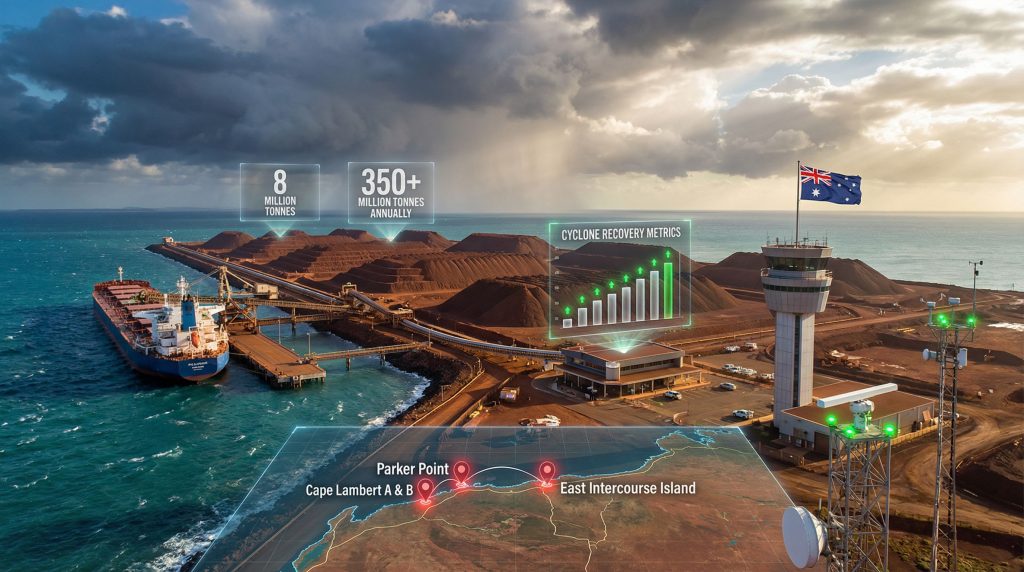
Rio Tinto iron ore operations after Tropical Cyclone Narelle experienced significant disruptions beginning March 24, 2026, as the cyclone approached Western Australia's coast. The company's East Intercourse Island, Parker Point, and Cape Lambert B facilities resumed ship loading operations on March 28, representing a four-day operational suspension. Cape Lambert A required extended repairs, with the company indicating shipping would recommence following damage assessment and infrastructure restoration.
Table: Cyclone Season Risk Factors for Pilbara Operations
| Risk Factor | Operational Impact | Infrastructure Effect |
|---|---|---|
| High Wind Speeds | Ship loading suspension | Equipment securing protocols |
| Storm Surge | Terminal flooding risk | Wharf structural assessment |
| Heavy Rainfall | Transport route disruption | Drainage system capacity |
| Extended Duration | Multi-day closures | Inventory management challenges |
The geographic concentration of iron ore export facilities creates systematic vulnerability where regional weather events can simultaneously impact multiple terminals. In addition, australian industry leadership depends heavily on the resilience of these critical infrastructure networks. This concentration effect amplifies the global supply chain significance of localised weather disruptions in Western Australia.
Production Impact Assessment: Quantifying Weather-Related Losses
The combined effect of Tropical Cyclone Narelle in March and Tropical Cyclone Mitchell in February 2026 resulted in approximately 8 million tonnes of iron ore shipment disruptions across Rio Tinto's operations. This figure represents the cumulative impact of port closures, transport interruptions, and operational delays spanning multiple weather events during the 2026 cyclone season.
Rio Tinto identified recovery pathways for approximately half of these production losses, indicating that 4 million tonnes could potentially be recovered through operational optimisation and flexible scheduling arrangements. The remaining 4 million tonnes represents net production impact that cannot be fully compensated within existing operational parameters.
Recovery Mechanism Analysis:
• Production acceleration at undamaged facilities during favourable weather periods
• Extended operating schedules to maximise output during stable conditions
• Deferred maintenance optimisation to prioritise production recovery
• Customer delivery coordination to manage shipping schedule adjustments
The company's ability to identify specific recovery volumes demonstrates sophisticated production modelling capabilities that factor weather disruption impacts into operational planning frameworks. However, iron ore demand insights indicate that market pressures continue to intensify despite these operational challenges.
Strategic Resilience: Maintaining Annual Production Targets
Despite the 8 million tonne combined impact from two significant cyclone events, Rio Tinto maintained its 2026 Pilbara iron ore shipment guidance unchanged at 323 to 338 million tonnes. This guidance stability indicates built-in operational flexibility and risk management protocols that accommodate weather-related production variations.
The maintenance of annual targets following substantial short-term disruptions suggests several strategic operational capabilities:
Production Buffer Management:
• Seasonal capacity optimisation during favourable weather periods
• Inventory management across multiple terminal locations
• Flexible workforce deployment to maximise recovery periods
• Enhanced equipment utilisation during stable operating conditions
Customer Relationship Strategies:
• Contractual flexibility provisions for weather-related delays
• Alternative delivery scheduling coordination
• Force majeure notification and management protocols
• Long-term supply agreement adaptations
The ability to absorb 2.4-2.5% production impact (8 million tonnes against 323-338 million tonne guidance) while maintaining full-year targets demonstrates sophisticated contingency planning integrated into annual production forecasting.
What Technologies Enable Effective Weather Risk Management?
Modern iron ore operations employ advanced forecasting and monitoring systems to optimise pre-cyclone preparations and post-event recovery protocols. The integration of meteorological data with operational decision-making enables proactive risk mitigation strategies.
Operational Technology Applications:
• Real-time weather monitoring integrated with production scheduling
• Automated equipment securing systems activated by wind speed thresholds
• Remote monitoring capabilities for infrastructure damage assessment
• Predictive maintenance scheduling around anticipated weather events
The four-day closure period at three Rio Tinto terminals during Cyclone Narelle reflects standardised protocols that balance safety requirements with operational continuity objectives. Consequently, these protocols enable rapid restart capabilities once weather conditions permit safe operations.
Global Supply Chain Implications and Market Dynamics
The Pilbara region's role in global iron ore supply creates market sensitivity to weather-related production disruptions. While 8 million tonnes represents a significant volume in absolute terms, the global iron ore market's scale and inventory management systems typically absorb short-term supply variations.
Market Response Mechanisms:
• Alternative supplier activation in Brazil and other regions
• Customer inventory buffer utilisation during supply interruptions
• Spot market adjustments reflecting temporary supply constraints
• Long-term contract flexibility provisions managing delivery timing
The maintenance of Rio Tinto's annual guidance provides market stability signals that help prevent excessive price volatility during cyclone season disruptions. For instance, top iron ore mines overview analysis demonstrates how diversified operations across multiple facilities enhance system resilience.
Infrastructure Investment and Climate Adaptation
Mining companies operating in cyclone-prone regions implement ongoing infrastructure hardening programmes designed to minimise weather-related operational impacts. These investments focus on both protective measures and recovery capability enhancement.
Adaptation Strategy Components:
• Enhanced structural design standards for port facilities
• Redundant systems installation across multiple terminals
• Advanced damage assessment and repair capability development
• Supply chain diversification to reduce concentration risk
The differential recovery timing between Rio Tinto's port terminals during Cyclone Narelle—with three facilities resuming operations within four days while Cape Lambert A required extended repairs—illustrates how infrastructure resilience varies across individual facilities within integrated networks. Additionally, recent developments in resumed haulage operations highlight the importance of maintaining flexible transport capabilities.
How Do Investment Strategies Account for Weather Risk?
For investors analysing mining operations in tropical cyclone regions, weather risk represents a permanent operational variable rather than exceptional circumstance. Companies demonstrating consistent guidance maintenance despite weather disruptions indicate sophisticated risk management capabilities.
Key Investment Considerations:
• Historical guidance accuracy during cyclone seasons
• Infrastructure investment priorities and resilience improvements
• Recovery capability demonstration following weather events
• Customer relationship stability during supply disruptions
Rio Tinto iron ore operations after Tropical Cyclone Narelle maintenance of 323-338 million tonne guidance following the March 2026 cyclone events provides evidence of operational resilience that factors weather risk into business planning frameworks.
The next major ASX story will hit our subscribers first
Risk Assessment Framework for Mining Operations
The March 2026 Tropical Cyclone Narelle event demonstrates how established mining operations manage weather-related disruptions through integrated risk management approaches. The ability to quantify impact, identify recovery pathways, and maintain annual guidance reflects mature operational frameworks.
Operational Risk Management Elements:
• Multi-terminal geographic distribution to reduce concentration risk
• Flexible production scheduling accommodating weather variability
• Customer contract provisions managing delivery timing flexibility
• Infrastructure hardening programmes reducing damage susceptibility
The integration of these risk management elements enables large-scale mining operations to maintain operational continuity and financial guidance stability despite significant short-term weather disruptions. According to recent reports on Rio Tinto's resilience, the company's ability to quickly resume operations demonstrates industry-leading recovery protocols.
Understanding weather risk management capabilities provides insight into operational maturity and long-term value creation potential within Australia's iron ore sector. However, challenges remain as detailed analysis shows that each cyclone season tests the limits of even the most sophisticated risk management systems.
Companies demonstrating consistent performance through cyclone season challenges indicate robust business models adapted to regional environmental realities. Rio Tinto iron ore operations after Tropical Cyclone Narelle exemplify how integrated risk management approaches enable mining enterprises to maintain operational effectiveness despite recurring weather-related disruptions.
The lessons learned from the March 2026 cyclone events continue to inform infrastructure development priorities and operational protocols across Australia's iron ore sector. This adaptive approach ensures that mining operations remain resilient against future weather challenges while maintaining their critical role in global steel production supply chains.
Looking for Opportunities in Weather-Resilient Mining Companies?
Discovery Alert's proprietary Discovery IQ model delivers real-time alerts on significant mineral discoveries across the ASX, helping investors identify companies with robust operational frameworks like those demonstrated during cyclone season disruptions. Begin your 14-day free trial today to gain immediate access to actionable mining investment opportunities that could provide substantial returns during market volatility.