July 10, 2026
Understanding Closed-Loop Water Systems
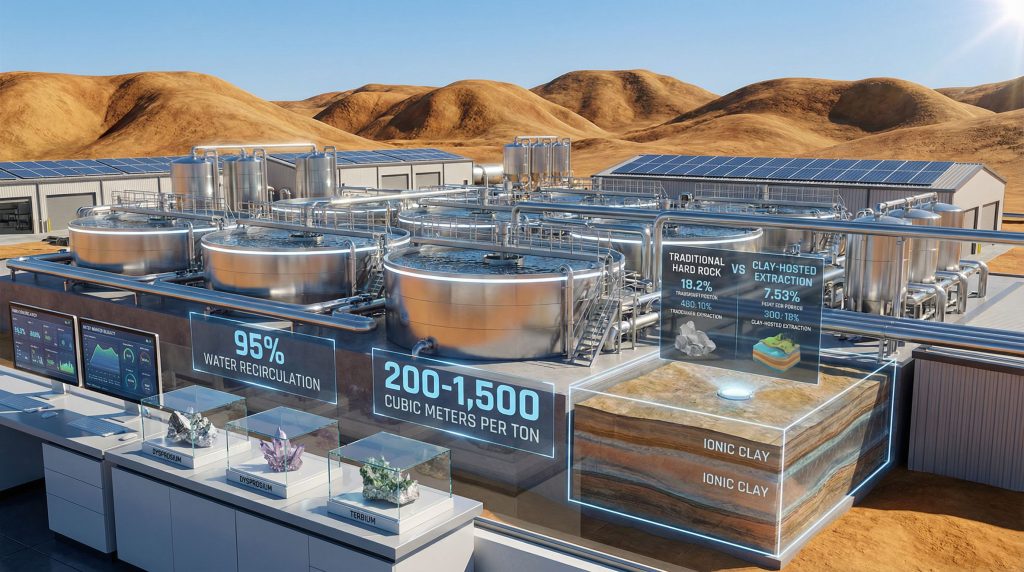
Modern mining operations face increasing pressure to minimise environmental impact while maintaining economic viability. Traditional rare earth extraction methods consume massive quantities of freshwater, often requiring 200-1,500 cubic metres per ton of rare earth oxides produced. This consumption rate creates significant challenges in water-scarce regions and jurisdictions with stringent environmental regulations.
Closed-loop water systems represent a fundamental shift from linear consumption models toward circular resource management. These systems treat water as a recoverable capital asset rather than a consumable input, implementing sophisticated multi-stage filtration and recirculation infrastructure to maintain water quality whilst minimising fresh water requirements.
The Aclara circular water system in rare earth mining demonstrates this technological evolution. At the Penco project in Chile's Biobío Region, 95% water recirculation eliminates conventional liquid industrial waste discharge whilst maintaining operational efficiency. This approach integrates real-time monitoring systems that continuously measure pH, conductivity, and dissolved solids to detect degradation before it impacts process performance.
Key technological components enable this circular approach:
• Advanced filtration systems removing suspended solids and chemical impurities
• Automated recirculation infrastructure with pump systems and flow control mechanisms
• Chemical dosing systems maintaining optimal pH and precipitation rates
• Continuous monitoring equipment tracking water quality parameters in real-time
When big ASX news breaks, our subscribers know first
The Environmental Challenge of Traditional Extraction
Conventional rare earth mining generates substantial environmental liabilities through acid mine drainage and excessive water consumption. When sulfide minerals undergo oxidation during extraction, they release hydrogen ions and dissolved metals, creating acidic runoff with pH levels between 2-4. This process mobilises radioactive elements like thorium and uranium commonly associated with rare earth deposits.
Water treatment in traditional operations requires continuous pH adjustment and chemical precipitation, generating secondary waste streams that compound environmental management challenges. The cumulative impact includes groundwater contamination risks, aquatic ecosystem disruption, and long-term remediation obligations that can extend decades beyond mine closure.
Mining operations globally account for approximately 7-10% of freshwater withdrawals, with rare earth extraction representing one of the most water-intensive subsectors. This consumption pattern creates resource competition with local communities, agricultural users, and other industrial operations, particularly in arid and semi-arid regions where many rare earth deposits are located.
The Mountain Pass Mine in California exemplifies these challenges, having required significant remediation investments for acid mine drainage management. Similarly, Lynas Rare Earths implemented water management improvements at their Malaysian operations following regulatory scrutiny regarding wastewater discharge practices. Consequently, comprehensive waste management solutions have become essential for modern mining operations seeking regulatory compliance and social acceptance.
Strategic Importance of Heavy Rare Earths
Heavy rare earths, particularly dysprosium and terbium, occupy critical positions in global supply chains due to their irreplaceable properties in high-performance applications. Global dysprosium demand reaches approximately 800-900 tonnes annually, whilst terbium production remains constrained at just 50-60 tonnes per year, making it one of the rarest commercially significant rare earth elements.
The Aclara Penco project targets 50 tonnes annually of these strategic heavy rare earths over a 14-year mine life beginning in 2028. This production represents a significant portion of global supply, particularly outside Chinese refining networks that currently control 80-85% of global processing capacity.
Critical Applications Driving Demand
Electric vehicle manufacturing creates substantial demand for dysprosium and terbium in permanent magnet motors. Modern EV drives require 200-500 grams of combined dysprosium and terbium per vehicle to achieve the magnetic performance necessary for efficient operation at elevated temperatures. With global EV production targeting 5 million units annually, automotive applications alone generate demand for 1,000-2,500 tonnes of these critical elements.
Wind energy infrastructure represents another major consumption sector. Modern 10-15 MW offshore turbines utilise 4-6 tonnes of permanent magnets containing 2-3% dysprosium and 1-2% terbium. Current offshore wind installation rates create annual demand for 300-500 tonnes of dysprosium from renewable energy applications.
Defence applications specify guaranteed dysprosium and terbium content for radar systems, hypersonic weapon guidance, and submarine detection equipment. These applications tolerate no substitution, creating inelastic demand that drives strategic supply security concerns.
| Application Sector | Dysprosium Content | Annual Demand (tonnes) | Substitution Feasibility |
|---|---|---|---|
| Electric Vehicles | 200-500g per vehicle | 1,000-2,500 | Limited |
| Wind Turbines | 2-3% of magnet weight | 300-500 | Minimal |
| Defence Systems | Specification-dependent | Classified | None |
Supply Chain Vulnerabilities and Concentration Risks
The rare earth supply chain exhibits characteristics of monopolistic bottleneck markets through concentrated processing capacity and high technical barriers to entry. China refines 80-85% of global rare earth oxides, creating strategic vulnerability for consuming nations dependent on these materials for defence and clean energy applications.
Processing bottlenecks outside Asia limit supply diversification options. Only 2-3 operational facilities with significant heavy rare earth recovery capacity exist outside Chinese control, including Lynas operations in Malaysia and REE facilities in Estonia. This concentration creates pricing volatility and supply disruption risks, as demonstrated by China's 2010 export quota reductions that decreased availability by 40%.
Technical Processing Challenges
Separating heavy rare earths from light rare earths requires liquid-liquid extraction cascades with hundreds of equilibrium stages. This hydrometallurgical complexity demands significant technical expertise and chemical management infrastructure, creating natural barriers to rapid capacity expansion.
Converting rare earth oxides to high-purity individual carbonates or chlorides involves multi-stage selective precipitation and crystallisation processes. These operations require continuous environmental compliance management, particularly regarding uranium and thorium radioactive material handling and wastewater treatment.
Recent developments include new processing facilities coming online, such as REE One in Estonia targeting European market supply and ongoing Mountain Pass processing restoration in the United States. However, these additions represent incremental capacity increases rather than fundamental supply chain restructuring. Furthermore, circular mineral harvesting approaches are being developed to address both processing challenges and environmental concerns.
Clay-Hosted Extraction Technology Advantages
Clay-hosted rare earth deposits enable fundamentally different extraction methodologies compared to conventional hard-rock mining. The Aclara circular water system in rare earth mining leverages ionic clay deposits where rare earth cations are weakly adsorbed within clay lattice structures, allowing selective leaching without mechanical liberation.
Operational Efficiency Improvements
Traditional hard-rock operations require multi-stage crushing and grinding consuming 30-50% of total operational energy. Clay-hosted extraction eliminates these comminution phases, reducing energy consumption from 50-100 kWh/ton to 20-30 kWh/ton. This efficiency gain directly contributes to operational cost reduction and carbon footprint minimisation.
The Penco project's US$130 million capital expenditure suggests 60-75% cost reduction compared to hard-rock operations typically requiring US$500 million to US$2 billion depending on scale and ore grade. This capital efficiency enables project financing and development in smaller deposit sizes that would be uneconomical using conventional methods.
Tailings volume reduction represents another significant advantage. Hard-rock mining produces waste rock representing 95-99% of material processed, creating long-term storage and environmental liabilities. Clay-hosted extraction generates minimal solid waste, with residual clay largely unchanged geochemically after rare earth removal.
Technical Process Characteristics
Ionic adsorption mechanisms in clay deposits enable selective rare earth recovery using dilute NH₄⁺ or H⁺ solutions at pH 3-5. This approach displaces rare earth ions into solution without disrupting clay crystal structure, maintaining deposit stability whilst recovering valuable elements.
Southern China's Jiangxi Province clay deposits demonstrate established technical feasibility, producing 20,000-25,000 tonnes rare earth oxides annually through ion adsorption techniques. These operations provide technological precedent for similar geological formations globally, including Chile's Biobío Region deposits targeted by Aclara. Consequently, comprehensive mining industry innovation continues to drive improvements in extraction efficiency and environmental performance.
Water Recirculation Engineering Systems
The Aclara circular water system in rare earth mining implements proprietary technology achieving 95% water recirculation whilst maintaining process efficiency. This system eliminates conventional liquid industrial waste discharge through integrated filtration, monitoring, and chemical recovery components.
Advanced Filtration Infrastructure
Multi-stage filtration removes suspended solids and chemical impurities to maintain water quality within operational thresholds. Primary filtration targets larger particles and precipitates, whilst secondary stages address dissolved metals and chemical compounds that accumulate during recirculation cycles.
Automated chemical dosing maintains pH balance and precipitation rates within narrow operational windows. These systems respond to real-time water quality data, adjusting reagent additions to optimise rare earth recovery whilst minimising chemical consumption and waste generation.
Fertiliser-based reagent recovery achieves 99% recirculation of extraction chemicals, further reducing environmental impact and operational costs. This closed-loop approach treats reagents as recoverable assets rather than consumable inputs, aligning with circular economy principles.
Monitoring and Control Systems
Continuous water quality monitoring measures conductivity, pH, dissolved solids, and specific ion concentrations throughout the recirculation system. These measurements enable predictive maintenance and process optimisation whilst ensuring regulatory compliance with discharge standards.
Real-time data integration allows automated adjustment of flow rates, chemical dosing, and filtration parameters. This responsiveness maintains optimal extraction efficiency whilst preventing system degradation that could compromise water quality or process performance.
Integration with renewable energy integration powers monitoring and recirculation infrastructure, reducing operational carbon footprint and energy costs. Solar and wind power availability in Chile's Biobío Region supports sustainable operation throughout the project's 14-year mine life.
The next major ASX story will hit our subscribers first
Regulatory and Permitting Strategy
Environmental compliance in OECD jurisdictions increasingly emphasises water stewardship and waste minimisation as core permitting requirements. The Aclara approach of relinquishing natural water rights demonstrates proactive environmental management that addresses community concerns before they become regulatory obstacles.
Social License Considerations
Water resource competition between mining operations and local communities creates social licence challenges that can delay or prevent project approval. By eliminating freshwater consumption, circular water systems remove this source of community opposition whilst demonstrating environmental responsibility.
The Penco project faces ongoing legal challenges from environmental groups and local communities despite its sustainable design. However, final approval from Chile's Environmental Evaluation Service remains expected by Q1 2026, suggesting regulatory acceptance of the circular water approach.
Pre-emptive environmental compliance reduces long-term operational risks and regulatory uncertainty. Projects implementing advanced sustainability measures often experience expedited permitting and reduced compliance monitoring requirements throughout operational phases. Additionally, implementing comprehensive mine reclamation innovation strategies strengthens community acceptance and regulatory approval prospects.
International Standards Alignment
ESG investment criteria increasingly emphasise water management and circular economy principles in mining project evaluation. The Aclara circular water system aligns with international sustainability frameworks, potentially improving access to development capital and reducing financing costs.
Carbon footprint reduction through renewable energy integration and elimination of energy-intensive processing supports national climate commitments and international agreements. These alignments strengthen political support for project approval and operation.
Economic Implications and Cost Analysis
Water-free operations eliminate ongoing freshwater procurement costs whilst reducing regulatory compliance expenses associated with wastewater treatment and discharge monitoring. The Aclara model demonstrates how environmental innovation can create operational cost advantages rather than additional expenses.
Capital Investment Requirements
Initial infrastructure investment for circular water systems includes advanced filtration equipment, monitoring technology, and automated control systems. The US$130 million Penco project budget incorporates these technologies whilst maintaining capital efficiency compared to conventional alternatives.
Long-term operational cost reduction through water and reagent recirculation offsets higher initial capital requirements. Elimination of freshwater purchase, wastewater treatment, and disposal costs creates ongoing savings throughout the mine life.
Market Positioning Advantages
Sustainable rare earth production commands premium pricing in markets emphasising supply chain responsibility. European and North American manufacturers increasingly specify sustainably produced materials to meet corporate ESG commitments and regulatory requirements.
The strategic importance of dysprosium and terbium combined with sustainable production methods positions Penco output as premium supply for defence and clean energy applications. This market positioning supports higher realised prices compared to conventional production sources. Furthermore, sustainable production initiatives across the mining sector demonstrate growing investor and consumer demand for environmentally responsible resource extraction.
Technology Scalability and Industry Adoption
The applicability of circular water systems extends beyond single projects to broader industry transformation. Clay-hosted deposits exist in multiple global locations, including Vietnam, Madagascar, and parts of South America, creating scaling opportunities for proven technologies.
Geographic Expansion Potential
Similar geological formations in other jurisdictions could benefit from technology transfer and adaptation. However, local regulatory environments, community relationships, and infrastructure availability affect deployment feasibility and timeline.
Retrofit applications for existing conventional mines present additional scaling opportunities. While full circular water implementation may require significant capital investment, partial recirculation improvements can reduce environmental impact and operational costs incrementally.
Integration with Alternative Technologies
Biomining and biotechnology approaches complement circular water systems by further reducing chemical reagent requirements. Research into bacterial leaching and virus-based extraction methods could enhance sustainability whilst maintaining economic viability.
Rare earth recycling integration creates synergistic opportunities for circular water systems. End-of-life magnet processing and urban mining operations could utilise similar water management technologies, creating integrated circular economy networks.
Performance Limitations and Technical Challenges
System performance variables affect long-term viability and operational efficiency. Water quality degradation over extended recirculation cycles requires ongoing monitoring and periodic system maintenance to prevent efficiency losses.
Scalability Constraints
Production volume limitations may restrict applicability to larger-scale operations requiring higher throughput rates. The 50 tonnes annually target at Penco represents moderate scale suitable for circular water management, but scaling to industrial-scale production may present technical challenges.
Geographic and climate considerations affect system performance and reliability. Water evaporation, temperature variations, and seasonal changes influence recirculation efficiency and require adaptive management strategies.
Equipment reliability factors include pumps, filtration systems, and monitoring technology requiring regular maintenance and eventual replacement. System redundancy and backup capacity planning ensure operational continuity during maintenance periods.
Chemical Recovery Efficiency
99% reagent recirculation represents near-theoretical efficiency limits, suggesting minimal room for further improvement. Achieving and maintaining this performance level requires precise process control and high-quality equipment throughout the system lifecycle.
Reagent degradation over time may reduce recovery efficiency and require periodic chemical replacement. Understanding degradation mechanisms and optimisation of chemical selection supports long-term system performance.
Competitive Technology Comparison
Alternative sustainable mining technologies offer different approaches to environmental impact reduction. Biomining using bacterial leaching processes reduces chemical reagent requirements whilst potentially extending extraction to lower-grade deposits.
Biotechnology Approaches
Virus-based extraction methods under development could revolutionise rare earth recovery through biological mechanisms. These approaches remain largely experimental but offer potential for further environmental impact reduction and energy efficiency improvements.
Bacterial leaching processes demonstrate commercial viability in copper and other metal recovery applications. Adaptation to rare earth extraction could complement circular water systems by reducing chemical inputs and improving selectivity.
Recycling and Urban Mining
End-of-life magnet processing provides alternative rare earth supply sources that complement primary mining operations. Recycling efficiency improvements and collection network expansion could reduce pressure on primary supply sources.
Urban mining potential includes electronic waste, automotive components, and industrial equipment containing recoverable rare earth elements. Integration with circular water technologies could create comprehensive rare earth recovery networks. Moreover, mining technology continues to advance in both primary extraction and recycling applications.
Future Supply Security Implications
The Aclara circular water system in rare earth mining contributes to Western hemisphere supply diversification whilst demonstrating sustainable production methods. This dual contribution addresses both strategic supply security and environmental responsibility requirements.
Geopolitical Supply Diversification
Reduced dependency on Asian processing networks supports supply security for defence and clean energy applications. However, global processing capacity expansion remains necessary to achieve meaningful diversification from current Chinese dominance.
Strategic reserve implications include potential for government support and procurement preferences for sustainably produced materials. National security considerations may drive policy support for domestic and allied nation production capacity.
Technology Transfer and Industry Evolution
Intellectual property considerations affect technology transfer and global adoption rates. Proprietary technologies require licensing arrangements that balance innovation rewards with industry-wide sustainability improvements.
Regulatory framework development supporting circular water systems could accelerate adoption through permitting advantages and compliance streamlining. International coordination on sustainability standards supports technology deployment across jurisdictions.
Global adoption timeline projections suggest gradual implementation over the next decade as proven technologies demonstrate commercial viability and regulatory acceptance. Early adopters like Aclara establish precedents that influence industry standards and best practices.
Frequently Asked Questions
How much water does traditional rare earth mining consume?
Traditional rare earth extraction typically requires 200-1,500 cubic metres of water per ton of rare earth oxides produced. In contrast, the Aclara circular water system achieves 95% water recirculation, dramatically reducing freshwater consumption whilst eliminating liquid industrial waste discharge.
What makes dysprosium and terbium strategically important?
These heavy rare earths are essential for high-performance permanent magnets used in electric vehicles, wind turbines, and advanced defence systems. Dysprosium and terbium have no direct substitutes for high-temperature magnetic applications, making them critical for clean energy transition and national security technologies.
Can circular water technology be applied to existing mines?
While primarily designed for clay-hosted deposits like Penco, circular water principles can potentially be adapted for conventional operations. However, retrofit costs, geological constraints, and existing infrastructure significantly influence implementation feasibility and economic viability.
What are the main advantages of clay-hosted extraction?
Clay-hosted extraction eliminates energy-intensive crushing and grinding operations, reduces capital expenditure by 60-75% compared to hard-rock mining, and generates minimal tailings waste. The process enables selective rare earth recovery using dilute chemical solutions without disrupting host rock structure.
How does the Penco project contribute to supply security?
The project will produce 50 tonnes annually of strategic heavy rare earths over 14 years, contributing to Western hemisphere supply diversification. Combined with sustainable production methods, this output supports both environmental responsibility and reduced dependency on concentrated Asian processing networks.
Investment Disclaimer: This article is for informational purposes only and does not constitute investment advice. Rare earth mining investments carry significant risks including commodity price volatility, regulatory uncertainty, and technological challenges. Potential investors should conduct independent research and consult qualified financial advisors before making investment decisions. Past performance does not guarantee future results, and all mining projects face development and operational risks that could result in total loss of investment.
Looking to Capitalise on Mining's Technological Evolution?
Discovery Alert's proprietary Discovery IQ model provides instant notifications on significant ASX mineral discoveries, empowering investors to identify companies pioneering sustainable extraction technologies like closed-loop water systems ahead of market recognition. Stay informed about breakthrough innovations in rare earth mining and other critical sectors by exploring Discovery Alert's discoveries page to see how major technological advances have historically generated substantial returns.