
June 11, 2026
When a Single Mine Becomes a Global Supply Bottleneck
The history of commodity markets teaches a consistent lesson: the most consequential supply disruptions rarely originate from the largest producers or the most geographically diversified operations. Instead, they tend to emerge from concentrated nodes within the supply chain where production scale, geological endowment, and ownership structures intersect to create outsized vulnerability. The June 2026 CMOC Tenke Fungurume strike illustrates this dynamic with striking clarity.
When workers at Tenke Fungurume Mining (TFM) walked off the job on June 1, 2026, they were not simply engaging in a localised labour dispute. They were pulling a thread that runs through the entire global copper supply chain, from DRC smelters to electric vehicle factories in Germany and battery gigafactories in the United States. Understanding why requires examining not just the specific grievances involved, but the broader structural conditions that have made a single copper mine in Lualaba Province one of the most consequential industrial operations on earth.
When big ASX news breaks, our subscribers know first
The Geological Foundation Behind TFM's Strategic Importance
Why the Central African Copper Belt Produces Some of the World's Richest Ore
The Tenke Fungurume deposit sits within the Central African Copper Belt, a geological formation spanning southern DRC and northern Zambia that represents one of the most mineralogically significant sediment-hosted copper systems on the planet. What separates this region from other major copper-producing territories is ore grade. TFM's ore body averages approximately 2.5% copper content, compared to a global mining industry average of roughly 0.6%. This differential is not marginal — it is transformative in economic and operational terms.
Higher ore grades translate directly into lower processing costs per tonne of metal produced. At TFM's scale, processing more than 100 million tonnes of ore annually through solvent extraction and electrowinning (SX-EW) circuits, the grade advantage compounds into operating cost structures that are estimated to sit approximately 30% below the global industry average. This explains why CMOC and its predecessor investors have deployed billions of dollars in remote, politically complex terrain: the geological economics are simply too compelling to ignore.
The mine also hosts significant cobalt mineralisation within the same ore body, a consequence of the region's sedimentary geology. Unlike operations where cobalt is an incidental trace element, TFM's cobalt content is substantial enough to warrant dedicated recovery circuits. The economic implications of this dual-metal structure are significant: disruptions at TFM do not affect a single commodity market but simultaneously stress both the copper supply chain and the cobalt market that underpins lithium-ion battery cathode chemistry.
The Processing Infrastructure Complexity
TFM's metallurgical plant includes specialised processing circuits for cobalt recovery that operate in parallel with copper SX-EW facilities. This creates operational interdependencies that are not always visible in headline production figures. A work stoppage affecting one part of the processing chain can cascade through both copper and cobalt recovery, meaning that even a brief disruption carries dual-market exposure. This technical reality amplifies the strategic significance of labour stability at the operation in ways that straightforward copper tonnage comparisons do not fully capture.
CMOC's DRC Footprint and the Concentration of Critical Mineral Supply
Production at a Scale That Commands Market Attention
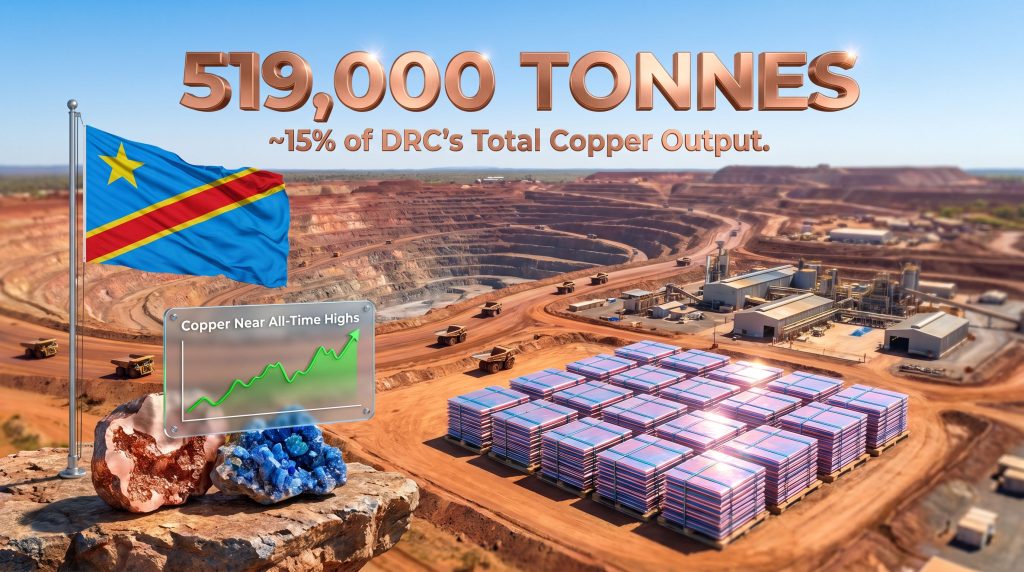
The numbers underpinning CMOC's position in the DRC are extraordinary by any measure. TFM produced approximately 519,000 tonnes of copper in 2024, a figure confirmed by company reporting and representing roughly 15% of the DRC's total annual copper output, according to MiningMX. When combined with CMOC's second Congolese operation at Kisanfu, the company extracted nearly 750,000 tonnes of copper from the DRC in 2024 — a concentration of production under a single corporate operator that has few parallels in global mining.
The DRC itself has undergone a remarkable transformation over the past decade, ascending to become the world's second-largest copper-producing nation, a position achieved almost entirely through large-scale Chinese capital deployment in copper and cobalt assets. The DRC mineral wealth underpinning this transformation has been realised so rapidly that governance frameworks — both at the corporate and national level — have struggled to keep pace with operational scale.
The copper market context surrounding the June 2026 strike matters enormously for understanding why this labour dispute attracted global attention. Copper has been trading near record highs, supported by structural demand drivers across multiple industries simultaneously: electric vehicle manufacturing requiring approximately 80 to 90 kilograms of copper per vehicle, utility-scale renewable energy infrastructure, grid modernisation programmes, and the growing energy demands of AI data centre buildouts. When the global copper supply forecast already signals tightening conditions, even a 72-hour work stoppage at an operation producing 15% of a major producing nation's output generates disproportionate market attention.
The market reacts to perceived supply reliability, not merely to actual tonnes lost. At current copper prices, even short-duration disruptions at operations of TFM's scale function as stress tests for market confidence in the entire DRC supply chain.
The Cobalt Dimension: A Less Visible But Equally Critical Risk
TFM's role as one of the DRC's leading cobalt producers adds a layer of market sensitivity that copper-focused analysis tends to underweight. The global cobalt production market is structurally far more concentrated than copper, with total annual output of approximately 220,000 tonnes compared to copper's roughly 22 million tonnes. TFM's cobalt output represents a significant proportion of global supply, meaning that disruptions at the mine propagate through cobalt pricing with greater force than they do through the much larger copper market.
For battery manufacturers supplying electric vehicle platforms and consumer electronics supply chains, cobalt from TFM feeds into NMC (nickel manganese cobalt) cathode chemistry that remains the dominant formulation for high-performance battery applications. While cathode chemistry evolution is gradually reducing per-kWh cobalt intensity, the absolute volume demanded by a growing global EV fleet means that total cobalt demand continues to rise. Supply concentration at operations like TFM therefore represents a genuine strategic vulnerability for downstream industries, not merely a commodity trading consideration.
What the June 2026 Strike Actually Reveals About Labour Governance
The Procedural Exclusion Problem: More Than a Wage Dispute
The June 2026 CMOC Tenke Fungurume strike is frequently characterised as a dispute over pay and conditions. This framing, while not inaccurate, misses the deeper structural issue. Workers at TFM did not walk off the job primarily over the quantum of their wages. They walked off because they believed a collective bargaining agreement had been negotiated between management and a union delegation without meaningful consultation with the workforce it purported to represent.
This distinction matters enormously from both a labour relations and an investment risk perspective. Disputes over pay levels are, in principle, resolvable through negotiated financial adjustments. Disputes over process legitimacy are considerably harder to resolve because they require rebuilding trust between parties that have fundamentally different views about who has the right to speak for workers. The specific demands cited — housing allowances and improved healthcare access — are materially significant in the context of a remote mine employing a large workforce far from urban centres, but they function as proxies for a deeper grievance about whether workers have genuine agency in determining their own working conditions.
| Strike Dimension | Confirmed Detail |
|---|---|
| Action commencement | June 1, 2026 |
| Core grievance | Exclusion from CBA negotiation process |
| Secondary demands | Housing allowance, improved healthcare |
| TFM classification | Declared illegal by management |
| Return-to-work deadline | Night of June 3, 2026 |
| Non-striker bonus | USD $500 loyalty payment |
| Bonus for intimidated non-strikers | USD $1,000 |
| Strike outcome | Ended, normal operations resumed |
| Production impact characterisation | Small (per CMOC) |
How Union Representation Structures Create Grassroots Disconnects
In large-scale mining operations across Central Africa, formal union representation structures can create a paradox: legally recognised bargaining agents may negotiate agreements that the broader workforce views as illegitimate. Union delegates, particularly in operations employing tens of thousands of workers across multiple shifts and processing circuits, can become institutionally distanced from the rank and file they represent.
When workers perceive that agreements have been reached without adequate mandate, the result is typically spontaneous industrial action that bypasses formal dispute resolution channels entirely. This is precisely the pattern the CMOC Tenke Fungurume strike followed. The action was not coordinated through union leadership — it emerged organically from a workforce that felt its representatives had negotiated on their behalf without their genuine input.
This structural tension between formal union processes and grassroots worker sentiment is a recurring fault line in DRC mining labour relations, and it will not be resolved by simply improving CBA outcomes. It requires mining operators to invest in genuine workforce consultation mechanisms that extend beyond representative delegates to include direct engagement with the broader workforce during bargaining processes.
Furthermore, the International Labour Organization's Convention No. 98 on the Right to Organise and Collective Bargaining establishes that workers must have genuine representation in bargaining processes. When that principle is honoured in form but not in substance, the conditions for unofficial industrial action are created regardless of whether domestic law technically classifies the resulting strike as illegal.
CMOC's Response Strategy: Effectiveness and Unintended Consequences
Three Simultaneous Response Tracks
TFM's management response to the CMOC Tenke Fungurume strike operated across three simultaneous tracks, as reported by Mining.com and confirmed by MiningMX:
-
Disciplinary escalation — Workers who had not returned to their posts by the June 3 deadline were warned of immediate dismissal proceedings, with management characterising the action as an illegal work stoppage.
-
Financial incentivisation — Non-striking workers received a $500 loyalty bonus as recognition of continued service. Workers who reportedly faced intimidation or physical coercion for refusing to join the strike were offered $1,000, with TFM publicly acknowledging their continued commitment.
-
Internal investigation — TFM announced a formal inquiry into alleged acts of aggression against non-striking colleagues and reported equipment damage, with findings to be referred to Congolese legal authorities.
This three-pronged approach succeeded in its immediate objective: the strike ended and normal operations resumed. However, each element carries longer-term complications that merit analytical attention.
The Dismissal Threat: Legal Complexity in DRC Labour Law
The use of dismissal threats in response to wildcat strikes is legally complex under DRC labour frameworks. While TFM characterised the action as illegal, the legal validity of such threats depends on whether proper procedural steps — including formal notice, union consultation, and conciliation mechanisms — were followed before the ultimatum was issued. The 48-hour window between strike commencement and the return-to-work deadline suggests that production continuity was prioritised over extended negotiation.
This does not necessarily mean TFM's response was unlawful. However, it does create a pattern of engagement that may complicate future labour relations. Workers who returned under threat of dismissal, but whose underlying grievances about CBA consultation remain unaddressed, are likely to remain a source of industrial tension. The resolution of the strike's immediate symptoms should not be conflated with resolution of the structural conditions that produced it.
The Differential Bonus Structure: Short-Term Tool With Long-Term Consequences
The decision to offer differential payments — $500 for non-strikers versus $1,000 for workers who resisted coercion — achieves its immediate objective of rewarding continued service while implicitly acknowledging that peer pressure and physical intimidation were present on the picket line during the dispute.
This acknowledgement carries significant legal implications. By formally recognising that some workers were subjected to coercion and compensating them at a premium, TFM has created a documentary record of the intimidation that occurred, strengthening its position in any subsequent legal proceedings related to the strike. However, differential bonus payments also create internal workforce stratification that can deepen divisions between labour factions in subsequent bargaining cycles. Workers who received higher payments may be perceived as informants or management allies by colleagues, creating social tensions that persist long after the immediate dispute has resolved.
The Chinese Investment Model and Its Labour Governance Implications
Operational Speed Versus Workforce Integration
China's investment in DRC copper and cobalt assets has undeniably transformed the country's extractive sector. The rapidity with which CMOC's combined DRC operations scaled to nearly 750,000 tonnes of annual copper production is a genuine industrial achievement that reflects both the quality of the geological assets and the efficiency of Chinese capital deployment in large-scale mining infrastructure.
However, the same operational speed that has driven production scale can create vulnerabilities in workforce governance. Rapid production ramp-ups place significant pressure on HR infrastructure, particularly around housing provision, healthcare access, and meaningful consultation mechanisms for a large, geographically dispersed workforce. The demands raised by TFM workers — housing allowances and healthcare improvements — are not unusual grievances in the context of remote-area mining operations globally. They reflect baseline expectations that, when consistently unmet, generate industrial action.
Comparing Labour Risk Profiles Across Major DRC Copper Operations
| Operation | Operator | 2024 Cu Output (est.) | Key Labour Risk Factors |
|---|---|---|---|
| Tenke Fungurume | CMOC | ~519,000 t | CBA exclusion, housing and healthcare demands |
| Kisanfu | CMOC | ~230,000 t (combined est.) | Linked operational risk via shared ownership |
| Kamoa-Kakula | Ivanhoe Mines / Zijin | ~600,000+ t | Community relations, rapid workforce scaling |
| Mutanda | Glencore | ~100,000+ t | Historically significant cobalt exposure |
Note: Production estimates are based on publicly available 2024 reporting and may vary from final audited figures.
The pattern of labour unrest at Chinese-operated African mining assets reflects a broader dynamic where management frameworks developed in different regulatory and cultural contexts can create friction with local workforce expectations around consultation, benefits, and community engagement. This is not unique to Chinese operators — similar tensions have historically emerged wherever rapid production scale has outpaced the development of robust labour relations infrastructure. Consequently, CMOC's scale in the DRC means that the consequences of such friction carry outsized market significance.
The next major ASX story will hit our subscribers first
Supply Chain Security and the Energy Transition: Why This Strike Matters Beyond the Mine Gate
The Structural Demand Case for Copper and Its Concentration Risk
The copper demand outlook through the 2030s is structurally compelling regardless of near-term economic volatility. Electric vehicle adoption curves, grid modernisation programmes, utility-scale renewable energy buildouts, and AI data centre power infrastructure all converge on copper as an irreplaceable conductor. The nexus between critical minerals and energy security means that with each EV requiring approximately 80 to 90 kilograms of copper, the market's sensitivity to supply-side concentration is entirely rational.
The CMOC Tenke Fungurume strike, despite its brief duration, functions as what might be described as a supply chain stress test: a real-world demonstration of how quickly labour governance failures at a single operation can create market nervousness about the reliability of the DRC's copper supply. The fact that the strike was resolved within 72 hours mitigated immediate market impact, but the underlying conditions that produced it remain unresolved.
Short-Term Versus Long-Term Market Risk Assessment
| Risk Category | Short-Term (0 to 3 months) | Long-Term (6 to 24 months) |
|---|---|---|
| Copper price impact | Minimal given swift resolution | Elevated if labour unrest recurs |
| Cobalt supply signal | Marginal immediate disruption | Heightened if CBA tensions persist |
| Investor sentiment on DRC assets | Temporary caution | Structural risk repricing possible |
| CMOC operational credibility | Largely contained | Dependent on CBA renegotiation outcome |
| ESG assessment of DRC investments | Incremental negative signal | Potential material risk reclassification |
The Investment Case for Supply Chain Diversification
Western governments and multilateral institutions have identified DRC supply concentration as a strategic vulnerability in critical minerals policy frameworks. The United States, European Union, and Australia have each published critical minerals strategies that reference the need to reduce dependence on single-country supply concentration points for copper and cobalt. In addition, the ongoing copper supply crunch reinforces the analytical case for these diversification objectives, even if the immediate market impact of the June 2026 strike was contained.
For institutional investors applying ESG frameworks to mining sector allocations, the TFM strike introduces several material considerations:
- Labour governance quality as an indicator of operational stability and social licence risk
- The adequacy of CBA consultation mechanisms as a predictor of industrial action frequency
- The relationship between workforce housing and healthcare standards, worker retention, and productivity
- The long-term sustainability of production profiles that rely on maintaining workforce goodwill in remote operating environments
Operations that deliver strong short-term production metrics while underinvesting in workforce governance infrastructure are accumulating a form of social licence debt that tends to express itself in precisely the pattern observed at TFM: spontaneous industrial action, differential bonus payments, and management-led investigations that address symptoms rather than causes.
Investor Consideration: Labour stability at DRC copper operations is increasingly a first-order supply chain risk for institutional portfolios with energy transition exposure. The TFM strike, while brief, provides a timely reminder that the governance quality of individual mining operations is a material factor in assessing the long-term reliability of critical mineral supply chains. Investors should treat such events as signals warranting deeper due diligence, not isolated operational footnotes.
Disclaimer: This article is intended for informational purposes only and does not constitute financial or investment advice. Commodity price forecasts, production estimates, and market analyses represent current assessments subject to material change. Readers should conduct their own research and consult appropriate professional advisors before making any investment decisions.
Frequently Asked Questions: CMOC Tenke Fungurume Strike
What caused the June 2026 strike at Tenke Fungurume?
Workers initiated industrial action on June 1, 2026, citing objections to a collective bargaining agreement they contended was negotiated between TFM management and a union delegation without meaningful rank-and-file participation. Secondary demands included housing allowance improvements and enhanced healthcare access.
How long did the Tenke Fungurume strike last?
The strike commenced on June 1, 2026, with TFM issuing a return-to-work deadline of June 3. CMOC subsequently confirmed that the strike had ended and normal operations had resumed, placing the duration at approximately 72 hours.
What bonuses did TFM offer during the strike?
TFM offered a $500 loyalty bonus to workers who did not participate in the industrial action. Workers who were reportedly subjected to intimidation or physical coercion for refusing to strike were offered $1,000, with TFM acknowledging their conduct during the dispute.
How significant is TFM's copper production globally?
TFM produced approximately 519,000 tonnes of copper in 2024, representing roughly 15% of the DRC's total annual copper output. Combined with CMOC's Kisanfu operation, the company extracted nearly 750,000 tonnes of copper from the DRC in 2024, placing CMOC among the world's top copper producers by volume.
Is TFM also a cobalt producer?
Yes. Tenke Fungurume is one of the DRC's major cobalt-producing operations. Disruptions at the mine carry direct implications for both copper and cobalt supply chains, with downstream relevance to battery manufacturing and the broader energy transition. For further context on this topic, the Tenke Fungurume Mine Wikipedia page provides a useful overview of the operation's history and mineral profile.
Why does labour unrest at a single DRC mine attract global market attention?
The DRC is the world's second-largest copper-producing nation, and TFM alone accounts for approximately 15% of that production. When copper is trading near record highs and structural demand is accelerating, even brief supply disruptions at operations of this scale generate market signalling effects that extend well beyond the actual tonnage affected.
For further coverage of DRC mining operations and global copper supply dynamics, MiningMX at miningmx.com provides ongoing reporting from the African mining sector.
Want to Track the Next Major Mineral Discovery Before the Market Moves?
When supply concentration risks at operations like Tenke Fungurume ripple through global copper and cobalt markets, early awareness is everything — Discovery Alert's proprietary Discovery IQ model delivers real-time alerts on significant ASX mineral discoveries, turning complex commodity data into actionable investment insights, so subscribers are positioned ahead of the broader market. Explore historic discoveries and their exceptional returns, then begin a 14-day free trial to secure a genuine market-leading edge.