June 12, 2026
Coal bed methane extraction represents a sophisticated engineering challenge that transforms coal formations into productive energy assets. Unlike conventional natural gas operations, CBM requires specialized techniques to release methane molecules adsorbed within coal's microporous structure. India's coal-rich regions, particularly the Gondwana formations, present substantial opportunities for unconventional gas development through advanced extraction methodologies. Furthermore, coal bed methane exploration in Singareni has emerged as a critical component of India's broader energy diversification strategy.
Understanding Coal Bed Methane: Technical Fundamentals and Resource Assessment
The extraction of methane from coal seams operates on fundamentally different principles compared to conventional gas production. Coal formations store methane through adsorption processes where gas molecules attach to internal coal surfaces rather than existing in free-flowing reservoirs. This critical distinction shapes every aspect of extraction methodology, from initial drilling approaches to long-term production management.
Modern data-driven mining operations have revolutionised how companies approach CBM extraction. However, the unique challenges of coal formations require specialised approaches that differ significantly from traditional mining methodologies.
What Makes Coal Seams Viable for Methane Production?
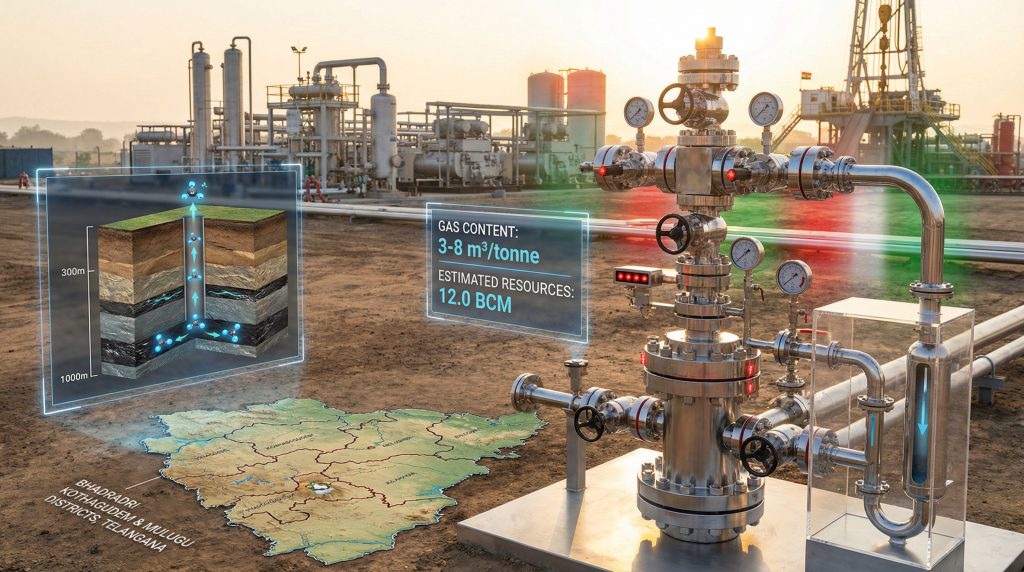
Successful CBM operations depend on specific geological conditions that determine commercial viability. Coal rank, permeability characteristics, and gas content form the foundation of resource assessment protocols. Gondwana coal formations in India typically contain 3-8 cubic metres of methane per tonne of coal, representing substantial energy potential when scaled across extensive coal seam networks.
The depth window of 300-1,000 metres provides optimal conditions balancing burial depth for gas generation with drilling accessibility. Deeper formations often contain higher gas concentrations but require more intensive extraction techniques. Conversely, shallower seams may lack sufficient pressure for sustained production rates.
Key geological requirements include:
- Permeability coefficients exceeding 1 millidarcy for sustainable flow rates
- Porosity ranges between 2-15% for adequate gas storage capacity
- Coal thickness of minimum 3 metres for commercial drilling targets
- Structural integrity with minimal fault disruption affecting gas migration
CBM vs Conventional Natural Gas: Key Technical Differences
The adsorption mechanism in coal bed methane extraction requires depressurisation strategies fundamentally different from conventional gas production. Coal seams initially contain significant water saturation that must be removed before sustained gas production begins. This dual-phase production characteristic creates unique operational challenges requiring specialised surface facilities and processing equipment.
Production curves for CBM wells demonstrate distinctive characteristics:
- Initial water production phase lasting 6-24 months depending on formation properties
- Gas breakthrough period with increasing gas-to-water ratios
- Peak gas production sustained for 5-15 years in optimal conditions
- Decline phase requiring enhanced recovery techniques or artificial lift systems
When big ASX news breaks, our subscribers know first
Regional Geological Assessment: Pranahita-Godavari Valley CBM Potential
The Pranahita-Godavari Valley contains some of India's most promising CBM resources within established Gondwana coal formations. Recent geological assessments have identified three major development blocks spanning multiple districts in Telangana. These blocks collectively represent 19 billion cubic metres of estimated methane resources, positioning coal bed methane exploration in Singareni as a transformative opportunity.
According to recent industry reports, the Singareni Collieries Company Limited (SCCL) is actively considering participation in upcoming CBM auctions. Furthermore, the Centre has urged SCCL to bid for CBM blocks in the Pranahita-Godavari valley.
Basin Characteristics and Formation Analysis
Gondwana formations in the Singareni region exhibit geological characteristics particularly favourable for CBM development. These Palaeozoic sedimentary sequences demonstrate consistent coal seam continuity across extensive areas, facilitating efficient drilling programs exploration and production optimisation.
Structural geology factors include:
- Fault density patterns affecting compartmentalisation and gas migration
- Dip angles typically ranging 5-25 degrees, suitable for horizontal drilling applications
- Coal seam thickness variations between 2-12 metres across different intervals
- Overburden characteristics providing adequate containment for gas retention
Resource Quantification Methodologies
Advanced assessment techniques have mapped CBM potential across the three identified development blocks using integrated geological and geophysical approaches. Volumetric calculations incorporate coal seam thickness, lateral extent, gas content measurements, and estimated recovery factors to establish resource estimates.
CBM Resource Distribution Table:
| Block Location | Districts Covered | Estimated Resources (BCM) | Resource Percentage |
|---|---|---|---|
| Northern Block | Mancherial, Peddapalli, Komaram Bheem | 5.0 | 26% |
| Central Block | Bhadradri Kothagudem | 2.0 | 11% |
| Southern Block | Bhadradri Kothagudem, Mulugu | 12.0 | 63% |
| Total Resources | Five Districts | 19.0 BCM | 100% |
The Southern Block's concentration of 12 billion cubic metres represents the most significant single resource accumulation. This concentration suggests structural controls and coal seam characteristics that enhance gas retention and production potential.
CBM Exploration and Development Workflow
Coal bed methane development follows a systematic progression through distinct operational phases, each requiring specialised techniques and equipment configurations. The workflow integrates geological assessment, pilot testing, and commercial development into a comprehensive framework optimised for Indian coal formation conditions.
Phase 1: Pre-Drilling Assessment
Initial exploration activities establish the geological foundation for CBM development through comprehensive data collection and analysis programmes. Seismic survey methodologies specifically designed for coal seam mapping utilise high-resolution techniques to identify seam continuity, structural features, and potential drilling targets.
Core sampling programmes provide direct measurement of gas content through standardised desorption testing protocols. Laboratory analysis determines gas composition, adsorption isotherms, and permeability characteristics essential for reservoir modelling and production forecasting.
Essential assessment components:
- 3D seismic acquisition with 25-metre station spacing for detailed structural mapping
- Stratigraphic drilling programmes targeting multiple coal intervals
- Hydrological studies characterising groundwater conditions and aquifer interactions
- Environmental baseline establishment including air quality, noise levels, and ecological surveys
Phase 2: Pilot Well Programmes
Pilot development validates commercial viability through controlled testing of extraction techniques and production optimisation. Drilling techniques optimised for coal formations employ specialised bit designs, mud systems, and casing programmes adapted to coal seam characteristics and associated rock formations.
Well completion design incorporates dual-phase production capabilities handling both water and gas throughout the production lifecycle. Artificial lift systems may be required during initial dewatering phases. Progressive cavity pumps or beam pump systems are commonly employed for sustained water removal.
Technical Insight: Pilot well programmes typically require 18-36 months to demonstrate commercial viability, with initial water production rates of 50-200 barrels per day gradually declining as gas production increases to target rates of 1,000-10,000 cubic metres daily.
Phase 3: Field Development Operations
Commercial development scales successful pilot techniques across identified resource areas through systematic drilling and infrastructure programmes. Well spacing optimisation balances reservoir drainage efficiency with capital investment requirements, typically employing 40-80 acre spacing patterns adapted to local geological conditions.
Surface facility design accommodates variable gas compositions and water production rates through modular processing systems. Water treatment requirements address produced water management through treatment, disposal, or beneficial use applications depending on water quality characteristics and local regulations.
Technical Challenges in Indian CBM Operations
Coal bed methane exploration in Singareni faces unique technical challenges requiring specialised engineering solutions and operational expertise. Coal heterogeneity, water management complexity, and equipment reliability represent primary operational considerations affecting project success and economic viability.
Geological Complexities
Coal heterogeneity across Gondwana formations creates variable production characteristics requiring flexible development approaches. Different coal ranks, maceral compositions, and permeability distributions within individual seams affect gas content, production rates, and recovery efficiency on a well-by-well basis.
Water influx management presents ongoing operational challenges as high-permeability zones may produce excessive water volumes requiring treatment and disposal. Gas composition variations between seams and across lateral distances affect processing requirements and market specifications for delivered gas.
Critical geological challenges include:
- Permeability anisotropy creating preferential flow directions affecting well performance
- Cleat system orientation influencing hydraulic fracturing effectiveness
- Coal swelling effects during gas desorption potentially reducing permeability over time
- Multi-seam interference in areas with stacked coal intervals requiring integrated completion strategies
Operational Considerations
Equipment selection for CBM operations must address corrosive environments containing carbon dioxide, hydrogen sulphide, and high water vapour content. Material specifications for surface piping, processing equipment, and downhole components require corrosion-resistant alloys and protective coatings to ensure operational reliability.
Artificial lift requirements become critical during extended dewatering phases. Progressive cavity pump systems are often preferred for handling produced water containing coal fines and suspended solids. Surface footprint minimisation addresses land use concerns in agricultural areas whilst maintaining operational efficiency.
Economic Framework for CBM Project Evaluation
Economic viability of coal bed methane projects depends on integrated analysis of capital requirements, operational costs, and revenue projections across multi-decade production periods. Development costs, production performance, and gas pricing form the fundamental economic framework determining project feasibility.
Capital Investment Components
Drilling and completion costs represent the largest capital investment component, typically ranging $2-5 million per well depending on depth, completion complexity, and local service costs. Surface facility requirements include gas processing, compression, water treatment, and electrical infrastructure scaled to anticipated production volumes.
CBM Project Economics – Key Performance Metrics:
| Parameter | Typical Range | Economic Impact |
|---|---|---|
| Gas Content | 3-8 m³/tonne | Primary production driver |
| Well Productivity | 1,000-10,000 m³/day | Determines well density requirements |
| Development Cost | $2-5 million/well | Major CAPEX component |
| Break-even Gas Price | $4-7/MMBTU | Market competitiveness threshold |
| Water Production | 10-200 bbl/day | Treatment cost factor |
Infrastructure development costs include access roads, pipeline connections, power supply, and communication systems essential for remote operations. Environmental compliance systems require investment in air emissions monitoring, water treatment facilities, and habitat restoration programmes.
Revenue Stream Analysis
Gas pricing mechanisms in Indian market context typically follow administered pricing for domestic production. However, there is potential for market-linked pricing for unconventional gas development. Carbon credit potential from methane capture provides additional revenue opportunities under climate policy frameworks encouraging emission reductions.
Primary revenue streams:
- Natural gas sales at prevailing domestic or export prices
- Carbon credits from avoided methane emissions during extraction
- Produced water beneficial use for agricultural or industrial applications
- Government incentive payments through unconventional gas development schemes
Water disposal or beneficial use creates potential revenue opportunities if produced water quality permits agricultural irrigation or industrial process applications. Government incentive structures may include tax benefits, accelerated depreciation, or direct subsidies for unconventional gas development projects.
Regulatory and Licensing Framework
Coal bed methane development operates within India's petroleum and natural gas regulatory framework administered through competitive bidding processes and comprehensive environmental compliance requirements. Auction mechanisms, work programme obligations, and revenue sharing models define the regulatory foundation for CBM operations.
The recent focus on mining permits regulations demonstrates the importance of understanding regulatory frameworks for resource extraction projects. In addition, industry innovation trends are increasingly influencing how regulatory bodies approach unconventional gas development.
Auction Process Mechanics
Technical qualification criteria require demonstrated experience in unconventional gas development or equivalent petroleum exploration capabilities. Financial capacity requirements typically include minimum net worth thresholds and bank guarantee commitments ensuring project completion capability.
Work programme commitments specify minimum exploration activities, drilling obligations, and investment commitments within defined timeframes. Revenue sharing models with government entities establish fiscal terms including royalty rates, profit sharing, and cost recovery mechanisms.
Qualification requirements include:
- Technical expertise in unconventional gas or petroleum operations
- Financial capacity meeting minimum net worth and liquidity standards
- Environmental management systems and compliance track record
- Social responsibility programmes demonstrating community engagement capabilities
Operational Compliance Requirements
Environmental clearance procedures require comprehensive impact assessments addressing air quality, water resources, noise pollution, and ecological effects. Safety protocols for unconventional gas operations emphasise well control, equipment integrity, and emergency response procedures specific to CBM extraction.
Community engagement processes mandate consultation with local communities, compensation frameworks for land use, and benefit-sharing mechanisms. Reporting obligations to petroleum ministry include production data, safety incidents, environmental monitoring results, and financial performance metrics.
The next major ASX story will hit our subscribers first
Technology Integration and Innovation Opportunities
Advanced extraction technologies offer opportunities to enhance CBM recovery rates and operational efficiency through horizontal drilling, hydraulic fracturing, and enhanced recovery techniques. Digital technology integration provides real-time monitoring, predictive maintenance, and automated control capabilities improving operational performance.
Advanced Extraction Techniques
Horizontal drilling applications maximise coal seam contact area through extended lateral sections drilled parallel to seam orientation. Multi-lateral well designs access multiple coal intervals from single surface locations, reducing environmental footprint whilst improving resource access.
Hydraulic fracturing considerations in coal formations differ from conventional applications due to coal mechanical properties and cleat system characteristics. Enhanced CBM recovery using carbon dioxide injection provides dual benefits of improved methane recovery and CO₂ sequestration.
Advanced technology applications:
- Steerable drilling systems for precise coal seam targeting
- Microseismic monitoring during hydraulic fracturing operations
- Coalbed sequestration combining CO₂ injection with enhanced methane recovery
- Smart completion systems optimising production from multiple coal intervals
Digital Technology Applications
Real-time production monitoring systems integrate downhole sensors, surface measurements, and automated control systems providing continuous operational oversight. Predictive maintenance algorithms analyse equipment performance data to optimise maintenance schedules and prevent unplanned downtime.
Reservoir simulation software specifically designed for coal bed methane incorporates dual-porosity models, gas desorption kinetics, and multi-phase flow characteristics. Automated control systems enable remote operations management reducing personnel requirements and improving safety performance.
Strategic Implications for India's Energy Security
Coal bed methane exploration in Singareni supports India's energy security objectives through domestic gas production, import substitution, and industrial feedstock diversification. Regional gas infrastructure development creates opportunities for economic development and energy access in coal-producing regions.
Domestic Gas Supply Enhancement
Import substitution potential from CBM development reduces dependence on liquefied natural gas imports whilst utilising indigenous energy resources. Regional gas grid connectivity extends natural gas access to areas previously lacking pipeline infrastructure, supporting industrial development and residential applications.
Industrial feedstock applications provide domestic gas supply for petrochemical manufacturing, fertiliser production, and other gas-intensive industries. Power generation fuel diversification offers cleaner alternatives to coal-fired power plants in regions with established gas infrastructure.
Energy security benefits:
- Domestic resource utilisation reducing import dependency
- Supply chain resilience through geographically distributed production
- Price stability from domestic production compared to volatile international LNG markets
- Strategic reserve potential from undeveloped CBM resources
Environmental Benefits Assessment
Methane emission reduction from coal mining operations provides climate benefits by capturing gas that would otherwise be vented to atmosphere during mining activities. Carbon footprint comparison with imported LNG demonstrates environmental advantages from reduced transportation and processing requirements.
Air quality improvements from cleaner fuel adoption support environmental objectives in coal-producing regions whilst providing economic development opportunities. Waste heat recovery from gas processing operations creates additional energy efficiency opportunities.
Furthermore, mine reclamation innovation plays a crucial role in ensuring that CBM operations maintain environmental sustainability throughout their operational lifecycle.
Future Development Scenarios and Projections
Coal bed methane development in India's coal-rich regions presents multiple development pathways depending on technology adoption, regulatory framework evolution, and market conditions. Production scaling timelines, infrastructure requirements, and market integration strategies define potential development scenarios.
Production Ramp-Up Timeline
Exploration phase duration typically requires 2-3 years for comprehensive geological characterisation, pilot well programmes, and commercial viability demonstration. Pilot development and testing periods validate extraction techniques and establish production performance baselines before commercial expansion.
Commercial production scaling follows successful pilot programmes through systematic drilling campaigns and infrastructure development. Peak production timing depends on resource extent, development capital availability, and market demand growth for domestic natural gas.
Projected development timeline:
- Years 1-3: Exploration, pilot drilling, and technical validation
- Years 4-7: Initial commercial development and infrastructure construction
- Years 8-15: Production scaling and market integration
- Years 16-30: Sustained production and enhanced recovery implementation
Market Integration Pathways
Pipeline connectivity to existing gas transmission networks requires coordination with national gas grid development plans and regional distribution systems. Industrial customer development strategies focus on establishing long-term gas supply agreements with manufacturing facilities, power plants, and petrochemical complexes.
CNG/LNG conversion facility development creates additional market outlets for CBM production whilst supporting transportation sector decarbonisation objectives. Export potential assessment evaluates opportunities for surplus production marketing to regional gas markets through pipeline or LNG export facilities.
Risk Assessment and Mitigation Strategies
Coal bed methane project development faces multiple risk categories requiring comprehensive assessment and mitigation strategies. Technical, commercial, regulatory, and environmental risks must be addressed through integrated risk management frameworks ensuring project viability and stakeholder protection.
Technical Risks
Reservoir performance uncertainty represents the primary technical risk affecting production forecasts and economic projections. Mitigation approaches include comprehensive pilot testing, advanced reservoir modelling, and conservative production estimates with upside potential recognition.
Equipment reliability in challenging operating conditions requires robust equipment selection, preventive maintenance programmes, and spare parts inventory management. Water management complexity necessitates flexible treatment systems, disposal alternatives, and beneficial use development programmes.
Risk mitigation strategies:
- Phased development reducing capital exposure whilst validating technical performance
- Technology partnerships accessing proven equipment and operational expertise
- Insurance coverage for drilling risks, equipment failure, and environmental liabilities
- Operational flexibility accommodating variable reservoir performance and market conditions
Commercial and Regulatory Risks
Gas price volatility affects project economics requiring hedging strategies, flexible pricing arrangements, and diversified market outlets. Policy changes impacting project economics demand regulatory engagement, industry advocacy, and adaptive business strategies.
Environmental compliance cost escalation requires proactive environmental management, stakeholder engagement, and regulatory compliance monitoring. Land acquisition and community relations challenges necessitate comprehensive social responsibility programmes and benefit-sharing mechanisms.
Disclaimer: This analysis presents technical and economic information about coal bed methane extraction for educational purposes. Actual project performance, regulatory requirements, and market conditions may differ from projections presented. Investment decisions should be based on comprehensive due diligence and professional consultation. Production estimates and economic projections are subject to geological, technical, and market uncertainties.
Want to Stay Ahead of India's Energy Revolution?
Discovery Alert's proprietary Discovery IQ model delivers instant notifications on significant ASX mineral and energy discoveries, empowering you to identify actionable opportunities before the broader market reacts. See how major discoveries can generate substantial returns by exploring Discovery Alert's dedicated discoveries page, then begin your 14-day free trial today to position yourself ahead of evolving energy markets.