May 21, 2026

Understanding the Structural Headwinds Facing Coal Export Economies
Southeast Asian commodity markets are experiencing profound transformation as global energy consumption patterns shift away from traditional fossil fuel dependencies. The world's largest coal-exporting nations find themselves navigating unprecedented economic pressures that extend far beyond cyclical market weakness, forcing strategic recalibrations in production planning and export policies. These structural changes reflect broader macroeconomic forces reshaping international commodity trade relationships, particularly evident in the Indonesian coal production decline affecting regional energy export challenges.
The intersection of declining international demand, evolving energy policies in major importing nations, and domestic economic pressures creates a complex web of challenges for coal-dependent economies. Traditional market mechanisms struggle to address situations where major importing regions simultaneously increase domestic production while reducing overall consumption, creating structural oversupply conditions that require intervention beyond conventional supply-demand adjustments.
When big ASX news breaks, our subscribers know first
What's Driving Indonesia's Strategic Coal Production Realignment in 2025-2026?
Production Volume Adjustments Reflect Market Realities
Indonesian coal production decline became evident in 2025, with output falling to 790 million tonnes, representing a 5.5% decrease from the previous year, according to data compiled by the Indonesian Coal Mining Association. This marks the first production decline since 2020, when pandemic-related disruptions affected both demand and supply chains. Export volumes followed similar patterns, falling to 514 million tonnes, down 7.9% year-over-year.
The production decrease occurred despite Indonesia initially targeting approximately 740 million tonnes for 2025, indicating that actual market conditions prompted producers to exceed their reduction targets. Furthermore, this strategic recalibration demonstrates how suppliers adjusted output in response to weakening demand and compressed pricing environments rather than maintaining production levels that would further depress market conditions.
Price Compression Amplifies Revenue Impact
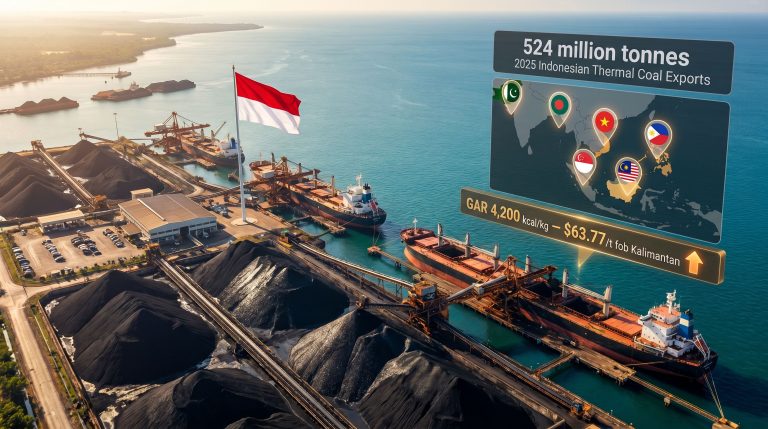
Coal price performance illustrates the severity of market adjustment pressures. GAR 4,200 kcal/kg coal was assessed at $44.99/t FOB Kalimantan on December 24, 2025, representing a 71% decline from the all-time high of $154.21/t recorded on October 21, 2021. Prices touched four-year lows of $39.40/t in June 2025, levels that industry sources indicated barely covered production costs for many operations.
Table: Indonesian Coal Market Performance (2024-2026)
| Metric | 2024 | 2025 | 2026 Target | Year-over-Year Change |
|---|---|---|---|---|
| Production Volume (million tonnes) | 836 | 790 | Under 700 | -5.5% |
| Export Volume (million tonnes) | 558 | 514 | TBD | -7.9% |
| GAR 4,200 Price (Dec 2025) | Higher | $44.99/t | Price stabilisation | -71% from 2021 peak |
Understanding Revenue Elasticity in Coal Markets
The disconnect between volume decreases and revenue impacts reveals critical market dynamics. Export revenues fell approximately 20% despite volume decreases of only 5.8%, demonstrating how price elasticity in coal markets creates amplified economic impacts for producing nations. This multiplier effect forces producers to consider production cuts as both volume and price optimisation strategies rather than simple supply management.
How Are Major Asian Economies Reshaping Coal Import Patterns?
China's Dual-Track Energy Security Strategy
China's position as the world's largest coal importer creates significant influence over global trade tensions patterns. Economic growth projections show China's expansion slowing to 4.4% in 2026 from an estimated 4.9% in 2025, according to World Bank projections. This economic deceleration coincides with China's strategic pivot toward energy independence through increased domestic coal production capacity and renewable energy infrastructure expansion.
The dual-track approach reduces China's reliance on Indonesian thermal coal, particularly lower-grade varieties that previously dominated bilateral trade flows. Consequently, China's gradual increase in renewable energy's share of power generation creates sustained pressure on overall coal demand beyond cyclical economic factors, indicating structural rather than temporary market shifts.
India's Weather-Enhanced Energy Transition
India's coal consumption patterns in 2025 demonstrated the accelerating impact of renewable energy deployment combined with favourable weather conditions. Extended monsoon spells boosted hydroelectric generation while solar and wind capacity additions continued displacing coal-fired power generation during peak demand periods. Coal burn remained largely lacklustre throughout 2025, indicating structural shifts rather than temporary weakness.
Currency factors further complicated India's import dynamics. The Indian rupee's sharp depreciation in 2025 weighed on coal imports by reducing purchasing power for international suppliers. This combination of reduced demand, increased domestic renewable generation, and currency headwinds created multiple pressure points for Indonesian coal exporters targeting the Indian market.
What Economic Pressures Are Forcing Indonesia's Policy Response?
Domestic Market Obligation (DMO) Leverage
Indonesian miners operate under regulations requiring them to sell at least 25% of production domestically through the Domestic Market Obligation programme. DMO sales reached 254 million tonnes in 2025, with year-end stocks at 22 million tonnes, according to government data. This regulatory framework provides the Indonesian government significant leverage over production allocation decisions and export availability.
The government prioritises coal mining quotas for DMO fulfilment before determining production levels available for export, demonstrating how domestic energy security takes precedence over export revenue optimisation.
Cost Threshold Pressures
Current price levels approach production cost thresholds for many Indonesian operations, forcing industry-wide efficiency improvements and operational consolidation. The sustained price environment since June 2025 lows has created conditions where only the most efficient operations remain economically viable at current market levels, contributing to the ongoing Indonesian coal production decline.
This cost pressure environment accelerates structural changes within the Indonesian coal industry, potentially leading to permanent capacity reductions rather than temporary production cuts. Operations with higher cost structures face existential challenges that may result in permanent closures rather than temporary suspensions.
Why Is Indonesia Targeting 600 Million Tonnes for 2026?
Strategic Supply Management Framework
Indonesian Energy Minister Bahlil Lahadalia indicated on January 8, 2026, that the country is considering setting coal production targets under 700 million tonnes for 2026, with the final figure to be determined after assessing domestic coal requirements. This represents a significant reduction from 2025's 790 million tonnes actual production.
The production target consideration reflects Indonesia's attempt to influence global coal pricing through supply management, mirroring approaches used by other commodity-exporting nations facing structural demand shifts. In addition, this strategy acknowledges that maintaining previous production levels would likely perpetuate oversupply conditions and continued price weakness.
Comprehensive Policy Tool Integration
Indonesia's supply management approach extends beyond simple production quotas to encompass multiple policy instruments, influenced by broader commodity market volatility:
- Export duty considerations: 1-5% range under discussion
- Enhanced regulatory oversight: RKAB validity periods revised back to one year from three years previously
- Stricter compliance requirements: Enhanced mine reclamation standards
- Transportation restrictions: Regional coal hauling limitations
- Financial compliance measures: Export sales proceeds retention requirements
Plans to introduce a 1-5% tax on coal exports from January 1, 2026, have been delayed, but remain under consideration as part of the comprehensive policy framework designed to provide better government control over mineral and coal production and sales.
What Are the Broader Implications for Global Coal Markets?
Seaborne Trade Restructuring Dynamics
As the world's largest thermal coal exporter, Indonesia's production adjustments occur within a global context where coal trade patterns are fundamentally shifting. The seaborne market appears well-supplied, with domestic supply in major importing nations potentially capping import outlook on top of broad economic weakness and changing generation patterns.
Major importing regions simultaneously increasing domestic production while reducing overall coal consumption creates structural oversupply situations that traditional market mechanisms struggle to address. However, this dynamic forces producing nations to consider supply management strategies that extend beyond market-driven adjustments.
Price Discovery Mechanism Challenges
The assessment of GAR 4,200 kcal/kg coal at $44.99/t FOB Kalimantan reflects broader challenges in coal price discovery mechanisms. These levels approach production cost thresholds for many operations, creating industry-wide pressure for efficiency improvements and operational consolidation.
Price levels hovering in narrow ranges since June 2025 lows indicate market conditions where traditional price signals struggle to clear supply-demand imbalances. For instance, this environment requires more active supply management interventions to establish sustainable pricing frameworks.
The next major ASX story will hit our subscribers first
How Do Infrastructure Constraints Amplify Production Challenges?
South Sumatra Transportation Disruptions
South Sumatra, accounting for approximately 14% of Indonesia's total coal output, faces significant transportation infrastructure challenges that compound market pressures. Coal barging on the Lalan River has been halted since January 1, 2026, following bridge collision damage from August 2024 that created debris obstructions, according to recent industry analysis.
The barging halt coincides with public road trucking bans implemented through August 2025 regulation, taking effect January 1, 2026. Coal mining companies were directed to use either private coal hauling roads or river barges, but the Indonesian Coal Mining Association noted that dedicated coal hauling roads in the region are inadequate to serve transportation needs.
Regional Production Impact Assessment
Indonesian Coal Production Distribution (2025 Estimates):
- East Kalimantan: ~45% of national output
- South Sumatra: ~14% of national output
- Central Kalimantan: ~12% of national output
- Other regions: ~29% of national output
Singapore-based traders confirmed that multiple coal producers in the affected South Sumatra region have reduced production due to transportation disruptions, although exact volumes remain difficult to determine. Supply from the affected region faces heavy impact with very few January-loading cargoes available.
Infrastructure development efforts to build alternative coal transportation roads represent significant undertakings requiring substantial time and financial capacity from coal companies. The uncertainty around completion timelines adds additional complexity to production planning decisions within the broader mining industry evolution.
What Long-Term Trends Are Reshaping Indonesian Coal Economics?
Energy Transition Timeline Implications
International Energy Agency projections suggest peak coal demand around 2030, creating planning challenges for long-lived mining investments. This timeline compression forces Indonesian coal producers to evaluate capital allocation decisions against shortened payback periods and accelerating demand destruction, particularly as part of the broader energy transition strategy.
The structural nature of demand decline differs from cyclical market weakness, requiring fundamental reassessment of industry investment strategies. Companies must balance maintaining operational efficiency against avoiding stranded asset risks in a transitioning energy landscape.
Currency and Financial Market Impacts
Foreign exchange volatility adds additional complexity to Indonesian coal export economics. The Indian rupee's sharp depreciation in 2025 exemplifies how currency movements amplify coal trade disruptions beyond fundamental supply-demand factors.
Indonesian coal exporters must navigate volume pressures, price pressures, and foreign exchange volatility simultaneously, creating multi-dimensional risk management challenges. Currency movements affect purchasing power in key markets, potentially accelerating demand destruction beyond energy transition factors alone.
Investment Capital Reallocation Pressures
Reduced coal sector profitability creates pressure for capital reallocation toward alternative energy investments within Indonesia. This shift could potentially position the country as a regional clean energy hub rather than primarily a fossil fuel exporter, though such transitions require substantial infrastructure development and policy support.
How Might Indonesia's Strategy Influence Regional Energy Security?
ASEAN Energy Cooperation Frameworks
Indonesia's coal production decisions carry implications for regional energy security frameworks within ASEAN. As the bloc's largest coal producer, Indonesian supply management affects energy planning across Southeast Asia's developing economies that remain dependent on coal for baseload power generation.
Regional energy cooperation mechanisms may need to adapt to accommodate reduced Indonesian coal availability while supporting member nations' energy security requirements during their respective energy transitions. Furthermore, this creates opportunities for enhanced renewable energy cooperation and grid interconnection initiatives.
Alternative Energy Investment Acceleration
The structural challenges facing Indonesian coal may accelerate investment flows toward renewable energy projects within the country. Government revenue pressures from reduced coal export earnings could drive policy support for alternative revenue streams through clean energy development and export potential.
Indonesia's significant renewable energy resources, including geothermal, solar, and wind potential, could provide alternative economic development pathways as coal sector economics deteriorate. Such transitions require coordinated policy frameworks and international partnership development to achieve scale and competitiveness.
This analysis reflects market conditions as of early 2026 and incorporates data from industry sources including the Indonesian Coal Mining Association and various commodity market assessment organisations. Projections and forecasts should be considered speculative and subject to significant uncertainty given rapidly evolving energy market conditions.
Looking for the Next Big Mining Discovery?
Discover why major mineral discoveries can lead to significant market returns by exploring Discovery Alert's discoveries page, which showcases historic examples like De Grey Mining and WA1 Resources delivering exceptional outcomes. Powered by the proprietary Discovery IQ model, Discovery Alert provides instant notifications on significant ASX mineral discoveries, transforming complex geological announcements into actionable investment insights ahead of the broader market.