
August 5, 2026
The global coal trade operates through critical infrastructure chokepoints that determine market access and pricing dynamics. While Asian thermal power generation continues expanding and European industrial sectors maintain baseline demand, the physical capacity to move coal from mining regions to international markets creates fundamental supply chain constraints. Understanding these operational bottlenecks reveals how infrastructure performance directly impacts commodity flows and market pricing mechanisms, particularly evident in the ongoing coal supply challenges 2025 affecting global markets.
Coal export terminals worldwide face similar challenges in optimising throughput while managing quality specifications for diverse international markets. The intersection of rail logistics, port handling capacity, and shipping coordination creates complex operational requirements that extend beyond simple tonnage calculations. These systems must balance high-volume commodity handling with precise quality control protocols demanded by different end-use applications across global markets.
What Infrastructure Specifications Enable High-Volume Coal Export Operations?
Annual Handling Capacity Versus Utilisation Metrics
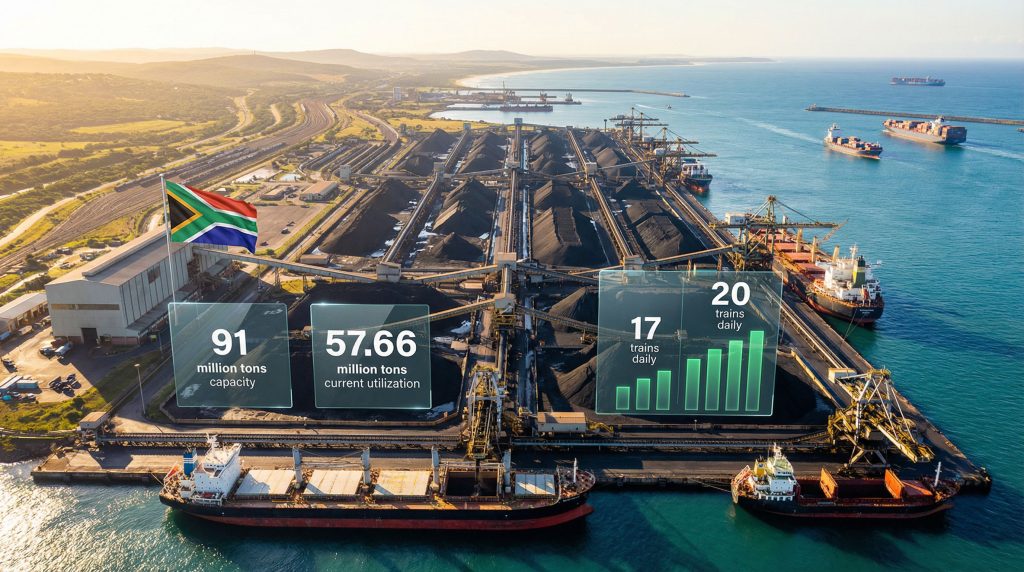
Modern coal export terminals demonstrate significant capacity differentials between designed throughput and actual operational performance. Richards Bay Coal Terminal operates with declared annual capacity of 91 million tons, yet achieved 57.66 million metric tons in 2025, representing approximately 63.4% utilisation of total infrastructure capability. This 36.6% capacity gap reflects systemic constraints in coal supply chain logistics rather than terminal design limitations.
The facility processed 7,157 trains in 2025, increasing from 6,342 trains in 2024, demonstrating 12.9% annual growth in rail throughput coordination. Daily train processing improved to 20 arrivals per day in 2025 from 17 daily arrivals in 2024, representing 17.6% frequency optimisation that directly correlates with export volume increases.
Port Infrastructure and Vessel Accommodation Standards
Coal export terminals require specialised infrastructure for bulk commodity handling that differs substantially from container or general cargo facilities. Deep-water access enables accommodation of Capesize vessels exceeding 150,000 deadweight tons, while multiple berth configurations allow simultaneous loading operations that maximise throughput efficiency.
Terminal specifications must accommodate coal stockpiling requirements, dust control systems, and cargo preparation protocols that ensure commodity quality during storage and loading processes. These operational requirements create infrastructure investment thresholds that limit global coal export capacity to established high-volume facilities.
Global Terminal Performance Comparisons
| Terminal Location | Annual Capacity (Million Tons) | Primary Markets Served | Infrastructure Advantages |
|---|---|---|---|
| Richards Bay, South Africa | 91 | Asia, Europe, Middle East | Strategic Indian Ocean positioning |
| Newcastle, Australia | 159 | Asia-Pacific | Proximity to major coal basins |
| Gladstone, Australia | 129 | Asia-Pacific | Multi-terminal complex |
| Hampton Roads, USA | 45 | Europe, South America | Atlantic shipping routes |
South Africa's Richards Bay coal exports up 11% in 2025 demonstrates infrastructure optimisation potential despite systemic constraints. The 11% year-on-year increase to 57.66 million tons represents the highest export volume achieved in four years, though still 24% below the 2017 peak of 76 million tons. This improvement aligns with broader trends in mining industry evolution throughout 2025.
When big ASX news breaks, our subscribers know first
Why Do Rail Network Constraints Determine Coal Export Capacity?
Locomotive Fleet Management and Operational Challenges
Rail infrastructure creates the primary constraint limiting coal export growth from major producing regions. Transnet's operational challenges include documented shortages of locomotives and spare parts, combined with infrastructure security issues from cable theft and vandalism. These factors combine to create binding constraints on coal transportation capacity regardless of mining production levels or port handling capability.
The transportation bottleneck forces industry adaptation strategies that increase total logistics costs while reducing system reliability. Some mineral exporters have implemented road transport alternatives and cross-border routing through Mozambican ports to circumvent rail capacity limitations. Furthermore, the recent onslow rail haulage update demonstrates how operational improvements can significantly impact export capabilities.
Performance Metrics and Recovery Indicators
Train frequency improvements from 17 to 20 daily arrivals at Richards Bay demonstrate measurable rail performance recovery during 2025. This 17.6% increase in daily train processing enabled the 11% annual export growth despite ongoing systemic constraints.
Major coal exporters including Thungela Resources and Exxaro Resources have acknowledged improving freight rail performance since the second half of 2024, indicating industry recognition of operational improvements following extended constraints. According to recent reports, these rail improvements have been instrumental in achieving the export growth.
Alternative Transportation Economics and Cross-Border Solutions
Road transport alternatives provide emergency logistics solutions but create substantial cost penalties compared to rail transportation. Cross-border routing through Mozambican ports offers intermediate cost structures while reducing dependence on domestic rail infrastructure.
These alternative transportation modes demonstrate industry adaptability to infrastructure constraints while highlighting the economic advantages of functional rail networks for bulk commodity transportation. The cost differentials between transportation modes create direct impacts on export competitiveness and mining project economics.
How Do Global Market Dynamics Shape Coal Export Destination Strategies?
Asian Market Concentration and Demand Patterns
Asian markets account for 79.8% of South African coal exports in 2025, declining from 84.5% in 2024 as exporters diversify geographic market exposure. India represents the single largest importer at 25.75 million tons, comprising 45% of total South African coal shipments. This concentration creates both market stability and geographic risk for South African coal producers.
The 4.7 percentage point decline in Asian market share indicates deliberate strategic diversification by South African coal exporters seeking to reduce concentration risk while developing alternative market opportunities. This shift reflects the changing global mining landscape and market dynamics.
European Market Development and Energy Transition Impacts
European coal imports from South Africa increased to 7.2% of total exports in 2025 from 6.8% in 2024, demonstrating modest but consistent market growth. Netherlands imports specifically increased, supporting the country's role as a regional distribution hub for coal commodities across European markets.
European demand patterns reflect industrial requirements rather than power generation applications, as energy transition policies reduce thermal coal consumption while maintaining metallurgical coal imports for steel production and other industrial processes. Moreover, coal trade data shows sustained European industrial demand despite overall energy transition trends.
Middle Eastern Market Expansion and Strategic Opportunities
Middle Eastern coal imports from South Africa nearly doubled to 3.54 million tons in 2025, representing the most significant regional market growth. Israeli imports specifically increased by 1 million tons to 1.78 million tons, demonstrating substantial bilateral trade development.
This regional market expansion provides geographic diversification benefits while serving growing industrial demand in Middle Eastern economies. The dramatic growth rates suggest these markets offer significant expansion potential for South Africa's Richards Bay coal exports up 11% success story.
What Operational Improvements Enable Export Volume Growth?
Train Scheduling Optimisation and Throughput Enhancement
Daily train frequency improvements from 17 to 20 arrivals represent 17.6% operational optimisation that directly enabled the 11% annual export growth. This correlation demonstrates how marginal infrastructure improvements can generate substantial throughput increases when properly implemented.
The increase from 6,342 annual trains in 2024 to 7,157 in 2025 represents 815 additional train movements that translated to approximately 6 million additional tons of coal export capacity. This productivity improvement occurred within existing infrastructure constraints through enhanced operational coordination and reflects broader data-driven mining operations principles.
Quality Control Systems and Market Specifications
Coal export operations require sophisticated quality management systems that ensure commodity specifications meet diverse international market requirements. Different export destinations demand specific coal characteristics including ash content, calorific value, moisture content, and sulphur levels that affect end-use applications.
Terminal operations must maintain segregated storage capabilities and blending facilities that enable custom coal preparation for specific export contracts. These quality control requirements create operational complexity that extends beyond simple bulk commodity handling.
Capacity Utilisation Analysis and Expansion Potential
Current 63.4% capacity utilisation at Richards Bay indicates 33.34 million tons of unutilised annual capacity remains available. This substantial unused capacity suggests that rail infrastructure improvements could enable significant export growth without requiring terminal expansion investments.
The gap between designed capacity (91 million tons) and current throughput (57.66 million tons) demonstrates the binding nature of rail constraints versus port handling limitations. Addressing transportation bottlenecks could potentially restore export volumes toward historical peak levels.
How Do Mining Companies Adapt Strategic Operations to Infrastructure Limitations?
Supply Chain Risk Management and Alternative Solutions
Coal mining companies have implemented diverse adaptation strategies to manage infrastructure constraints while maintaining export commitments. Some mineral exporters have adopted road transport alternatives despite higher unit costs, while others have developed cross-border logistics through Mozambican ports.
These strategic adaptations demonstrate industry resilience while highlighting the economic impact of infrastructure constraints on mining sector competitiveness. Companies must balance operational flexibility against cost optimisation when infrastructure reliability creates uncertainty.
Investment Strategies and Long-term Planning
Major coal exporters including Thungela Resources and Exxaro Resources have adjusted operational planning based on infrastructure capacity rather than mining production potential. This strategic shift reflects recognition that transportation constraints create binding limitations on export growth.
Industry investment priorities increasingly focus on logistics optimisation and alternative transportation development rather than mining capacity expansion. This strategic reorientation demonstrates how infrastructure constraints reshape capital allocation decisions across the coal value chain.
Contract Flexibility and Market Diversification
Coal exporters have developed more flexible contract structures that accommodate infrastructure uncertainties while maintaining customer relationships. Geographic market diversification strategies reduce dependence on single destination markets while spreading transportation risk across multiple logistics routes.
The shift from 84.5% Asian market concentration in 2024 to 79.8% in 2025 demonstrates active market diversification efforts that reduce geographic risk while developing alternative revenue streams. This strategic approach provides operational resilience against both infrastructure constraints and market volatility.
What Role Does Coal Export Infrastructure Play in Economic Development?
Foreign Exchange Generation and Trade Balance Impacts
Coal exports contribute substantially to South African foreign exchange earnings through high-volume commodity sales to diverse international markets. The 57.66 million tons exported in 2025 represents significant foreign currency generation that supports trade balance and currency stability.
Export revenue optimisation requires balancing volume throughput against pricing strategies that maximise total foreign exchange earnings. Infrastructure constraints limit volume potential while operational efficiency improvements can enhance unit pricing through improved delivery reliability. However, South Africa's Richards Bay coal exports up 11% demonstrates positive momentum despite constraints.
Employment Generation and Regional Development
Coal export operations support extensive employment across mining, transportation, and port handling sectors. The complex supply chain from mining operations through rail transportation to export terminals creates employment multiplier effects that extend throughout regional economies.
Infrastructure improvements enable employment growth through increased operational activity while supporting economic development in coal-producing regions. The 11% export growth in 2025 likely supported proportional employment increases across the coal value chain.
Investment Attraction and Infrastructure Development
Reliable coal export infrastructure attracts international mining investment while supporting domestic mining sector development. Infrastructure capacity and reliability affect mining project economics through transportation cost and delivery certainty considerations.
Continued infrastructure optimisation could enable additional mining investment by improving project economics and reducing operational risk. The demonstrated ability to achieve 11% export growth through operational improvements suggests significant potential for investment-driven expansion.
The next major ASX story will hit our subscribers first
How Do Global Energy Transitions Affect Coal Export Market Dynamics?
Industrial Versus Power Generation Demand Evolution
Global coal demand increasingly concentrates in industrial applications including steel production, cement manufacturing, and chemical processing rather than thermal power generation. This demand evolution affects coal quality requirements and pricing structures across different export markets.
South African coal exports serve diverse end-use applications that require different coal specifications and quality standards. Understanding these demand patterns enables strategic positioning for coal grades that maintain market relevance despite energy transition pressures.
Asian Market Sustainability and Growth Projections
Asian markets continue representing the primary destination for South African coal despite declining percentage share. India's 45% share of total exports demonstrates sustained bilateral trade relationships that support long-term market stability.
Regional industrial growth in Asia maintains coal demand for steel production and other manufacturing processes that resist substitution pressures affecting power generation applications. These industrial demand patterns provide market stability for coal exports despite energy transition trends.
Infrastructure Investment Priorities and Future Capacity
Coal export infrastructure requires continued investment to maintain competitiveness and capacity utilisation despite energy transition pressures. Rail network modernisation and port facility optimisation enable cost reduction and reliability improvements that enhance export competitiveness.
Technology integration opportunities include automated handling systems, real-time logistics coordination, and predictive maintenance protocols that optimise infrastructure performance while reducing operational costs.
What Strategic Lessons Apply to Global Commodity Export Operations?
Supply Chain Resilience and Infrastructure Dependencies
Coal export operations demonstrate how infrastructure constraints can limit commodity export potential regardless of production capacity or market demand. Single-point failures in transportation networks create systemic risks that require diversification strategies and alternative logistics development.
Resource exporters must balance infrastructure optimisation investments against alternative transportation development to create operational resilience. The South African experience demonstrates both the risks of infrastructure concentration and the potential for operational improvements within existing constraints.
Operational Efficiency and Capacity Optimisation
The 17.6% improvement in daily train frequency that enabled 11% annual export growth demonstrates how operational optimisation can generate substantial capacity increases without major infrastructure investment. These efficiency gains require coordination across multiple supply chain participants and operational protocol improvements.
Best practices include train scheduling optimisation, loading and unloading efficiency improvements, and quality control system integration that maximise throughput while maintaining commodity specifications.
Market Diversification and Risk Management
Geographic market diversification strategies reduce concentration risk while developing alternative revenue streams that provide operational resilience. The evolution from 84.5% to 79.8% Asian market concentration demonstrates active diversification efforts that maintain market stability while exploring growth opportunities.
Successful market diversification requires understanding different regional demand patterns, quality specifications, and logistics requirements that affect coal export competitiveness across diverse destination markets.
Frequently Asked Questions About Coal Export Infrastructure Operations
How does infrastructure capacity affect coal export pricing and competitiveness?
Infrastructure constraints directly impact export pricing through transportation cost increases and delivery reliability concerns. Limited rail capacity creates bottlenecks that increase unit transportation costs while reducing delivery certainty, both factors that affect export competitiveness versus alternative supply sources.
What operational factors determine daily throughput at coal export terminals?
Daily throughput depends on train arrival frequency, loading and unloading efficiency, coal quality preparation requirements, and vessel scheduling coordination. The improvement from 17 to 20 daily train arrivals at Richards Bay demonstrates how frequency optimisation can enhance overall capacity utilisation.
How do coal quality specifications affect export terminal operations?
Different export markets require specific coal characteristics including ash content, calorific value, moisture levels, and particle size distributions. Export terminals must maintain segregated storage and blending capabilities that enable custom coal preparation for diverse international market requirements.
What infrastructure investments provide the highest return for coal export capacity expansion?
Rail infrastructure improvements typically provide the highest return for coal export capacity since transportation constraints often represent the binding limitation on throughput. The correlation between train frequency improvements and export volume increases demonstrates the direct impact of rail optimisation investments.
How do energy transition policies affect long-term coal export infrastructure planning?
Energy transition trends require coal export infrastructure to focus on industrial market applications rather than thermal power generation. This market evolution affects quality specification requirements and destination market strategies while maintaining relevance for metallurgical coal and industrial applications that resist substitution pressures.
Disclaimer: This analysis incorporates market data and operational information from publicly available sources. Infrastructure performance metrics and market projections involve inherent uncertainties that may affect actual outcomes. Export volume projections and capacity utilisation estimates should be considered alongside broader market dynamics and policy developments that may influence future performance.
Looking to Capitalise on Coal Export Infrastructure Opportunities?
Discovery Alert's proprietary Discovery IQ model delivers real-time alerts on significant mineral discoveries across the ASX, instantly identifying actionable investment opportunities in coal, iron ore, and other commodities that benefit from infrastructure developments. Secure your market-leading advantage and explore how historic mineral discoveries generate substantial returns by beginning your 30-day free trial today.