
August 8, 2026
The Hidden Mechanics Behind Oil Price Spikes in Conflict Zones
Most commodity traders understand that oil prices respond to supply and demand fundamentals. What is far less understood is the precise psychological and structural mechanism that causes prices to surge before a single barrel of confirmed supply is actually lost. When military operations target energy infrastructure in one of the world's most strategically sensitive regions, markets do not wait for pipeline flow data or export terminal reports. They reprice immediately, based on probability distributions of what could happen next.
That mechanism was on full display in early June 2026, when crude oil prices jump after Israel strikes Iran facilities became one of the most searched terms across financial terminals globally. Understanding why this happened, how deep the price move was, and what the structural implications are for global energy markets requires examining several interlocking layers, from chokepoint geography to OPEC+ credibility to the fiscal arithmetic of non-combatant energy exporters.
When big ASX news breaks, our subscribers know first
What Actually Happened: The Strike That Broke the Ceasefire Calm
A ceasefire agreed on 8 April 2026 had briefly introduced a degree of stability into what had been a rapidly deteriorating regional conflict. Oil markets responded to that ceasefire with a notable pullback in prices on the Friday prior to the events of early June, with traders pricing in a reduced probability of sustained supply disruption.
That optimism evaporated within 48 hours.
Israel confirmed strikes on a petrochemical facility in south-western Iran, along with additional military targets. The significance of that specific target cannot be overstated: this was the first confirmed strike on Iranian energy infrastructure since the April ceasefire agreement, representing a qualitative escalation beyond military-to-military targeting. Simultaneously, Israeli operations in Lebanon intensified, compounding market anxiety across two theatres of conflict simultaneously.
Iran's response was swift. Missile strikes on Israeli targets on Sunday created what analysts describe as an escalation feedback loop, where each exchange raises the credible probability that the next exchange will involve higher-value targets, including critical energy export infrastructure. Furthermore, reporting on the Israel-Iran strikes confirmed that markets moved sharply the moment news of the energy facility targeting broke.
How Did Oil Prices React? A Breakdown of the Market Movement
The price response was immediate and significant. By 06:09 GMT on Monday, 9 June 2026, both major oil benchmarks had moved sharply higher:
| Benchmark | Price at 06:09 GMT | Single-Session Gain | Percentage Change |
|---|---|---|---|
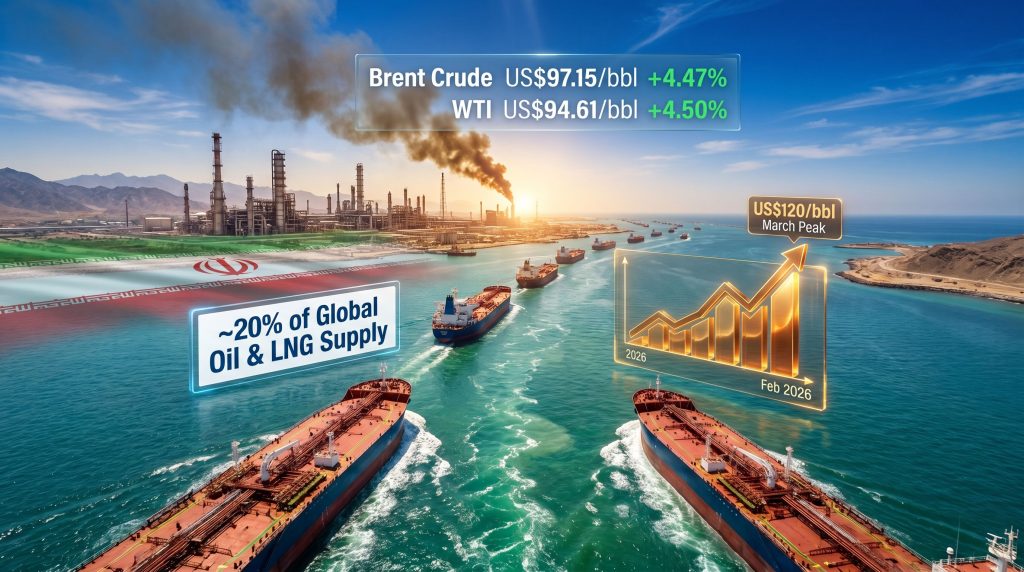
| Brent Crude | US$97.15/bbl | +US$4.42 | +4.47% |
| WTI (US Crude) | US$94.61/bbl | +US$4.07 | +4.50% |
A gain of more than US$4 per barrel in a single session is a significant move by any historical standard. To contextualise this within the broader trend: crude oil price trends show oil prices had already climbed approximately 60% since late February 2026, driven by the sustained conflict and progressive restrictions on Hormuz transit. Brent crude had reached nearly US$120 per barrel at its March 2026 peak before retreating on intermittent ceasefire expectations.
The fact that prices remain below that March ceiling is analytically important. It indicates that the market has not yet priced in a worst-case scenario, which means significant further upside risk exists if the conflict deepens or key transit infrastructure is directly compromised.
The price surge was driven primarily by a rising geopolitical risk premium. Traders were not responding to confirmed production losses but to the credible threat that further escalation could choke off critical export corridors, a distinction that is fundamental to understanding how oil markets price political risk.
What Is a Geopolitical Risk Premium and Why Does It Matter?
The geopolitical risk premium is the additional price embedded in commodity markets when political or military instability creates a credible threat to supply chains. It is not simply a panic response. Institutional trading desks construct probability-weighted scenario models that assign likelihood values to outcomes ranging from partial disruption to full transit closure.
The key insight is that a risk premium can persist even when physical supply remains technically available. As long as the probability of disruption remains elevated, the price will reflect that probability. This is why the April ceasefire produced a price retreat, and why a single strike on an Iranian energy facility was sufficient to reverse that retreat entirely. However, broader oil market analysis also points to how trade tensions and diplomatic fragility amplify these risk premiums significantly.
The Strait of Hormuz: A 33-Kilometre Waterway Carrying 20% of Global Energy
No analysis of Middle East oil market dynamics is complete without a rigorous examination of the Strait of Hormuz. At its narrowest point, the strait measures approximately 33 kilometres across, yet this geographic bottleneck serves as the transit corridor for roughly 20% of global oil and liquefied natural gas supplies on a daily basis.
The alternative routing options that are frequently cited in mainstream commentary are more limited in practice than they appear:
- The Saudi East-West Pipeline (Petroline) has a capacity of approximately 5 million barrels per day, covering only a fraction of normal Hormuz transit volumes
- The UAE's Habshan-Fujairah pipeline adds additional bypass capacity but again falls well short of replacing full strait volumes
- Both pipelines require significant lead time to increase throughput and are subject to their own infrastructure vulnerabilities
Since February 2026, exports through the strait have been severely curtailed following US-imposed port blockades and attacks on Iranian shipping infrastructure. Iran's Ambassador to Moscow, Kazem Jalali, signalled in a published interview that the strait would remain open but under new conditions to be determined jointly by Iranian and Omani authorities. What those conditions will mean in practice for tanker operators, cargo insurers, and downstream Asian importers remains deeply uncertain. In addition, oil surging to $110 a barrel following earlier strikes on Iranian energy facilities underscored precisely how rapidly Hormuz anxiety transmits into benchmark pricing.
The Invisible Cost: War Risk Insurance and Freight Rate Escalation
One dimension of the Hormuz situation that receives insufficient attention in mainstream energy reporting is the cascading effect on shipping economics. War risk insurance premiums for vessels transiting the Persian Gulf have surged to levels not seen since the tanker wars of the 1980s. These cost increases do not simply affect oil producers and consumers directly. They compound through the global logistics system:
- Higher insurance premiums increase the delivered cost of crude for every importing nation
- Elevated freight rates are embedded in final consumer energy prices across Asia and Europe
- Extended routing around the Arabian Peninsula, where applicable, adds days to transit times and increases fuel consumption per voyage
- Tanker operators demanding war risk bonuses effectively add a hidden tax on every cargo that successfully transits the region
A full or prolonged Hormuz closure would remove the world's single largest oil transit corridor from the supply equation, a scenario that would dwarf any OPEC+ production adjustment in its potential market impact.
OPEC+ Output Targets Versus Reality: The Growing Credibility Gap
OPEC+ has responded to the supply disruption environment by raising output targets for four consecutive months. The headline numbers look significant. The gap between those targets and actual production is more significant still. Consequently, the influence of OPEC on global markets has never been more scrutinised than in the current environment.
| Metric | Data Point |
|---|---|
| OPEC+ Quota Increase (April to June) | ~600,000 barrels per day |
| July Increase (agreed by 7 members) | 188,000 barrels per day |
| Actual OPEC Output (April average) | 33.19 million bpd |
| OPEC Output (February, pre-conflict) | 42.77 million bpd |
| Output Decline Since February | ~9.58 million bpd |
The arithmetic here is stark. OPEC+ is announcing quota increases measured in hundreds of thousands of barrels per day while actual physical output has collapsed by nearly 9.6 million barrels per day since February. The July increase of 188,000 bpd represents approximately 2% of the production that has already been lost.
This disconnect raises a fundamental question about whether OPEC+ output announcements currently function as genuine market management tools or primarily as signalling devices. When Gulf member nations cannot physically deliver incremental barrels because their export infrastructure is operating under conflict-driven constraints, the announced targets become largely symbolic.
Non-Gulf OPEC+ members including Russia, West African producers, and South American exporters have limited capacity to compensate for Gulf shortfalls at the scale required. The credibility gap between OPEC+ targets and deliverable volumes is itself a market variable, one that sophisticated traders are actively incorporating into their price models.
Russia: The Unexpected Fiscal Beneficiary of Middle East Conflict
One of the more strategically complex dimensions of the current oil market environment is the fiscal windfall accruing to Russia as a direct consequence of conflict in a region where Russia is not a combatant. Russia recorded a 32.4% year-on-year increase in oil and gas tax revenues in May 2026, a figure directly attributable to the elevated global price environment created by Hormuz disruption.
The United States has extended sanctions waivers permitting vulnerable importing nations to continue purchasing Russian seaborne crude, creating a bifurcated global oil market structure. Sanctioned Russian barrels flow to price-sensitive buyers at discounted rates, while the broader Brent benchmark, elevated by the conflict risk premium, simultaneously increases the revenue Russia collects on every barrel sold.
Igor Sechin, the chief executive of Rosneft, has publicly alleged that US energy companies have strategically positioned themselves to benefit from Hormuz instability. He has simultaneously cautioned that sustained supply disruption at elevated price levels carries the risk of accelerating long-term demand destruction, particularly in emerging market economies where energy price sensitivity is highest and structural fuel-switching can occur relatively quickly when price pain is sustained.
This tension between short-term revenue maximisation and long-term demand preservation is not unique to Russia. It is a structural challenge for all high-cost supply scenarios.
The next major ASX story will hit our subscribers first
Scenario Analysis: Three Paths Forward for Global Oil Markets
Given the current state of the conflict and the structural vulnerabilities exposed in global energy supply chains, three broad scenarios frame the range of likely market outcomes:
Scenario 1: Controlled Escalation (Base Case)
The conflict remains regionally contained. Hormuz remains technically open under the new Iranian-Omani framework. Brent trades within a US$90 to US$100 per barrel range, with elevated but manageable risk premiums. OPEC+ output gradually recovers as Gulf members restore partial export capacity over a 60 to 90 day horizon.
Scenario 2: Diplomatic De-escalation
A durable ceasefire is achieved. Hormuz conditions normalise. Brent retreats toward US$75 to US$85 per barrel as the risk premium unwinds. OPEC+ production targets become achievable and the market rebalances within a quarter.
Scenario 3: Full Hormuz Closure or Major Infrastructure Strike
Further confirmed strikes on Iranian energy facilities or a formal Hormuz closure trigger a supply shock. Brent approaches or exceeds the March US$120 per barrel peak. Demand destruction accelerates in emerging markets. Global recession risk rises materially, particularly for energy-importing economies in Asia.
Australia's Dual Exposure to the Conflict Price Cycle
Australia occupies an unusual position in the global energy economy. As both a major LNG exporter and a net importer of refined petroleum products, the country experiences the current price environment from two directions simultaneously. Indeed, the challenges facing Australian energy exports in 2025 and beyond have been compounded further by these escalating geopolitical pressures.
On the export side, elevated Brent prices and the effective removal of Hormuz-routed LNG from Asian spot markets has strengthened demand for Australian LNG from buyers seeking supply alternatives. This represents meaningful revenue upside for Australian LNG producers.
On the import side, Australian consumers and freight-dependent industries face sustained upward pressure on petrol prices, diesel costs, and the energy inputs that underpin manufacturing and logistics. This inflationary transmission is particularly difficult for monetary policy to address because it originates from a supply-side geopolitical shock rather than domestic demand conditions. Furthermore, the broader effects of trade wars on oil markets have added an additional layer of complexity to Australia's already delicate energy import equation.
What Markets Are Telling Us Right Now
The crude oil prices jump after Israel strikes Iran facilities episode is not simply a news event. It is a live demonstration of how tightly integrated geopolitical risk, physical supply geography, and financial market pricing have become in the modern energy system. Several structural conclusions follow:
- The geopolitical risk premium is the dominant pricing variable in the current environment, not supply-demand fundamentals
- The Strait of Hormuz remains the single most consequential variable in the global oil supply equation, and its effective restriction since February has already removed nearly 9.6 million barrels per day of Gulf output
- OPEC+'s announced production increases are structurally insufficient to offset the scale of Gulf export disruption
- Russia's 32.4% year-on-year revenue increase highlights the complex geopolitical economy of energy conflict
- Markets will remain acutely sensitive to any further military developments, Hormuz transit conditions, or diplomatic signals in the weeks ahead
Disclaimer: This article is intended for informational purposes only and does not constitute financial advice. Oil price forecasts and scenario projections involve significant uncertainty and should not be relied upon as the basis for investment decisions. Past price movements are not indicative of future performance.
For ongoing coverage of global energy markets and petroleum sector developments, visit Petroleum Australia.
Want to Identify the Next Major Resource Discovery Before the Market Does?
Discovery Alert's proprietary Discovery IQ model delivers real-time alerts on significant ASX mineral discoveries — instantly converting complex resource data into actionable investment insights for traders and long-term investors alike. Explore how historic discoveries have generated substantial returns on Discovery Alert's dedicated discoveries page, and begin your 14-day free trial today to position yourself ahead of the broader market.