July 9, 2026
The Structural Logic Behind India's Most Ambitious Coal-to-Chemicals Programme
Across the global energy landscape, few industrial economies carry as acute a dual vulnerability as India does today: a vast, domestically abundant fossil fuel resource sitting alongside a chronic dependence on imported petrochemicals and gas. This contradiction has persisted for decades, but the economics of import substitution have never aligned more favourably than they do now. Volatile LNG spot prices, disrupted global ammonia supply chains, and the strategic recalibration of commodity trade flows following repeated geopolitical shocks have collectively elevated coal gasification from a fringe industrial concept to a centrepiece of India's near-term energy security architecture.
Understanding why the coal gasification incentive scheme in India has scaled so dramatically in 2026, and what it means for investors, developers, and the broader chemicals sector, requires examining both the structural import vulnerabilities it targets and the technical mechanics that make coal-derived syngas a credible substitute across multiple product categories. Furthermore, the LNG supply outlook and broader energy security trends both point toward the strategic urgency underpinning this policy shift.
When big ASX news breaks, our subscribers know first
India's Import Dependency: The Numbers Behind the Policy Urgency
The scale of India's chemical and gas import dependency is frequently underappreciated outside specialist circles. The country currently sources more than 50% of its LNG requirements from overseas markets, while its domestic ammonia production covers virtually none of its national demand, leaving India effectively 100% import-dependent on ammonia. Methanol sits in a similarly exposed position, with 80 to 90% of consumption met through imports. Even urea, the agricultural fertiliser that underpins India's food production system, relies on imported feedstocks for roughly 20% of its supply.
These figures are not abstract trade statistics. They represent structural pressure points across India's fertiliser supply chains, industrial chemicals manufacturing, and city gas distribution networks. When LNG prices spike on global spot markets, the downstream cost impact cascades through ammonia production, methanol synthesis, and ultimately into agricultural input costs for hundreds of millions of farmers.
India's LNG import structure further illustrates how pricing mechanisms and tariff design compound this vulnerability, making domestic syngas production an increasingly attractive alternative for downstream manufacturers seeking feedstock cost stability.
"Coal gasification addresses each of these vulnerabilities simultaneously by converting domestically mined coal into synthesis gas (syngas), a versatile feedstock that can be directed toward SNG, ammonia, methanol, urea, or petrochemical precursors depending on downstream processing configuration."
This is the core economic logic the coal gasification incentive scheme in India is designed to activate at commercial scale.
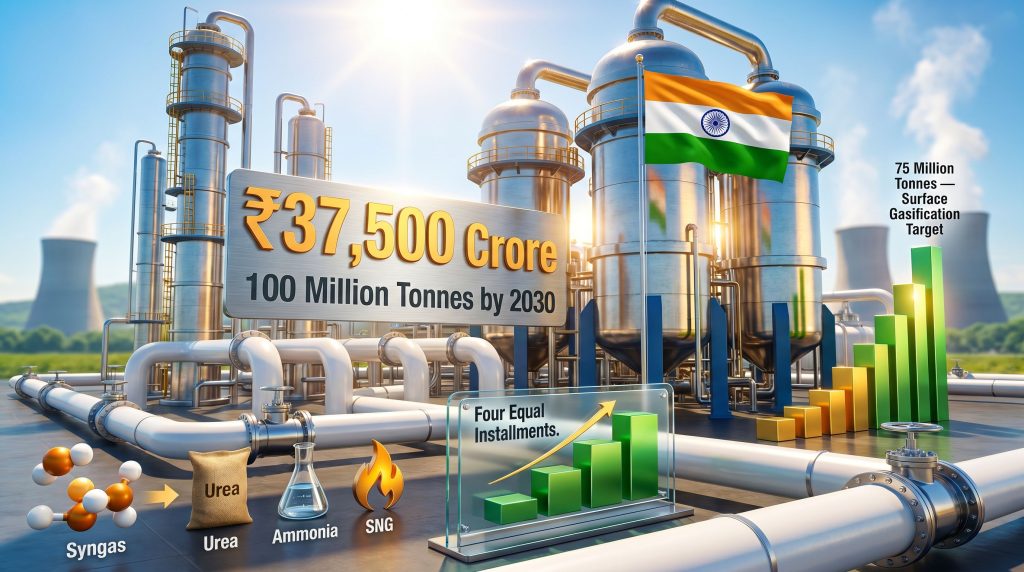
What the ₹37,500 Crore Scheme Actually Does
Cabinet approval for the scheme arrived in May 2026, with formal guidelines issued on June 25, 2026. The Coal Ministry's Request for Proposal was released on July 9, 2026, opening a formal application window that closes on September 7, 2026. A pre-application conference scheduled for July 20, 2026 will give prospective developers an opportunity to receive official clarifications before committing to application preparation.
The financial architecture of the scheme is worth examining in detail, because the incentive structure is materially more sophisticated than earlier iterations:
| Parameter | Details |
|---|---|
| Total Scheme Outlay | ₹37,500 crore (~USD $3.9 billion) |
| Incentive Rate | Up to 20% of Plant and Machinery cost |
| Single Project Cap | ₹5,000 crore |
| Single Product Cap (excl. SNG and Urea) | ₹9,000 crore |
| Single Entity Group Cap | ₹12,000 crore |
| Gasification Target | ~75 million tonnes of coal and lignite |
| Disbursement Model | Four equal milestone-linked instalments |
The inclusion of project-level, product-level, and entity group-level caps is a structural refinement that was absent from the earlier ₹8,500 crore scheme. These caps prevent capital concentration in a single large project, broadening the scheme's commercial reach and encouraging participation from a wider developer cohort.
Milestone-Linked Disbursements: Why Does the Payment Structure Matter?
Financial support is not released as an upfront grant. Instead, it flows across four equal instalments, each contingent on verifiable project development milestones. This design serves multiple objectives simultaneously:
- It protects public capital from speculative applications that do not advance to construction
- It aligns incentive capture with actual capital deployment, improving fiscal accountability
- It creates a built-in project monitoring mechanism for the Coal Ministry
- It signals to commercial lenders that government disbursements will track real project progress, improving debt serviceability assessments
For developers, the milestone structure demands disciplined project execution but also provides a predictable funding cadence that can be modelled into project finance structures from the outset.
The 30-Year Coal Linkage: The Scheme's Most Underappreciated Feature
Among all the scheme's provisions, the extension of coal supply linkage tenure to 30 years for qualifying projects may prove to be the single most consequential design element for long-term project viability.
Historically, one of the most persistent barriers to large-scale coal-to-chemicals investment in India was fuel supply uncertainty. Long-duration capital projects, particularly those with 20 to 25-year asset depreciation horizons, require bankable fuel supply certainty to attract project finance at competitive rates. Short-tenure coal linkages introduced refinancing risk and created uncertainty around feedstock cost assumptions embedded in financial models.
The 30-year linkage tenure directly addresses this structural financing barrier. Its implications cascade through multiple layers of project economics:
- Lender comfort: Long-dated fuel supply certainty reduces perceived cash flow volatility, lowering the risk premium lenders apply to project debt
- Equity IRR improvement: Stable feedstock cost assumptions over a 30-year horizon allow equity investors to model returns with greater confidence
- Downstream offtake negotiation: A project with secure 30-year coal linkage is a stronger counterparty in long-term product offtake negotiations with industrial buyers
- Refinancing optionality: Stable long-term fuel supply reduces refinancing risk at debt maturity, improving terminal value assumptions
"The combination of a 20% capital cost subsidy and a 30-year coal linkage tenure represents one of the most comprehensive de-risking packages the coal-to-chemicals sector has seen in India. For project developers, this materially improves internal rate of return calculations and reduces the cost of capital relative to unassisted project development."
Syngas as a Strategic Feedstock: Understanding the Downstream Value Chain
A critical aspect of the coal gasification incentive scheme in India that is often overlooked in general coverage is the sheer breadth of the syngas value chain. Synthesis gas is not a single-use product stream. It is a compositionally flexible intermediate that can be directed toward radically different end products depending on downstream reactor configuration, catalyst selection, and process design.
Key Downstream Products and Their Import Substitution Significance
- Synthetic Natural Gas (SNG): Chemically identical to natural gas, SNG from coal gasification can be injected directly into existing city gas distribution networks, displacing imported LNG without requiring infrastructure modification
- Ammonia: India's near-total import dependency on ammonia creates a powerful economic case for domestic coal-derived ammonia production, particularly given the country's large nitrogen fertiliser manufacturing base
- Methanol: With 80 to 90% of methanol currently imported, coal-to-methanol projects represent one of the scheme's largest single substitution opportunities, with downstream applications spanning fuel blending, chemical synthesis, and dimethyl ether production
- Urea: Syngas can be processed into both ammonia and carbon dioxide, the two feedstocks required for urea synthesis, enabling fully integrated coal-to-urea production
- Petrochemical precursors: Syngas-derived methanol can be further converted to olefins via methanol-to-olefins (MTO) processes, opening a pathway to domestic plastic feedstock production
One technically important but lesser-known characteristic of coal gasification is the ability to tune syngas composition by adjusting the hydrogen-to-carbon monoxide ratio through water-gas shift reactions. This compositional flexibility means a single gasification facility can theoretically pivot between product streams depending on relative market pricing, giving operators a degree of commercial agility not available to conventional petrochemical plants locked into a single feedstock configuration.
Policy Evolution: From ₹8,500 Crore to ₹37,500 Crore
The current scheme does not exist in isolation. It supersedes an earlier ₹8,500 crore general coal and lignite gasification programme, representing a 4.4-fold increase in committed financial support. This acceleration reflects not simply elevated policy ambition but a concrete reassessment of commercial viability based on project development experience from the earlier scheme's consultation and application phases.
| Policy Phase | Outlay | Scope | Status |
|---|---|---|---|
| Earlier General Scheme | ₹8,500 crore | General coal and lignite gasification | Superseded |
| Current Surface Gasification Scheme (2026) | ₹37,500 crore | Surface coal and lignite gasification only | Active |
| Underground Coal Gasification Initiatives | Separate allocation | Sub-surface gasification | Parallel programme |
The current scheme is explicitly scoped to surface coal and lignite gasification. Underground coal gasification, which involves in-situ combustion of coal seams without mining, is addressed through entirely separate policy mechanisms. This distinction matters for technology selection, capital cost profiling, and environmental permitting, and developers should ensure their project configurations align with the surface gasification definition before progressing applications.
The next major ASX story will hit our subscribers first
Technology Agnosticism and the Indigenous Technology Incentive
One of the scheme's more nuanced design features is its technology-agnostic eligibility framework. Developers are not restricted to a single approved gasification technology, which matters considerably given the range of commercially available gasification processes currently in operation globally.
Proven commercial gasification technologies span fixed-bed, fluidised-bed, and entrained-flow reactor designs, each carrying different capital cost profiles, coal quality tolerances, and syngas output characteristics. Fixed-bed gasifiers tend to handle higher-ash coals more effectively, which is particularly relevant for India's domestic coal supply, which typically carries ash content significantly higher than internationally traded thermal coals.
India's domestic coal is characterised by high ash content, often ranging from 30 to 45%, which creates technical challenges for entrained-flow gasifiers designed for lower-ash feedstocks. This feedstock characteristic has historically tilted Indian coal gasification project design toward fluidised-bed technologies, and developers familiar with this constraint will likely hold a competitive advantage in technology selection and project engineering.
While indigenous technology adoption is encouraged under the scheme, the absence of a technology mandate preserves developer flexibility to select proven international technologies where indigenous alternatives lack sufficient commercial track records for lender comfort.
Environmental Positioning: Coal Gasification as a Transition Bridge
Coal gasification is not a zero-emission technology, and characterising it as such would misrepresent both its environmental profile and its strategic role within India's energy transition. The scheme's environmental logic operates on a different basis: coal gasification, when displacing direct coal combustion or imported hydrocarbon feedstocks, can reduce net carbon intensity per unit of chemical output, particularly when integrated with carbon capture infrastructure.
Gasification produces a concentrated CO2 stream in the syngas cleanup stage that is technically more amenable to carbon capture than the dilute flue gas produced by conventional coal combustion. This characteristic makes coal gasification facilities more compatible with future carbon capture, utilisation, and storage infrastructure than the thermal power plants they may partially substitute.
Consequently, the scheme can be understood as a transition technology investment: it expands domestic chemical and fuel production capacity using existing coal infrastructure while maintaining a technical pathway toward lower-carbon operation as carbon capture economics improve. This positioning also sits within the broader context of energy transition pressures shaping industrial policy across major emerging economies, where the shift away from fossil dependence rarely follows a linear path.
Key Application Milestones for Project Developers
| Milestone | Date |
|---|---|
| Scheme Guidelines Issued | June 25, 2026 |
| Request for Proposal Released | July 9, 2026 |
| Pre-Application Conference | July 20, 2026 |
| Application Submission Deadline | September 7, 2026 |
The pre-application conference on July 20 is particularly important for developers navigating the cap structure for the first time. Understanding precisely how the single project, single product, and entity group caps interact — especially for developers planning multiple gasification projects or integrated product configurations — will require detailed clarification from the Coal Ministry before application preparation is finalised.
Furthermore, developers considering applications should pay particular attention to the following structural considerations:
- How project boundary definitions affect eligibility for the ₹5,000 crore single-project cap
- Whether integrated gasification-to-ammonia-to-urea configurations qualify under single-product or multi-product cap structures
- The documentation requirements for demonstrating verifiable milestone achievement under the four-instalment disbursement mechanism
- Coal linkage application procedures for securing the 30-year tenure under the sub-sector provisions
In addition, those with broader exposure to trade-driven energy volatility will recognise that the window for securing long-dated domestic feedstock certainty — at subsidised capital cost — is unlikely to remain open indefinitely as global commodity markets continue to reprice geopolitical risk. The National Coal Gasification Mission provides further context on India's long-term targets and the policy ecosystem within which this scheme sits.
This article is intended for informational purposes only and does not constitute financial or investment advice. Readers should conduct independent due diligence before making investment or project development decisions based on government scheme parameters, which may be subject to interpretation, amendment, or implementation variation.
Ongoing coverage of the coal gasification incentive scheme in India and related energy policy developments is available through ET EnergyWorld at energy.economictimes.indiatimes.com.
Want to Identify ASX Opportunities in the Energy and Resources Sector Before the Broader Market?
Discovery Alert's proprietary Discovery IQ model delivers real-time alerts on significant ASX mineral discoveries across more than 30 commodities, instantly converting complex resource data into actionable investment insights — begin your 14-day free trial today and explore how historic discoveries have generated substantial returns for well-positioned investors.