July 9, 2026
When the "Crown Jewel" Loses Its Shine: Understanding Vedanta Aluminium's Post-Demerger Performance
Corporate spin-offs have a long history of producing short-term price dislocations that confuse even experienced investors. When a conglomerate breaks apart, the resulting entities often trade at valuations that reflect incomplete information, shifting sentiment, and the mechanical complexity of how base prices are assigned. The Vedanta demerger is a textbook example of this phenomenon, and nowhere has the confusion been more pronounced than in the debate around whether Vedanta Aluminium stock fell after the demerger or simply became a victim of misread market mechanics and an unfavourable commodity cycle.
When big ASX news breaks, our subscribers know first
Decoding the Demerger: Four Entities, One Fractured Narrative
Anil Agarwal's restructuring of Vedanta Limited into four independently listed entities was one of the most significant corporate events in India's metals sector in recent years. The parent company was stripped of its aluminium, power, oil and gas, and iron and steel businesses, each of which began trading as a standalone entity with its own base price derived from the pre-demerger valuation of the parent.
Understanding that base price mechanism is critical. Unlike an initial public offering, where a listing price is set by market demand during a book-building process, demerger base prices are calculated as an accounting allocation of the parent company's existing valuation across the newly separated businesses. This means the percentage performance of each entity after listing must be measured against its assigned base, not against any externally validated price discovery process.
When Vedanta Ltd's share price reset by approximately 63% on April 30, many observers interpreted this as a collapse. In reality, it was a technical adjustment reflecting the removal of four major operating divisions from the parent's balance sheet. No value was destroyed; it was redistributed. This kind of aluminium sector restructuring has become increasingly common globally as conglomerates seek to unlock shareholder value.
The Performance Divergence: What the Numbers Actually Say
The post-listing trajectories of the four demerged entities tell a story that challenges the dominant narrative around Vedanta Aluminium stock falling after the demerger.
| Entity | Base / Listing Price (INR) | Post-Listing Direction | Notable Development |
|---|---|---|---|
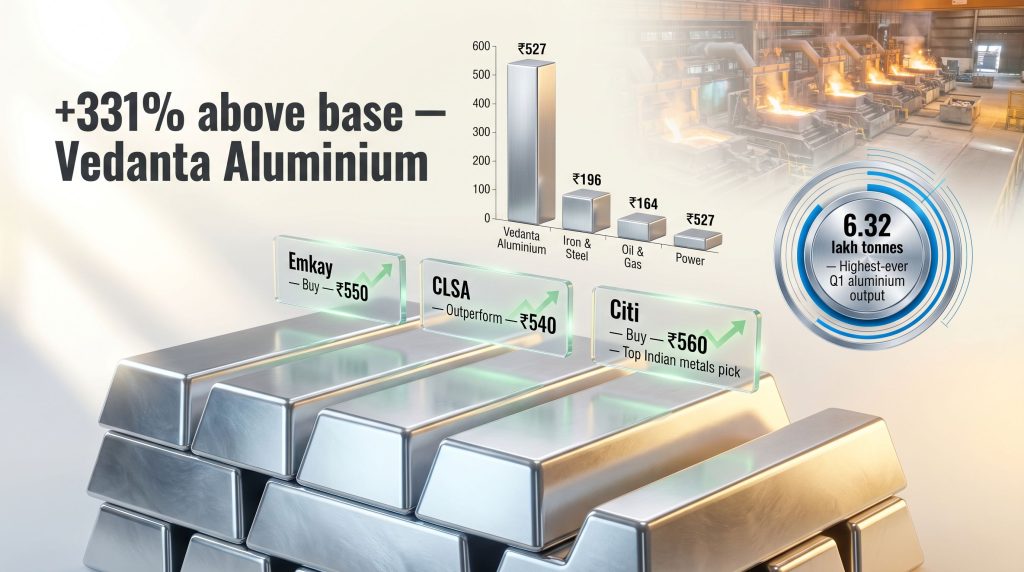
| Vedanta Aluminium | INR 527 (listing) | Down ~12% from listing price | Record Q1 FY27 output of 6.32 lakh tonnes |
| Vedanta Power | INR 42 | Up ~9% from listing | Supported by domestic power demand |
| Vedanta Iron & Steel | INR 22 | Up ~84% from listing | Strongest post-demerger performer |
| Vedanta Oil & Gas | INR 39 | Up ~10% from listing | Commodity price recovery |
The data above reflects the situation as of early July 2026. While the outline presented an earlier snapshot where Vedanta Aluminium appeared to be the standout performer relative to its assigned base price, the more complete picture as confirmed by the source material tells a more nuanced story. According to reporting on Vedanta Aluminium's debut, the company debuted at INR 527 on June 15, but by early July had declined roughly 12% from that listing price, erasing more than INR 250 billion in market value. Far from being the technical laggard misidentified in early market commentary, it became the genuine underperformer among the four newly listed businesses.
The key analytical distinction here is understanding why Vedanta Aluminium underperformed its demerged siblings. The answer does not lie in operational weakness or structural deterioration. It lies almost entirely in the behaviour of LME aluminium prices following a geopolitically driven supply disruption that subsequently began to unwind.
Aluminium Price Correction: The Primary Culprit
The timing of Vedanta Aluminium's post-listing weakness aligns closely with a correction in LME aluminium prices triggered by the Iran-US peace agreement. During the period of Middle East conflict, markets had priced in a meaningful supply disruption premium, given that approximately 2.2 million tonnes per annum of primary aluminium capacity was at risk across the region.
The affected assets included:
- Qatar Aluminium and Alba (Bahrain): Both facilities were considered capable of returning to normalised operations relatively quickly once risk premiums unwound.
- EGA's Al Taweelah (UAE): Analysts flagged this as presenting a potentially longer-duration outage risk given its scale and operational complexity.
As peace negotiations progressed, the war-risk premium embedded in LME pricing began to unwind. Despite low inventory levels and some regional premium tightness, prices corrected, directly compressing the near-term earnings outlook for primary aluminium producers including Vedanta Aluminium. The commodity price impact on equity valuations in this scenario is well documented, and Vedanta Aluminium proved no exception.
This dynamic illustrates a critical point about commodity equity valuation: even operationally strong companies with record output can see their stock prices decline when the underlying commodity price falls faster than cost efficiencies can compensate.
Why Aluminium Supply Analysis Is More Complex Than Most Investors Realise
One of the less appreciated dimensions of aluminium market dynamics is the metal's circular supply structure. Unlike crude oil or thermal coal, aluminium is not consumed in a single use cycle. Industry analysis suggests that approximately 1.5 billion tonnes of aluminium remains available above ground, and close to 80% of all aluminium ever produced remains part of the usable metal pool in some form.
This means that supply-demand forecasts for aluminium cannot be constructed from primary smelter output data alone. Scrap collection rates, remelting infrastructure capacity, sorting technology, and recycling economics all feed into the true supply picture, creating a layer of analytical complexity that crude supply-demand models frequently miss.
Furthermore, understanding global bauxite supply constraints is essential context here, as bauxite availability remains a fundamental upstream variable in any serious aluminium market analysis. For investors evaluating Vedanta Aluminium, this distinction matters because it affects how quickly any supply shortfall can be addressed. If LME prices rise, recycling economics improve, scrap flows increase, and secondary supply can partially offset primary production gaps without requiring new smelter capacity.
The Long-Term Structural Case: Why Brokerages Remain Constructive
Despite the near-term headwinds, institutional coverage of Vedanta Aluminium has been broadly positive. Three major brokerages initiated coverage following the listing, each arriving at a Buy or Outperform recommendation.
| Brokerage | Rating | Target Price (INR) | Implied Upside | Key Investment Thesis |
|---|---|---|---|---|
| Emkay | Buy | 550 | ~15% | Global deficit through CY28; backward integration driving cost reduction |
| CLSA | Outperform | 540 | ~18% | 1.5 mt incremental supply in 2026; electrification demand resilience |
| Citi | Buy | 560 | Top Indian metals pick | BALCO expansion; net cash position expected by FY28 |
Emkay's thesis centres on the view that the global aluminium market will remain in structural deficit through calendar year 2028 despite anticipated capacity additions from Indonesia. The brokerage argues that Indonesia's expansion plans face meaningful constraints across multiple dimensions:
- Bauxite availability at sufficient scale and grade to support large-scale refining
- Alumina refining capacity that needs to be built or expanded in parallel with smelting
- Power infrastructure capable of sustaining the energy-intensive electrolytic reduction process
- Project financing in a higher-for-longer interest rate environment
Simultaneously, China's aluminium production is approaching what analysts describe as an effective regulatory ceiling of approximately 45 million tonnes, limiting the world's largest producer's ability to absorb global demand growth. The China metals demand outlook remains a key variable in this equation, as any demand-side softening from Beijing could further complicate the supply-demand balance. With China constrained and Indonesia's additions facing structural delays, the supply-demand balance may remain tighter than spot pricing currently implies.
CLSA's incremental supply projections of 1.5 million tonnes in 2026 and 1.9 million tonnes in 2027 are consistent with this framing, with the brokerage emphasising that demand resilience from electrification and materials substitution provides a structural floor even if near-term pricing remains soft.
The next major ASX story will hit our subscribers first
Backward Integration: The Earnings Story That Transcends Metal Prices
One of the more sophisticated elements of the Vedanta Aluminium investment case is that its earnings potential is not solely dependent on higher LME prices. The company is pursuing a deliberate vertical integration strategy that could structurally reduce its cash cost per tonne, strengthening its position on the global aluminium cost curve regardless of where spot prices settle.
The key pillars of this integration effort include:
- Bauxite self-sufficiency: Scaling captive bauxite mining to reduce dependence on third-party ore supply, which is subject to both cost variability and geopolitical disruption risk.
- Lanjigarh refinery expansion: Moving the alumina refinery toward higher utilisation rates increases captive alumina supply, reducing exposure to alumina spot market pricing.
- Captive coal and power: Securing own-source energy supply insulates the smelting business from grid tariff volatility, which is particularly relevant in India's energy transition environment.
Emkay values the company at 6x FY28E EV/EBITDA, with Citi projecting a move to a net cash position by FY28, suggesting that deleveraging could become a meaningful catalyst if integration milestones are achieved on schedule. The identified risk factors include weak LME prices, elevated energy costs, integration execution delays, and adverse regulatory developments in India's mining and power sectors.
Copper's Record Run and What It Means for Aluminium Demand
An underappreciated demand driver for aluminium in 2026 is the substitution effect created by copper's extraordinary price performance. Record copper prices during the year pushed the copper-to-aluminium price ratio above 4.2x. At this ratio, the economic case for substituting aluminium in a range of electrical and industrial applications becomes materially stronger.
| Metric | Copper | Aluminium |
|---|---|---|
| Electrical Conductivity | 100% (baseline) | ~61% of copper |
| 2026 Price Level | Record high | Significantly lower |
| Price Ratio (Cu:Al) | 4.2x | Baseline |
| Design Workaround | Standard gauge | Thicker cable where permitted |
| Demand Trend | Cost-constrained adoption | Rising substitution interest |
While aluminium's lower electrical conductivity requires design accommodations, such as using thicker cable gauges where structural and spatial constraints allow, the cost differential at a 4.2x price ratio is large enough to justify the engineering trade-off across a widening range of applications. Electrical wiring in construction, grid infrastructure cabling, and certain automotive harness applications are among the areas where aluminium substitution has historically accelerated during periods of elevated copper pricing.
FAQ: Vedanta Aluminium, the Demerger, and What Investors Need to Know
Did Vedanta Aluminium shares fall after the demerger?
Yes. As of early July 2026, Vedanta Aluminium had declined approximately 12% from its listing price of INR 527 on June 15, making it the weakest performer among the four demerged entities despite strong operational fundamentals. Indeed, analysis of the newly listed stocks confirms that Vedanta Power hitting the upper circuit stood in stark contrast to aluminium's slip on listing day.
What caused Vedanta Ltd's share price to drop ~63% on April 30?
This was a technical accounting reset, not a market crash. When four major operating divisions were removed from Vedanta Ltd's balance sheet, its share price adjusted mechanically to reflect the reduced asset base of the remaining parent entity.
What is driving Vedanta Aluminium's underperformance?
The primary driver is the correction in LME aluminium prices following the Iran-US peace agreement, which unwound the war-risk premium that had been embedded in aluminium spot pricing.
What is Vedanta Aluminium's recent production record?
The company achieved its highest-ever quarterly aluminium output of 6.32 lakh tonnes in Q1 FY27, demonstrating strong operational performance even as the stock came under pressure.
When is Vedanta Aluminium expected to reach net cash?
Citi projects the company will move to a net cash position by FY28, supported by deleveraging driven by operational cash flows and cost reduction through backward integration.
Why do brokerages maintain Buy ratings despite the stock's decline?
The investment thesis centres on structural factors: a global supply deficit expected to persist through CY28, cost reductions from vertical integration, copper substitution demand, and the BALCO expansion pathway — all of which are medium-to-long-term drivers that short-term LME price moves do not invalidate.
Reassessing the Crown Jewel: Near-Term Pain, Long-Term Potential
The debate around Vedanta Aluminium stock falling after the demerger ultimately reduces to a question of time horizon and analytical framework. In the near term, the stock has faced genuine pressure from a commodity price correction that is structurally temporary but economically meaningful. The unwinding of Middle East supply disruption premiums has reset LME pricing in ways that compress margins for all primary aluminium producers.
Over the medium to long term, however, the structural arguments supporting Vedanta Aluminium remain largely intact. The global market deficit thesis, the copper substitution tailwind, the cost curve improvement potential from backward integration, and the deleveraging trajectory toward net cash by FY28 collectively present a fundamentally different picture from what near-term price action suggests.
What investors should monitor closely in H2 FY27 and beyond includes:
- Progress on the Lanjigarh refinery utilisation ramp-up and captive bauxite mine scaling
- The pace of LME aluminium price recovery as Middle East risk premiums fully normalise
- BALCO expansion milestones and their contribution to incremental output
- Vedanta Aluminium's leverage trajectory relative to Citi's FY28 net cash projection
- Any changes to India's regulatory framework governing mining and captive power
The crown jewel label may have been premature as a short-term descriptor, but as a characterisation of the long-term strategic and earnings potential of a vertically integrating, cost-optimising primary aluminium producer in the world's fastest-growing major economy, the fundamentals have not fundamentally changed. The question is whether management can execute on its integration roadmap quickly enough to close the gap between structural potential and near-term market sentiment.
Disclaimer: This article is for informational purposes only and does not constitute financial advice. Past performance is not indicative of future results. Brokerage target prices and analyst ratings referenced reflect views published as of July 2026 and may have changed. Investors should conduct their own due diligence before making investment decisions.
Want to Stay Ahead of Major Mineral Discoveries Before the Broader Market Reacts?
While Vedanta Aluminium's demerger illustrates how commodity price cycles and corporate restructuring can create complex investment narratives, Discovery Alert's proprietary Discovery IQ model cuts through that complexity by delivering real-time alerts on significant ASX mineral discoveries — explore historic examples of exceptional discovery returns to understand the scale of opportunity, then begin your 14-day free trial at Discovery Alert to position yourself ahead of the market.