July 9, 2026
The Processing Gap That Western Battery Makers Cannot Afford to Ignore
Battery supply chain conversations tend to fixate on mining — the race to secure lithium, cobalt, and nickel deposits across Africa, South America, and Australia. Yet the more strategically precarious bottleneck sits not in the ground, but inside the processing facilities that transform raw ore and intermediate concentrates into battery-ready materials. For cobalt specifically, that transformation bottleneck has a precise geographic address: China.
Approximately 70 to 80 percent of global cobalt refining capacity currently operates within China, according to industry data compiled across multiple critical mineral assessments. This concentration means that even cobalt mined in politically stable jurisdictions must, in most cases, travel through Chinese processing infrastructure before it can enter a lithium-ion battery cathode. For North American automakers navigating an increasingly complex trade and supply chain compliance environment, this single-point dependency is not a theoretical risk — it is an operational constraint affecting sourcing decisions today.
The First Cobalt Ontario refinery pre-construction phase, now underway in Temiskaming Shores, directly targets this structural deficit. It is a project that deserves analysis not simply as a corporate milestone, but as an infrastructural response to one of the most significant vulnerabilities in the Western electric vehicle supply chain. Understanding the broader battery metals investment landscape is essential context for evaluating why this project matters now.
When big ASX news breaks, our subscribers know first
Understanding What Battery-Grade Cobalt Sulphate Actually Requires
The Chemistry Behind the Commercial Challenge
Raw cobalt and cobalt intermediate concentrates bear little resemblance to the battery-ready product that cathode active material manufacturers actually require. Cobalt sulphate destined for lithium-ion battery production must typically meet purity thresholds exceeding 20.5% cobalt content by weight, with tightly controlled impurity profiles covering elements such as iron, nickel, manganese, and copper.
Achieving these specifications demands multi-stage hydrometallurgical processing. The core purification mechanism is solvent extraction (SX), a process in which cobalt ions are selectively transferred from an aqueous leach solution into an organic solvent phase, then stripped back into a purified aqueous product. Downstream of solvent extraction, a cobalt crystallizer converts the purified solution into the specific sulphate crystal form required by cathode producers.
What makes this technically demanding is not any single step in isolation, but the interdependence of each stage. Impurity carryover from leaching affects SX efficiency. SX phase separation performance influences crystallizer feed quality. Crystallizer operating conditions determine the final cobalt sulphate crystal morphology and purity. Optimising this entire chain requires both pilot plant validation and experienced process engineering — neither of which can be shortcut without jeopardising product quality at scale.
Why Geography Now Determines Commercial Viability
Refinery location has moved from a logistical consideration to a commercial compliance variable. North American EV manufacturers and battery producers increasingly face content origin requirements tied to eligibility under critical mineral frameworks embedded in both Canadian and United States clean energy policy architecture. Furthermore, the relationship between critical minerals and energy security has become a central pillar of industrial policy across Western governments.
Cobalt sulphate refined outside allied jurisdictions may not qualify for incentive eligibility purposes, regardless of where the original ore was mined. This means that a Western automaker sourcing battery materials from a Chinese refinery — even if the cobalt originated in a politically aligned country — faces growing compliance and reputational exposure. Domestic refining capacity effectively converts a geopolitical risk variable into a commercial advantage.
First Cobalt Ontario Refinery Pre-Construction: What Is Actually Being Built
A Brownfield Site with an Industrial Pedigree
The refinery site in Temiskaming Shores, Ontario, carries operational history dating to 1996, when it first processed cobalt materials from the surrounding region. The facility ran intermittently across nearly two decades before ceasing operations in 2015. That history is not merely contextual colour — it represents tangible commercial value.
A permitted brownfield industrial site eliminates the 3 to 5 year environmental assessment and permitting timeline that a greenfield hydrometallurgical facility would require. Existing infrastructure including power connections, water management systems, and road access reduces capital expenditure versus remote site development. Community acceptance risk is substantially lower on a site with a documented industrial use history. These are not marginal advantages; in the current environment of extended permitting timelines and heightened community consultation requirements, they represent schedule certainty that greenfield developers simply cannot offer.
Electra Battery Materials restarted construction on what is positioned as North America's first cobalt sulphate refinery, underscoring the strategic importance of this brownfield advantage in delivering a project that has already navigated the most time-consuming regulatory hurdles.
Pre-Construction Activities: The Engineering Work Happening Now
The First Cobalt Ontario refinery pre-construction phase encompasses several parallel workstreams, each designed to compress the overall project schedule by eliminating sequential dependencies wherever possible.
| Pre-Construction Activity | Strategic Purpose |
|---|---|
| Detailed engineering design | Converts feasibility study into construction-ready technical drawings |
| Long-lead equipment procurement | Secures crystallizer, SX units, and filtration systems early to avoid schedule delays |
| Pilot plant solvent extraction testwork | Validates the refinery flowsheet before full capital commitment |
| EPCM contract negotiation with Ausenco | Transfers construction execution risk to a specialist contractor |
| Debt financing process | Runs concurrently with engineering to avoid sequential schedule dependency |
The pilot plant testwork deserves particular attention. Hydrometallurgical processes exhibit non-linear behaviour when scaled from laboratory to industrial throughput. Solvent extraction kinetics, phase separation efficiency, and impurity rejection performance can all diverge meaningfully from laboratory predictions at pilot scale. Completing this validation work before committing full construction capital is the engineering standard for de-risking flowsheet assumptions, and any shortcut here carries real downstream consequences for product quality.
The Role of Ausenco as EPCM Contractor
The engagement of Ausenco under an Engineering, Procurement, Construction, and Management contract structure is a deliberate risk allocation decision. Unlike a fixed-price lump-sum contract, an EPCM structure places the contractor in a coordination and management role, which is better suited to technically complex projects where scope definition continues to evolve during early engineering phases.
For a hydrometallurgical refinery with a flowsheet still being optimised through pilot plant work, this flexibility is not a weakness — it is appropriate risk management. Ausenco brings specific hydrometallurgical project delivery credentials that are directly relevant to a cobalt sulphate production circuit.
Capital Structure: How a US$77 Million Refinery Gets Funded
The Funding Architecture
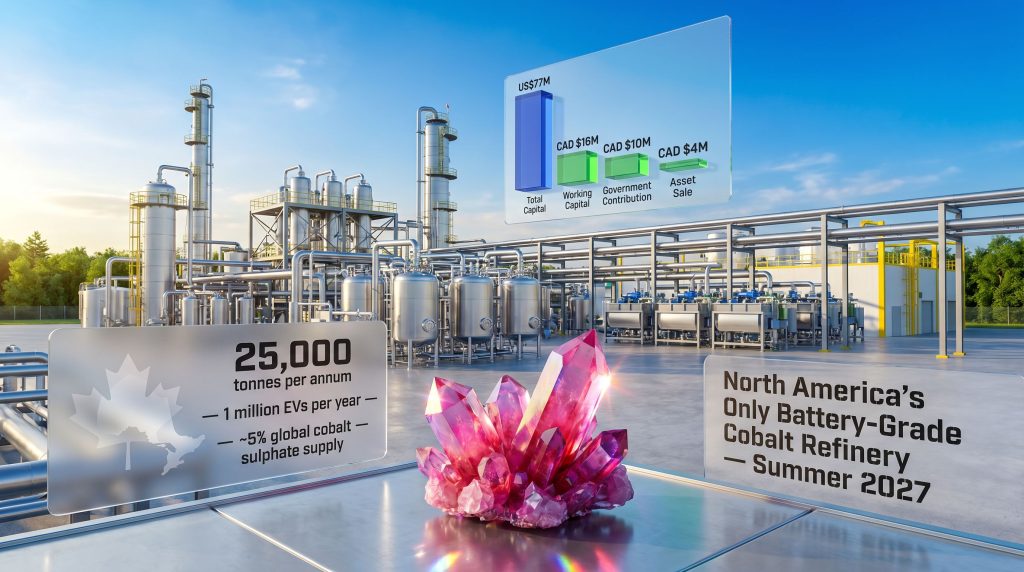
The total capital requirement for the refinery has been updated to approximately US$77 million, a meaningful increase from the US$56 million figure established in the May 2020 feasibility study. This escalation reflects real-world inflationary pressures on construction materials, engineering services, and equipment costs that have affected capital-intensive projects across the sector since that feasibility baseline was set.
The funding structure draws from multiple sources:
- $16 million CAD in working capital available at pre-construction commencement
- $10 million CAD in government contributions from Canadian federal and Ontario provincial sources
- Approximately $4 million CAD from the sale of a silver property to Kuya Silver, announced in December 2020
- Project-level debt financing currently being negotiated to cover the remaining capital requirement
Capital Structure Logic: The combination of working capital, public contributions, and asset sale proceeds provides sufficient runway to commence detailed engineering and long-lead procurement without waiting for debt financing to close. This parallel-path approach is deliberately designed to compress the schedule, accepting some execution risk in exchange for timeline compression.
The Debt Financing Risk Dimension
The project-level debt process running concurrently with engineering activities introduces a schedule dependency risk that investors and analysts should understand clearly. Certain long-lead equipment items, particularly the cobalt crystallizer and solvent extraction mixer-settler units, carry manufacturing lead times of 12 to 18 months. If procurement commitments for these items must be deferred pending debt financing closure, the overall project timeline extends accordingly.
The government contributions serve a function beyond their direct dollar value. Public co-investment signals policy alignment to commercial debt providers, reducing the perceived risk premium on the project and improving coverage ratio metrics in lender credit assessments. The silver asset monetisation demonstrates capital discipline — converting a non-core holding into liquidity at a point when project funding efficiency matters most.
Production Capacity and Strategic Market Position
What Full-Scale Output Looks Like
| Production Metric | Value |
|---|---|
| Annual cobalt sulphate output | ~25,000 tonnes |
| Contained cobalt equivalent | ~6,500 tonnes |
| Global cobalt sulphate market share | ~5% |
| EV battery packs supportable annually | Over 1 million |
| Target mechanical completion | H1 2027 |
| Expected commercial production | Summer 2027 |
The 6,500 tonnes of contained cobalt figure warrants contextualisation against real battery demand. At current NMC 811 and NMC 622 cathode chemistries, a mid-range EV battery pack consumes approximately 6 to 10 kilograms of cobalt sulphate. This means the Ontario refinery's full output supports somewhere between 2.5 million and 4 million individual battery pack equivalents depending on chemistry and pack size — though the headline figure of over one million vehicles is based on more conservative pack-level cobalt consumption assumptions.
Representing 5% of global cobalt sulphate supply from a single facility is commercially significant. In a market where Western battery manufacturers are actively seeking non-Chinese supply alternatives, a tier-one scale Western refinery commands a structural pricing premium over spot market cobalt sulphate sourced from Chinese processors. Indeed, shifts in global cobalt production are increasingly favouring Western processing alternatives as policy and market forces converge.
Feed Security: The 90% Utilisation Achievement
One of the more technically underappreciated aspects of this project is the feed security outcome. Securing cobalt feed agreements covering 90% of nameplate refinery capacity before construction commences fundamentally de-risks the revenue model. This level of pre-committed feedstock is exceptional for a facility not yet in production.
The sourcing geography of this feed is also instructive. The Democratic Republic of Congo accounts for approximately 70% of global cobalt mine production, and cobalt intermediate producers operating there have historically had limited refining pathway options outside of Chinese processing networks. The Ontario refinery's feed agreements reflect an active market demand from DRC-based intermediary producers seeking diversified refining routes — a dynamic with direct implications for long-term feed security. However, the recent DRC cobalt export ban introduces additional complexity around feed sourcing timelines that project planners will need to navigate carefully.
Ontario's Cobalt Belt: The Regional Industrial Context
A Century of Industrial Heritage
The Temiskaming Shores region carries a mining and metallurgical legacy extending back over a century, built initially on the silver and cobalt discoveries of the early 1900s that established the town of Cobalt, Ontario as one of Canada's most historically significant mining districts. This heritage translates into practical operational advantages: an experienced industrial workforce familiar with mineral processing operations, established contractor and supplier networks, and community familiarity with industrial activity.
Proximity to cobalt and nickel mining districts across northern Ontario and Quebec also creates potential for domestic feed diversification over time — reducing dependence on DRC-sourced intermediates as Canadian cobalt production develops. Reviewing cobalt supply by country reveals that Canada's domestic resource base, while currently modest relative to the DRC, represents a strategically important longer-term feedstock diversification pathway.
The next major ASX story will hit our subscribers first
Key Risks That Sophisticated Observers Are Watching
Technical and Operational Risks
- Flowsheet scale-up uncertainty: Pilot plant results may identify impurity management challenges requiring process design modifications before full-scale construction, adding time and cost to the pre-construction phase
- Crystallizer performance under variable feed: Battery-grade cobalt sulphate specifications are unforgiving, and crystallizer performance must be maintained across the full range of feed chemistry variability expected from multiple cobalt intermediate sources
- 18-month commissioning timeline: This reflects genuine technical complexity in achieving consistent battery-grade product quality at nameplate throughput, and should not be treated as conservative scheduling
Market and Competitive Risks
- Cobalt price cyclicality: Cobalt sulphate pricing has historically been highly volatile, with price swings of 50% or more within single calendar years. Project debt service coverage assumptions are sensitive to this variability
- Battery chemistry evolution: The accelerating commercial deployment of lithium iron phosphate (LFP) cathode chemistries in passenger EVs, particularly in the Chinese market, introduces a longer-term structural question about cobalt demand growth trajectories. LFP requires no cobalt whatsoever. However, NMC chemistries retain dominance in Western markets for energy-density-sensitive applications
- Chinese competitive advantages: Established Chinese cobalt refiners benefit from decades of process optimisation, integrated supply chains, and scale efficiencies that a new Western entrant cannot immediately match
Speculative Consideration: Some industry analysts have theorised that the shift toward higher-nickel, lower-cobalt cathode formulations (such as NMC 9.5.5) could reduce per-vehicle cobalt intensity even if total EV production volumes grow substantially. If this trend accelerates, absolute cobalt sulphate demand growth may disappoint versus projections embedded in 2020-era feasibility assumptions. This is a minority view balanced against the consensus expectation that overall EV volume growth will more than offset per-vehicle cobalt intensity reductions.
Frequently Asked Questions: First Cobalt Ontario Refinery Pre-Construction
What is the current status of pre-construction activities?
Detailed engineering, long-lead equipment procurement, and pilot plant solvent extraction testwork are all advancing concurrently. The EPCM contract with Ausenco is under negotiation alongside an active debt financing process.
Why is the capital cost higher than the 2020 feasibility estimate?
The original May 2020 feasibility study pegged initial capital at US$56 million. The updated figure of approximately US$77 million reflects construction cost inflation, engineering refinements, and updated equipment pricing that have materially affected project economics across the sector since 2020.
What does battery-grade cobalt sulphate mean in practice?
It refers to cobalt sulphate crystals meeting purity specifications accepted by cathode active material manufacturers, typically requiring cobalt content above 20.5% with controlled trace impurity levels. Standard cobalt intermediate concentrates cannot be used directly in cathode production without this refining step.
Why is solvent extraction pilot plant work so important?
Hydrometallurgical process performance does not scale linearly from laboratory to industrial operation. Pilot plant validation at representative throughput rates is essential to confirm flowsheet assumptions before committing full construction capital, particularly for impurity rejection performance that directly determines final product quality.
How significant is 5% of global cobalt sulphate supply from a single refinery?
In a Western market actively seeking alternatives to Chinese-refined cobalt sulphate, a facility producing 5% of global supply operates at a scale that qualifies it as a primary supplier to major battery manufacturers rather than a niche or supplementary source.
What Pre-Construction Progress Actually Signals to the Market
The transition from a permitted feasibility study to active pre-construction is a qualitative shift in project status that experienced resource investors recognise as disproportionately significant. A feasibility study is a financial and technical document. Pre-construction is capital deployed, engineering teams mobilised, and procurement commitments initiated.
Each pre-construction milestone completed in the First Cobalt Ontario refinery pre-construction program reduces the project's risk premium in two distinct ways: it narrows the technical uncertainty around the solvent extraction flowsheet, and it compresses the timeline to revenue in a manner that directly improves debt financing terms. Ontario's preparations for North America's first cobalt refining facility signal a level of governmental confidence in the project's strategic and commercial foundations that commercial lenders will weigh accordingly.
The broader industrial precedent being established here extends well beyond this single facility. Successfully delivering North America's first battery-grade cobalt sulphate refinery would create a replicable template for onshoring other critical mineral refining steps currently dominated by Chinese processing infrastructure. Governments, battery manufacturers, and mining companies across multiple jurisdictions will be watching the Ontario project's technical and commercial outcomes as a reference point for their own critical mineral processing investment decisions.
This article contains forward-looking statements and analysis involving project timelines, capital estimates, and production forecasts. These are subject to material risks including commodity price volatility, financing uncertainty, technical execution risk, and evolving battery chemistry demand dynamics. This content is informational in nature and does not constitute financial or investment advice. Readers should conduct their own due diligence before making investment decisions.
Want to Stay Ahead of the Next Major Battery Metals Discovery on the ASX?
Discovery Alert's proprietary Discovery IQ model scans ASX announcements in real time, instantly identifying significant mineral discoveries across cobalt, lithium, nickel, and over 30 other commodities — turning complex data into actionable investment opportunities before the broader market catches on. Explore how historic mineral discoveries have generated extraordinary returns and begin your 14-day free trial today to position yourself ahead of the market.