June 9, 2026
India's Coal Gasification Gamble: Can Domestic Chemistry Replace a $33 Billion Import Habit?
Every time a geopolitical conflict ripples through global energy markets, import-dependent economies face an uncomfortable truth: their industrial foundations are built on borrowed stability. For nations that source the majority of their fuels, fertilisers, and chemical feedstocks from abroad, supply chain disruptions are not abstract policy problems. They are direct threats to agricultural output, manufacturing competitiveness, and household energy affordability. This dynamic sits at the heart of why coal gasification in India has graduated from a niche industrial concept to a declared national priority.
When big ASX news breaks, our subscribers know first
The $33 Billion Import Problem That Coal Can Solve
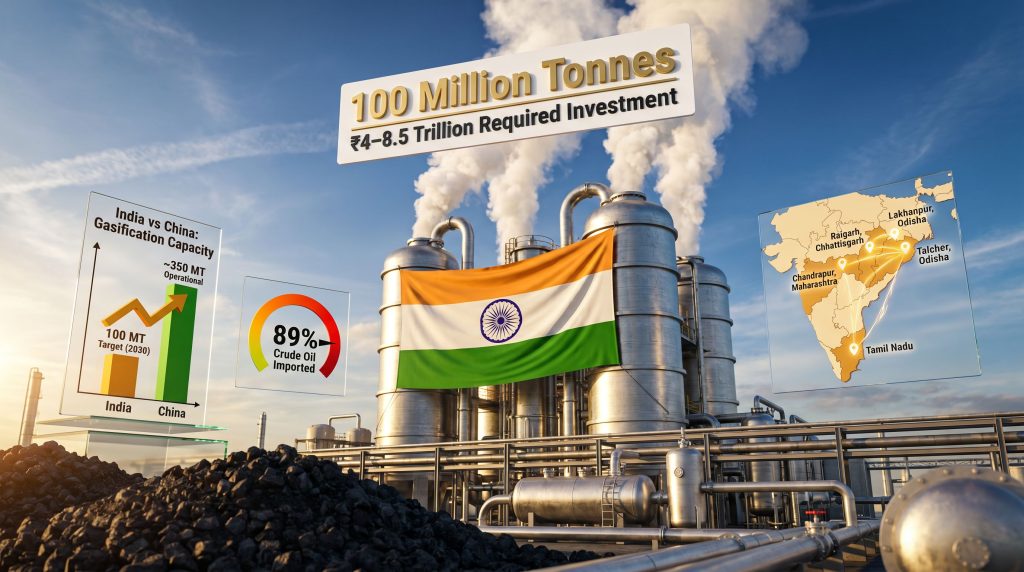
India's structural exposure to external energy and chemical markets is substantial by almost any measure. The country imports approximately 89% of its crude oil requirements, according to Pavan Kaushik, corporate advisor for mining, metals and infrastructure sectors and co-founder of Gurukshetra Consultancy, writing via ET EnergyWorld (May 12, 2026). That single figure captures a deep strategic vulnerability that compounds across multiple commodity categories.
When the full scope of India's import dependency is mapped across energy and industrial supply chains, the annual cost reaches nearly ₹2.77 lakh crore (roughly $33 billion USD), covering the LNG import tax structure, LPG, methanol, ammonia, urea, coking coal, and chemical feedstocks, according to Balasaheb Darade, Founder and Managing Director of New Era Cleantech Solutions, speaking to ET EnergyWorld (May 12, 2026). What makes this figure particularly striking is that many of these products can, in principle, be derived from a single domestic resource: coal.
Recent global supply disruptions, including those triggered by conflicts in West Asia, have intensified pressure on Indian policymakers to accelerate domestic alternatives. Prime Minister Narendra Modi publicly appealed for fuel conservation and reduced reliance on imported products to protect foreign exchange reserves during this period of supply chain stress (ET EnergyWorld, May 12, 2026). That appeal reflected a recognition that geopolitical volatility had moved from a theoretical risk category to an active economic pressure point.
How Coal Gasification Works: From Solid Rock to Strategic Asset
Understanding the strategic case for coal gasification requires grasping what the process actually does. Unlike conventional coal combustion, which burns solid coal to release heat energy, gasification chemically transforms coal into synthesis gas (syngas), a mixture of hydrogen, carbon monoxide, and carbon dioxide, through thermochemical reactions at high temperature and pressure with controlled amounts of oxygen or steam.
Coal gasification refers to the conversion of dry fuel into synthetic gas, which serves as an alternative fuel and contributes to reduced carbon emissions compared to direct combustion (ET EnergyWorld, May 12, 2026). That description understates its industrial versatility. Syngas is not simply a fuel substitute. It is a chemical platform from which downstream processes can produce:
- Hydrogen for clean energy applications and industrial uses
- Methanol for fuel blending, chemicals, and pharmaceutical feedstocks
- Ammonia for fertiliser production
- Urea for agricultural applications
- Dimethyl ether (DME) as an LPG blending agent and clean cooking fuel
- Ammonium nitrate for industrial and agricultural purposes
- Various petrochemical feedstocks currently sourced through imports
One technically underappreciated challenge specific to India is the high ash content in Indian coal reserves, which can reach up to 40% in certain coalfields. This significantly complicates the gasification process compared to lower-ash international benchmarks. Economic viability for standard gasification technologies typically requires ash content below approximately 30%, meaning that much of India's coal resource base requires pre-treatment or advanced reactor configurations to be commercially usable. This technical constraint is rarely discussed in mainstream policy coverage but represents one of the most significant engineering hurdles to achieving India's 2030 targets.
The 100 Million Tonne Target: Ambition Meets Arithmetic
India's National Coal Gasification Mission, launched in 2020, established a target of 100 million tonnes of coal gasification capacity by 2030. Achieving that goal would require capital investment estimated at ₹4 to ₹8.5 trillion (approximately $48 to $102 billion USD), according to Darade (ET EnergyWorld, May 12, 2026). To support project development, the government has budgeted ₹8,500 crore for gasification promotion initiatives, and commercial coal block auction frameworks include a 20% revenue share concession to improve project economics.
| Policy Metric | Detail |
|---|---|
| Mission Launch Year | 2020 |
| Capacity Target by 2030 | 100 million tonnes |
| Required Investment Range | ₹4 to ₹8.5 trillion (~$48 to $102B USD) |
| Government Budget Allocation | ₹8,500 crore |
| Revenue Share Incentive | 20% concession |
| Plants Formally Finalized | 7 |
| Groundbreakings Completed | 3 (as of 2026) |
A Steering Committee has been established under NITI Aayog, and a dedicated task force has been constituted for coal-based hydrogen production planning. Seven plants have been formally finalised under the mission framework, with three groundbreaking ceremonies completed as of 2026. These institutional structures signal policy commitment, but they do not automatically translate into operational capacity.
Kaushik frames the target as a multi-dimensional strategic instrument, describing it as reflecting a clear vision to strengthen energy security priorities, support domestic manufacturing, and reduce pressure on foreign exchange reserves (ET EnergyWorld, May 12, 2026). Critically, he emphasises that citizens increasingly understand that nation-building measures must be evaluated through long-term strategic outcomes rather than short-term economic calculations.
The Execution Gap: Where India Actually Stands
Despite holding the world's fifth-largest coal reserves, estimated at approximately 360 billion metric tonnes, India has commercialised only a fraction of its gasification ambitions. As of 2026, the country operates a single functioning commercial-scale coal gasification facility, Jindal Steel and Power's plant in Angul, Odisha, which represents approximately 2% of the 2030 capacity target. That gap between declared ambition and operational reality is the defining challenge of the mission.
A significant milestone occurred in April 2026 when India's first land-leasing agreement for an indigenous coal gasification project was signed at Lakhanpur, Odisha, between Bharat Coal Gasification and Chemicals Limited (BCGCL) and Mahanadi Coalfields Limited (MCL). The project is designed to produce ammonium nitrate using technology developed by Bharat Heavy Electricals Limited (BHEL), marking an important step toward deploying domestically engineered gasification systems. The minimum completion timeline from the agreement signing is estimated at two years.
The gap between India's 2030 ambition and current operational capacity is not merely a policy execution problem. It reflects the genuine complexity of deploying high-capital, long-gestation industrial infrastructure across a diverse regulatory, geographic, and technical landscape.
Projects in the Pipeline: A Multi-State Buildout
Beyond the Lakhanpur project, a multi-site development landscape is taking shape across India's coal-belt states. The project pipeline spans different gasification applications and organisational structures:
| Organisation | Location | Project Type |
|---|---|---|
| BCGCL and MCL | Lakhanpur, Odisha | Coal-to-Ammonium Nitrate |
| NLC India | Tamil Nadu | Lignite-to-Methanol (target: March 2027) |
| JSPL | Raigarh, Chhattisgarh | Coal-to-Syngas (second plant) |
| Talcher Fertilizer | Talcher, Odisha | Coal-based Urea Production |
| Eastern Coalfields | Jharkhand/West Bengal | Coal-to-Methanol |
| Central Coalfields | Ranchi, Jharkhand | Coal-to-Ammonium Nitrate |
| New Era Cleantech Solutions | Chandrapur, Maharashtra | Integrated Gasification (~$2.5B, 5 MMTPA) |
New Era Cleantech Solutions' Chandrapur project stands out as one of the largest private-sector commitments in the sector, targeting a 5 million metric tonnes per annum (MMTPA) facility in Maharashtra (ET EnergyWorld, May 12, 2026). BHEL's involvement as an indigenous technology provider across multiple projects is particularly significant, as it signals movement toward reducing India's dependency on imported gasification equipment — a strategic irony given the self-reliance objectives driving the entire programme.
The next major ASX story will hit our subscribers first
China's 350 Million Tonne Blueprint: What India Can Learn
China's coal gasification ecosystem provides both a benchmark and a cautionary tale about the time required to build industrial capacity at scale. China currently operates approximately 350 million tonnes of coal gasification capacity, a figure that exceeds India's entire 2030 target by a factor of more than three (Darade, ET EnergyWorld, May 12, 2026).
The strategic value of that infrastructure became visible during recent West Asia supply disruptions. While multiple countries experienced LNG shortages, fertiliser supply breaks, and commodity price spikes, China's domestic coal-to-chemicals ecosystem functioned as an industrial buffer, maintaining supply stability and reducing exposure to volatile global markets (ET EnergyWorld, May 12, 2026). This is precisely the resilience architecture that India is attempting to construct.
Furthermore, several specific capability gaps distinguish India's current position from China's:
- India lacks coal-to-olefins production capability, meaning entire product categories including ethylene remain inaccessible through domestic gasification pathways
- India continues to import critical gasification equipment from China as of early 2026, creating a dependency within a programme designed to reduce dependency
- China's model was built through phased capacity scaling, state-backed financing, and vertically integrated coal-chemical industrial clusters developed over multiple decades
China's coal gasification capacity was not the result of a single policy announcement. It was constructed through coordinated industrial strategy over decades. India's 2030 target requires compressing that developmental arc into less than ten years, which demands a fundamentally different execution velocity than anything India's industrial sector has previously attempted.
Strategic Benefits Across Multiple Sectors
The case for scaling coal gasification in India extends well beyond energy metrics. When mapped across India's economic structure, domestic syngas production addresses vulnerability simultaneously in several critical sectors:
Energy and Fuel Security
- Domestic syngas production reduces LNG and LPG import volumes directly
- DME can be blended with LPG as a partial substitute for imported household cooking fuel
- Hydrogen from gasification pathways connects to India's broader blue and grey hydrogen strategy
Fertiliser and Agricultural Resilience
- Domestically produced ammonia and urea insulate India's agricultural input supply chain from global price volatility
- Reduces exposure to fertiliser supply disruptions caused by geopolitical conflicts or shipping route interruptions
Pharmaceutical and Chemical Independence
- Methanol produced through gasification serves as a feedstock for active pharmaceutical ingredients (APIs)
- Reduces India's reliance on imported chemical intermediates across both speciality and bulk chemical categories
Regional Employment and Industrial Transition
- Coal-belt states including Jharkhand, Odisha, and Chhattisgarh stand to gain direct and indirect employment
- Gasification infrastructure creates downstream logistics, MSME supplier, and services sector employment
- Provides a structured industrial transition pathway for communities facing reduced activity from thermal power sector changes
Key Barriers Slowing India's Coal Gasification Rollout
Kapil Bansal of EY-Parthenon frames the strategic opportunity clearly, noting that coal gasification offers a pathway to strengthen energy security, fertiliser resilience, and industrial stability by enabling domestic production of critical fuels and chemical feedstocks (ET EnergyWorld, May 12, 2026). However, multiple structural barriers complicate the translation of that opportunity into operational capacity.
Technical Constraints
- High ash content (up to 40%) in Indian coal reduces gasification efficiency and increases processing costs significantly
- Economic viability deteriorates sharply when ash content exceeds approximately 30% without advanced pre-treatment
- Limited domestic engineering expertise in gasification reactor design, commissioning, and long-term operations management
Infrastructure and Regulatory Bottlenecks
- Complex multi-agency land acquisition processes extend project development timelines substantially
- Environmental clearance delays introduce significant uncertainty into capital deployment decisions
- Reliable water supply and grid-quality power access remain prerequisites that are inconsistently available across project sites
Structural and Policy Gaps
- Persistent low compliance with government coal-washing directives undermines feedstock quality across multiple project sites
- The capital intensity of projects, which involve multi-year construction timelines and multi-billion dollar commitments, limits private sector appetite without robust risk-sharing frameworks
- Technology transfer constraints mean India's coal-to-olefins gap leaves entire product categories accessible only through imports
The Carbon Question: Is Coal Gasification Environmentally Justified?
Critics of expanded coal gasification infrastructure raise legitimate concerns about locking in fossil fuel dependency during a period when renewable energy costs are declining rapidly. The counterargument, however, rests on a pragmatic assessment of India's energy transition timeline.
Coal gasification produces fewer particulate emissions per unit of useful output than direct coal combustion and offers a more efficient chemical conversion pathway. When integrated with carbon capture and storage (CCS) systems, the technology becomes substantially more compatible with long-term climate commitments. NITI Aayog projects that coal will remain a central component of India's energy mix until at least 2050, meaning the coal that will be consumed regardless can either be burned directly or converted through gasification into a broader range of useful products at higher efficiency.
In addition, the renewable energy transition will take decades to fully displace fossil fuel-derived chemical feedstocks. The honest framing of coal gasification is as a transitional technology: not a long-term clean energy solution, but a pragmatic mechanism for maximising the economic and environmental yield of fossil fuel resources during an unavoidable multi-decade energy transition. Whether that framing justifies the capital commitment depends entirely on how quickly renewable alternatives can scale to replace imported fossil fuels and chemical feedstocks.
Atmanirbhar Bharat: Coal Gasification as Economic Doctrine
Kaushik articulates the philosophical foundation for India's coal gasification push in terms that extend beyond energy policy into economic sovereignty. In his view, no major economy can afford excessive dependence on external energy and industrial supply chains in today's geopolitical environment, and global conflicts, trade disruptions, and currency volatility have demonstrated how strategic vulnerabilities translate directly into economic damage (ET EnergyWorld, May 12, 2026).
Within the Atmanirbhar Bharat framework, coal gasification functions as a multi-sector import substitution mechanism simultaneously addressing energy, fertilisers, chemicals, and pharmaceuticals. Reducing the ₹2.77 lakh crore annual import burden across gasification-addressable product categories would protect foreign exchange reserves, reduce current account pressure, and insulate Indian manufacturers from the currency volatility that amplifies commodity price shocks.
Consequently, nations with domestic industrial feedstock production maintain structural cost advantages in manufacturing. India's long-term competitiveness in fertiliser-intensive agriculture, chemical manufacturing, and pharmaceutical production is therefore partially contingent on whether its gasification ambitions translate into operational infrastructure by the time competing economies have locked in their supply chain configurations. This challenge is also reflected in how Australia and other resource-exporting nations approach their own resource and energy exports amid shifting global demand patterns.
Frequently Asked Questions: Coal Gasification in India
What is India's coal gasification target for 2030?
The National Coal Gasification Mission, launched in 2020, targets 100 million tonnes of gasification capacity by 2030, requiring an estimated investment of ₹4 to ₹8.5 trillion.
What products can be made through coal gasification?
Syngas produced through gasification can be converted into hydrogen, methanol, ammonia, urea, ammonium nitrate, dimethyl ether, and various chemical feedstocks — many of which India currently imports at significant cost. These outputs also align closely with green transition materials that are central to global decarbonisation strategies.
Why does India's coal type create technical challenges?
Indian coal can contain up to 40% ash content, which reduces gasification efficiency and increases processing complexity. Standard gasification technologies typically require ash content below 30%, making pre-treatment or advanced reactor designs necessary for much of India's coal resource base.
How does India compare to China in gasification capacity?
China operates approximately 350 million tonnes of coal gasification capacity, exceeding India's entire 2030 target more than threefold, and leveraged that infrastructure as a strategic buffer against disruptions from global energy shocks.
Is coal gasification a clean technology?
Coal gasification produces fewer particulate emissions than direct combustion and can be integrated with carbon capture systems. However, it remains a fossil fuel-based process and is best understood as a bridge technology rather than a permanent clean energy solution.
The Road to 2030: Closing the Execution Gap
Darade has described coal gasification's potential as one of India's largest industrial and economic transformation opportunities over the next two decades (ET EnergyWorld, May 12, 2026). Realising that potential within the 2030 timeframe requires simultaneous progress across several dimensions:
-
Regulatory acceleration through streamlined environmental and land clearance processes that reduce project development timelines without compromising oversight quality
-
Technology scaling by deploying BHEL's indigenous gasification technology across multiple project sites to reduce equipment import dependency and build domestic engineering expertise
-
Feedstock quality improvement through enforced coal-washing compliance mechanisms that bring Indian coal within viable ash content thresholds for efficient gasification
-
De-risked financing frameworks that lower the capital cost and execution risk for private sector participants in long-gestation, high-capital infrastructure projects
-
Integrated product planning that aligns gasification output strategies with India's fertiliser, petrochemical, pharmaceutical, and hydrogen policy roadmaps to ensure market demand absorbs new domestic supply
-
Workforce development through engineering education and technical training programmes that build the operational expertise required to run complex gasification facilities at commercial scale
The arithmetic of the 2030 target is demanding. Moving from approximately 2% of target capacity to 100% in under a decade requires an execution velocity that India's industrial sector has rarely achieved in comparable capital-intensive programmes. However, as Kaushik summarises, the strategic logic is not about short-term optics. It is about preparing India to remain economically strong, strategically independent, and globally competitive for the next several decades (ET EnergyWorld, May 12, 2026).
Disclaimer: This article contains forward-looking statements, projections, and investment-related information for informational purposes only. Statements regarding future capacity targets, investment requirements, project timelines, and economic outcomes are based on publicly available expert commentary and government policy announcements, and are subject to significant uncertainty. Readers should conduct independent due diligence before making any investment or business decisions based on this content. The views attributed to named individuals are sourced from publicly available media and do not constitute investment advice.
Want to Stay Ahead of the Next Major Mineral Discovery Driving India's Energy Transition?
As demand for commodities underpinning coal gasification, fertilisers, and industrial chemicals reshapes global resource markets, Discovery Alert's proprietary Discovery IQ model delivers real-time ASX mineral discovery alerts, turning complex geological data into actionable investment insights — explore historic discoveries and their exceptional returns, then begin your 14-day free trial to position yourself ahead of the market.