
May 11, 2026
India's Coal Supply Architecture and the Signals Hidden in Monthly Auction Data
Across the global energy landscape, few procurement mechanisms reveal as much about a nation's near-term fuel security as routine auction data. Monthly auction volumes from large state-owned producers do not merely reflect supply decisions; they encode signals about production constraints, buyer inventory cycles, geopolitical pressure, and strategic market positioning simultaneously. Interpreting those signals correctly separates informed market participants from those reacting to headlines alone.
Coal India's April 2026 e-auction data is a case study in exactly this kind of multi-layered reading. The Coal India April coal auction quantity drops 6% story is real, but the 6% figure is arguably the least interesting number in the dataset.
When big ASX news breaks, our subscribers know first
Coal India's Structural Role in India's Energy Economy
India's energy system operates at a scale that most markets struggle to conceptualise. The country consumes well over one billion tonnes of coal annually across its power, steel, cement, and industrial sectors, and a single entity is responsible for sourcing the overwhelming majority of it domestically.
Coal India Limited controls more than 80% of domestic coal production, operating as a Maharatna public sector undertaking under the Ministry of Coal. Its output decisions, auction pricing, and volume offerings ripple through the entire Indian economy in ways that go far beyond the energy sector. When CIL adjusts its auction supply, thermal power generators, sponge iron manufacturers, and cement producers all recalibrate their procurement and inventory strategies within days.
The company serves a buyer base that spans:
- Thermal power plants requiring high-volume, predictable supply
- Sponge iron producers with specific grade requirements (lower ash content preferred)
- Cement kilns needing cost-effective fuel
- Industrial consumers across a broad range of processing sectors
What makes CIL's e-auction mechanism particularly significant as a market barometer is that auction data is published and trackable on a monthly basis, creating a publicly visible data series that encodes demand and supply signals with relatively short lag times. Furthermore, the coal supply challenges facing India's energy market make this transparency all the more valuable for market participants.
The SWMA Platform: More Than Just an Auction Interface
The Single Window Mode Agnostic platform, launched in 2022, represents a substantial operational upgrade from CIL's legacy procurement architecture. Previously, buyers had to navigate separate auction windows for spot purchases, special spot allocations, and forward contracts, each with different interfaces, eligibility requirements, and bid mechanics. The fragmentation created information asymmetries that advantaged experienced traders over end-use consumers.
SWMA consolidates these formats into a single digital procurement interface, improving price discovery, reducing transaction friction, and creating a more transparent competitive bidding environment. For market analysts, the consolidated platform produces a cleaner data series than the fragmented predecessor system, making month-on-month comparisons more reliable as analytical tools.
A less-discussed but important feature of the SWMA design is its capacity for dynamic volume calibration. CIL can adjust the quantity of coal offered in any given month in response to production realities and demand signals, without being locked into a fixed calendar schedule. This flexibility is a structural improvement that makes auction volume changes more deliberate and signal-rich than they were under earlier mechanisms.
Dissecting the April 2026 Auction Numbers
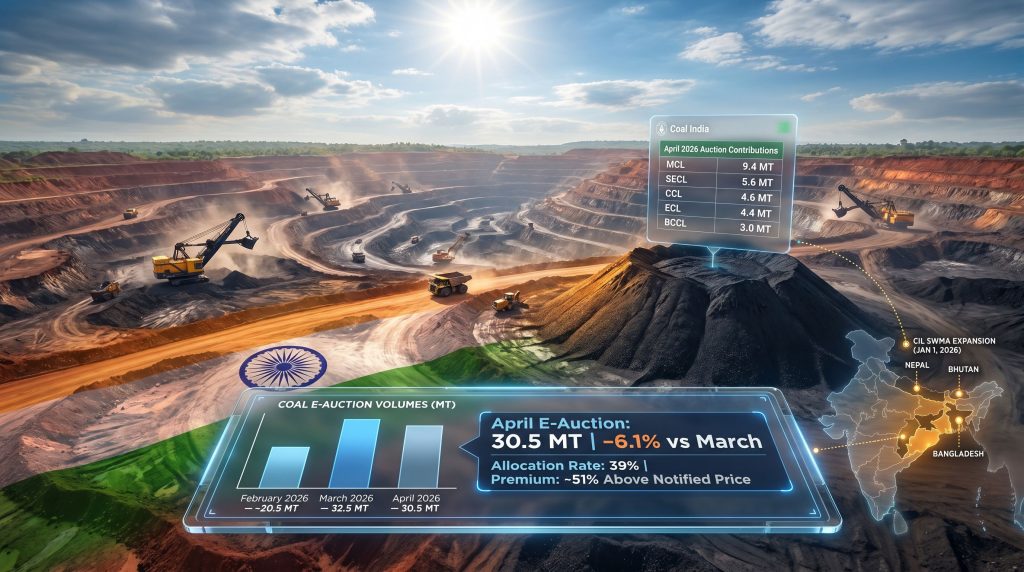
The headline figure, a sequential decline from 32.5 MT in March to 30.5 MT in April, represents a 6.1% month-on-month reduction in offered auction volume. Taken in isolation, this looks like a tightening supply story. Examined alongside the allocation rate and subsidiary breakdown, a more nuanced picture emerges.
Full April 2026 Auction Snapshot
| Metric | March 2026 | April 2026 | Change |
|---|---|---|---|
| Total Offered Volume | 32.5 MT | 30.5 MT | -6.1% |
| Approximate Allocated Volume | N/A | ~11.8 MT | ~39% of offer |
| Premium Over Notified Price | N/A | ~51% | Pricing resilient |
| CIL FY26 Full-Year Production | 781.1 MT (FY25) | 768.1 MT | -1.7% YoY |
| March 2026 Monthly Output | 85.8 MT (prior yr) | 84.5 MT | Modest decline |
The 39% allocation rate is the most strategically significant number in this dataset. When buyers collectively take up less than half of what is offered, it communicates that procurement urgency is low. This is not a market under stress from undersupply; it is a market where buyers have adequate inventory buffers and are choosing selectivity over volume accumulation.
Subsidiary-Level Auction Contributions: April 2026
| CIL Subsidiary | April Volume (MT) | Share of Total |
|---|---|---|
| Mahanadi Coalfields Ltd (MCL) | 9.4 | 30.8% |
| South Eastern Coalfields Ltd (SECL) | 5.6 | 18.4% |
| Central Coalfields Ltd (CCL) | 4.6 | 15.1% |
| Eastern Coalfields Ltd (ECL) | 4.4 | 14.4% |
| Bharat Coking Coal Ltd (BCCL) | 3.0 | 9.8% |
| Other subsidiaries | ~3.5 | 11.5% |
MCL's dominance at nearly 31% of total auction supply reflects the scale and operational efficiency of its open-cast mining operations in Odisha, which represent some of CIL's most productive blocks. BCCL's comparatively modest contribution at 3.0 MT reflects the particular profile of its operations in Jharkhand, which include a higher proportion of underground coking coal extraction — a more resource-intensive process but one with higher per-tonne operating costs.
The geographic concentration of auction supply across eastern and central India, spanning Odisha, Chhattisgarh, Jharkhand, and West Bengal, underscores an important structural characteristic of CIL's production base: supply is regionally clustered, which creates both logistical efficiency and vulnerability to region-specific disruptions.
Three Converging Forces Behind April's Volume Softness
Understanding why the Coal India April coal auction quantity dropped 6% requires examining production-side constraints and demand-side dynamics simultaneously. Neither factor alone explains the full picture.
Force 1: Production Headwinds Accumulating Through FY26
CIL's FY26 full-year production of 768.1 MT came in 1.7% below the FY25 figure of 781.1 MT, a contraction that marked a notable reversal from the trajectory of recent years. March 2026 output declined modestly to 84.5 MT from 85.8 MT in the prior corresponding period, per CIL's provisional data.
Several factors contributed to this broader production softness:
- Logistical bottlenecks at rail loading points, particularly affecting subsidiaries dependent on dedicated freight corridors
- Environmental clearance delays for new mining areas, slowing the activation of replacement capacity as older blocks deplete
- Operational constraints at ageing underground mines, where productivity rates decline over time without capital-intensive modernisation
- Pre-monsoon weather disruptions in April affecting open-cast mining efficiency across Odisha and Chhattisgarh operations
An important technical point that is not widely appreciated outside the sector: open-cast mining operations, which account for approximately 80–85% of CIL's total output, are significantly more weather-sensitive than underground operations. Pre-monsoon moisture buildup in April can affect bench stability, haul road conditions, and the performance of draglines and shovels operating in exposed pit environments. This creates predictable seasonal production compression that shows up reliably in April output data.
Force 2: Buyers Are in Inventory Management Mode
Despite robust summer electricity demand, India's thermal power plants entered April 2026 with meaningfully improved coal stockpile positions. Coal stockpiles at power plants reached approximately 54 MT as of late March 2026, representing the first notable improvement in inventory positions in roughly 28 months.
This context transforms the interpretation of the low 39% allocation rate. Generators were not absent from auctions because coal was unavailable or unaffordable; they were present but selective because existing inventory buffers reduced the urgency to accumulate additional volumes through spot channels.
This dynamic reflects a well-established pattern in commodity procurement psychology: when inventories are adequate, procurement managers shift from volume-maximising behaviour to cost-optimisation behaviour. Rather than bidding aggressively to secure any available volume, buyers wait for pricing conditions they consider favourable, knowing their operational continuity is not immediately at risk.
When power plant inventory levels rise above operational comfort thresholds, the spot auction market shifts from a necessity-driven market to a preference-driven one. That transition is visible in allocation rates, not offered volumes.
Force 3: West Asian Tensions Creating a Coal Competitiveness Paradox
Ongoing geopolitical instability across West Asia, a critical global oil and LNG production corridor, pushed crude oil and LNG prices higher during the period. This created an indirect but significant effect on India's coal market dynamics. In addition, the broader oil price movements stemming from regional tensions introduced further complexity into India's energy procurement calculus.
The mechanism works as follows: LNG pricing in Asia is substantially indexed to crude oil benchmarks, typically following formulaic relationships that translate crude oil price movements into gas contract pricing within a few months. When crude rises sharply, contracted and spot LNG costs follow, reducing the competitiveness of gas-fired power generation relative to coal-fired alternatives.
For India's power sector, which sources approximately 70% of electricity from coal-fired plants and imports a small but meaningful share of gas for combined-cycle generation, rising LNG costs reinforced the operational preference for coal dispatch. This accelerated coal burn from existing stockpiles at power plants, which simultaneously:
- Increased coal consumption rates
- Drew down inventory buffers faster than they would have depleted under normal demand conditions
- Created forward procurement urgency for future months even while near-term auction participation remained selective
The paradox this creates: West Asian tensions are bullish for domestic Indian coal demand over the medium term, but the immediate effect on April 2026 auction participation was neutral to slightly dampening, as power plants focused on utilising existing stocks before bidding for incremental volumes.
The FY27 Production Trajectory: An Early Warning Signal
Provisional data indicates that CIL's cumulative output for the April through July FY27 period declined approximately 6% year-on-year to 229.8 MT. This early-year production softness, arriving before the peak monsoon season, warrants careful monitoring.
Monthly Auction Volume Progression: February to April 2026
| Month | Offered Volume (MT) | Sequential Trend |
|---|---|---|
| February 2026 | ~20.5 | Low base |
| March 2026 | 32.5 | Sharp ramp-up |
| April 2026 | 30.5 | Moderate pullback |
The February-to-March surge in offered volumes, rising from approximately 20.5 MT to 32.5 MT, followed by April's moderation to 30.5 MT, suggests CIL was actively managing auction supply in response to real-time demand signals rather than following a rigid calendar. This is a meaningful operational capability that the SWMA platform enables, and it distinguishes the current procurement architecture from legacy systems where offered volumes were largely predetermined.
The monsoon season covering June through September typically constrains open-cast mining productivity across CIL's eastern and central India operations. If early FY27 production is already running 6% below the prior year before the monsoon arrives, there is a plausible pathway to a wider full-year shortfall unless operational performance recovers sharply in the post-monsoon quarters.
For market participants, this creates a monitoring priority: watch CIL's October and November production data as the post-monsoon recovery indicator. Historical patterns suggest Q3 (October through December) output needs to significantly compensate for Q2 losses. A failure to recover in Q3 would put India's coal self-sufficiency target under tangible pressure, potentially creating conditions for elevated import volumes and higher domestic auction premiums in late FY27.
Cross-Border Market Opening: A Structural Shift With Medium-Term Implications
Among the developments embedded in this auction cycle, the least-discussed but most structurally significant is CIL's decision to extend direct SWMA participation to coal consumers in Bangladesh, Bhutan, and Nepal, effective January 1, 2026. This move also aligns with the broader India coal trading exchange proposal that has been under discussion as part of India's evolving energy market architecture.
Before and After: How the Market Structure Changed
| Dimension | Before January 2026 | After January 2026 |
|---|---|---|
| Market access for regional buyers | Via domestic Indian traders only | Direct SWMA platform participation |
| Price transparency | Limited due to trader margin opacity | Market-driven, publicly discoverable |
| Surplus coal utilisation | Constrained by domestic-only mandate | Expandable via regional demand |
| CIL revenue potential | Domestic volume dependent | Augmented by cross-border demand |
| Competition dynamics | Domestic buyers only | Regional buyers competing alongside domestic |
The previous arrangement carried inherent inefficiencies that are not always visible in headline data. Domestic traders who intermediated coal sales to regional buyers operated without end-use restrictions, meaning coal purchased ostensibly for regional export could be resold domestically during periods of high domestic prices. This created pricing opacity and occasional supply leakage that the SWMA direct-participation model eliminates.
A senior CIL official described the policy rationale as a calibrated approach to market expansion designed to fully safeguard domestic coal requirements while enhancing transparency, competition, and regional market integration. The key phrase is calibrated: CIL has not opened the platform unconditionally but rather created a structured access mechanism that preserves domestic supply priority while creating an incremental demand channel.
Why This Matters for Auction Premium Dynamics
The addition of foreign buyers to the SWMA bidding pool creates a structural upside for auction premiums during periods of high demand. When Bangladesh, Bhutan, or Nepali buyers compete alongside Indian industrial consumers, the bidding depth increases. In tight supply conditions, this additional competitive layer could support premiums above the approximately 51% level recorded in April 2026.
Conversely, it introduces a new dynamic: during periods of subdued Indian domestic demand (as seen in April with the 39% allocation rate), foreign buyer participation could improve overall allocation rates by absorbing volumes that might otherwise remain unallocated. This functions as a demand buffer that improves CIL's resource utilisation efficiency.
The broader strategic implication is that CIL is gradually repositioning itself from a purely domestic supply mandate towards a regional energy supplier role — a shift that aligns with India's broader foreign economic engagement with its South Asian neighbours.
The next major ASX story will hit our subscribers first
Coal Quality, Grade Dynamics, and the Auction Premium Signal
A dimension of coal auction data that receives insufficient analytical attention is the relationship between coal grade, auction category, and premium realisation. India grades coal primarily on the basis of Useful Heat Value (UHV), which incorporates calorific value alongside moisture and ash content penalties. Grades A through G represent a descending quality spectrum.
The approximately 51% premium above notified prices observed in April 2026 is not uniform across all grades. Higher-grade coals, particularly those with lower ash content demanded by sponge iron producers and washery operators, typically command premium premiums materially above the blended average. Lower-grade thermal coal for less-sensitive power plants tends to attract smaller premiums.
This grade differentiation has a less commonly understood implication: when CIL reports aggregate auction premiums, the blended figure masks significant pricing dispersion by grade. A 51% average premium could include grades commanding 70–80% premiums from sponge iron buyers competing intensely for metallurgical-quality coal, alongside grades attracting 20–30% premiums from thermal generators using the auction as a flexible top-up to their linkage allocations.
Understanding this grade-level premium structure is important for assessing whether CIL's pricing power is broad-based or concentrated in specific quality categories, which has implications for revenue stability if production mix shifts over time.
India's Coal Self-Reliance Agenda: Structural Context
CIL's auction data exists within a specific policy framework that shapes how production and supply targets are set and communicated. India's push to reduce dependence on imported coal, which carries significant foreign exchange costs and exposure to global commodity price volatility, has elevated CIL's production mandate well beyond a simple commercial objective. The global crude steel outlook further reinforces this imperative, as steel production's dependence on coking coal makes any CIL supply shortfall a cross-sector concern.
The FY26 production figure of 768.1 MT, representing a 1.7% decline from FY25's 781.1 MT, marks the first notable year-on-year contraction in recent years. Against the backdrop of rising electricity demand driven by economic growth, industrial expansion, and summer cooling load, any sustained production shortfall from CIL creates a direct pressure on India's current account through increased coal import requirements.
India imports coal primarily from Indonesia, Australia, and South Africa for use in coastal power plants and for blending with domestic supplies at inland plants. Each incremental tonne of imported coal represents a foreign exchange outflow and a price risk exposure to global commodity markets — exactly the vulnerability that the self-reliance agenda is designed to minimise. India's resource energy exports balance consequently becomes a critical barometer for how successfully CIL meets its domestic mandate.
The early FY27 production data showing a 6% year-on-year decline through April to July is therefore not merely an operational story. It is a policy risk indicator with macroeconomic dimensions that extends well beyond CIL's corporate performance metrics.
Key Takeaways for Market Participants
The Coal India April coal auction quantity drops 6% dataset, when read carefully, communicates several distinct signals:
- The 6% sequential volume decline is a supply-side operational adjustment, not evidence of a structural market withdrawal
- The 39% allocation rate is the primary signal, indicating buyers are managing inventory rather than building it
- Auction premiums holding near 51% above notified prices confirm that CIL's pricing authority remains intact despite softer volumetric demand
- The cross-border SWMA expansion to Bangladesh, Bhutan, and Nepal is a medium-term structural demand catalyst that could meaningfully alter allocation dynamics during low-domestic-demand periods
- Early FY27 production running 6% below prior year before the monsoon season is a data point warranting close monitoring through October and November as the post-monsoon recovery window opens
- West Asian geopolitical pressures create a medium-term coal demand tailwind but produced near-term inventory draw-down dynamics that moderated April auction participation
This article contains forward-looking analysis and interpretive assessments based on publicly available data. Market conditions, production trajectories, and geopolitical developments are inherently uncertain. Readers should not rely on this content as investment advice. Independent verification of all statistics is recommended prior to any investment or commercial decision.
Want to Capitalise on the Next Major Resource Discovery Before the Market Catches On?
While India's coal supply dynamics reveal how rapidly commodity markets can shift, Discovery Alert's proprietary Discovery IQ model scans ASX announcements in real time, instantly identifying significant mineral discoveries across more than 30 commodities and transforming complex data into actionable opportunities — explore the historic returns major discoveries have delivered and begin your 14-day free trial at Discovery Alert to position yourself ahead of the broader market.