August 6, 2026
India's Raw Material Reckoning: Why the World's Largest Coal Miner Is Now an Iron Ore Developer
When a single state-owned enterprise controls more coal output than any other entity on Earth, its decision to pursue an entirely different mineral commodity carries weight beyond a simple balance sheet calculation. The logic running beneath Coal India's move into iron ore is not merely corporate diversification for its own sake. It reflects a structural tension building inside one of the world's fastest-growing industrial economies: the gap between India's steel ambitions and its ability to secure the raw materials needed to realise them.
Coal India wins Gadadharpur iron ore block in Odisha — a headline that may initially read as a routine auction result, but understanding this pivot requires stepping back from the surface details and examining the deeper mechanics of resource nationalism, energy transition pressures, and the reconfiguration of India's state-owned enterprise ecosystem that together make this acquisition a genuinely significant moment in Indian mining history.
When big ASX news breaks, our subscribers know first
The Strategic Logic Behind Coal India's Iron Ore Entry
When a Coal Giant Looks Beyond Coal
Coal India Limited has operated for decades as the backbone of India's energy supply chain, accounting for the overwhelming majority of the country's domestic coal production. Its scale is extraordinary: the company operates across multiple states, employs hundreds of thousands of workers, and its output decisions move markets. That identity, however, is increasingly complicated by India's long-term decarbonisation trajectory and the structural questions it raises about coal demand beyond the next decade.
In response, Coal India has been quietly repositioning itself. Prior diversification moves included investments in solar energy generation and early-stage exploration activities in critical minerals. The Gadadharpur auction win represents the most commercially substantial step yet in that strategic evolution, transforming Coal India from a single-commodity producer into a licensed developer of one of the world's most fundamental steelmaking inputs.
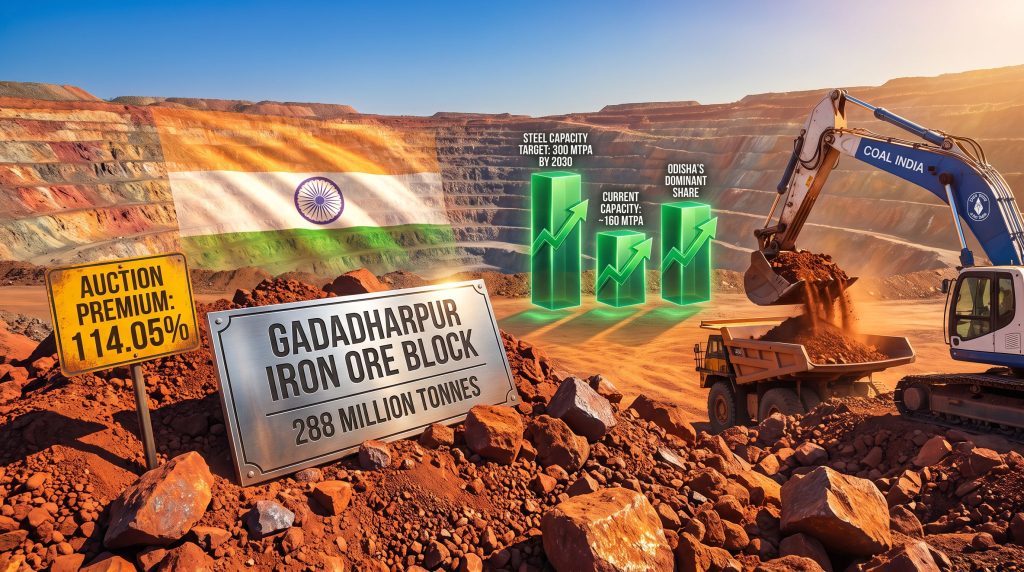
The policy rationale is straightforward. India's National Steel Policy targets steelmaking capacity of 300 million tonnes per annum (MTPA) by 2030, compared to approximately 160 MTPA currently. That trajectory demands a parallel and sustained expansion in iron ore supply. Captive block ownership by state-linked entities reduces raw material price volatility for downstream producers and insulates strategic industries from spot market shocks.
India's MMDR Framework and the Auction Gateway
The competitive auction mechanism through which Coal India secured Gadadharpur operates under India's Mines and Minerals (Development and Regulation) Act, significantly reformed in 2015. These reforms replaced discretionary allocation of mineral blocks with transparent e-auction processes, fundamentally reshaping how India distributes its mineral wealth. The reforms were designed to:
- Maximise state revenue through competitive bidding
- Reduce the scope for opaque allocation decisions
- Accelerate the transition of blocks from allocation to active production
- Enable state-owned enterprises to compete directly with private sector bidders
The post-2015 MMDR environment has generated some of the most competitive mineral auctions seen anywhere in Asia, with premium percentages frequently reaching levels that would have seemed extraordinary under the prior allocation regime.
Block Profile: Gadadharpur Iron Ore in Detail
Geological Classification and Resource Confidence
The Gadadharpur iron ore block sits within the Kendujhar (Keonjhar) district of Odisha, a region that sits at the centre of India's iron ore geography. The district is part of the Iron Ore Belt of eastern India, a geological formation extending across parts of Jharkhand and Odisha that hosts some of the subcontinent's most significant banded iron formation deposits. Understanding the various iron ore types and deposits in this region is essential context for evaluating the block's longer-term potential.
| Parameter | Detail |
|---|---|
| Block Name | Gadadharpur Iron Ore Block |
| Location | Kendujhar (Keonjhar) District, Odisha |
| Exploration Stage | G3 (early-stage reconnaissance) |
| Reported Resource Estimate | ~288 million tonnes |
| Successful Bidder | Coal India Limited |
| Auction Premium | 114.05% of mineral dispatch value |
The G3 classification is a critical detail that deserves careful unpacking. Under India's geological exploration framework, resource classifications follow a tiered confidence system:
- G4: Reconnaissance-level, broadest spatial coverage, lowest confidence
- G3: Prospecting-level, geological mapping and limited sampling completed
- G2: General exploration, systematic drilling and sampling underway
- G1: Detailed exploration, resource estimates approaching bankable feasibility quality
A G3 classification means the 288 million tonne estimate is based on prospecting-level evidence. Significant additional drilling, geochemical sampling, and resource modelling work is required before this figure can be upgraded to a bankable reserve estimate suitable for project financing or detailed mine planning. Furthermore, understanding the distinction between mineral deposit tiers helps clarify why investors and analysts should treat this resource figure as a geological indicator rather than a confirmed reserve, as the final mineable tonnage may differ materially once detailed exploration is complete.
"Geological Insight: Banded iron formations in the Kendujhar region typically host iron ore with grades ranging from moderate to high-grade haematite and magnetite mineralisation. However, G3-stage resource estimates carry wide confidence intervals, and the ratio of proved to inferred resources will only become clear through systematic infill drilling."
Why Odisha Sits at the Centre of India's Iron Ore Strategy
Odisha is India's largest iron ore producing state by volume, and its mineral districts are directly connected to the country's steel capacity expansion narrative. The Kendujhar district in particular hosts multiple operating mines and undeveloped blocks, with rail connectivity to the major steel corridors of eastern India and port access through Paradip and Dhamra.
When measured against India's total iron ore reserve base, a 288 million tonne resource is a meaningful incremental addition, though it represents a fraction of the total endowment. Its strategic value lies less in absolute scale and more in the captive supply security it provides a state-linked entity navigating an increasingly competitive raw material environment. As covered in recent reporting by Mining Weekly, this block win is being closely watched across the broader mining community.
The Competitive Auction: Process, Premium, and Fiscal Implications
How the Gadadharpur Auction Unfolded
The allocation of Gadadharpur to Coal India followed the structured e-auction process mandated under MMDR reforms:
- Block notification by the Odisha government, listing Gadadharpur as available for competitive tender
- Bidder qualification, where eligible entities including state-owned enterprises submitted technical and financial credentials
- Competitive bid submission, with participants nominating premium percentages over the mineral dispatch value
- Preferred bidder declaration, with Coal India emerging as the winning party at a premium of 114.05%
- Preferred bidder period of up to one year, during which Coal India must satisfy conditions to transition to successful bidder status
- Mining lease execution, with up to three years from preferred bidder declaration to formalise the lease deed
Decoding the 114.05% Premium
For those unfamiliar with India's mineral auction mechanics, the premium percentage can be counterintuitive. It does not mean Coal India pays 114.05% of the block's estimated value as a one-time upfront sum. Instead, the premium represents an ongoing levy on every unit of iron ore dispatched from the mine.
In practical terms: for every ₹100 worth of iron ore dispatched from Gadadharpur, Coal India pays the Odisha government ₹114.05 as a premium, stacked on top of statutory royalties and other applicable levies. This is a revenue-linked obligation that scales directly with production volume, aligning the state government's fiscal interests with the mine's operational output.
"Fiscal Context: Odisha's state government has become increasingly sophisticated at extracting maximum value from its mineral wealth through competitive auctions. Premium levels above 100% of dispatch value reflect the intense competition for quality iron ore assets and the state's leverage in a supply-constrained market."
This premium structure has meaningful implications for the economics of Gadadharpur's development. The higher the premium, the more important it becomes for Coal India to achieve production volumes that justify the ongoing per-tonne fiscal burden. Consequently, this creates an incentive for Coal India to progress the block efficiently once environmental and lease approvals are secured.
Development Timeline and Key Risk Factors
The Multi-Year Journey from Block Award to First Ore
Even with the preferred bidder status secured, the path to active iron ore production at Gadadharpur stretches across multiple years and involves navigating some of India's most complex regulatory and environmental approval processes.
Year 1: Transitioning from preferred to successful bidder requires satisfying regulatory conditions, confirming feasibility at the exploration-stage resource, and initiating environmental impact assessment processes.
Years 1 to 3: Execution of the formal mining lease deed involves detailed geological drilling to upgrade the G3 resource toward higher confidence categories, along with forest and environmental clearance applications across relevant central and state government agencies.
Post-lease period: Mine development proper begins only after the lease is executed. Infrastructure build-out, including access roads, internal haul routes, crushing and screening facilities, and rail linkages to connect with the broader eastern India logistics network, represents a capital-intensive phase before the first tonne of ore can be dispatched. A comprehensive definitive feasibility study will be essential before any final development decisions can be made.
Risk Landscape: What Could Slow or Complicate Development?
Several material risks bear close attention:
- Resource uncertainty at G3 stage: The gap between a prospecting-level estimate and a bankable reserve can be substantial. Detailed drilling may reveal structural complexity, variability in ore grade, or waste rock ratios that affect the economics of extraction.
- Environmental and forest clearances: Mineral-rich districts in Odisha frequently overlap with ecologically sensitive and forested terrain. Obtaining clearances from the Ministry of Environment, Forest and Climate Change, as well as state-level authorities, has historically extended timelines for multiple iron ore projects in the region.
- Operational capability gap: Coal India has no existing operational experience in iron ore mining. The mineralogy, processing requirements, and logistics of iron ore differ significantly from coal. Building internal capability through workforce training, equipment procurement, and potentially technical partnerships with experienced iron ore operators will be essential.
- Logistics infrastructure: While Kendujhar has existing rail connectivity, the specific location of the Gadadharpur block relative to the nearest railhead will determine the capital requirements for first-mile infrastructure development.
"Speculative Perspective: Some industry observers have suggested that Coal India may eventually seek technical collaboration with an experienced iron ore producer to accelerate the operational learning curve at Gadadharpur. While no such arrangement has been confirmed, the precedent of knowledge-transfer partnerships in India's mining sector is well established, and it would not be unprecedented for a first-time iron ore operator of this scale to pursue such an arrangement."
India's Steel Demand Equation and Odisha's Role
The Supply-Demand Gap Coal India Is Helping to Bridge
India's steel sector is in the midst of a generational expansion. The country's per-capita steel consumption remains well below global averages, and urbanisation, infrastructure development, and manufacturing growth are expected to drive sustained demand increases through the 2030s. Against this backdrop, the iron ore supply chain is a strategic chokepoint. The broader dynamics shaping steel and iron ore markets globally provide important context for understanding why India is accelerating its domestic supply security strategy.
Odisha's production dominance makes it the indispensable node in India's iron ore supply architecture. The state's output supports both integrated blast furnace steel plants and the growing fleet of electric arc furnace operators that are increasingly prominent in India's evolving steel production mix. As India's steel sector transitions toward greater scrap-based production over the longer term, the near and medium-term demand for virgin iron ore remains robust and growth-oriented.
Infrastructure Demand as a Secondary Driver
Beyond steelmaking, iron ore demand is supported by the extraordinary scale of India's infrastructure investment programme. National highway expansion, urban metro rail networks, port capacity additions, and river development projects collectively represent steel-intensive demand that has no near-term ceiling. Captive iron ore ownership by state entities like Coal India creates a degree of raw material pricing stability that benefits the entire downstream chain, from structural steel fabricators to project developers.
The next major ASX story will hit our subscribers first
What Coal India's Diversification Signals to the Market
The SOE Repositioning Narrative
Coal India's entry into iron ore is not an isolated event. It is part of a broader restructuring of India's state-owned enterprise landscape, driven by the recognition that single-commodity SOEs face existential strategic risk in a world where resource demand patterns are shifting. In addition, the iron ore industry advantages that established producers hold over newcomers illustrate just how significant the operational learning curve will be for Coal India.
The Gadadharpur win positions Coal India as a multi-commodity resource company. While a single block does not transform the enterprise overnight, it establishes the precedent, the internal capability building process, and the institutional knowledge base that could support further mineral diversification over time. For investors monitoring India's listed mining and steel sector companies, Coal India's iron ore entry raises a downstream integration question: could a future arrangement see Gadadharpur's production feeding into state-owned steel producers such as SAIL?
Such an arrangement would represent a logical extension of the resource security rationale that appears to have motivated the original auction bid. No such arrangement has been announced, and this remains speculative at this stage. However, as further analysis from Live Mint has noted, the structural incentives for vertical integration within India's SOE ecosystem are compelling.
Market Psychology and the Precedent Effect
Capital markets will be watching Coal India's iron ore execution closely, not just for its direct commercial implications but for what it signals about the viability of the SOE diversification model. A successful development at Gadadharpur could encourage other coal-focused state enterprises in emerging markets to pursue analogous pivots into steelmaking raw materials. A prolonged development timeline or cost overrun, however, would reinforce the operational capability arguments that sceptics have raised about single-commodity entities moving into technically distinct mineral domains.
Frequently Asked Questions: Coal India Wins Gadadharpur Iron Ore Block in Odisha
What is the Gadadharpur iron ore block?
It is a mineral resource located in the Kendujhar district of Odisha, holding an estimated 288 million tonnes of iron ore resources at G3 exploration stage. Coal India secured the block through a competitive government auction.
Why is Coal India entering iron ore mining?
The move reflects a strategic mandate to diversify beyond coal, support India's steel production ambitions, and build raw material supply security for the country's industrial expansion programme.
What does the 114.05% auction premium mean in practice?
For every ₹100 worth of iron ore dispatched from the mine, Coal India pays ₹114.05 to the Odisha state government as an ongoing premium, in addition to standard royalties and statutory levies.
What is G3 exploration classification?
G3 represents an early-stage geological assessment where prospecting work has been completed but detailed systematic drilling has not yet been conducted. The resource estimate carries meaningful uncertainty and requires significant further work before bankable reserves can be confirmed.
How long before mining begins at Gadadharpur?
Coal India has up to one year to achieve successful bidder status and up to three years to execute the mining lease deed. Active mining would commence only after lease execution, environmental clearances, and infrastructure development, placing first production several years away at the earliest.
What does this mean for Odisha's state revenues?
The 114.05% premium on mineral dispatch value represents a significant and production-linked revenue stream for the Odisha government, adding to the state's substantial existing income from its mineral sector.
This article is intended for informational purposes only and does not constitute financial or investment advice. Resource estimates at G3 exploration stage carry material uncertainty and should not be interpreted as confirmed reserves. Readers should conduct independent due diligence before making investment decisions related to any company or sector mentioned.
Want to Stay Ahead of Significant Mineral Discoveries on the ASX?
Discovery Alert's proprietary Discovery IQ model delivers real-time alerts the moment significant mineral discoveries are announced on the ASX, transforming complex geological data into actionable investment insights — explore historic discovery returns to understand the potential scale of major finds, then begin your 14-day free trial at Discovery Alert to position yourself ahead of the broader market.