August 6, 2026
The Architecture of India's Grid-Scale Storage Revolution
Battery energy storage is not simply a technology product. It is an infrastructure layer that determines whether a country's renewable energy ambitions can translate into reliable, dispatchable electricity at national scale. Across markets where solar and wind penetration has accelerated rapidly, the pattern is consistent: generation capacity builds faster than grid management tools can accommodate, creating structural imbalances that storage must ultimately resolve. India is now at precisely this inflection point, and the Ola Electric and Axis Energy battery storage deal represents exactly the kind of commercial framework that will define the country's grid stability trajectory well into the 2030s.
When big ASX news breaks, our subscribers know first
Why India's Energy Transition Demands a Domestic BESS Industry
The Grid Reliability Gap That Renewables Alone Cannot Solve
India's renewable energy expansion has been one of the most aggressive in the world, with solar installations in particular growing at a pace that has surprised even optimistic forecasters. Yet the engineering reality of renewable integration creates a paradox: the faster generation capacity grows, the more acute the need becomes for firm, dispatchable power that can be called upon regardless of weather conditions.
Intermittency is not a minor operational inconvenience. It manifests as renewable curtailment during periods of oversupply, grid frequency instability when generation and demand fall out of balance, and reliability shortfalls during evening peak demand windows when solar generation has ceased. Without large-scale BESS acting as an enabling infrastructure layer, each additional gigawatt of renewable capacity added to India's grid carries diminishing reliability returns. Furthermore, the critical minerals demand required to support this scale of deployment is intensifying across the supply chain.
The Central Electricity Authority's 400+ GWh Storage Mandate by 2032
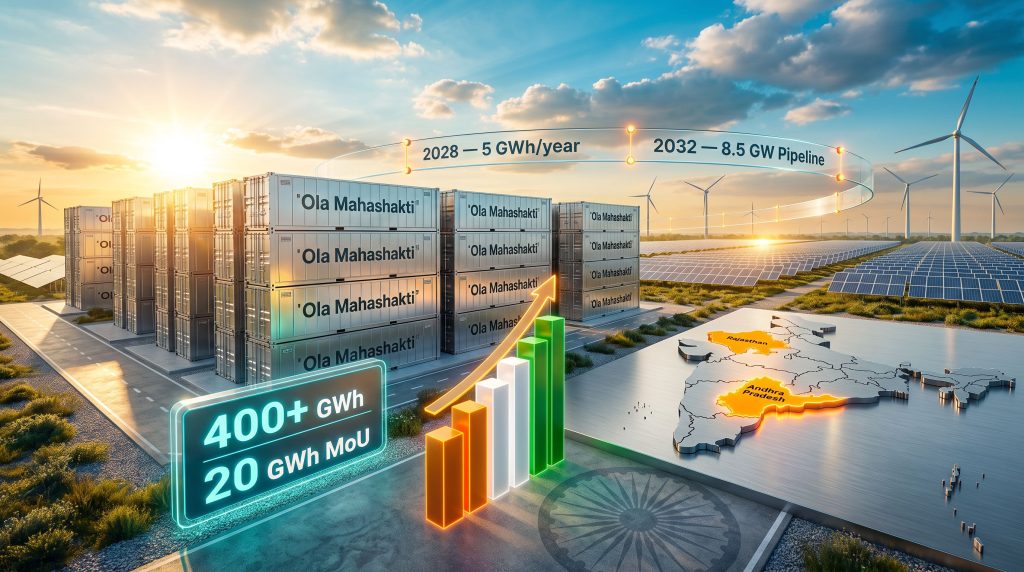
India's Central Electricity Authority has quantified the storage requirement embedded in the country's energy transition plan at more than 400 GWh by 2032. This is not a target derived from aspiration alone. It reflects the calculated gap between firm power demand and the intermittent output profiles of renewable assets across India's diverse geographic zones.
The 400 GWh figure represents one of the most substantial national storage planning requirements of any emerging economy globally, and the commercial gap between current installed capacity and this target is the market that domestic and international BESS players are now positioning to capture.
The scale of this requirement helps contextualise why private-sector bilateral agreements are now complementing the traditional government tender pathway. Tenders alone, with their multi-year procurement cycles, cannot close a gap of this magnitude within the available timeframe.
What Is the Ola Electric and Axis Energy Battery Storage Deal?
Deal Structure at a Glance
The Ola Electric and Axis Energy battery storage deal represents one of the most significant private-sector storage commitments announced in India's energy market to date. The agreement, structured as a memorandum of understanding, establishes a framework for deploying up to 20 GWh of battery energy storage systems across Axis Energy's renewable project portfolio through 2032.
| Parameter | Detail |
|---|---|
| Agreement Type | Memorandum of Understanding (MoU) |
| Total Deployment Target | Up to 20 GWh |
| Annual Deployment Rate (from 2028) | Up to 5 GWh per year |
| MoU Duration | Through 2032 |
| Technology Platform | Ola Mahashakti BESS |
| Application Scope | Commercial, industrial, and utility-scale |
Why This MoU Matters Beyond the Numbers
Several dimensions of this agreement deserve analytical attention beyond the headline gigawatt-hour figure. In addition, the battery raw materials market context makes the timing of this deal particularly significant:
- This is Ola Electric's first large-scale utility-grade storage partnership, representing a decisive strategic expansion beyond its established electric two-wheeler business.
- For Axis Energy, the MoU signals a deliberate evaluation of domestically manufactured BESS as an alternative to imported systems, a choice with meaningful supply chain and cost implications.
- The deal provides the Mahashakti platform with a commercially credible deployment pipeline ahead of its August 2026 public launch, validating the platform's utility-scale positioning before it has entered the market.
- The bilateral structure bypasses public tender timelines, potentially compressing deployment schedules relative to government procurement pathways.
Introducing Ola Mahashakti: India's Vertically Integrated BESS Platform
What Sets Mahashakti Apart From Imported BESS Solutions
The competitive positioning of the Mahashakti platform rests on a vertically integrated manufacturing architecture that spans cell chemistry, production processes, and complete system engineering. This end-to-end integration model is relatively rare in India's current BESS landscape, where most deployed systems rely on imported cell packs assembled into locally configured enclosures.
Vertical integration carries specific technical and commercial advantages in the BESS context. Consequently, these advantages are becoming increasingly relevant as India's direct lithium extraction capabilities continue to evolve:
- Cell-to-system optimisation: When cell chemistry and system engineering are developed within the same organisation, performance parameters, thermal management, and battery management system algorithms can be co-designed rather than adapted from third-party specifications.
- Supply chain resilience: Domestic cell production reduces exposure to import bottlenecks, currency movements, and geopolitical trade disruptions that have periodically affected global battery supply chains.
- Cost trajectory control: Vertically integrated manufacturers can capture margin across multiple production stages and apply manufacturing learning curve effects more comprehensively than assemblers reliant on external cell supply.
- Customisation capability: Domestic engineering control allows configuration adjustments for India-specific climate conditions, grid voltage requirements, and application profiles.
Manufacturing Infrastructure Supporting Mahashakti
Ola Electric's production ecosystem supporting the Mahashakti platform operates across two dedicated facilities:
- The Future Factory in Tamil Nadu serves as the primary manufacturing hub for electric vehicles and components, with BESS production integrated into this industrial-scale facility.
- The Battery Innovation Centre (BIC) in Bengaluru provides dedicated research and development capacity for cell technology advancement and system performance optimisation.
This separation of innovation from production mirrors the organisational structure adopted by leading global battery manufacturers, allowing R&D cycles to proceed without disrupting production throughput.
Target Application Segments for Mahashakti
The platform's commercial scope spans three distinct market segments, each with different technical requirements and procurement dynamics:
- Commercial and Industrial (C&I): Behind-the-meter deployments for large energy consumers seeking to reduce peak demand charges, improve power quality, and build resilience against grid outages. Notably, India's C&I segment has historically been slower to adopt battery storage than utility-scale customers, partly because economics vary considerably from site to site, unlike rooftop solar where payback periods are more predictable.
- Utility-Scale Grid Storage: Front-of-meter deployments supporting frequency regulation, voltage stability, and renewable energy firming across transmission-connected grid nodes.
- Firm and Dispatchable Renewable Energy (FDRE): Storage-backed renewable configurations designed to deliver guaranteed output profiles under power purchase agreements requiring round-the-clock delivery commitments.
Axis Energy's Renewable Pipeline: Why Scale Demands Storage
Understanding Axis Energy's Project Portfolio
Axis Energy Ventures, headquartered in Hyderabad, brings more than 15 years of renewable energy development experience to this partnership. Its portfolio metrics establish the company as one of India's most substantial independent renewable developers:
| Portfolio Metric | Figure |
|---|---|
| Commissioned Renewable Capacity | More than 1.5 GW |
| Total Development Pipeline | Over 8.5 GW |
| Grid-Approved Projects (Andhra Pradesh and Rajasthan) | Over 3.75 GW |
| Additional Capacity in Development | 3.5 GW |
| Years of Industry Experience | 15+ |
The geographic concentration of grid-approved projects in Andhra Pradesh and Rajasthan is strategically significant. Both states rank among India's highest-quality renewable resource zones, with Rajasthan hosting some of the subcontinent's strongest solar irradiance conditions and Andhra Pradesh offering strong wind-solar hybrid potential. However, both regions also experience pronounced renewable generation variability and grid balancing challenges at scale.
Why Axis Energy Needs Large-Scale BESS
Axis Energy's project configurations, spanning FDRE contracts, hybrid renewable formats, and non-solar generation types, share a common technical requirement: storage integration is not optional but structurally necessary to meet contracted output obligations.
FDRE contracts, in particular, place stringent performance requirements on developers. These agreements commit to delivering a specified quantum of electricity during defined time blocks, regardless of solar irradiance or wind speed at the moment of delivery. Meeting these commitments without storage backing is not technically feasible under current grid conditions.
The Brookfield Renewable Connection
Axis Energy operates through a 51:49 joint venture with Brookfield Renewable, structured through the Evren platform and backed by Brookfield's $20 billion Global Transition Fund II. This institutional relationship provides several strategic advantages:
- Access to institutional-grade project finance at scale, reducing the cost of capital for storage-integrated renewable developments.
- International investment credibility that supports procurement of long-term power purchase agreements with large off-takers.
- Brookfield's global BESS procurement experience, which informs Axis Energy's evaluation of domestic versus imported storage solutions.
Strategic Scenario Analysis: What Does 20 GWh of BESS Deployment Actually Mean?
Scenario 1: Full Execution by 2032 (Base Case)
If the Ola Electric and Axis Energy battery storage deal converts to binding contracts and deployment proceeds at 5 GWh per year from 2028, the outcomes are material for both parties and for India's domestic storage manufacturing sector:
- Ola Mahashakti would rank among India's largest domestic BESS suppliers within five years of commercial launch.
- 20 GWh deployed across Axis Energy's portfolio would substantially improve the dispatchability profile of projects representing a significant fraction of its 8.5 GW pipeline.
- Demonstrated deployment at this scale would likely attract additional utility-scale partnerships for Ola, creating a commercial flywheel effect for the Mahashakti platform.
Scenario 2: Partial Execution (Conservative Case)
MoUs in India's energy sector carry well-documented execution risk. Grid connectivity timelines, financing conditions, land acquisition complexities, and regulatory approvals have historically combined to delay even well-capitalised projects.
Even at 50% execution, approximately 10 GWh of deployed capacity would represent a commercially meaningful milestone for India's domestic BESS manufacturing sector and provide Ola with sufficient scale to drive manufacturing learning curve cost reductions.
The credibility buffer in this deal, however, is stronger than a typical speculative MoU. Axis Energy already holds grid approvals for over 3.75 GW of projects in Andhra Pradesh and Rajasthan. These are not conceptual pipelines but assets with regulatory clearances in place, creating a realistic foundation for storage procurement conversations to progress toward binding agreements.
Scenario 3: Accelerated Execution (Upside Case)
India's storage tender pipeline is intensifying, with procurement activity accelerating as the gap between renewable ambition and grid delivery capability becomes more visible. If Axis Energy's grid-approved projects translate to construction starts ahead of schedule, annual BESS deployment could exceed the 5 GWh MoU parameter.
An accelerated execution outcome would carry implications beyond Ola and Axis Energy individually. It would position the Mahashakti platform as a benchmark domestic product and could attract interest from energy developers and off-takers across South and Southeast Asian markets where similar grid reliability dynamics are emerging.
The next major ASX story will hit our subscribers first
How Does This Deal Fit India's Broader BESS Market Landscape?
From Tenders to Bilateral Commercial Models
India's BESS procurement history has been dominated by centralised government tenders, where the Solar Energy Corporation of India and state electricity regulators have defined storage specifications, volume targets, and tariff structures. This model has advantages in terms of policy alignment but creates execution bottlenecks: multi-year procurement cycles, appeal processes, and financing conditions have caused persistent gaps between announced tender volumes and actual installed capacity.
The Ola–Axis partnership reflects a structural evolution in how storage capacity is being contracted in India, with private-sector bilateral agreements emerging as a parallel and potentially faster pathway for large-scale deployment. This shift mirrors patterns observed in more mature BESS markets, where bilateral offtake agreements between developers and manufacturers have consistently delivered faster execution than public procurement. Furthermore, battery expansion alliances in other markets demonstrate how these commercial structures can unlock investment at speed.
Comparing India's Storage Ambitions Against Global Benchmarks
| Market | National Storage Target | Timeline |
|---|---|---|
| India | 400+ GWh | By 2032 |
| European Union | 45 GW installed capacity | By 2030 |
| United States | No single federal target; state-level mandates vary | Ongoing |
India's 400 GWh requirement is notably defined in energy terms rather than power capacity terms, reflecting the Central Electricity Authority's focus on dispatchable energy delivery rather than instantaneous grid support alone.
The Domestic Manufacturing Imperative and Import Dependency Risk
India's current BESS supply chain carries a structural vulnerability that the Mahashakti platform is directly designed to address. The overwhelming majority of battery cells deployed in India's energy storage systems today are manufactured in China, creating exposure across multiple risk dimensions:
- Geopolitical trade risk: Bilateral trade tensions or export restrictions could disrupt supply chains with minimal advance warning.
- Currency exposure: Rupee depreciation against the yuan directly inflates the cost of imported cells and reduces the competitiveness of storage-backed renewable projects.
- Technology dependency: Reliance on external cell manufacturers limits India's ability to optimise cell chemistry for local conditions or develop proprietary performance advantages.
Government production-linked incentive schemes for advanced chemistry cell manufacturing are designed to accelerate domestic production capability. However, without large-scale domestic demand commitments, manufacturing investment decisions struggle to achieve the volume thresholds needed for cost-competitive production. The Indian lithium investment landscape is consequently shifting as developers and policymakers alike recognise this supply chain gap.
What Does Ola Electric's Pivot to Energy Storage Mean for Its Business Strategy?
From EV Manufacturer to Integrated Energy Company
Ola Electric has established itself as India's leading electric two-wheeler manufacturer, but the Mahashakti initiative represents a more fundamental strategic evolution. The company is repositioning from a single-market EV player into a diversified energy technology company with exposure to both mobility and grid storage.
This diversification follows a pattern demonstrated by global EV manufacturers. Tesla's Megapack product line, now a multi-billion dollar revenue contributor, emerged directly from the battery manufacturing expertise developed for the Model S and subsequent vehicle platforms. The underlying logic is compelling from a capital allocation perspective: EV and stationary BESS manufacturing share cell chemistry requirements, battery management system engineering, thermal management design, and manufacturing process expertise.
R&D and capital expenditure incurred for EV production can be partially amortised across a second, large and growing revenue stream in grid storage. Ola Electric's chairman described the Axis Energy partnership as the first large-scale validation of Mahashakti's commercial potential, positioning it as an early signal of a broader partnership programme rather than a singular deal.
The emphasis on safety, performance, and total cost of ownership as competitive differentiators reflects an understanding that large-scale BESS buyers, particularly developers backed by institutional capital like Brookfield, apply rigorous technical and financial due diligence to storage procurement decisions. Reports following the announcement indicated that Ola Electric's share price responded positively, reflecting capital market recognition of grid-scale storage as a material growth vector for the company beyond its established EV business.
Frequently Asked Questions: Ola Electric and Axis Energy Battery Storage Deal
What is the Ola Electric and Axis Energy battery storage deal?
Ola Electric and Axis Energy Ventures have signed a memorandum of understanding to deploy up to 20 GWh of battery energy storage systems across India by 2032, targeting up to 5 GWh of annual deployment from 2028. The storage systems will be supplied through Ola Electric's Mahashakti platform and integrated across Axis Energy's renewable project portfolio.
What is Ola Mahashakti and when does it launch?
Ola Mahashakti is Ola Electric's battery energy storage platform, targeting commercial, industrial, and utility-scale applications. It is built on a vertically integrated, India-designed and India-manufactured architecture covering cell technology, production, and system engineering. The platform was scheduled to launch on 15 August 2026.
Why does India need 400 GWh of battery storage by 2032?
India's Central Electricity Authority has identified 400+ GWh of storage as a grid planning requirement to support the country's energy transition. This volume is needed to enable firm and dispatchable renewable energy delivery, maintain grid frequency stability at high renewable penetration levels, and replace fossil fuel-based peaking power with clean dispatchable alternatives.
Who is Axis Energy and what is the Brookfield connection?
Axis Energy Ventures is a Hyderabad-based renewable energy developer with over 15 years of industry experience, more than 1.5 GW of commissioned capacity, and an 8.5 GW development pipeline. The company operates through a 51:49 joint venture with Brookfield Renewable via the Evren platform, backed by Brookfield's $20 billion Global Transition Fund II.
Is the 20 GWh deployment target guaranteed?
The current agreement is structured as an MoU, establishing intent and a collaboration framework rather than binding contractual obligations. Conversion to firm contracts will depend on project financing timelines, grid connectivity approvals, and construction schedules across Axis Energy's portfolio.
What is FDRE and why does it require battery storage?
Firm and Dispatchable Renewable Energy is a power purchase structure that requires developers to guarantee delivery of a specified electricity quantum during defined time windows, regardless of real-time generation conditions. Meeting FDRE obligations from solar or wind assets without storage backing is technically impossible, making BESS a structural component of all FDRE project configurations.
Key Takeaways: What the Ola–Axis Deal Signals for India's Energy Storage Future
- Private-sector bilateral BESS deals are emerging as a complement to government tender pathways, with potential to deliver faster execution for projects with existing grid approvals and financing depth.
- Domestic vertical integration is evolving from industrial policy aspiration to commercial reality, with Mahashakti representing a credible market-entry challenge to imported BESS systems across India's utility-scale segment.
- The Brookfield-backed depth of Axis Energy's pipeline distinguishes this MoU from aspirational announcements, grounding the 20 GWh target in a portfolio of grid-approved, financeable projects.
- Ola Electric's strategic pivot into grid storage mirrors the EV-to-energy company transitions observed globally and introduces a substantial new total addressable market to the company's growth narrative.
- The 2028 to 2032 deployment window aligns with India's most critical grid transformation period, when renewable penetration will require storage at scale to prevent the system reliability deterioration that has accompanied rapid renewable build-out in other markets.
- India's import dependency in battery cells remains a structural risk, and domestic manufacturing platforms like Mahashakti represent the supply chain diversification response that both commercial and policy logic demands.
Disclaimer: This article contains forward-looking statements, scenario projections, and analytical assessments based on publicly available information as of the date of publication. The deployment targets discussed reflect a memorandum of understanding and are subject to conversion into binding contracts. Nothing in this article constitutes financial or investment advice. Readers should conduct independent due diligence before making any investment decisions.
Want to Capitalise on the Next Major Energy Transition Discovery Before the Market Moves?
Discovery Alert's proprietary Discovery IQ model instantly identifies significant ASX mineral discoveries across critical battery materials — from lithium to the commodities powering India's grid-scale storage revolution — delivering real-time alerts so subscribers can act ahead of the broader market. Explore historic examples of exceptional discovery returns and begin your 14-day free trial at Discovery Alert to position yourself at the forefront of the next major find.