August 6, 2026
Africa's Downstream Dilemma: Why Refining Capacity Lags Behind the Drill Bit
Across Africa's oil-producing nations, a recurring pattern has emerged over the past three decades. Countries discover commercially viable crude reserves, attract upstream investment, advance production timelines, and then discover that their downstream infrastructure is nowhere near ready to process what comes out of the ground. This sequencing failure is not unique to any single country, but Uganda has become one of its most visible examples. The Uganda Kabaale refinery delay is no longer a minor scheduling issue. It has evolved into a structural liability with compounding fiscal consequences that will shape the country's economic trajectory well into the next decade.
Understanding why this keeps happening requires looking beyond any single decision or announcement. The forces at work are systemic: capital intensity, regulatory complexity, investor confidence cycles, and the fundamental difficulty of building greenfield energy infrastructure in frontier markets where the financing ecosystem is shallow and project risks are concentrated. Furthermore, the broader geopolitical risk landscape facing African energy projects adds another layer of unpredictability to an already complex picture.
When big ASX news breaks, our subscribers know first
The $2 Billion Annual Problem Uganda Cannot Afford to Ignore
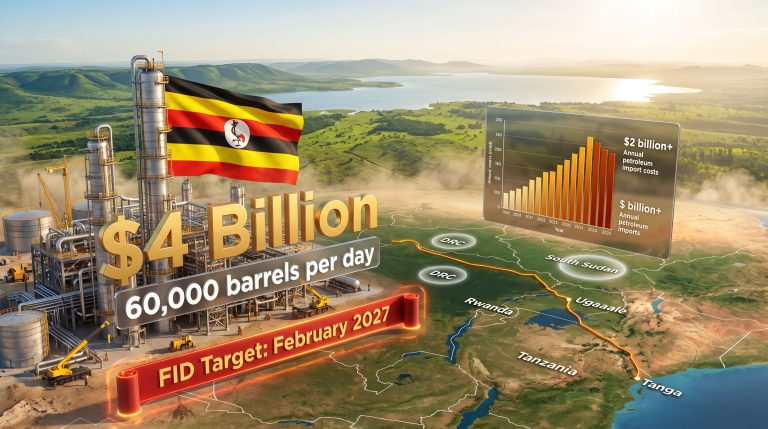
Before examining the refinery's troubled history, it is worth anchoring the discussion in the fiscal reality Uganda faces every year the project remains unbuilt. According to data published by Africa Energy Portal, Uganda currently spends more than $2 billion annually on imported petroleum products. That figure represents one of the most significant drains on the country's foreign exchange reserves, and it accumulates regardless of whether global oil prices are high or low.
The cruel irony is that Uganda sits atop commercially proven crude reserves in the Albertine Graben basin, estimated at approximately 6.5 billion barrels of oil in place. The country is approaching commercial production, yet every litre of petrol, diesel, and jet fuel consumed domestically must still be purchased on international markets, refined elsewhere, and transported overland at significant cost. Without the Kabaale refinery, this situation will persist even after Uganda begins exporting crude oil, creating a scenario where the country simultaneously exports raw barrels and imports processed products.
The table below places the current situation in context:
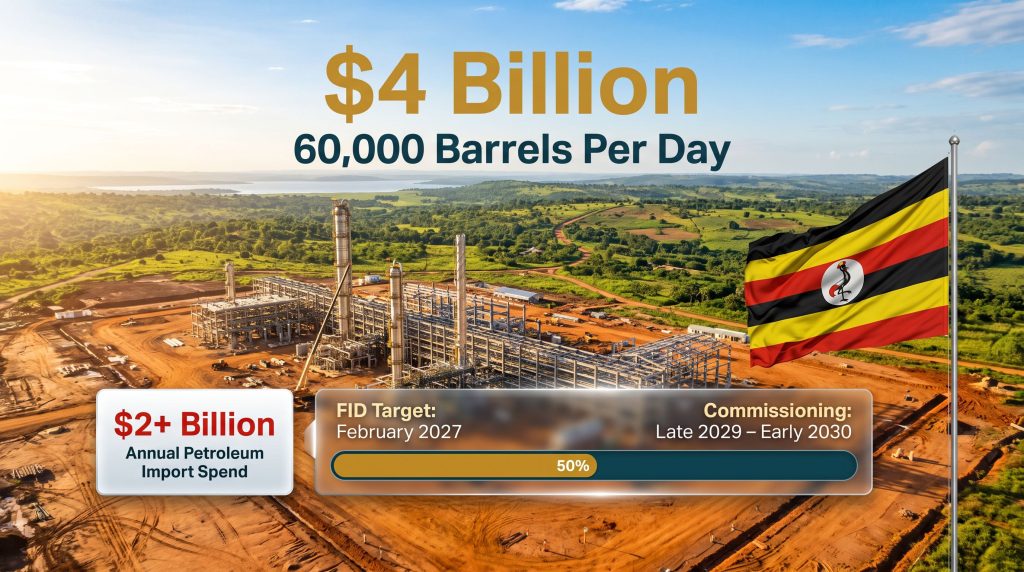
| Metric | Current Status |
|---|---|
| Annual petroleum import expenditure | $2+ billion USD |
| Planned refinery processing capacity | 60,000 barrels per day |
| Total refinery project value | $4 billion USD |
| FID revised target date | February 2027 |
| Estimated commissioning window | Late 2029 to early 2030 |
| Current FEED study completion (as of Oct 2025) | ~50% |
| Alpha MBM Investments equity stake | 60% |
| UNOC equity stake | 40% |
What the Kabaale Refinery Is Actually Designed to Do
Location, Scale, and Strategic Purpose
The Kabaale refinery is planned for Hoima District in western Uganda, positioned within the Albertine Graben region that also hosts the Tilenga and Kingfisher upstream oil fields. With a designed throughput of 60,000 barrels of crude oil per day, it is intended to shift Uganda from being a net importer of refined petroleum products into a domestically self-sufficient petroleum economy with potential surplus capacity to supply landlocked neighbours.
The regional market opportunity is substantial. Rwanda, Burundi, South Sudan, and parts of eastern Democratic Republic of Congo all depend on road and rail supply chains for petroleum products, making them natural customers for a cost-competitive regional refinery. If the Kabaale facility reaches full operational capacity, it could consequently reshape East Africa's refined products trade flows meaningfully.
The EACOP Connection and the Two-Track Strategy
The refinery was never intended to stand alone within Uganda's oil architecture. The East African Crude Oil Pipeline (EACOP), a 1,443-kilometre heated export pipeline connecting the Albertine Graben fields to Tanzania's port of Tanga, was designed to run parallel to domestic refining capacity. The logic was straightforward: Uganda would export surplus crude through EACOP while the refinery processed the volumes required for domestic consumption and regional supply.
The Petroleum Authority of Uganda (PAU) serves as the primary regulatory body overseeing both infrastructure streams. That dual oversight role has become increasingly strained as both projects experience concurrent schedule slippage. In addition, government intervention risks across the region have created further uncertainty for project developers navigating Uganda's regulatory environment.
Two Decades of Setbacks: Tracing the Full Timeline
Three Investors in Twenty Years
The Kabaale refinery project has cycled through three separate developer arrangements since it was first proposed, with each transition resetting financing timelines, renegotiating commercial terms, and consuming years of pre-construction work.
- RT Global Resources (Russia): the original developer, withdrew without achieving financial close
- Albertine Graben Refinery Consortium: assumed the development mandate before also exiting the project
- Alpha MBM Investments (UAE): signed a memorandum of understanding in December 2023, followed by a full implementation agreement in March 2025
The current ownership structure places Alpha MBM Investments at 60% and the Uganda National Oil Company (UNOC) at 40%, a configuration that represents the most stable governance arrangement the project has had. However, stability in ownership structure is a necessary rather than sufficient condition for delivery. The harder challenge remains assembling the financing and completing the engineering prerequisites for a final investment decision.
Key Milestones and Missed Deadlines
| Period | Development |
|---|---|
| Pre-2020 | RT Global Resources withdrawal; full project restart required |
| 2020 to 2023 | Albertine Graben Consortium exit; renewed investor search |
| December 2023 | Alpha MBM Investments signs memorandum of understanding |
| March 2025 | Implementation agreement formally executed |
| October 2025 | FEED study reported at approximately 50% completion |
| July 2026 (original) | FID previously targeted |
| August 5, 2026 | PAU announces FID postponed to February 2027 |
| Late 2029 to early 2030 | Earliest realistic commissioning estimate |
Four Structural Barriers Behind the Latest Uganda Kabaale Refinery Delay
1. The FEED Study Gap
A Front-End Engineering Design study is the foundational technical document that underpins any final investment decision for a large-scale industrial facility. It defines the engineering parameters, equipment specifications, cost estimates, and process configurations that lenders and equity investors require before committing capital. Without a completed FEED, no credible FID is contractually or financially possible.
The FEED study for the Kabaale refinery, being conducted by UOP Honeywell, was reported at approximately 50% completion as of October 2025. This single data point made the original July 2026 FID target unrealistic well before the PAU formally announced the postponement. The PAU confirmed in August 2026 that basic engineering works remain ongoing but declined to disclose the current completion percentage, leaving the market without a clear signal of when the documentation will be finalised.
The incompleteness of the FEED at the time of the original FID target window is arguably the most technically decisive factor behind the latest delay. No major project lender will commit to a $4 billion greenfield refinery on the basis of half-finished engineering documentation.
2. Financing Architecture Complexity
Assembling project finance for a $4 billion greenfield refinery in a frontier oil market is among the most complex capital-raising exercises in infrastructure finance. Lenders typically require completed FEED documentation, environmental and social impact assessments, offtake agreements, and government consent packages before credit committees will approve term sheets.
The UNOC's 40% equity position, while strategically important for Ugandan government participation, also adds layers of approval processes and inter-party negotiation to the financing structure. Coordinating between a UAE-based private developer, a state-owned oil company, and an international lender syndicate across multiple jurisdictions is a process measured in years, not months. For context, African project finance trends indicate that frontier market capital structures are becoming increasingly complex as global risk appetites shift.
3. Unresolved Land Compensation Disputes
Long-running compensation disputes involving residents displaced by the Hoima District land acquisition for the refinery site remain unresolved. These proceedings create a category of legal uncertainty that project lenders treat with particular sensitivity. Financial institutions operating under international environmental and social standards cannot advance funding to a project carrying active litigation over community displacement without a clear resolution pathway. No disclosed timeline for resolving these disputes has been made public by either the government or the PAU.
4. Competing Priorities Within Uganda's Oil Programme
The Tilenga and Kingfisher upstream fields have progressed further through the regulatory and construction pipeline than the refinery. The EACOP pipeline is simultaneously experiencing its own schedule slippage. The PAU attributed the pipeline delays to logistics disruptions linked to conflict in the Middle East, which has affected equipment procurement and delivery timelines across multiple African energy projects.
Managing three major oil infrastructure programmes simultaneously stretches regulatory bandwidth and creates resource allocation pressures within a single oversight body. This is a structural constraint that is rarely discussed in project-specific reporting but has meaningful implications for delivery timelines across Uganda's entire oil programme. Moreover, supply chain disruptions stemming from global trade tensions have compounded equipment delivery challenges for large-scale energy infrastructure projects throughout the region.
The EACOP Complication: Concurrent Slippage Across Uganda's Oil Infrastructure
The interdependency risk created by simultaneous delays to both the Kabaale refinery and the EACOP pipeline deserves closer attention than it typically receives. Uganda's crude oil monetisation strategy depends on both infrastructure streams being operational within a reasonably compressed timeframe.
Commercial crude production from the Tilenga and Kingfisher fields is expected to begin in late 2026 or early 2027. If neither the refinery nor the export pipeline is ready when production commences, Uganda faces a scenario where it is generating crude oil without a viable large-scale exit route for either raw exports or domestic processing.
The interim consequences would include:
- Continued dependence on imported refined petroleum products at a cost exceeding $2 billion annually
- Reliance on road and rail export routes with significantly lower throughput capacity than a completed pipeline
- Compression of Uganda's net oil revenue in the early production years when the resource economics should be most favourable
- Potential pressure on Alpha MBM Investments and UNOC to demonstrate tangible project delivery to maintain financing relationships
No revised EACOP completion timeline has been publicly disclosed as of August 2026, leaving the combined infrastructure risk difficult to quantify precisely.
The next major ASX story will hit our subscribers first
African Greenfield Refineries: A Pattern of Underperformance
Uganda's experience is part of a broader continental pattern. Greenfield refinery projects across Africa have consistently taken longer and cost more than initial projections suggested. Comparing the Kabaale project against regional and continental peers illustrates the structural dynamics at work.
| Country | Project | Planned Capacity | Key Delay Factor | Status |
|---|---|---|---|---|
| Uganda | Kabaale Refinery | 60,000 bpd | FEED incomplete; investor changes | FID target February 2027 |
| Nigeria | Dangote Refinery | 650,000 bpd | Financing and construction complexity | Operational (phased) |
| Tanzania | EACOP-linked refinery discussions | TBC | Policy alignment | Pre-feasibility |
| Niger | Zinder Refinery expansion | ~20,000 bpd | Political instability | Constrained |
The Dangote Refinery in Nigeria, despite its enormous scale, took approximately a decade longer than originally planned to reach operational status. Its eventual commissioning demonstrates that these projects can be completed, but the timeline expectations embedded in initial announcements are rarely realistic.
Across Africa, greenfield refinery delays share common root causes:
- Capital intensity: multi-billion dollar projects require financing structures that take years to fully assemble and are sensitive to commodity price cycles
- Regulatory layering: overlapping national, environmental, lender-required, and host government approval processes that run sequentially rather than in parallel
- Infrastructure prerequisites: power supply, water access, logistics networks, and workforce capacity requirements that must be developed alongside the refinery itself
- Investor confidence cycles: frontier market risk premiums that expand and contract with oil price geopolitics, affecting the cost and availability of project finance
What February 2027 Actually Requires: The FID Checklist
Achieving a credible FID in February 2027 is not simply a matter of announcement. It requires the simultaneous completion of several independent workstreams, each of which carries its own uncertainty.
Step-by-step: from current position to a viable FID
- Complete the UOP Honeywell FEED study from approximately 50% to full completion, including all engineering documentation required by lenders and the PAU
- Obtain PAU regulatory review and formal approval of the engineering documentation package, a process whose timeline has not been publicly disclosed
- Finalise project financing agreements between Alpha MBM Investments, UNOC, and the lender syndicate, incorporating completed FEED outputs into credit documentation
- Resolve or adequately manage outstanding land compensation proceedings to satisfy international lender environmental and social standards
- Execute Engineering, Procurement, and Construction (EPC) contracts on terms consistent with the finalised financing structure
If FID is achieved in February 2027, the construction and commissioning sequence would then unfold as follows:
- Site preparation and civil works: estimated 6 to 12 months post-FID
- Major equipment procurement and delivery: 18 to 24 months, subject to global supply chain conditions
- Mechanical completion: estimated 2028 to 2029
- Commissioning and testing: 6 to 12 months
- First refined product output: earliest realistic window is late 2029 to early 2030
Each six-month extension beyond the February 2027 FID target translates directly into a corresponding period of additional petroleum import dependency. At Uganda's current import expenditure rate, a six-month delay beyond FID costs the country in excess of $1 billion in additional foreign exchange outflows, compounding a fiscal pressure that has already accumulated over two decades.
Frequently Asked Questions: Uganda Kabaale Refinery Delay
What is the current status of the Kabaale refinery project?
As of August 2026, the Final Investment Decision has been postponed to February 2027. Basic engineering works are underway, and PAU approval is required before construction can formally commence. The FEED study by UOP Honeywell was approximately 50% complete as of October 2025, with no updated completion percentage disclosed publicly. The UNOC project page provides the most current official documentation on project milestones.
Who currently owns the Kabaale refinery project?
UAE-based Alpha MBM Investments holds a 60% stake following an implementation agreement signed in March 2025. Uganda National Oil Company (UNOC) retains the remaining 40%.
When will the Kabaale refinery be operational?
Based on the February 2027 FID target and standard construction timelines for a facility of this scale and complexity, the earliest realistic commissioning window is late 2029 to early 2030.
How much does Uganda spend on petroleum imports?
Uganda currently spends more than $2 billion annually on imported petroleum products, a figure that will continue to accumulate until the refinery becomes operational and reaches commercial throughput.
Why has the project been delayed so many times?
The project has experienced delays spanning more than two decades, driven by three separate investor exits, incomplete pre-construction engineering, the inherent complexity of financing a $4 billion greenfield facility in a frontier market, unresolved land compensation disputes in Hoima District, and competing regulatory priorities across Uganda's broader oil development programme.
Energy Sovereignty vs. Infrastructure Reality: The Longer View
The policy logic behind the Kabaale refinery remains sound. A domestically operating refinery would reduce Uganda's foreign exchange outflows significantly, create skilled downstream employment, capture processing margin value within the national economy, and position Uganda as a refined products exporter to landlocked regional markets. These strategic objectives have not changed across two decades and three investor cycles.
What has changed is the urgency. With commercial crude production now approaching, the window in which the refinery can come online before Uganda is locked into a prolonged structural paradox of simultaneous crude export and petroleum product import is narrowing considerably. The February 2027 FID target is achievable in principle, but achieving it will require every component of the pre-FID workstream to advance without further interruption, a standard that has not been met at any point in this project's history.
The broader lesson for African energy development is that downstream infrastructure cannot be treated as a secondary planning priority relative to upstream production. The upstream-downstream sequencing gap that now characterises Uganda's oil strategy is not the result of a single decision but of two decades of accumulated delays, each of which appeared manageable in isolation but collectively compounded into a structural problem of significant scale.
Readers seeking ongoing coverage of Uganda's oil sector and the broader East African energy landscape can explore related reporting from The East African at theeastafrican.co.ke, which provides in-depth analysis of regional energy and business developments.
Want to Stay Ahead of the Next Major Resource Discovery Before the Market Moves?
Discovery Alert's proprietary Discovery IQ model delivers real-time alerts on significant ASX mineral discoveries, instantly transforming complex resource data into actionable investment insights — explore the historic returns major discoveries have generated and begin a 14-day free trial to position yourself ahead of the broader market.