August 6, 2026
When State-Owned Giants Pivot: The Industrial Logic Behind Coal India's Iron Ore Move
India's industrial story over the next two decades will be written largely in steel. The country's infrastructure ambitions, its manufacturing expansion under initiatives like Make in India, and rapid urbanisation are collectively generating a structural, long-term hunger for iron ore that current supply configurations are only beginning to strain against. Into this environment, a familiar but unexpected name has stepped forward: Coal India enters iron ore mining after Odisha block win, marking a significant shift in how India's public sector approaches raw material security.
This is not simply a story about one company winning one auction. It is a signal of something broader — a deliberate reorientation of public sector capital toward raw material security at a moment when India's steel industry is scaling faster than its ore supply pipeline. Furthermore, understanding the China steel and iron ore market helps contextualise why domestic supply security has become so critical for emerging steel nations.
When big ASX news breaks, our subscribers know first
Understanding the Gadadharpur Block: Scale, Location, and Strategic Weight
The Gadadharpur iron ore block sits within Odisha, a state that functions as the geological backbone of India's ferrous metals industry. Odisha is home to some of the country's highest-grade hematite and banded iron formation (BIF) deposits, the latter being a sedimentary rock type that accounts for a significant proportion of global iron ore reserves.
BIF deposits in Odisha often carry iron content grades that make them commercially attractive without extensive beneficiation, reducing processing costs compared with lower-grade sources. For those interested in iron ore deposit types, understanding BIF versus hematite formations is essential to evaluating a block's long-term commercial viability.
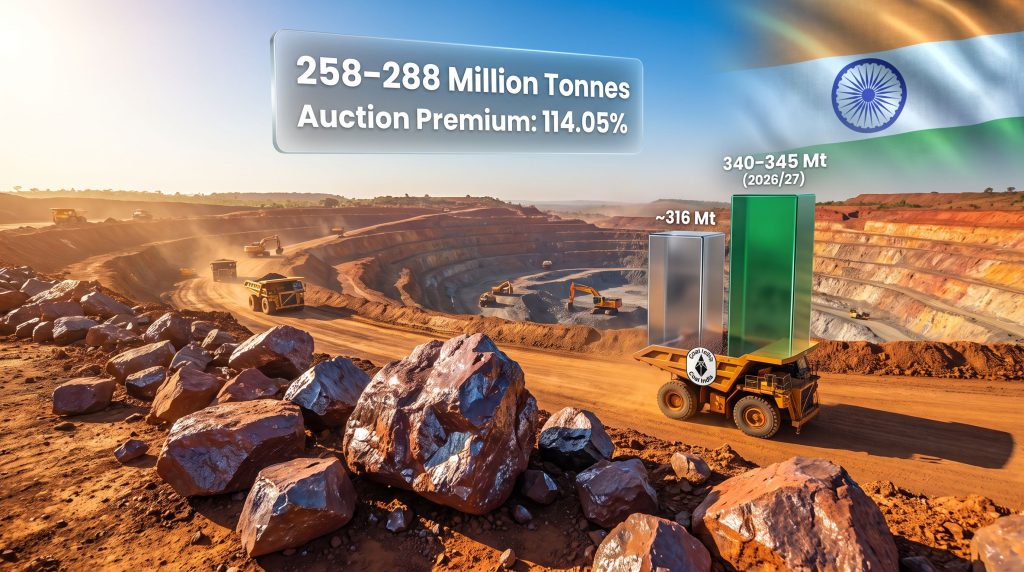
According to data from commodities consultancy BigMint, confirmed through reporting by Reuters on 6 August 2026, the Gadadharpur block contains an estimated 258 million tonnes of iron ore resources. This volume is substantial enough to underpin a multi-decade mining operation at industrial scale, and positions Coal India as a credible long-term ore supplier rather than a marginal participant.
To contextualise that figure:
- A mid-scale iron ore operation producing 10 to 15 million tonnes per year could sustain output from this block for 17 to 25 years
- A larger operation scaled to 20 million tonnes annually would still support roughly 12 to 13 years of continuous production
- At current Indian domestic ore pricing, even conservative production scenarios represent tens of billions of rupees in annual mineral value
The block's location in Odisha further amplifies its commercial utility. The state benefits from established rail corridors connecting ore-producing regions to coastal export terminals and inland steel plants, a pre-existing workforce with deep mining expertise, and a state government that has actively cultivated an investor-friendly mineral auction environment to maximise royalty revenues and industrial employment.
The Auction Mechanism and What a 114.05% Premium Actually Means
India's mineral allocation system underwent a fundamental transformation following the Mines and Minerals (Development and Regulation) Amendment Act of 2015, which replaced the older discretionary licensing regime with a transparent, competitive auction process. Under this framework, blocks are awarded to the highest bidder based on an auction premium expressed as a percentage of the value of mineral dispatched, rather than a fixed upfront payment.
Coal India was declared the preferred bidder for the Gadadharpur block at an auction premium of 114.05%, according to Odisha's Director of Mines and Geology, as reported through Reuters. This figure warrants careful interpretation.
An auction premium above 100% does not mean Coal India is paying more than the ore is worth. It means the company is committing to remit more than the equivalent of the mineral's dispatch value to the state in royalties and levies, reflecting a long-term confidence in ore economics that absorbs elevated cost structures.
In practical terms, a premium at this level signals several things simultaneously:
- Aggressive competitive bidding in the room, suggesting other participants also placed high valuations on the block
- Long-term steel demand conviction, with Coal India pricing in decades of Indian infrastructure-driven ore consumption rather than near-term spot pricing
- Balance sheet strength, since only an entity with sustained capital capacity can comfortably absorb a premium this size without jeopardising project economics
- Strategic intent over pure commercial logic, consistent with a mandate to secure domestic raw material supply chains rather than purely maximise return on capital
The Two-Stage Pathway from Preferred Bidder to Active Mining
Winning the auction is only the beginning of a structured administrative sequence. The regulatory pathway breaks into two distinct phases:
| Stage | Milestone | Timeframe |
|---|---|---|
| Stage 1 | Complete all post-auction formalities | Within 1 year of preferred bidder declaration |
| Stage 2 | Execute formal mining lease deed | Up to 3 years from Stage 1 completion |
| Post-lease | Mine development, infrastructure, first ore | Additional 2 to 4 years depending on complexity |
This means realistic first production from the Gadadharpur block is unlikely before the early 2030s under an optimistic scenario, with the late 2020s representing only the completion of administrative and legal prerequisites. Environmental clearances, forest and land-use approvals, and state-level regulatory sign-offs all sit between preferred bidder status and the first blast.
India's Iron Ore Macro Picture: Supply, Demand, and the Structural Gap
The timing of Coal India entering iron ore mining after Odisha block win coincides with a pronounced upswing in Indian ore output. According to BigMint data cited by Reuters, India is projected to produce 340 to 345 million tonnes of iron ore in the 2026/27 financial year, up from approximately 316 million tonnes the prior year. That represents year-on-year growth of roughly 8 to 9%, a pace that is remarkable for a mature extractive industry.
| Metric | Data Point |
|---|---|
| India's steel production rank globally | 2nd (behind China) |
| Iron ore output 2025/26 | ~316 million tonnes |
| Iron ore output forecast 2026/27 | 340–345 million tonnes |
| Year-on-year growth estimate | ~8–9% |
| Gadadharpur block resource base | 258 million tonnes |
Yet even this growth trajectory may be insufficient given the scale of steelmaking capacity being planned and built. India has publicly targeted crude steel capacity of 300 million tonnes per annum by 2030, a figure that would require proportional iron ore supply expansion. The arithmetic of meeting that target while managing existing mine depletion creates a structural demand pull for new ore supply that extends well beyond current production growth rates. Consequently, monitoring iron ore price trends will be essential for all stakeholders navigating this evolving landscape.
An important but often overlooked dynamic in this context is mine depletion. Existing Odisha iron ore operations, including those run by major integrated steel producers, face resource exhaustion timelines that are shortening as production accelerates. Industry commentary from Rio Tinto executives, as reported by Mining Weekly in August 2026, has pointed to global iron ore mine depletion as a potential price-support mechanism over the coming decade. In the Indian context, this dynamic is particularly acute because domestic producers cannot simply substitute depleted reserves with imports without significant cost and logistics penalties.
Coal India's Operational Transferability: Strengths and Gaps
A critical question surrounding Coal India's iron ore ambitions is whether decades of coal extraction genuinely translate into iron ore mining competence. The honest answer is: partially.
Where transferable competencies exist:
- Large-scale open-cut and opencast mining operations, which characterise most Odisha iron ore extraction
- Heavy equipment fleet management, blast-and-haul logistics, and bulk materials handling
- Community relations and land acquisition experience across large operational footprints
- Access to domestic financing at preferential rates given state-owned enterprise status
- Regulatory navigation capability developed across hundreds of existing coal operations
Where knowledge gaps exist:
- Iron ore beneficiation technology, particularly for processing lower-grade material to meet steelmaker specifications
- Ore quality management and grade blending to maintain consistent iron content, silica, and alumina ratios that steel producers require
- Customer relationship infrastructure with domestic steel mills, including long-term offtake negotiation
- Export logistics optimisation, if Coal India pursues seaborne markets in addition to domestic supply
These gaps are real but not insurmountable. Coal India's financial scale means it can acquire expertise through joint ventures, technical service agreements, or targeted hiring — approaches that state-owned enterprises in comparable transitions have used successfully elsewhere.
The Broader Pattern: PSUs as Instruments of Industrial Policy
Coal India's entry into iron ore is best understood not as an isolated corporate decision but as part of a deliberate pattern in which Indian public sector undertakings are being directed toward raw material security across multiple mineral categories. India's domestic steel industry is heavily dependent on a concentrated group of ore suppliers, creating supply concentration risk that is increasingly recognised as a strategic vulnerability.
By deploying Coal India's balance sheet into iron ore, the government achieves multiple objectives without direct budgetary expenditure:
- Introducing a new large-scale supplier into a market where concentration among private incumbents has occasionally drawn regulatory scrutiny
- Anchoring a portion of ore supply under public sector control, providing a policy lever for price stability
- Reducing the risk of import dependency in a commodity that is both strategically critical and bulky to transport
- Establishing a precedent for PSU diversification that could extend to manganese, bauxite, limestone, and potentially critical minerals as India's battery and electronics manufacturing ambitions grow
However, it is worth noting that India is not alone in rethinking its approach to ore supply leadership. Australia's iron ore supply leadership demonstrates how long-term strategic investment in mining infrastructure can underpin decades of competitive advantage — a model India's policymakers appear to be studying closely.
The Gadadharpur auction win is not simply a business decision — it is an expression of industrial policy executed through competitive market mechanisms, a model that combines state intent with market discipline in ways that pure government procurement or direct allocation cannot achieve.
The next major ASX story will hit our subscribers first
What Private Sector Iron Ore Incumbents Should Watch
For established iron ore producers operating in Odisha, Coal India's arrival introduces a well-capitalised competitor that does not need to optimise for short-term profitability. State-owned enterprises operating under government mandates can absorb margin compression that would be commercially unsustainable for listed private companies.
In addition, the competitive pressure extends beyond Coal India alone. JSW Steel's recent acquisition of a fourth iron ore mine in Odisha further illustrates how aggressively both public and private players are positioning for long-term ore security in the region.
This does not immediately threaten existing producers, given that India's ore demand trajectory absorbs new supply readily. However, over a multi-decade horizon, Coal India's growing ore volumes could exert downward pressure on domestic ore pricing at the margin, particularly if production coincides with periods of weaker steel demand or global price softness.
Furthermore, the broader policy environment adds another layer of complexity. The impact of tariffs on iron ore markets globally means that Indian producers must also factor in shifting trade flows and potential demand redirection from key export markets as they plan capacity additions.
Private incumbents with higher-grade reserves, integrated steel operations that provide captive demand, or strong export customer relationships are best positioned to navigate this shift. Those relying on domestic spot market pricing for standalone ore sales face the most exposure.
Frequently Asked Questions
What is the Gadadharpur iron ore block?
A mineral block located in Odisha, eastern India, containing an estimated 258 million tonnes of iron ore resources, awarded to Coal India through a competitive state-level auction in August 2026.
What does the 114.05% auction premium represent?
It represents Coal India's commitment to pay 114.05% of the value of mineral dispatched to the state as a royalty premium, indicating aggressive competitive bidding and long-term confidence in Indian steel demand.
When could Coal India begin iron ore production?
Given the one-year formalities window, up to three-year lease execution period, and subsequent mine development requirements, realistic first production is unlikely before the early 2030s.
Why is Odisha central to India's iron ore supply?
Odisha hosts large, high-grade hematite and banded iron formation deposits, well-developed mining logistics infrastructure, and an active auction framework that has attracted sustained investment from both public and private sector miners.
How does this affect India's steel producers?
In the near term, the event of Coal India entering iron ore mining after Odisha block win adds a new supply pipeline into a market already scaling to support 300 million tonnes per annum of crude steel capacity by 2030. Over the longer term, it introduces a state-backed competitor that could influence domestic pricing dynamics.
Readers tracking India's iron ore sector, mineral policy developments, and ferrous metals market dynamics can explore additional coverage through Mining Weekly's ferrous metals and iron ore reporting archives at miningweekly.com.
This article contains forward-looking statements and production forecasts drawn from third-party industry sources. These represent estimates only and are subject to change based on regulatory outcomes, market conditions, and operational developments. Nothing in this article constitutes financial or investment advice.
Want To Be First When the Next Major Mineral Discovery Hits the ASX?
Discovery Alert's proprietary Discovery IQ model scans ASX announcements in real time, instantly converting complex mineral data across 30+ commodities into clear, actionable insights for both traders and long-term investors — just as transformative discoveries like those made by De Grey Mining and WA1 Resources were unfolding. Explore historic discovery returns on Discovery Alert's dedicated discoveries page and begin your 14-day free trial to position yourself ahead of the broader market.