August 6, 2026
The Upstream-Downstream Paradox Reshaping East African Oil Economics
Across Sub-Saharan Africa, a recurring pattern has emerged among frontier oil economies: the race to first oil consistently outpaces the development of the infrastructure needed to process it. Upstream exploration and production attract international capital relatively quickly, while the complex web of downstream refining, pipeline logistics, and commercial agreements tends to lag years, sometimes decades, behind. Uganda is now the region's most visible example of this structural imbalance, and the latest decision to push the Uganda delays Kabaale refinery FID timeline to February 2027 crystallises just how deep that imbalance runs.
When big ASX news breaks, our subscribers know first
The Cost of Producing Oil Without the Means to Refine It
Uganda is on the cusp of a historic milestone. Commercial crude oil production is expected to begin in late 2026 or early 2027, an achievement that has taken the better part of two decades to reach. Yet the infrastructure needed to convert that crude into usable fuel for Ugandan households, businesses, and neighbouring countries remains far from construction-ready.
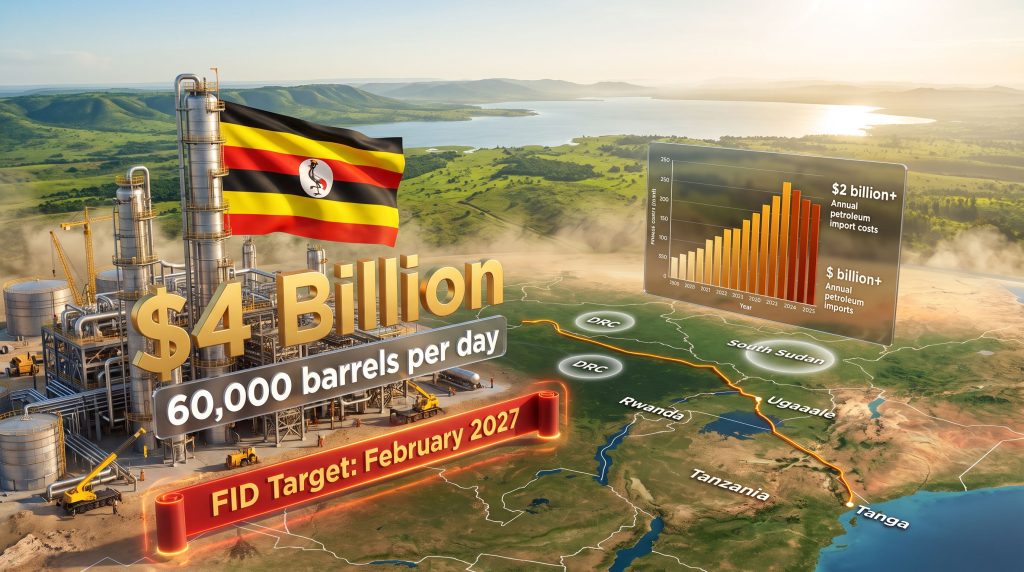
The country currently spends more than $2 billion annually on imported petroleum products. That figure represents a persistent fiscal drain that will not be relieved by upstream production alone. Without a domestic refinery, Uganda will export raw crude while simultaneously importing the refined products derived from crude, a value chain reversal that strips away the very economic benefits oil production is supposed to generate.
This is not a minor scheduling inconvenience. Every year the Kabaale refinery FID is delayed extends the window during which Uganda transfers economic value abroad rather than capturing it domestically. The margin between crude oil and refined petroleum products, known in the industry as the refining spread or crack spread, represents real revenue that Uganda cannot access without processing capacity. At 60,000 barrels per day, the Kabaale facility's intended capacity, that margin, even at conservative estimates, amounts to hundreds of millions of dollars in annual foregone value. For broader context on how shifting oil dynamics affect regional economies, the latest crude oil market update provides useful background.
What the Kabaale Refinery Is and Why It Occupies a Unique Strategic Position
Project Fundamentals
The Kabaale refinery is planned for Hoima District in western Uganda, within the Albertine Graben basin. This geographic placement is deliberate: the same basin hosts Uganda's principal oil fields, meaning feedstock supply distances are minimised and pipeline logistics between production sites and the refinery are relatively straightforward compared to coastal configurations.
At full capacity, the refinery is designed to process 60,000 barrels of crude oil per day, making it a mid-scale facility by global standards but transformative by East African ones. The total estimated capital cost stands at $4 billion, which places it among the largest single energy infrastructure commitments in the region's history.
Ownership Structure
The current project ownership is divided between two parties following the most recent investor transition:
| Stakeholder | Ownership Stake | Entity Type |
|---|---|---|
| Alpha MBM Investments LLC (UAE) | 60% | Private sector investor |
| Uganda National Oil Company (UNOC) | 40% | State-owned enterprise |
Alpha MBM Investments signed a Memorandum of Understanding in December 2023, followed by a binding Implementation Agreement in March 2025. UNOC's retained 40% stake reflects Uganda's intent to preserve sovereign participation in downstream value creation rather than fully ceding control to external capital. According to the Uganda National Oil Company, the refinery represents a centrepiece of Uganda's midstream development strategy.
Regional Significance Beyond Uganda's Borders
Uganda's landlocked geography has historically made it a net importer of refined petroleum transported over long, expensive overland supply chains. A functional Kabaale refinery would not only reduce domestic import dependency but could reposition Uganda as a regional supplier to equally landlocked neighbours including Rwanda, South Sudan, and parts of the Democratic Republic of Congo. Each of these markets currently relies on refined fuel shipped from coastal refineries or imported via extended logistics corridors, making a centrally located Albertine Graben refinery economically competitive if it can reach operational status.
Understanding FID: Why This Decision Gateway Matters So Much
For readers unfamiliar with large-scale energy project development, the Final Investment Decision (FID) is the formal threshold at which project investors and their financing partners commit capital to construction. Prior to FID, expenditure is limited to studies, engineering, and planning. After FID, physical construction contracts are awarded and the capital clock begins.
FID cannot be declared without several prerequisites being satisfied simultaneously:
-
Completion of the Front-End Engineering Design (FEED) study, which defines the project's technical scope, cost, and constructability in sufficient detail for lenders to evaluate risk.
-
Execution of commercial agreements governing feedstock supply, product offtake, and shareholder governance.
-
Satisfaction of regulatory approval conditions from the relevant authority, in this case the Petroleum Authority of Uganda (PAU).
-
Securing of project financing, whether through equity contributions, development finance, commercial debt, or a combination.
The Kabaale refinery currently falls short on at least the first two of these requirements.
Why Uganda Delays Kabaale Refinery FID: The Technical and Commercial Barriers
The FEED Study Bottleneck
The FEED study for the Kabaale refinery is being conducted by UOP Honeywell, a globally recognised process technology licensor with extensive refinery design experience. As of October 2025, the study was reported to be only approximately 50% complete, according to AfricaOne News. A FEED study at the halfway point with a July 2026 FID target was, in practical engineering terms, an unrealistic combination. FEED completion typically takes 12 to 18 months for a project of this scale, and the output must then be reviewed and validated before financing institutions will commit capital.
The PAU confirmed in August 2026 that basic engineering works are underway but declined to specify the current FEED completion percentage, introducing a transparency gap that complicates external assessment of the revised February 2027 target's credibility.
Unsigned Commercial Agreements
Beyond engineering readiness, three critical commercial agreements must be executed before FID can be formally declared:
-
Crude Suppliers Agreement: Governs the terms under which feedstock crude oil will be delivered to the refinery from Ugandan production fields.
-
Product Sales Agreement: Establishes offtake arrangements for the refined petroleum products the facility will produce, including pricing mechanisms and buyer commitments.
-
Shareholders' Agreement: Formalises the governance, rights, and obligations between Alpha MBM Investments and UNOC as co-owners of the refinery entity.
These are not administrative formalities. Lenders and equity investors require binding commercial frameworks before they will release capital into a project of this magnitude. The absence of signed agreements represents a substantive legal barrier, not a procedural one. Furthermore, the influence of oil trading sanctions on global capital flows adds another layer of complexity for projects seeking international project finance in the current environment.
The Regulatory Approval Pathway
Dr. Michael Mugerwa, General Manager of Uganda Refinery Holdings at UNOC, publicly confirmed that basic engineering works have commenced and that PAU approval must be secured before construction can begin. This introduces a regulatory processing timeline that sits outside the direct control of either Alpha MBM or UNOC, adding schedule risk to an already compressed timeline between the current FEED status and the February 2027 FID target.
Key Risk: Even if FID is achieved in February 2027 as planned, greenfield refinery construction at 60,000 bpd scale typically requires four to six years. This places first operations no earlier than 2031 under a best-case scenario, and potentially closer to 2032 or 2033 if construction encounters the logistical challenges that have affected comparable projects across the continent.
A Two-Decade History of Investor Transitions and Missed Milestones
The Kabaale project's troubled development timeline is not a recent phenomenon. The refinery has cycled through three separate investor groups over more than 20 years, each transition resetting planning timelines and eroding stakeholder confidence:
| Investor | Role | Outcome |
|---|---|---|
| RT Global Resources (Russia) | Original project partner | Withdrew without reaching financial close |
| Albertine Graben Refinery Consortium (AGRC/AGEC) | Second development consortium | Exited after implementation framework expired |
| Alpha MBM Investments LLC (UAE) | Current investor (60% stake) | FID now targeted February 2027 |
The latest schedule change, a seven-month slip from July 2026 to February 2027, fits a pattern of incremental delays that have collectively pushed the project's operational timeline by years. For investors and development finance institutions evaluating Uganda's broader energy infrastructure landscape, three investor transitions and two decades of FID deferrals constitute a meaningful signal about project bankability and regulatory environment complexity. The broader geopolitical landscape affecting resource development across the continent compounds these concerns further.
The next major ASX story will hit our subscribers first
The EACOP Complication: A Second Infrastructure Delay With Cascading Effects
The Kabaale refinery delay does not exist in isolation. The East African Crude Oil Pipeline (EACOP), the 1,443-kilometre heated pipeline connecting Uganda's oil fields to Tanzania's port of Tanga, has also fallen behind its original construction schedule. The PAU attributed this slippage to logistics disruptions arising from the Middle East conflict, which has affected global supply chains for specialised pipeline components and construction materials.
The convergence of these two delays creates what might be characterised as a tripartite infrastructure risk scenario:
| Infrastructure Asset | Current Status | Primary Risk |
|---|---|---|
| Kabaale Refinery | Pre-FID; target February 2027 | FEED incomplete; agreements unsigned |
| EACOP (1,443 km pipeline) | Behind construction schedule | Middle East supply chain disruptions |
| Commercial Crude Production | Expected late 2026 / early 2027 | Dependent on EACOP operational readiness |
If EACOP slips beyond crude production readiness, Uganda faces a scenario where oil is being produced but cannot be exported through the intended primary export route. Combined with the absence of domestic refining capacity, this creates a situation where Uganda is technically an oil producer with limited ability to monetise that production in the near term. In addition, understanding the LNG supply implications of shifting global energy patterns helps illustrate why downstream infrastructure has become so critical to resource-dependent economies.
Quantifying the Opportunity Cost of Continued Delay
The arithmetic of Uganda's refinery delay is straightforward but striking. At more than $2 billion annually in petroleum product imports, Uganda is spending the equivalent of a significant share of its national development budget on refined fuel it could theoretically produce domestically. Over a five-year delay window, the cumulative import bill approaches $10 billion, capital that could otherwise have been directed toward infrastructure, education, healthcare, or industrial development.
The opportunity cost has a regional dimension as well. Each year the Kabaale refinery remains unbuilt, East African markets for refined petroleum products continue to be supplied by external sources. When the refinery eventually becomes operational, it will enter a market that has already adapted to existing supply chains, potentially reducing the commercial advantage Uganda might have enjoyed by being an early regional supplier.
Three Scenarios for Uganda's Downstream Energy Trajectory
Scenario 1: FID Achieved February 2027, Construction Proceeds on Schedule
The FEED study is completed by late 2026, commercial agreements are executed in parallel, PAU approvals are processed efficiently, and Alpha MBM secures project financing. Construction begins mid-2027, with first operations achievable by 2031 to 2032. Uganda manages a four-to-five-year crude production window without domestic refining, partially offset by crude export revenues via EACOP.
Scenario 2: Further FID Delay Beyond 2027
FEED complexity or commercial negotiation difficulties push FID to mid-2027 or later. The import dependency window extends, fiscal pressure accumulates, and regional market competitors consolidate their positions. Investor confidence signals deteriorate further with each successive announcement of postponement. Consequently, an oil price rally in global markets could also amplify the fiscal burden of sustained petroleum imports during this period.
Scenario 3: Structural Project Reset
A fourth investor transition or fundamental restructuring of the commercial framework effectively defers Uganda's downstream ambitions to the mid-2030s. Regional refining investment by neighbouring or competing nations captures the East African market opportunity that Kabaale was intended to serve.
Key Project Metrics at a Glance
| Metric | Detail |
|---|---|
| Total project cost | $4 billion |
| Processing capacity | 60,000 barrels per day |
| Current FID target | February 2027 |
| Previous FID target | July 2026 |
| Most recent delay duration | Approximately 7 months |
| FEED study status (October 2025) | Approximately 50% complete |
| FEED study contractor | UOP Honeywell |
| Annual petroleum import cost | $2 billion+ |
| Investor transitions to date | 3 over 20+ years |
| Current private investor | Alpha MBM Investments LLC (60%) |
| State partner | UNOC (40%) |
| Related infrastructure delay | EACOP (1,443 km heated pipeline) |
| Refinery location | Hoima District, Albertine Graben |
What Would Accelerate the Path to FID?
For the February 2027 FID target to be credible rather than aspirational, several conditions would need to be satisfied in parallel rather than sequentially:
-
Accelerated completion of the UOP Honeywell FEED study from its reported 50% baseline, targeting completion by late 2026.
-
Simultaneous negotiation and execution of the Crude Suppliers Agreement, Product Sales Agreement, and Shareholders' Agreement, rather than treating these as sequential milestones.
-
Streamlined PAU regulatory review processes for engineering submissions, reducing approval queue times.
-
Early mobilisation of development finance institutions or sovereign wealth capital to provide financing certainty ahead of FID, reducing the risk that capital constraints delay construction following a successful investment decision.
Without these conditions being met in concert, the February 2027 date risks becoming another entry in a long list of deferred milestones rather than the definitive turning point Uganda's downstream energy ambitions require. Indeed, Reuters reporting from August 2026 confirms the significance of this latest FID announcement and the pressure on all parties to deliver on the revised timeline.
This article draws on reporting from Ecofin Agency and Africa Energy Portal. All financial figures, timelines, and ownership details reflect information available as of August 2026. This article does not constitute financial or investment advice. Readers should conduct independent research before drawing conclusions about sovereign risk, project bankability, or energy infrastructure investment in Uganda or East Africa more broadly.
Want to Stay Ahead of Significant Mineral Discoveries on the ASX?
While Uganda's upstream-downstream paradox illustrates how critical timing is in resource development, Discovery Alert's proprietary Discovery IQ model delivers real-time alerts the moment significant ASX mineral discoveries are announced — turning complex data across 30+ commodities into clear, actionable insights for investors at every level. Explore how historic discoveries have generated substantial returns on Discovery Alert's discoveries page, and begin your 14-day free trial today to position yourself ahead of the broader market.