August 6, 2026
The Quiet Revolution Beneath the Surface: Why Mining's Powertrain Shift Is Accelerating
Underground mining has always been defined by its relationship with diesel. For decades, the internal combustion engine powered the industry's most critical equipment — haul trucks, load-haul-dump (LHD) machines, drill rigs, and utility vehicles — operating in environments where exhaust accumulation created persistent occupational health challenges and ventilation costs consumed a disproportionate share of mine operating budgets. That relationship is now under serious strain.
The pace of change is compressing timelines that many operators once thought were decades away. The forces driving this shift are not singular. Tightening Scope 1 emissions reporting requirements, the declining capital cost of lithium-ion battery systems, maturing electric mining vehicles platforms from major original equipment manufacturers (OEMs), and the compelling economics of underground ventilation savings are collectively reshaping how mining companies think about mobile equipment procurement.
Against this backdrop, industry forums that bring technical research, regulatory dialogue, and commercial innovation together under one roof have become genuinely consequential gatherings rather than routine calendar events. The MDEC Mining Vehicle Powertrain Conference registration opening for October 2026 arrives at precisely this inflection point.
When big ASX news breaks, our subscribers know first
Understanding MDEC and Its Role in Mining Decarbonisation
The Mining Diesel Emissions Council (MDEC) occupies a distinctive position in the mining industry's emissions governance landscape. Rather than functioning as a purely regulatory body or a commercial industry association, MDEC bridges the gap between equipment manufacturers, mine operators, occupational health researchers, and the regulatory community. Its work centres on building the technical evidence base that makes practical, operationally viable emissions standards possible.
This bridging function matters more than it might initially appear. Mining emissions standards that fail to account for operational realities on the ground tend to produce compliance theatre rather than genuine emissions reduction. MDEC's approach, which emphasises peer-reviewed research, field measurement data, and multi-stakeholder dialogue, positions it as one of the more credible institutional voices in the space.
Furthermore, the decarbonisation benefits extend well beyond regulatory compliance, touching on operational efficiency, worker safety, and long-term financial planning.
"The mining industry's decarbonisation challenge is fundamentally different from surface transport electrification. Underground environments introduce constraints around charging infrastructure, battery thermal management, ventilation interactions, and equipment duty cycles that have no direct equivalent in road vehicle applications."
MDEC Mining Vehicle Powertrain Conference 2026: Event Details at a Glance
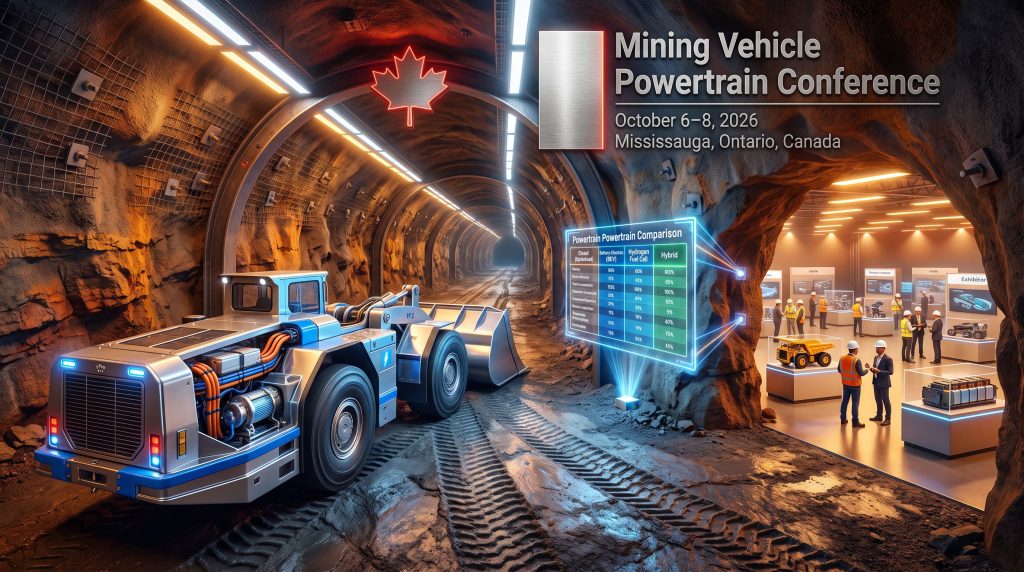
The Mining Vehicle Powertrain Conference (MVPC) returns in October 2026, offering a focused three-day programme specifically designed for professionals navigating the technical and commercial dimensions of mining fleet transformation.
| Detail | Information |
|---|---|
| Event Name | Mining Vehicle Powertrain Conference (MVPC) |
| Organiser | Mining Diesel Emissions Council (MDEC) |
| Dates | October 6–8, 2026 |
| Venue | Four Points by Sheraton, Mississauga, Ontario, Canada |
| Registration Fee | $750 CAD |
| Registration Method | Online via mdec.ca (credit card payment) |
| Abstract Submission Deadline | August 30, 2026 |
The three-day structure is deliberately sequenced to move attendees from broad technical discourse toward applied problem-solving:
- Days 1 and 2 (October 6–7): Technical sessions covering the latest research and field data, an exhibitor floor showcasing powertrain and emissions technology, and a structured networking reception designed to facilitate commercial and technical conversations simultaneously.
- Day 3 (October 8): A hands-on applied workshop providing deeper technical engagement beyond the session format, allowing attendees to work through specific challenges with subject matter experts.
The registration fee of $750 CAD covers access to all technical sessions, entry to the exhibitor floor, catered breakfasts, morning and afternoon breaks, lunches on conference days, attendance at the networking reception, and full participation in the Day 3 workshop.
Who Attends MVPC and Why the Cross-Sector Mix Matters
The conference draws a deliberately diverse professional cohort, and that diversity is arguably its most underappreciated asset. The attendee mix typically includes:
- Mine operators and fleet managers responsible for emissions compliance and capital equipment decisions
- OEM engineers and commercial teams developing and deploying next-generation powertrain systems
- Academic researchers and laboratory scientists generating the evidence base for both technology development and regulatory frameworks
- Occupational health and safety professionals focused on underground air quality, particulate matter exposure, and worker health outcomes
- Regulatory and government representatives involved in setting and enforcing emissions standards for the mining sector
The intersection of health science, mechanical engineering, environmental policy, and commercial strategy under a single programme is rare. In most industry contexts, these communities operate in parallel rather than in dialogue. MVPC's architecture creates conditions for genuine cross-pollination, which is where procurement decisions get informed, technology partnerships get seeded, and evidence gaps get identified.
"For an OEM engineer, understanding how an underground health and safety professional quantifies the benefit of removing diesel exhaust from a decline can reframe an entire product value proposition. That kind of insight is difficult to replicate outside a conference setting."
Technical Topics Shaping the MVPC 2026 Agenda
The conference programme addresses both the immediate challenge of managing existing diesel fleets more effectively and the longer-term transition toward alternative powertrains. Core subject areas confirmed for the 2026 event include:
- Diesel engine performance and emissions optimisation for heavy mining environments, including after-treatment technology for existing fleets
- Battery-electric vehicle (BEV) integration covering underground and surface mining applications, duty cycle analysis, and infrastructure requirements
- Alternative powertrain architectures including hydrogen fuel cells, hybrid diesel-electric systems, and emerging propulsion technologies
- Emission control and after-treatment systems addressing regulatory compliance pathways for operators not yet ready for full electrification
- Occupational health research covering particulate matter exposure modelling, ventilation system interactions with powertrain technology, and quantifiable worker safety outcomes
- Laboratory and field study findings providing the measurement methodologies and real-world performance data that underpin both technology development and policy decisions
The Ventilation Savings Calculation: An Often-Overlooked Driver
One of the less widely understood financial arguments for underground fleet electrification concerns ventilation. Underground mines running diesel fleets must move enormous volumes of fresh air through decline systems to dilute exhaust gases to safe working levels. This ventilation requirement is energy-intensive and represents a significant share of total site operating costs.
When diesel equipment is replaced with battery-electric alternatives, the reduction in underground exhaust load can substantially reduce ventilation requirements. For deep underground operations in particular, this reduction in primary ventilation energy consumption can represent a material improvement in operating economics, independent of any fuel cost differential. This is a nuance that total cost of ownership (TCO) comparisons between diesel and BEV platforms do not always capture at the headline level.
Comparing Powertrain Technology Pathways for Mining Applications
| Powertrain Type | Current Maturity | Key Advantage | Primary Challenge |
|---|---|---|---|
| Diesel (optimised) | Mature | Established infrastructure | Emissions compliance burden |
| Battery-Electric (BEV) | Rapidly scaling | Zero direct emissions, ventilation savings | Charging infrastructure, battery weight |
| Hydrogen Fuel Cell | Early commercial | High energy density, fast refuelling | Hydrogen supply chain, cost |
| Hybrid (diesel-electric) | Commercial | Transitional flexibility | Complexity, partial emissions reduction |
The hybrid category deserves particular attention for operators facing near-term compliance pressures without the capital or infrastructure readiness for full electrification. Diesel-electric hybrid systems can reduce direct emissions meaningfully while operating within existing mine infrastructure, providing a bridge pathway that maintains operational continuity. However, the complexity premium and the reality that hybrid systems deliver only partial emissions reduction mean they are increasingly viewed as a transitional technology rather than a destination.
The next major ASX story will hit our subscribers first
How to Complete Your MDEC Mining Vehicle Powertrain Conference Registration
The registration process is straightforward and conducted entirely online through MDEC's official website.
- Visit the official MDEC website at www.mdec.ca
- Navigate to the MVPC 2026 event page to access the registration portal
- Complete the online registration form with your professional and organisational details
- Submit payment of $750 CAD via credit card through the secure online payment system
- Receive confirmation of your registration and event access information by email
- Plan your programme across the three-day event, including the applied workshop on Day 3
Given the specialist and focused nature of MVPC, early registration is advisable. The conference is not a mass-market trade event, and session capacity reflects its technical depth rather than volume ambitions.
Speaker Submissions: Open Call Closes August 30, 2026
MDEC has confirmed that a limited number of presentation slots remain available in the October 2026 programme, and the organisation is actively seeking technical paper submissions from industry professionals. The abstract submission deadline is August 30, 2026, leaving a narrow window for prospective speakers.
| Technical Theme | Relevance to Conference Agenda |
|---|---|
| Diesel engine innovation and efficiency | Core emissions reduction pathway for existing fleets |
| Mining equipment electrification | BEV adoption challenges and case studies |
| Emission control technology | After-treatment systems and regulatory compliance |
| Electric vehicle systems for mining | Underground and surface deployment considerations |
| Occupational health and air quality | Worker safety outcomes from powertrain transitions |
| Laboratory and field emissions studies | Evidence base for policy and procurement decisions |
Who Should Consider Submitting an Abstract?
The call for papers is genuinely broad in its intended scope. Professionals who would add meaningful value to the programme include:
- Academic researchers with peer-reviewed findings on diesel or electric vehicle emissions in mining environments
- OEM engineers with field data from BEV or alternative powertrain deployments at operating mine sites
- Mine operators with documented case studies from fleet transition programmes, including lessons learned
- Health and safety specialists with quantitative research on underground air quality improvements attributable to powertrain changes
- Regulatory professionals with insights on the practical application and evolution of emissions standards
The Macro Forces Reshaping Mining Powertrain Strategy in 2026
Several converging pressures are making 2026 a particularly consequential year for mining fleet electrification discourse. The broader mining energy transition is accelerating these pressures across multiple fronts simultaneously.
Scope 1 emissions disclosure requirements are tightening across major mining jurisdictions, placing mobile equipment fleets squarely in the crosshairs of ESG reporting obligations. For large diversified miners, mobile equipment can represent a substantial proportion of total Scope 1 emissions, making fleet electrification a strategic rather than purely operational decision.
Battery technology economics continue to shift in favour of electrification. Lithium-ion energy density has improved substantially over the past decade while cell costs have declined, and purpose-built mining battery systems from both established OEMs and specialist suppliers are now commercially available in configurations suitable for demanding underground duty cycles.
OEM product pipeline acceleration is perhaps the most tangible signal of the transition's momentum. The mining electrification trends are reflected in major equipment manufacturers moving beyond concept studies to commercial deployments of electric haul trucks, LHD machines, and drill rigs. The availability of proven electric equipment across a broader range of machine classes is removing one of the primary barriers that previously limited operator adoption.
Diesel fuel cost volatility continues to create financial planning uncertainty for mine operators, adding a risk management dimension to the electrification case that extends beyond pure ESG motivation. Furthermore, the growth of renewable energy in mining operations is creating new opportunities to power electric fleets from low-carbon energy sources, strengthening the overall emissions reduction case.
"It is worth noting that electrification economics in mining are highly site-specific. Energy costs, mine depth, equipment duty cycles, and existing infrastructure all influence the TCO calculation materially. Generalisations about the financial case for electrification should always be stress-tested against site-level data."
Frequently Asked Questions: MDEC MVPC 2026 Registration
When and where is the conference held?
The Mining Vehicle Powertrain Conference runs from October 6 to 8, 2026, at the Four Points by Sheraton in Mississauga, Ontario, Canada.
How much does registration cost?
MDEC Mining Vehicle Powertrain Conference registration is priced at $750 CAD and is completed online at www.mdec.ca via credit card payment.
What does the registration fee include?
The fee covers access to all technical sessions, the exhibitor floor, catered meals and breaks during conference days, the networking reception, and the hands-on workshop on Day 3.
Can I still submit a presentation abstract?
Yes, a limited number of presentation slots remain open. Abstract submissions must be received by August 30, 2026. The full submission guidelines are available through the MDEC event resources.
Is MVPC relevant for professionals outside Canada?
The technical content spans diesel emissions optimisation, battery-electric vehicle integration, alternative powertrain systems, and occupational health research, all of which are directly applicable to mining operations globally regardless of jurisdiction.
Key Takeaways for Mining Professionals Considering Attendance
Different professional communities will extract different value from the MVPC programme. At a practical level:
- Fleet managers and operators gain access to the latest BEV and alternative powertrain field data to inform capital expenditure decisions and compliance planning
- OEM and technology suppliers benefit from direct engagement with procurement decision-makers and the ability to contextualise product positioning against real operational challenges
- Researchers and academics find a platform to translate laboratory findings into industry-relevant applications, with direct feedback from practitioners
- Health and safety professionals access updated evidence on occupational exposure reduction achievable through powertrain transitions
- Policymakers and regulators gain industry-informed perspectives that support the development of practical, enforceable emissions standards
The MDEC Mining Vehicle Powertrain Conference registration window is now open, and the August 30 abstract deadline means the immediate priority for prospective speakers is securing a submission slot. For everyone else, early registration remains the prudent approach for an event where depth of content consistently reflects the specialist composition of its audience.
This article is provided for informational purposes only. Event details, dates, fees, and deadlines are based on information available at the time of publication. Readers should verify current information directly with MDEC at www.mdec.ca prior to making registration or travel commitments. Nothing in this article constitutes financial, investment, or professional advice.
Want to Stay Ahead of the Next Major Mining Discovery?
While the mining sector's powertrain revolution reshapes operational economics underground, Discovery Alert's proprietary Discovery IQ model scans ASX announcements in real time, instantly alerting subscribers to significant mineral discoveries across more than 30 commodities — explore historic discoveries and their returns to understand the opportunity, then begin your 14-day free trial at Discovery Alert to position yourself ahead of the broader market.