May 21, 2026
India's Coal Import Dependency: A Structural Challenge Requiring Structural Solutions
Across the global energy landscape, few economic vulnerabilities are as persistently misunderstood as import dependency on a commodity as fundamental as coal. When a nation requires hundreds of millions of tonnes of an energy input annually, and a significant portion of that requirement is sourced internationally, the economic exposure extends far beyond fuel costs alone. It reaches into foreign exchange reserves, trade balances, industrial competitiveness, and ultimately, national energy security. India's coal import challenge exemplifies this dynamic at scale, and the country's response through the Coal India 10-year roadmap to slash coal imports represents one of the most ambitious domestic resource mobilisation programmes in its energy history.
When big ASX news breaks, our subscribers know first
The Foreign Exchange Reality Behind 243 Million Tonnes
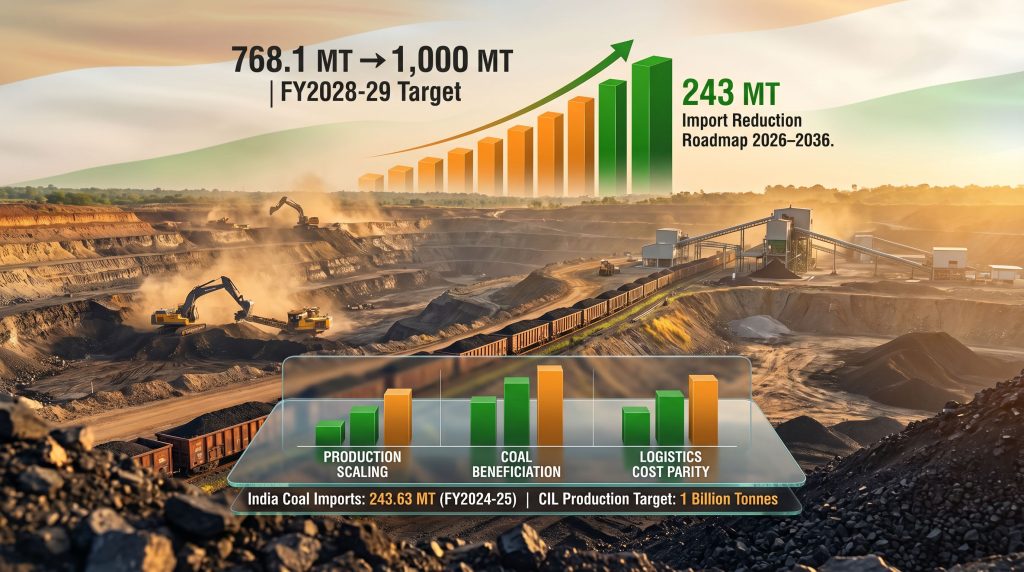
India imported approximately 243.63 MT of coal in FY2024-25, representing an 8% decline from the 264.53 MT purchased internationally in the prior year. While the directional trend is encouraging, the absolute volume remains enormous, and the associated foreign exchange drain creates genuine macroeconomic exposure.
At average landed costs ranging from roughly USD 100 to USD 130 per tonne depending on grade and origin, India's total annual coal import bill represents a foreign exchange outflow in the vicinity of USD 24 to USD 32 billion. Even a 50% reduction in import volumes through successful substitution with domestically produced coal could preserve USD 12 to USD 16 billion in annual forex reserves — a macroeconomically significant outcome that extends well beyond the coal sector itself.
The complicating factor is that India's import profile is not uniform. Coal flows into multiple end-use sectors, each with distinct quality specifications, supply chain requirements, and substitution timelines:
- Thermal power generation requires coal within specific calorific value ranges and with manageable ash content
- Steel manufacturing depends on coking coal (metallurgical coal) with precise chemical properties that determine coke quality and blast furnace performance
- Cement production uses coal primarily as a heat source, with somewhat more flexible quality tolerances
- Industrial processing encompasses a diverse range of applications with varying grade requirements
This sectoral complexity means import substitution cannot be approached as a single policy lever. A coal grade suitable for power generation cannot simply replace coking coal in steel production. Understanding why each tonne of coal is imported, and what domestic alternative could credibly substitute for it, is the analytical foundation upon which the entire reduction strategy must be built.
| Metric | Value | Context |
|---|---|---|
| Total Coal Imports (FY2024-25) | 243.63 MT | Down 8% from 264.53 MT in FY2023-24 |
| CIL Domestic Production (FY2026) | 768.1 MT | Over 80% of national output |
| CIL Production Target | 1,000 MT by FY2028-29 | Requires ~9.2% CAGR over three years |
| National Production Target | 1,500 MT by FY2029-30 | Implies 6-7% annual sector growth |
| Estimated Annual Forex Outflow | USD 24-32 billion | Based on USD 100-130/tonne landed cost |
The Strategic Architecture of the 2026-2036 Roadmap
Coal India Ltd (CIL), which accounts for more than 80% of India's domestic coal output, is developing a comprehensive 10-year roadmap spanning 2026 to 2036 with the explicit objective of totally substituting all "substitutable" coal imports. The plan targets a reduction in the current 243 MT import volume through three interconnected reform pillars operating simultaneously rather than sequentially.
Pillar One: Domestic Production at Unprecedented Scale
CIL produced 768.1 MT of coal in FY2026 and has set a target of reaching 1 billion tonnes by FY2028-29, a production uplift of approximately 232 MT within roughly three years. This implies a compound annual growth rate of approximately 9.2%, a demanding pace that sits meaningfully above the 6-7% annual sectoral growth rate projected across the broader roadmap horizon.
Achieving this production ambition requires parallel progress across several critical path items that have been formally identified within the planning framework:
- Environmental and forest clearances for key expansion projects currently awaiting regulatory approval
- Land acquisition pipelines for new mine development across multiple states
- Evacuation infrastructure including rail sidings, conveyor systems, and road connectivity to move increased output to markets
- High-capacity excavator deployment and advanced surface mining technologies for opencast operations
- New coal block activations to expand the productive reserve base
The national coal output target extends further, with production across all operators projected to reach 1,500 MT by FY2029-30, implying that CIL's expansion forms part of a broader sectoral growth mandate rather than an isolated corporate strategy. Furthermore, the global steel demand outlook reinforces why scaling domestic coking coal supply remains a national priority alongside thermal grades.
Pillar Two: Coal Quality Enhancement Through Beneficiation
One of the least discussed but most technically significant constraints on domestic coal's ability to displace imports is the quality differential between Indian coal and international alternatives. Indian coal typically carries higher ash content than premium imported grades, which limits its direct substitutability in applications where ash creates operational or environmental complications.
Coal beneficiation, commonly referred to as coal washing, addresses this constraint by processing raw coal to reduce ash content and improve calorific value. The output of a beneficiation plant (washed or beneficiated coal) can meet quality specifications that raw domestic coal cannot, thereby expanding the range of end-uses where domestic supply can credibly compete with imports.
Technical Insight: Coal beneficiation generates two output streams: the higher-quality product and a residue called "middlings" or "rejects." Managing these byproducts efficiently is a critical operational and environmental consideration in any national washery expansion programme.
The roadmap places particular emphasis on coking coal washeries designed to upgrade domestic metallurgical coal quality for steel industry applications, where the quality bar is highest and the substitution challenge is most acute. In addition, monitoring metallurgical coal price trends will remain critical to assessing whether domestic substitution delivers genuine cost competitiveness over time.
Pillar Three: Logistics Cost Parity
Production volume and coal quality improvements are necessary but insufficient conditions for successful import substitution. Even where domestic coal meets quality specifications, its competitiveness at the point of end-user delivery depends on total delivered cost, which includes rail freight, handling charges, port or terminal costs, and last-mile logistics.
In many cases, the landed cost of imported coal at Indian ports is competitive with or even cheaper than domestic coal delivered to distant end-users, particularly when rail freight rates and evacuation bottlenecks inflate the domestic supply chain cost. Achieving logistics cost parity requires systemic infrastructure investment and network optimisation rather than incremental improvements at individual facilities.
Understanding the National Washery and Logistics Grid
The National Washery and Logistics Grid is a purpose-built infrastructure system positioned as a cornerstone institutional mechanism within the 10-year roadmap. Rather than treating coal washing capacity and transportation networks as separate policy domains, the Grid integrates them into a unified supply chain optimisation framework.
The architecture addresses two chronic and interconnected bottlenecks simultaneously:
- Insufficient washing infrastructure, which limits the volume of domestic coal that can be upgraded to import-competitive quality specifications
- Inefficient multimodal logistics, which inflates the delivered cost of domestic coal relative to imported alternatives, undermining price competitiveness even where quality parity has been achieved
| Supply Chain Stage | Current Constraint | Grid Intervention |
|---|---|---|
| Coal Washing | Fragmented capacity, quality gap | Coordinated national washery network |
| Rail Evacuation | Route inefficiencies, siding bottlenecks | Optimised evacuation corridors |
| Port Interface | Import terminal bias | Logistics redirection toward domestic channels |
| End-User Delivery | High last-mile cost | Sector-specific cost parity benchmarking |
The Grid's significance extends beyond infrastructure. It represents a framework for systematic supply chain reform that addresses the structural reasons why domestic coal often struggles to compete on delivered cost, even when gross production capacity exists in sufficient volumes.
The Forensic Import Audit: Why Data Precision Matters
A foundational step in the 10-year roadmap is a forensic audit of all existing coal import streams. The logic is straightforward but often overlooked in policy design: without granular data on why each import category exists, substitution strategies cannot be accurately targeted.
The audit classifies imports into two categories:
- Substitutable volumes where domestic coal, after quality enhancement and logistics optimisation, can credibly replace the imported alternative on cost and specification grounds
- Non-substitutable volumes where domestic alternatives are technically or geologically unavailable, primarily certain specialised coking coal grades used in steelmaking
This distinction is critical to realistic policy design. The roadmap explicitly targets the total substitution of substitutable imports rather than the elimination of all coal trade — a degree of policy realism that strengthens the strategy's credibility.
Following audit completion, sector-specific import substitution policies will be developed for thermal power, steel, cement, and industrial users, with phased transition timelines tied to domestic supply readiness and quality improvement milestones. An inter-ministerial coordination framework supports ongoing import tracking and substitution management through dedicated administrative mechanisms.
Policy Precedent: India has already demonstrated the effectiveness of sector-targeted import reduction in thermal coal. Thermal coal imports for power generation are targeted to fall approximately 70% in 2026, declining from roughly 50 MT to approximately 15 MT, reflecting the relative maturity of domestic thermal coal substitution compared to metallurgical coal grades.
Non-Tariff Barriers: The Hidden Architecture of Import Dependency
One of the most sophisticated dimensions of CIL's strategic framework is its explicit recognition of non-tariff barriers (NTBs) as a structural driver of import dependency that persists independently of production volumes or coal quality. The engagement of a specialist consultant specifically to identify and recommend NTB reforms signals an understanding that removing these barriers is as important as scaling production.
NTBs in the Indian coal import context include several distinct mechanism categories:
- Contractual lock-in: Long-term import agreements with penalty clauses for early termination create financial disincentives for end-users to switch to domestic supply, even when a competitive domestic alternative becomes available
- Specification standards bias: Quality standards written around imported coal grades can inadvertently exclude domestic coal that is technically substitutable but does not precisely match import-derived benchmarks
- Infrastructure orientation: Port and terminal infrastructure historically designed and optimised for import handling can create operational friction and cost disadvantages for domestic coal logistics
- Financing structure alignment: Certain industrial financing arrangements are structured around international coal procurement, creating embedded incentives that favour import continuation
A scenario where CIL successfully reaches 1 billion tonnes of annual production but systemic NTBs prevent end-users from transitioning to domestic supply would leave import volumes structurally elevated despite the production achievement. This explains why NTB reform requires cross-ministerial coordination spanning the Ministries of Coal, Steel, Power, and Finance, and why it cannot be addressed through CIL's actions alone. The trade impacts on bulk commodities illustrate how policy and non-tariff mechanisms can reshape commodity flows in ways that pure production metrics fail to capture.
The next major ASX story will hit our subscribers first
The 1 Billion Tonne Target: Ambition Versus Execution Reality
The production scaling ambition embedded in the roadmap is substantial. Adding approximately 232 MT of annual production capacity within three years represents a compound annual growth rate of roughly 9.2%, well above historical precedent and the 6-7% average projected across the longer roadmap horizon. Understanding the execution risk landscape is essential for any realistic assessment of the strategy's probability of success.
| Risk Category | Specific Challenge | Roadmap Mitigation |
|---|---|---|
| Regulatory | Forest and environmental clearance delays | Pre-identification of clearance requirements for key projects |
| Infrastructure | Rail evacuation capacity constraints | Evacuation infrastructure mapped as critical path enabler |
| Quality | High ash content limiting substitutability | Beneficiation investment and National Washery Grid |
| Market | End-user contractual lock-in to imports | NTB reform programme with specialist consultant engagement |
| Geological | Reserve quality variation across new blocks | Advanced block selection and exploration |
| Financial | Capex intensity of simultaneous expansion | Phased implementation across 10-year horizon |
The roadmap's acknowledgment that all key projects and enablers — including environmental and forest clearances, land acquisition, and evacuation infrastructure — have been formally identified is meaningful. Pre-identification of bottlenecks within a structured project management framework differs significantly from aspirational production targets without delivery pathway specificity. However, India's coal trading exchange proposal adds another dimension, potentially creating more transparent domestic pricing signals that could further incentivise end-users to shift away from imported coal.
India's Steel Sector: The Hardest Substitution Challenge
Of all the sectors contributing to India's 243 MT annual import volume, the steel industry's coking coal dependency represents the most technically and geologically constrained substitution challenge. Coking coal, also called metallurgical coal, is a specialised grade used in the coke-making process that feeds blast furnaces. Its quality is measured by properties including coking strength, volatile matter content, and sulphur levels — parameters that directly determine coke quality and steel production efficiency.
India's domestic coking coal reserves are both geologically limited in volume and often below the quality threshold required for direct use in steel production without significant blending. The country's steel industry relies heavily on premium coking coal imports from Australia, the United States, and Canada — sources that are geographically distant and exposed to international price volatility.
The roadmap's coking coal strategy operates on two tracks:
Near-term (blending strategy): Investment in coking coal washeries to upgrade domestic metallurgical coal to a quality level acceptable for blending with imported coal, reducing the proportion of premium imports required per unit of steel output without eliminating imports entirely.
Longer-term (reserve development): Exploration and development of new coking coal blocks within India to expand the domestic reserve base and progressively improve the quality and volume of domestically available metallurgical coal.
The roadmap's categorisation of some coking coal volumes as potentially non-substitutable in the near to medium term reflects geological and technical realism. High-quality coking coal with the coke-making properties required for efficient blast furnace operation cannot be created simply by processing lower-rank coal more intensively; the fundamental chemical composition must be present in the raw resource.
Energy Security, Atmanirbhar Bharat, and the 2047 Vision
CIL's import substitution roadmap sits within a broader framework of national strategic objectives. The Atmanirbhar Bharat (Self-Reliant India) initiative frames energy independence as both an economic sovereignty priority and a national security imperative. Reducing coal import dependency by even half of the current 243 MT volume would represent a transformational shift in India's energy sector exposure to international commodity markets.
The roadmap's 2026-2036 horizon also intersects with India's energy independence aspirations by 2047, the centenary of independence. The Coal India 10-year roadmap to slash coal imports contributes to the fiscal and policy bandwidth required for concurrent renewable energy scale-up by freeing foreign exchange resources previously absorbed by coal procurement. Moreover, Australia's resource export outlook will be directly affected as one of India's largest coal suppliers, should substitution milestones be achieved on schedule.
The National Coal Gasification Mission represents a parallel and complementary pathway. Coal gasification converts domestic coal into syngas for industrial and chemical applications, creating productive demand pathways for coal grades that cannot be beneficiated to import-competitive quality for direct combustion. Consequently, gasification and beneficiation are not competing strategies but complementary ones: beneficiation upgrades coal for direct-use markets, while gasification expands the addressable market for grades that cannot reach direct-use quality thresholds.
What Full Substitution Would Mean: Quantifying the Strategic Prize
Successful execution of the roadmap would deliver economic benefits extending well beyond the coal sector itself:
- Forex preservation at the scale of USD 12-32 billion annually depending on the proportion of substitutable imports eliminated and prevailing global coal prices
- Domestic ecosystem development encompassing coal mining equipment manufacturing, logistics services, washery construction, water treatment, and skilled employment across coal-producing regions
- Industrial competitiveness improvements for energy-intensive sectors including steel, cement, and power generation that benefit from more predictable domestic coal pricing relative to volatile international markets
- Geopolitical resilience through reduced dependence on coal supply from a concentrated set of international source countries
Phased Impact Timeline
| Phase | Period | Key Milestones |
|---|---|---|
| Foundation | 2026-2028 | Forensic audit completion, consultant engagement, washery grid design, NTB reform initiation |
| Acceleration | 2028-2031 | CIL reaches 1 BT production, National Washery Grid operational, sector-specific policies active |
| Consolidation | 2031-2036 | Full substitutable import elimination, logistics cost parity achieved, coking coal blending optimised |
Frequently Asked Questions: Coal India's Import Reduction Strategy
What is the Coal India 10-year roadmap to slash coal imports?
It is a structured 2026-2036 programme developed by Coal India Ltd targeting the total elimination of all "substitutable" coal imports from India's current annual import volume of approximately 243 MT. The strategy combines domestic production scaling toward 1 billion tonnes by FY2028-29, coal quality enhancement through beneficiation investment, logistics cost parity initiatives, and reform of non-tariff barriers that sustain import reliance.
Why does India import so much coal despite having large domestic reserves?
Indian coal reserves are substantial but often carry higher ash content and lower calorific values than imported alternatives, limiting their direct substitutability in certain applications. Additionally, logistics costs, quality specification standards, and contractual arrangements have historically favoured imported coal in some market segments, even where domestic supply is available in volume.
What is coal beneficiation and why does it matter?
Beneficiation is the industrial process of washing or processing raw coal to reduce ash content and improve calorific value. It is central to the import substitution strategy because it upgrades domestic coal to quality specifications that can compete with or substitute for imported grades in thermal power, steel blending, and industrial applications.
Is the 1 billion tonne production target by FY2028-29 achievable?
The target requires approximately 9.2% compound annual production growth over three years, demanding near-simultaneous progress across environmental clearances, land acquisition, evacuation infrastructure, and equipment deployment. The roadmap has formally identified these as critical path items, but execution risk remains real and significant.
Will India eliminate all coal imports through this programme?
No. The roadmap explicitly targets substitutable imports only. Certain specialised coking coal grades required for steel manufacturing are categorised as potentially non-substitutable in the near to medium term due to geological limitations in domestic reserves. Blending strategies and new coking coal block development aim to reduce these volumes progressively without necessarily eliminating them entirely.
Disclaimer: This article contains forward-looking statements, projections, and analytical assessments based on publicly available information and government-reported data. Production targets, import reduction timelines, and financial estimates are subject to change based on regulatory, operational, geological, and macroeconomic factors. This article does not constitute financial advice. Readers should conduct independent research and consult qualified advisers before making investment decisions related to the coal sector or any associated companies or instruments.
Want to Stay Ahead of Major Mineral Discoveries Shaping the Resources Sector?
As India's coal import substitution strategy reshapes global commodity flows and drives renewed interest in resource self-sufficiency, Discovery Alert's proprietary Discovery IQ model delivers real-time alerts on significant ASX mineral discoveries — instantly identifying actionable opportunities across coal, metallurgical, and broader resource sectors before the wider market reacts. Explore historic discoveries and their exceptional returns on Discovery Alert's dedicated discoveries page, and begin your 14-day free trial today to position yourself ahead of the next major find.