July 8, 2026
India's Coal Logistics Gap: Why Moving Coal Is as Critical as Mining It
For decades, the conversation around India's coal sector has centred almost exclusively on production targets, mine openings, and output benchmarks. Yet the more persistent constraint on energy availability has rarely been how much coal India digs out of the ground. It has been how reliably that coal reaches the power stations, steel furnaces, and cement kilns that depend on it. The physical movement of coal from pithead to end-user represents one of the most complex and under-examined logistics challenges in any major economy, and the structural gaps within it have quietly shaped India's industrial competitiveness for years.
This context makes the recently formalised SECL and CWC coal logistics MoU far more significant than a routine intergovernmental agreement. It reflects a deliberate institutional response to a problem that has constrained India's coal supply chain at precisely the moment when output is reaching record levels.
When big ASX news breaks, our subscribers know first
The Gap Between What India Produces and What Industries Actually Receive
India's coal production ecosystem has grown substantially over recent years, with Coal India Limited crossing the 100 Million Tonne production threshold in the early months of FY2026-27. That milestone is operationally meaningful. However, production volumes and delivered volumes are two entirely different metrics, and the distance between them is where India's energy security risk tends to concentrate.
Rail infrastructure functions as the primary artery of India's coal supply chain, handling the overwhelming majority of bulk coal movement across the country. When that artery experiences congestion, wagon shortages, or scheduling inefficiencies, the downstream effects ripple across thermal power plants, integrated steel mills, and cement manufacturers simultaneously. India's general freight rail network was not purpose-built for the scale of bulk commodity movement now demanded of it, and that mismatch has become increasingly difficult to manage through ad hoc solutions.
The problem is structural. First-mile connectivity, meaning the physical links between mine sites and the nearest rail loading points, remains underdeveloped at many colliery locations. At the other end, last-mile connectivity challenges prevent timely delivery even when coal reaches the correct rail junction. The result is a system where strong production performance at the mine level does not automatically translate into fuel security for consuming industries. These supply chain bottlenecks affect not just domestic consumers but also India's broader resource export challenges in the global market.
What the SECL and CWC Coal Logistics MoU Actually Establishes
South Eastern Coalfields Limited (SECL), the second-largest coal-producing subsidiary within the Coal India Limited group, has entered into a Memorandum of Understanding with the Central Warehousing Corporation (CWC), a Navaratna Central Public Sector Enterprise operating under the Government of India. The agreement covers several operationally distinct but interconnected domains.
The core commitments within the MoU include:
- Dedicated railway rake operations under the Goods Train Private Wagon Investment Scheme (GPWIS) and functionally equivalent frameworks
- Integrated rail logistics services designed to reduce transit times between mine and consumer
- Multimodal transportation solutions incorporating road, rail, and warehousing nodes
- First-mile and last-mile connectivity improvements at both mine and consumer ends
- Deployment of digital monitoring systems for real-time logistics tracking and operational oversight
- Long-term transportation planning to reduce systemic bottlenecks
The agreement was formally signed in the presence of Harish Duhan, Chairman-cum-Managing Director of SECL, and Santosh Sinha, Managing Director of CWC, alongside functional directors and senior officials from both organisations.
The SECL and CWC coal logistics MoU establishes a framework for dedicated railway rake operations, multimodal coal transportation, and digital logistics monitoring intended to improve coal evacuation efficiency across India's core industrial supply chains.
Understanding GPWIS: The Engine Behind Dedicated Rake Provisioning
What Is the Goods Train Private Wagon Investment Scheme?
One of the least publicly understood mechanisms in India's coal transport ecosystem is the Goods Train Private Wagon Investment Scheme, commonly referred to as GPWIS. This framework allows for the provisioning of privately owned or institutionally dedicated wagons for bulk freight movement, operating outside the constraints of the Indian Railways general freight pool. For coal specifically, this matters enormously.
Under conventional rail dispatch arrangements, wagon availability is subject to competing demand from dozens of commodity types and freight operators. Coal consignments can face extended wait times during peak freight periods, creating unpredictable dispatch windows that make supply planning difficult for power utilities and industrial consumers alike.
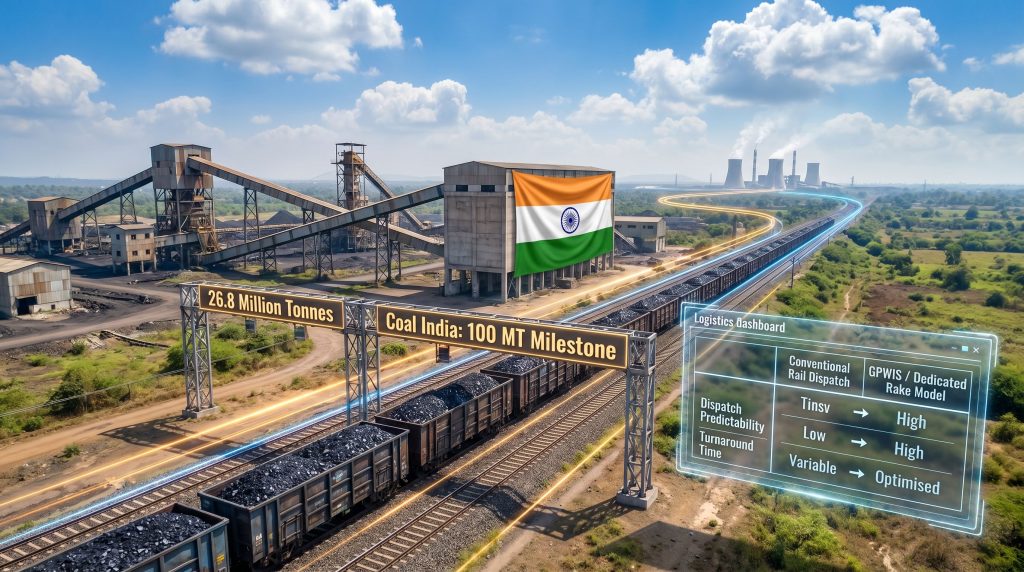
The GPWIS model addresses this directly by reserving dedicated rolling stock for a specific shipper or commodity type. Pre-planned scheduling becomes possible, turnaround times shorten, and the predictability of dispatch windows improves substantially. For a coal producer operating at SECL's scale, these advantages compound significantly across thousands of rake movements per year.
| Feature | Conventional Rail Dispatch | GPWIS and Dedicated Rake Model |
|---|---|---|
| Wagon availability | Subject to general freight demand | Reserved and dedicated allocation |
| Turnaround time | Variable, frequently delayed | Optimised through pre-planned scheduling |
| Dispatch predictability | Low | Substantially higher |
| Suitability for bulk coal | Moderate | High |
| Digital monitoring integration | Limited | Built into operational framework |
CWC's Institutional Strengths and Why This Partnership Makes Strategic Sense
Central Warehousing Corporation brings a specific and complementary capability set to this agreement. As a leading integrated logistics and warehousing organisation with deep experience in rail-linked cargo movement, CWC operates an extensive national infrastructure network that spans warehousing nodes, cold chain facilities, and multimodal transport interfaces.
What makes this partnership structurally interesting is what it is not. SECL has not attempted to build parallel in-house logistics capacity, which would require substantial capital investment, procurement lead times, and operational expertise outside its core competency. Instead, the agreement leverages CWC's existing institutional infrastructure and rail logistics knowledge base, pairing it with SECL's production volumes and mine-to-market requirements.
This model, pairing a commodity producer with a specialist logistics organisation rather than vertically integrating transport functions, reflects a broader shift in how large public sector enterprises in India are approaching operational efficiency. The logic is sound: CWC has already built the capabilities, the network relationships, and the regulatory familiarity that SECL would take years to replicate independently. Furthermore, this approach is comparable to the integrated mine-to-port logistics strategy being adopted by resource producers in other major mining jurisdictions.
SECL's Production Scale Creates an Urgent Logistics Imperative
SECL's position within Coal India Limited is not marginal. In the ongoing financial year FY2026-27, SECL produced over 26.8 Million Tonnes in the period leading up to Coal India Limited's 100 Million Tonne production milestone, making it the single highest-contributing subsidiary across the entire group during that window.
At that output level, logistics capacity is not an operational nicety. It is a fundamental constraint on whether that production actually delivers value to the Indian economy. Consider the consuming sectors dependent on reliable SECL supply:
- Thermal power generation, where fuel shortfalls translate directly into grid instability and load-shedding risks
- Integrated steel manufacturing, where coking and thermal coal are process-critical inputs with narrow substitution options — a concern directly linked to the broader steel demand outlook across global markets
- Cement production, where coal is the primary kiln fuel and supply disruptions compress margins and output
- Other energy-intensive industries that rely on consistent coal availability for continuous process operations
Each of these sectors operates on procurement schedules and inventory buffers calibrated to a particular level of supply reliability. When that reliability deteriorates, the downstream costs extend well beyond the coal sector itself.
The next major ASX story will hit our subscribers first
The Operational Domains of the MoU: A Structured Overview
The practical scope of the SECL and CWC coal logistics MoU spans the full logistics value chain rather than addressing a single chokepoint. This is significant because India's coal evacuation challenges are not concentrated in one location or process step.
| Collaboration Domain | Expected Operational Outcome |
|---|---|
| Dedicated railway rake operations | Improved dispatch frequency and scheduling reliability |
| Integrated rail logistics services | Reduced transit time from mine gate to consumer |
| Multimodal transportation solutions | Greater flexibility across road, rail, and warehousing modes |
| First-mile connectivity improvements | Elimination of loading delays at mine-adjacent rail points |
| Last-mile connectivity improvements | Reliable delivery to end-user facilities |
| Digital logistics monitoring systems | Real-time supply chain visibility and delay reduction |
| Long-term transportation planning | Systemic reduction in structural bottlenecks over time |
Multimodal Integration: Why the Full Chain Matters More Than Any Single Link
A technically important but often underappreciated dimension of this agreement is its multimodal character. Indian coal logistics historically defaulted to a rail-dominated model, which created single-mode dependency risk. When rail capacity tightened, whether due to infrastructure constraints, monsoon-related track disruptions, or competing freight demand, the entire supply chain stalled.
Multimodal frameworks reduce this vulnerability by building redundancy and flexibility into the transport architecture. Coal can move from mine to railhead by road, transition to dedicated rail rakes for long-haul movement, and then distribute from a central warehousing node to final consumers via road or additional rail legs. Each mode handoff introduces complexity, but digital monitoring systems are specifically designed to manage that complexity by providing real-time visibility across every node in the chain.
The deployment of digital tracking and operational oversight tools within this MoU reflects an important evolution in Indian coal logistics thinking. Historically, supply chain visibility in this sector was limited, making proactive management of delays and bottlenecks extremely difficult. Real-time monitoring changes the operational calculus fundamentally, enabling faster intervention when disruptions occur and better demand-supply matching across the network. In addition, proposals such as the India coal trading exchange further signal India's commitment to modernising the coal supply ecosystem end-to-end.
Execution Challenges That Will Determine the MoU's Real-World Impact
What Are the Key Risks to Implementation?
Structural agreements of this type carry inherent execution risks that are worth examining clearly. Several factors will determine whether the SECL and CWC coal logistics MoU delivers its intended outcomes.
- Coordination complexity: Two large public sector enterprises with distinct institutional cultures, mandate structures, and internal approval processes must align operationally across multiple domains simultaneously. This is rarely straightforward.
- Regional rail infrastructure constraints: SECL operates primarily across Chhattisgarh and Madhya Pradesh, where existing rail infrastructure at the local level has capacity limitations that no MoU can resolve without parallel physical investment.
- Digital system deployment timelines: Building and integrating logistics monitoring platforms at the scale required for SECL's production volumes involves procurement, testing, and staff training cycles that typically extend beyond initial projections.
- Demand variability from power utilities: Thermal power procurement follows seasonal and grid-demand patterns that can spike rapidly, making it difficult to maintain stable rake scheduling when demand signals shift sharply.
- Inter-ministerial alignment: Coordinating between the Ministry of Coal's operational priorities and the Ministry of Railways' capacity allocation frameworks requires ongoing engagement that goes beyond a bilateral agreement between two PSEs.
Why PSE-to-PSE Logistics Partnerships Represent a Maturing Infrastructure Model
The SECL and CWC coal logistics MoU is not an isolated event. It reflects a broader pattern emerging across India's public sector infrastructure landscape, where large state-owned enterprises are increasingly leveraging each other's capabilities through formal collaboration frameworks rather than duplicating functions or relying on fragmented private sector contracting.
This approach carries several systemic advantages. Procurement complexity is reduced because both parties operate within aligned regulatory and accountability frameworks. Incentive structures are easier to align when both organisations are ultimately accountable to national energy and logistics policy objectives. Furthermore, the institutional knowledge embedded within organisations like CWC, built over decades of warehousing and rail logistics operations, can be deployed at scale without the time and cost of building comparable capability from scratch.
If the operational outcomes of this partnership prove measurable and replicable, the model has clear potential for expansion across other Coal India Limited subsidiaries facing similar evacuation challenges. India's coal production geography is diverse, and each producing region presents its own logistics profile. The principles embedded in this agreement — dedicated rake provisioning, multimodal flexibility, digital monitoring, and long-term planning discipline — are broadly applicable. Detailed reporting from PSU Watch confirms that institutional collaboration of this kind is gaining traction across India's central public sector enterprise landscape.
For India's industrial economy, the efficiency of coal logistics is not a secondary concern. It is a primary determinant of whether record production volumes translate into genuine energy security or simply impressive headline statistics.
Disclaimer: This article is intended for informational purposes only and does not constitute financial, investment, or policy advice. Production figures and institutional details are drawn from publicly available sources. Readers should conduct independent verification before drawing operational or investment conclusions.
Want To Stay Ahead of Major ASX Mineral Discoveries Before the Broader Market Does?
Discovery Alert's proprietary Discovery IQ model scans ASX announcements in real time, delivering instant alerts on significant mineral discoveries and turning complex data into actionable investment insights for traders and long-term investors alike — explore historic discovery returns on the Discovery Alert discoveries page to understand what's possible, then begin your 14-day free trial at Discovery Alert to secure your market-leading edge.