June 11, 2026
Understanding Coal Mine Emergency Protocols in Australia
Queensland's underground coal mining operations function under one of the world's most stringent regulatory frameworks, where emergency protocols prioritise worker safety above production continuity. The Coronado Curragh mining suspension demonstrates how the Coal Mining Safety and Health Act 1999 establishes mandatory suspension requirements following fatal incidents, creating immediate operational halts that can extend across entire mining complexes regardless of incident location.
When underground emergencies occur, Queensland's Department of Resources implements a standardised response sequence that begins with immediate evacuation protocols. Mine operators must notify the Queensland Resources Safety and Health Representative within four hours, triggering independent investigation procedures that can suspend operations indefinitely until safety concerns are resolved.
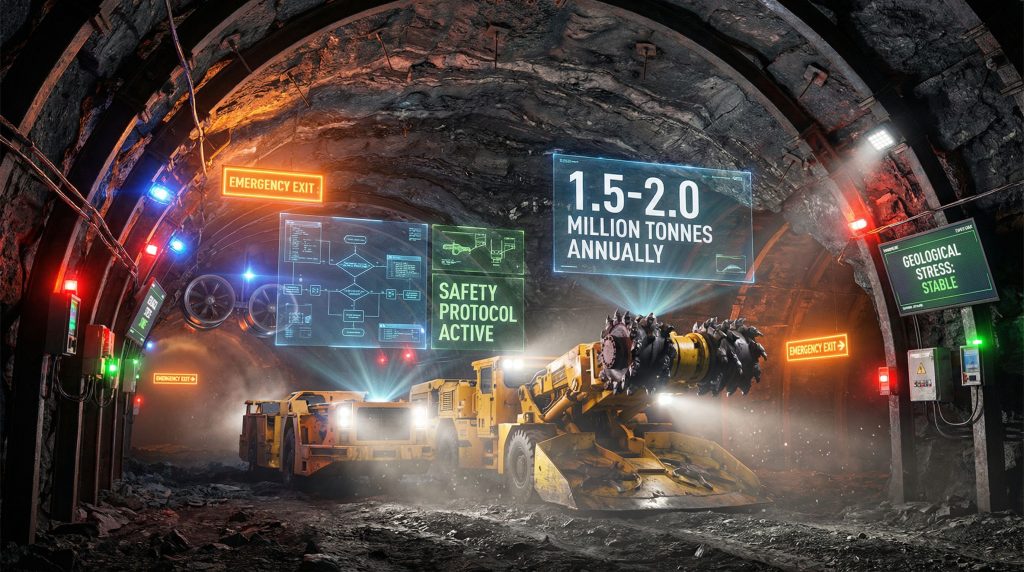
Underground coal extraction using bord-and-pillar methods presents unique emergency challenges due to structural complexity. These operations involve selective coal removal whilst maintaining coal pillars for roof support, creating intricate underground networks where roof stability depends on precise pillar geometry and stress distribution.
Critical monitoring systems track vertical displacement rates through laser extensometry and maintain pillar stress ratios between 0.3 and 0.5 of structural capacity. Emergency response coordination requires immediate ventilation system stabilisation to prevent hazardous gas accumulation, particularly methane and carbon monoxide buildup common in underground coal environments.
Furthermore, Queensland's regulatory model mandates specialised rescue teams with structural engineering expertise to assess ground stability before personnel access is permitted. These teams must understand mining permit guidelines to ensure compliance throughout emergency response procedures.
When big ASX news breaks, our subscribers know first
What Triggered the Curragh Mining Complex Shutdown?
The Coronado Curragh mining suspension began with a roof collapse at the Mammoth Underground Mine on December 27, 2025, at approximately 3 PM local time. This incident resulted in one worker fatality and triggered comprehensive operational halts across the entire 256-square-kilometre mining complex.
Shaun Newberry, Vice President of Operations at Curragh, announced a voluntary production pause across all three operational areas as a sign of respect for the deceased worker. This decision extended beyond regulatory requirements, demonstrating corporate-level risk management that prioritised worker welfare over production continuity during crisis response.
Consequently, the shutdown affected unaffected open-cut operations at Curragh North and Curragh South, highlighting how modern mining companies implement company-wide safety protocols during emergency situations.
Technical Analysis of Underground Coal Mining Risks
Roof collapses in bord-and-pillar operations typically result from multiple interconnected failure mechanisms. Pillar geometry represents the primary structural variable, where width-to-height ratios below 0.8 create exponential load concentration increases.
Industry standards maintain ratios between 0.8 and 1.2 to ensure adequate load distribution across underground support systems. Strata stress redistribution occurs when localised mining activities alter natural stress fields, creating unstable conditions in previously secure areas.
Roof rock layer separation becomes critical when weak interbedding, particularly clay layers between coal seams and overlying strata, propagates fractures vertically through geological formations. Dynamic loading from equipment vibration, blasting operations, or seismic activity elsewhere in the mine can trigger sudden failure in structurally compromised areas.
The Mammoth Underground operation, having commenced production approximately one year prior to the incident in December 2024, represented a relatively new underground development where geological understanding was still evolving. The extended nighttime recovery operation required structural stabilisation before rescue personnel could safely access the incident location.
How Does Operational Suspension Impact Coal Production Economics
Coronado Curragh mining suspension creates immediate financial stress through zero-revenue periods whilst fixed costs continue accumulating. The Mammoth Underground operation was projected to produce up to 2 million tonnes of high-grade metallurgical coal annually, translating to approximately 5,479 tonnes of daily production capacity loss during suspension.
Combined with the voluntary halt of Curragh North and Curragh South open-cut operations, the total complex suspension eliminates an estimated 20,000 to 30,000 tonnes of daily production. At current metallurgical coal prices near four-year lows of approximately USD $140 per tonne, daily revenue losses exceed USD $1.4 million before considering operational cost continuation.
Queensland coal mining operations typically maintain 40 to 60 percent of total operating costs as fixed expenses, including labour obligations, infrastructure maintenance, equipment leasing, and environmental compliance. For instance, the Curragh complex faces estimated daily fixed cost burn reaching AUD $800,000 to $1.2 million during production suspension.
This creates negative cash flow exceeding USD $2 million daily, demonstrating why mining companies require robust capital raising methods to manage such operational disruptions.
Financial Stress Multipliers in Mining Operations
Debt service obligations continue regardless of production status, creating compounding liquidity pressure. Coronado's total debt increased from AUD $468.1 million at the end of 2023 to approximately AUD $928.4 million by late 2025, nearly doubling in two years.
Monthly interest costs approach USD $3.1 million, requiring sustained production to maintain debt coverage ratios. Supply chain disruption effects extend beyond immediate operational losses, as steel manufacturing customers typically maintain 20 to 40 days of coking coal inventory.
Furthermore, credit rating deterioration accelerates during production suspensions. Fitch Ratings had already withdrawn its CCC- long-term issuer default rating in November 2025 after cutting Coronado's rating three times from an initial B+ in September 2024.
Why Mammoth Underground Represented Critical Growth Infrastructure
Mammoth Underground's projected 2 million tonnes of annual high-grade metallurgical coal production represented Coronado's primary recovery strategy for financial restructuring. Jefferies analysts characterised Coronado's balance sheet and liquidity position as being at "the cross road" in October 2025.
They specifically noted that progress at Mammoth "remains critical to recovery." Underground mine development typically requires AUD $300 to $500 million in capital expenditure for metallurgical coal bord-and-pillar operations.
Mammoth's estimated investment of AUD $250 to $350 million based on project scope and site infrastructure creates capital payback periods extending 8 to 12 years at current commodity prices and projected operating margins. The strategic importance of Mammoth extends beyond production capacity to operational diversification.
Moreover, Curragh's 43-year operational history focused exclusively on open-cut mining, making Mammoth the complex's first underground expansion. This diversification was intended to access higher-grade metallurgical coal reserves unsuitable for surface extraction methods.
Underground vs. Open-Cut Mining Economics Comparison
| Operation Type | Capital Intensity | Operating Costs | Production Flexibility |
|---|---|---|---|
| Underground Bord-and-Pillar | High initial investment | Higher per-tonne costs | Limited scaling capability |
| Open-Cut Surface Mining | Lower setup costs | Variable with strip ratios | Rapid production adjustments |
Integration benefits with existing open-cut operations were designed to optimise infrastructure utilisation, including shared processing facilities, transportation networks, and administrative overhead. Mammoth's high-grade metallurgical coal classification commands premium pricing relative to thermal coal.
Additionally, this premium pricing is crucial for offsetting higher underground extraction costs. Coronado's market capitalisation declined 80 percent over the two-year period preceding the incident, reflecting investor scepticism about the company's financial sustainability.
What Are the Broader Queensland Coal Industry Pressures?
Queensland's coal industry faces systemic challenges extending beyond individual operational incidents. Metallurgical coking coal prices have declined to near four-year lows, falling from peak levels exceeding USD $300 per tonne during 2021-2022 to approximately USD $130 to $150 per tonne by late 2025.
BHP's coal strategy exemplifies industry-wide rationalisation through their September 2025 announcement to close Saraji South mine and curb further coal investment under Queensland's royalty regime. Saraji South represented approximately 2.5 to 3 million tonnes of annual capacity reduction.
This indicates major producers are prioritising capital preservation over production maintenance. However, some companies have resumed safety operations following comprehensive safety reviews and infrastructure upgrades.
Industry-Wide Operational Adjustments
The sector implements several strategic responses to market pressures:
• Production curtailment strategies: Major coal companies are implementing selective mine closures to concentrate resources on highest-margin operations
• Capital expenditure deferrals: New project development has slowed significantly as companies preserve cash during commodity price weakness
• Workforce reduction programs: Regional employment in Queensland coal mining has contracted as operators adjust to sustained lower pricing
• Infrastructure consolidation: Shared transportation and processing facilities are being optimised to reduce per-tonne operational costs
Global steel demand softening contributes to metallurgical coal market weakness. Integrated steelmakers in key markets including China, Europe, and North America have reduced production rates, diminishing coking coal consumption and creating supply-demand imbalances in seaborne markets.
In addition, Queensland's royalty regime imposes additional cost pressures on mining operations through progressive taxation structures that increase with commodity prices. Whilst providing revenue during peak pricing periods, these frameworks reduce operational flexibility during market downturns when fixed royalty obligations continue regardless of profitability.
How Do Mining Companies Navigate Liquidity Crises?
Mining companies facing operational suspensions and commodity price pressures employ multiple strategies to preserve liquidity and maintain operational viability. Debt restructuring represents the primary tool for companies with significant leverage, particularly when production disruptions threaten covenant compliance.
Working capital optimisation becomes critical during revenue disruptions. Companies typically negotiate extended payment terms with suppliers, accelerate receivables collection, and minimise inventory holdings to preserve cash flow.
For coal mining operations, this includes managing stockpile levels and optimising product blending to maintain customer specifications whilst reducing working capital requirements. Meanwhile, government intervention measures may provide additional support frameworks during crisis periods.
Credit Rating Deterioration Cascade Effects
Credit deterioration creates multiple operational challenges:
• Borrowing cost increases: Credit rating downgrades trigger higher interest rates on existing revolving credit facilities and new debt issuances
• Supplier payment term renegotiations: Vendors may require shortened payment cycles or additional security for continued service provision
• Customer contract security requirements: Steel industry customers may demand additional guarantees or security deposits for long-term coal supply agreements
• Insurance premium increases: Coverage costs for operational, environmental, and business interruption insurance typically increase following credit deterioration
Asset divestiture strategies provide immediate liquidity but reduce long-term production capacity. Mining companies may sell non-core assets, joint venture interests, or exploration properties to generate cash for debt service and operational continuity.
Furthermore, credit facility covenant management requires careful balance between operational flexibility and lender requirements. Companies often negotiate covenant modifications or waivers during operational disruptions, typically involving increased oversight and operational restrictions in exchange for continued facility access.
The next major ASX story will hit our subscribers first
What Recovery Pathways Exist for Suspended Operations?
Operational restart following underground incidents requires comprehensive investigation completion and regulatory approval processes. Queensland's Department of Resources conducts detailed structural assessments, safety protocol reviews, and geological evaluations before permitting production resumption.
Investigation timelines for complex underground incidents typically extend 14 to 45 days, depending on incident complexity and remediation requirements. Roof collapse scenarios necessitate extensive geological reassessment, structural reinforcement planning, and enhanced monitoring system implementation before operations can resume.
Mining companies across Australia face similar challenges when managing operational suspensions and financial pressures during commodity price volatility.
Risk Management Framework for Mining Resumption
Recovery implementation requires systematic approach:
• Enhanced safety protocol implementation: Upgraded monitoring systems, revised operational procedures, and additional training requirements for underground personnel
• Geological reassessment and structural reinforcement: Comprehensive review of pillar design, roof support systems, and ground control measures
• Workforce retraining and confidence restoration programmes: Psychological support services and safety training to address worker concerns following fatal incidents
• Operational restart sequencing: Phased production ramp-up beginning with limited areas and gradually expanding based on performance monitoring
Production ramp-up following extended shutdowns requires careful workforce coordination and equipment recommissioning. Underground operations face particular challenges in ventilation system restart, electrical system inspection, and ground condition assessment after periods of inactivity.
Consequently, market re-entry strategies during commodity price volatility involve contract renegotiation with existing customers and potential pricing adjustments to reflect changed market conditions. Steel industry customers may have secured alternative supply sources during suspension periods, requiring competitive pricing to regain market share.
How Do Fatal Mining Incidents Reshape Industry Safety Standards?
Fatal mining incidents trigger comprehensive regulatory review processes that often result in enhanced safety standards across entire jurisdictions. Queensland's mining safety framework evolution demonstrates how individual incidents influence systematic improvements in hazard detection, operational protocols, and emergency response procedures.
Technology advancement acceleration typically follows major incidents, with increased investment in real-time monitoring systems, automated hazard detection, and remote operational capabilities. Ground penetrating radar, continuous stress monitoring, and predictive analytics become standard rather than optional technologies.
Moreover, regulatory response patterns following underground fatalities include mandatory safety audits across similar operations, enhanced inspector presence, and potential revision of existing safety regulations. The Queensland Department of Resources typically implements temporary operational restrictions whilst conducting comprehensive industry reviews.
Insurance and Liability Framework Adjustments
Risk management evolution includes several key components:
• Coverage requirement increases: Enhanced business interruption, workers compensation, and liability insurance minimums following fatal incidents
• Premium structure modifications: Risk assessment models updated to reflect incident patterns and operational risk factors
• Claims handling protocol evolution: Streamlined processes for operational suspension coverage and family compensation procedures
Industry-wide safety protocol updates involve collaborative development between regulators, operators, and worker representatives. These protocols often extend beyond incident-specific locations to address systemic risks identified through incident investigation processes.
However, implementation timelines vary significantly based on operational complexity and regulatory approval processes. Companies must balance enhanced safety measures with operational efficiency requirements to maintain competitive positioning.
What Does This Signal for Australian Coal Mining Investment?
The Coronado Curragh mining suspension exemplifies broader investment challenges facing Australian coal mining operations. Capital allocation patterns are shifting toward lower-risk surface operations as underground development faces increased regulatory scrutiny and operational complexity.
International investor sentiment toward Australian coal assets reflects growing concerns about regulatory environment evolution, climate policy uncertainty, and operational risk management. ESG-focused investment funds have reduced exposure to thermal coal operations, whilst metallurgical coal assets face scrutiny over long-term steel industry transition pathways.
In addition, regulatory environment evolution includes enhanced safety compliance requirements, environmental monitoring obligations, and community consultation processes. These developments increase project development timelines and capital requirements, reducing investment attractiveness relative to alternative commodity exposures.
Strategic Implications for Coal Industry Consolidation
Market transformation creates multiple opportunities and challenges:
• Distressed asset acquisition opportunities: Financial stress among highly leveraged operators creates potential acquisition targets for well-capitalised companies
• Market share redistribution: Operational suspensions and mine closures shift production capacity toward surviving operators with enhanced pricing power
• Geographic concentration trends: Investment capital increasingly focuses on proven, low-cost mining regions with established infrastructure and regulatory stability
• Technology integration acceleration: Surviving operators invest heavily in automation, monitoring systems, and operational efficiency to maintain competitiveness
Long-term viability assessment for underground coal development requires evaluation of regulatory compliance costs, technological advancement requirements, and market demand sustainability. Furthermore, the transition toward electric arc furnace steelmaking and hydrogen-based steel production technologies may reduce metallurgical coal demand over 10 to 20 year timeframes.
Consequently, the Coronado Curragh mining suspension represents broader industry challenges including operational risk management, financial sustainability, and regulatory compliance requirements. Mining companies must navigate these complexities whilst maintaining safety standards and operational efficiency to ensure long-term viability.
Disclaimer: This analysis contains forward-looking statements and projections based on current market conditions and regulatory frameworks. Mining operations involve inherent risks including operational hazards, commodity price volatility, and regulatory changes. Past performance and current operational status do not guarantee future results. Investors should conduct independent due diligence and consider professional advice before making investment decisions.
Ready to Invest in the Next Major Mining Discovery?
Discovery Alert delivers instant notifications on significant ASX mineral discoveries using its proprietary Discovery IQ model, transforming complex geological data into actionable investment insights for both short-term traders and long-term investors. Explore why major mineral discoveries can generate substantial market returns and begin your 30-day free trial today to position yourself ahead of the market.