June 18, 2026
India's Coal Beneficiation Bottleneck: Why Washery Capacity Matters More Than Mine Output
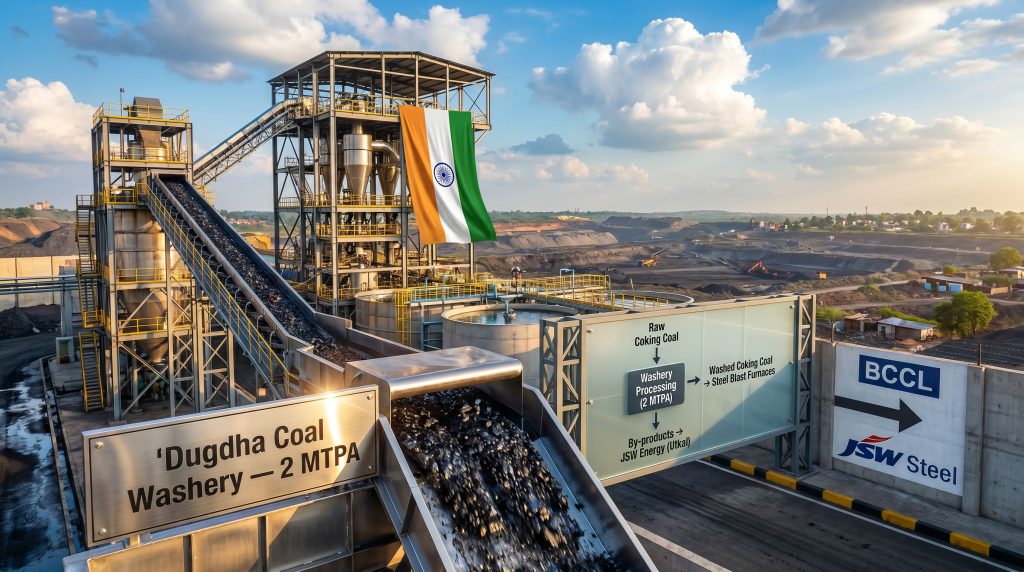
The conversation around India's coking coal challenge has long centred on the mines themselves, the tonnage extracted, the reserves still underground, and the geological formations waiting to be developed. Yet a quieter constraint has shaped the steel industry's raw material economics for decades: the country's chronic shortage of functional, high-throughput coal washing capacity. Without beneficiation infrastructure capable of processing domestic coking coal into blast furnace-ready grades, even abundant mine output fails to translate into usable steelmaking feed. This structural gap is precisely why BCCL hands over Dugdha Coal Washery to JSW Steel on June 18, 2026, carrying significance well beyond a routine asset transfer.
When big ASX news breaks, our subscribers know first
Understanding Coal Washing: The Critical Step Between Mine and Furnace
To appreciate what the Dugdha transaction represents, it helps to understand what a coal washery actually does and why its absence creates cascading inefficiencies across the steel value chain.
Raw coking coal extracted from Indian mines typically contains elevated levels of ash, sulphur, and moisture. These impurities are not merely inconvenient — they are metallurgically disqualifying. Blast furnace steelmaking requires coking coal with ash content typically below 17 percent, and ideally closer to 10 to 12 percent, to maintain coke strength and thermal efficiency.
Much of India's domestic coking coal comes out of the ground with ash levels ranging from 25 to 35 percent, making it unusable in its raw form for premium steelmaking applications. The beneficiation process, colloquially called coal washing, uses a combination of dense medium separation, froth flotation, and jigging technologies to stratify coal particles by density. The result is a separation into three streams:
- Washed coking coal (low ash, high carbon content) suitable for coke ovens and blast furnaces
- Middlings (intermediate grade) used in thermal power generation or blended with other coals
- Rejects and slurry (high ash residue) with limited but recoverable calorific value for industrial boilers and power plants
This three-stream output structure is precisely why the Dugdha monetisation involves not just JSW Steel but also JSW Energy (Utkal) as a consortium partner for by-product streams. The architecture captures value at every grade level, rather than treating low-grade residuals as pure waste.
BCCL Hands Over Dugdha Coal Washery to JSW Steel: What the Transaction Entails
The formal handover ceremony took place at Coal Bhawan, BCCL's headquarters in Dhanbad, Jharkhand. BCCL Chairman and Managing Director Manoj Kumar Agarwal led the proceedings alongside executive directors and senior officials from both JSW Steel and JSW Energy. The event marked the culmination of a process that began with the issuance of a Letter of Intent in March 2025, with the formal site handover completed approximately fifteen months later.
The key parameters of the transaction are summarised below:
| Parameter | Detail |
|---|---|
| Facility | Dugdha Coal Washery |
| Outgoing Operator | Bharat Coking Coal Ltd (BCCL) |
| Incoming Operator | JSW Steel Ltd |
| Washery Capacity | 2 Million Tonnes Per Annum (MTPA) |
| Firm Coking Coal Linkage | 2 MTPA |
| Letter of Intent | March 2025 |
| Formal Handover | June 18, 2026 |
| By-product Consortium Partner | JSW Energy (Utkal) |
| Supervising Authority | Ministry of Coal |
Under the arrangement, BCCL retains ownership of the underlying coal resource while JSW Steel assumes operational and commercial responsibility for running the washery. The firm linkage of 2 MTPA of coking coal is a foundational commercial mechanism, guaranteeing JSW Steel a reliable feedstock volume that justifies the capital investment required to modernise and operate the facility. This distinction between resource ownership and operational control is what differentiates washery monetisation from outright mine privatisation.
Furthermore, commodity price impacts on steelmaking margins reinforce the strategic logic here. When import costs rise, domestic processing capacity becomes proportionally more valuable to integrated steel producers seeking cost insulation.
Why This Is Structurally Different From Coal Mine Privatisation
India's coal sector reform narrative has often been framed around the contentious question of mine privatisation, a debate laden with political sensitivities around public sector employment, resource nationalism, and energy security. The Dugdha model sidesteps this debate entirely by separating the processing layer from the extraction layer.
BCCL continues to mine the coal. It continues to own the reserves. What changes is who operates the washing infrastructure and who bears the responsibility for converting raw output into value-added product. This is a meaningfully different risk allocation, and it is likely one reason the transaction reached completion where full mine privatisation proposals have faced prolonged resistance.
"The Dugdha transaction demonstrates that public-sector coal asset reform does not require a binary choice between full state ownership and full privatisation. Operational unbundling at the processing layer may prove to be the more politically durable and commercially effective path forward."
For private sector participants, the firm linkage mechanism resolves the investment case problem that has historically deterred washery development. Without guaranteed feedstock, no rational investor will commit capital to processing infrastructure. The 2 MTPA linkage transforms an uncertain project into a financeable one.
In addition, India's coal trading reforms signal a broader willingness within the public coal sector to experiment with market-oriented structures that preserve state ownership while inviting private operational expertise.
The Jharia Coalfield: India's Most Consequential Coking Coal Basin
The Dugdha washery sits within the Jharia coalfield in Jharkhand, a geological formation that holds a unique and somewhat precarious place in India's industrial history. Jharia contains the largest reserves of prime coking coal in the country, estimated at approximately 19 billion tonnes of geological reserves, making it irreplaceable for domestic steel production.
However, the coalfield has been exploited continuously since the late 19th century, and extensive underground mining has left large sections susceptible to subsidence and underground fires. The Jharia coalfield's coking coal is distinctive in several geological respects:
- It belongs to the Gondwana sedimentary sequence, specifically the Barakar Formation of Lower Gondwana age
- The coking coals are classified as medium to high volatile bituminous grades, with vitrinite reflectance values typically ranging from 0.8 to 1.4 percent Ro, placing them in the metallurgically critical semi-hard to hard coking coal category
- Ash content in run-of-mine coal from Jharia typically ranges from 25 to 32 percent, confirming why washery processing is not optional but mandatory for steelmaking use
- The seams range from relatively thin bands to commercially significant thicknesses exceeding 10 metres in some areas
This geological profile explains why beneficiation infrastructure located within or adjacent to the Jharia coalfield, as the Dugdha washery is, carries strategic importance disproportionate to its nameplate capacity. Processing close to the source reduces transportation costs for raw coal and minimises the risk of coal degradation during transit.
Mission Coking Coal and the Import Substitution Imperative
India's dependence on imported coking coal represents one of the steel sector's most persistent cost vulnerabilities. The country imports approximately 50 to 55 million tonnes of coking coal annually, predominantly from Australia, the United States, Canada, and Mozambique. At prevailing international prices, this import bill runs into tens of billions of dollars per year, creating significant foreign exchange exposure and supply chain vulnerability to geopolitical disruptions.
Mission Coking Coal, the framework under which the Dugdha monetisation operates, targets a reduction in this import dependency by:
- Expanding domestic coking coal mine production through accelerated exploration and block development
- Increasing beneficiation capacity to improve the usability of lower-grade domestic coking coal
- Encouraging private sector participation in coal processing infrastructure to bring operational efficiency and investment capital
- Developing coking coal blending technologies that reduce the proportion of premium imported hard coking coal required per tonne of coke produced
The Dugdha washery's 2 MTPA processing capacity directly addresses the second objective. Each tonne of domestically washed coking coal that displaces an equivalent imported tonne reduces foreign exchange outflows and insulates Indian steelmakers from international price volatility. Given the steel sector's scale, even incremental domestic supply additions have meaningful macroeconomic consequences.
The next major ASX story will hit our subscribers first
JSW Steel's Strategic Logic: Why Domestic Washery Control Changes the Input Economics
For JSW Steel, one of India's largest steel producers with an installed steelmaking capacity of approximately 28 MTPA as of mid-2026, coking coal procurement is a perpetual balancing act between cost, quality, and supply security. The company's blast furnace operations require substantial volumes of metallurgical coke, and by extension, substantial volumes of coking coal feed.
The economics of operating the Dugdha washery versus purchasing equivalent volumes on the spot or tender market differ in several important dimensions:
- Supply certainty: The 2 MTPA firm linkage removes procurement uncertainty that spot market dependence creates, particularly during periods of international supply tightness
- Cost structure: Domestically produced and washed coking coal, even after washing costs, has historically traded at a meaningful discount to equivalent imported hard coking coal grades when landed costs are compared
- Blending optionality: Control over a washing operation gives JSW Steel the ability to optimise ash content and coking properties through blending different raw coal grades before and during the washing process
- By-product monetisation: Through the JSW Energy (Utkal) consortium arrangement, middlings and rejects become revenue-generating outputs rather than disposal costs
The vertical integration logic is compelling. JSW Steel gains influence over a segment of its raw material supply chain that was previously entirely external, while JSW Energy gains a captive source of lower-grade coal for power generation. Consequently, the overall group's energy and materials economics are strengthened simultaneously.
Understanding metallurgical coal prices further contextualises why this vertical integration strategy is timely — periods of elevated import pricing directly amplify the cost advantage of domestic washing capacity.
The Replication Question: Can Dugdha Become a Template?
BCCL and the Ministry of Coal have positioned the Dugdha transaction as a replicable model for broader coal washery asset monetisation across Coal India's subsidiary network. The criteria that made Dugdha suitable as a pilot asset provide a useful framework for assessing which other facilities could follow.
| Replication Criterion | Dugdha Suitability | Implication for Future Candidates |
|---|---|---|
| Capacity Scale | 2 MTPA, commercially meaningful | Minimum viable scale likely required |
| Infrastructure Condition | Suitable for private investment | Facilities needing full rebuild may require different structures |
| Proximity to Feedstock | Within Jharia coalfield | Co-location with raw coal supply reduces logistics risk |
| Private Sector Demand | JSW Steel's strategic need | Anchor tenant with clear strategic rationale is essential |
| By-product Utilisation | JSW Energy consortium | Adjacent energy/industrial user improves project economics |
| Regulatory Clarity | Ministry of Coal supervised | Clear ministerial oversight reduces transaction risk |
BCCL alone operates several washeries across the Jharia coalfield, some functioning below nameplate capacity and others requiring capital investment to return to productive operation. Whether the Dugdha model can be replicated will depend heavily on whether subsequent transactions can attract private sector partners with comparable strategic motivations and financial capacity.
"The pace of future coal washery monetisations will likely serve as a leading indicator of the broader appetite within India's public coal sector for operational unbundling, providing market participants with an early read on the trajectory of coal infrastructure reform."
One structural challenge worth noting is the tension between allocating firm coal linkages to private washery operators and fulfilling BCCL's existing supply obligations to other customers. As more washeries are monetised with guaranteed feedstock allocations, BCCL's capacity to service traditional buyers without corresponding mine production growth will require careful management.
The broader raw materials transition underway globally also shapes the context here. As steelmakers increasingly face pressure to justify carbon-intensive processes, improving the efficiency of domestic coking coal utilisation becomes part of a longer-term decarbonisation argument.
Jharkhand's Industrial Ecosystem: The Regional Multiplier Effect
Jharkhand's economic geography is deeply entwined with the coal and steel sectors. The state accounts for a substantial share of India's coking coal output and hosts a cluster of downstream industrial facilities that rely on reliable coal supply chains. When washery infrastructure operates below capacity or under suboptimal management, the inefficiencies ripple outward through transportation logistics, coke oven operations, and power generation facilities that depend on coal by-products.
Improved operational performance at the Dugdha washery under private management is expected to generate ancillary benefits including:
- More predictable coal quality and volume for downstream processors in the Jharkhand industrial corridor
- Enhanced employment stability associated with increased washery throughput and associated logistics activity
- Potential for additional private capital to flow into complementary coal processing and handling infrastructure in the region
- Strengthened case for infrastructure investment connecting washery output to steel plant rail and road networks
The regional implications reinforce the national policy rationale. Jharkhand's industrial activity is meaningfully tied to how well its coal processing infrastructure performs, and the Dugdha handover represents a direct intervention in that performance equation. Furthermore, the global crude steel outlook for 2025 and beyond underscores why India must increase the efficiency of its domestic coking coal supply if it is to remain competitive in international steel markets.
Frequently Asked Questions
What makes coking coal different from thermal coal?
Coking coal, also called metallurgical coal, has specific physical and chemical properties that allow it to form coke when heated in the absence of oxygen. Coke is the primary reductant in blast furnace steelmaking, providing both the carbon source and the structural support needed to sustain the furnace burden. Thermal coal, by contrast, is used primarily for combustion in power generation. The distinction matters enormously for pricing: coking coal commands a significant premium over thermal coal because of its specialised role and the relatively limited number of deposits that meet metallurgical specifications.
Why does India struggle with domestic coking coal supply despite large reserves?
India's coking coal reserves are large in absolute terms but structurally challenging. A significant proportion of the resource is classified as semi-coking or weakly coking coal, requiring blending with higher-quality grades to meet blast furnace specifications. Additionally, high native ash content means substantial volumes of run-of-mine coal must be washed before use, and washery capacity has historically lagged behind mining output growth. The result is a paradox where a coal-rich country imports more than half its coking coal needs because the domestic resource requires processing infrastructure that has been chronically underdeveloped.
What is the commercial significance of a firm coal linkage?
A firm linkage is an administratively allocated entitlement to purchase a specified volume of coal from a public sector producer at a regulated price, as distinct from e-auction procurement where prices fluctuate with market conditions. For a washery operator, a firm linkage transforms the project's financial risk profile by eliminating feedstock price and volume uncertainty. It is the mechanism that makes private investment in government-owned coal processing assets commercially viable, and it is central to why the Dugdha model attracted JSW Steel's participation.
How does washery by-product management work in the JSW consortium structure?
Coal washing generates three broad output streams. Washed coking coal goes to JSW Steel's blast furnaces. Middlings, which retain significant calorific value but cannot meet coke oven specifications, are channelled to JSW Energy (Utkal) for power generation. Fine coal slurry, the lowest grade residual, can also be used as a boiler fuel or pressed into briquettes. This consortium structure ensures that no significant calorific value is wasted and that each output stream has a defined commercial home within the JSW group's integrated operations.
Key Takeaways
- The Dugdha Coal Washery handover by BCCL to JSW Steel represents India's first coal washery monetisation, establishing a new policy instrument for unlocking value from public-sector coal processing assets without full divestiture
- A 2 MTPA firm coking coal linkage forms the commercial backbone of the arrangement, providing JSW Steel with supply certainty that transforms the investment case
- The transaction operates at the processing layer of the coal supply chain, separating operational control from resource ownership in a structure that avoids the political sensitivities of outright mine privatisation
- The Jharia coalfield's coking coals, characterised by high native ash content of 25 to 35 percent, make beneficiation infrastructure a physical necessity rather than an economic preference
- India's annual coking coal import bill, covering 50 to 55 million tonnes of imported metallurgical coal, provides the macroeconomic rationale underpinning Mission Coking Coal and the Dugdha transaction's strategic logic
- JSW Energy (Utkal)'s consortium role captures value from washery by-product streams, creating an integrated resource utilisation model across the JSW group
- The success of the Dugdha model will determine the pace and scope of future coal washery monetisations across BCCL and other Coal India subsidiaries
This article contains forward-looking statements and analytical projections regarding India's coal sector, beneficiation capacity, and import substitution potential. These representations are based on publicly available information and sector analysis and should not be construed as financial advice. Readers should conduct independent research before making investment or commercial decisions related to the coal or steel sectors.
Want to Identify the Next Major ASX Resource Opportunity Before the Market Does?
Discovery Alert's proprietary Discovery IQ model delivers real-time alerts on significant ASX mineral discoveries — transforming complex resource data into actionable investment insights for both short-term traders and long-term investors. Explore how historic discoveries have generated substantial returns on Discovery Alert's dedicated discoveries page, and begin your 14-day free trial today to position yourself ahead of the broader market.