June 18, 2026
India's Advanced Manufacturing Pivot: Why Odisha's Latest Investment Clearances Signal a Structural Shift
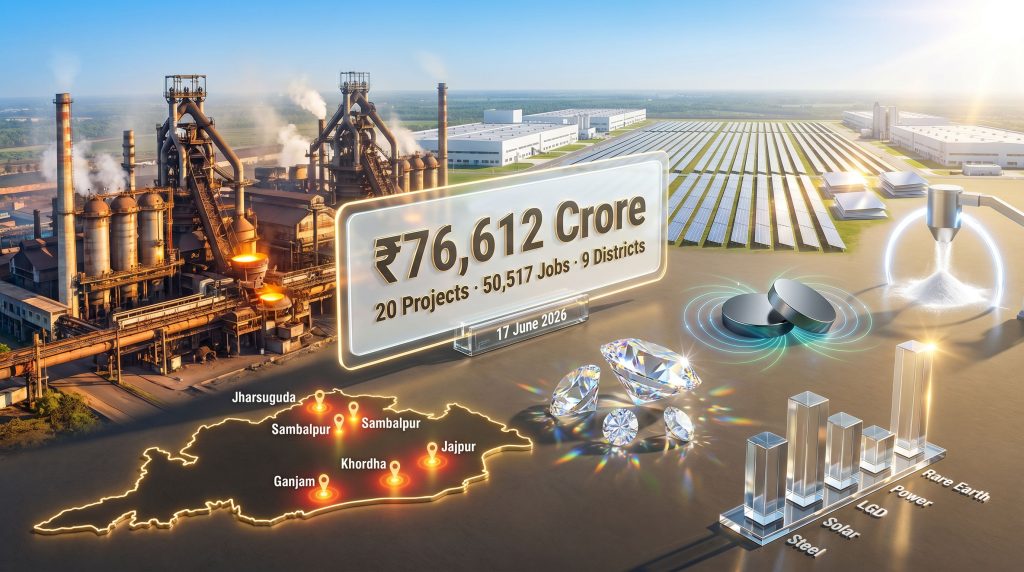
For decades, conversations about India's industrial heartland centred on a handful of western and southern states. Gujarat commanded headlines for its petrochemical corridors and diamond polishing districts. Maharashtra anchored pharmaceutical and engineering manufacturing. Tamil Nadu dominated automotive supply chains. Yet a quiet but accelerating transformation has been unfolding along India's eastern coast, where Odisha approves ₹76,612 crore investment proposals that signal the state is positioning itself at the intersection of multiple high-priority industrial themes simultaneously.
When Odisha's High-Level Clearance Authority convened on 17 June 2026 under Chief Minister Mohan Charan Majhi and greenlit 20 industrial mega-projects with a combined capital commitment of ₹76,611.86 crore, it was not simply a procurement of factories. It was a declaration about what kind of industrial state Odisha intends to become over the next decade. The sectoral composition of these approvals — spanning lab-grown diamonds, NdFeB permanent magnets, solar photovoltaic manufacturing, pumped storage hydropower, and titanium dioxide pigments alongside conventional steel and thermal power — tells a more nuanced story than the headline figure alone.
When big ASX news breaks, our subscribers know first
What the HLCA Approval Mechanism Actually Does, and Why It Matters
India's federal structure creates a layered approval environment for large industrial projects. Environmental clearances, land acquisition proceedings, utility connections, and sector-specific licences have historically operated on independent timelines, creating compounding delays that erode investor confidence before a single foundation is poured.
Odisha's High-Level Clearance Authority was designed precisely to dissolve this fragmentation. By consolidating departmental sign-offs under a single apex body chaired by the Chief Minister, the HLCA dramatically compresses the window between investment intention and ground-level execution. For capital-intensive projects where financing costs accumulate during pre-construction phases, this acceleration carries tangible economic value.
The institutional architecture surrounding the HLCA also reflects Odisha's broader ease-of-doing-business strategy. The state has progressively refined its single-window clearance systems through successive investment conclave cycles, including the Make in Odisha framework, building a track record that institutional investors and major industrial groups now factor into location decisions. Furthermore, Odisha's mineral endowment has long provided a natural foundation upon which these industrial ambitions are being built.
Breaking Down the ₹76,612 Crore Investment Package: Scale, Scope, and Sectoral Spread
The aggregate figure of ₹76,612 crore approved across 20 projects spans nine districts and is projected to generate 50,517 jobs in both direct manufacturing and supply chain-adjacent roles. The sectoral distribution reveals a deliberate balancing act between Odisha's established mineral-processing strengths and its emerging advanced manufacturing ambitions.
| Sector | Approximate Investment (₹ Crore) | Estimated Jobs Created |
|---|---|---|
| Steel, Iron and Ferro-Alloys | ~₹35,530 | ~20,000+ |
| Green Energy and Solar Manufacturing | ~₹11,710 | Under assessment |
| Lab-Grown Diamond Manufacturing | ₹9,817.50 | ~8,100 |
| Power and Renewable Energy | ~₹7,692 | ~500+ |
| Rare Earth and Advanced Materials | ~₹4,050 | Under assessment |
| Pharmaceuticals and Capital Goods | ~₹2,670 | Under assessment |
| Chemicals and Aluminium Downstream | ~₹1,300 | Under assessment |
Geographic Distribution: Which Districts Benefit Most?
The nine beneficiary districts reflect a conscious effort to spread industrial activity beyond Odisha's existing metallurgical clusters:
- Jajpur receives integrated steel investments and speciality metals manufacturing
- Ganjam emerges as a multi-sector hub hosting solar PV, NdFeB magnets, and titanium dioxide processing
- Khordha anchors lab-grown diamond manufacturing and rare earth magnet production
- Sambalpur takes in steel plants, pharmaceutical facilities, and power generation
- Jharsuguda accommodates steel-cement expansion and coal-based power
- Sundargarh sees iron ore beneficiation investment
- Malkangiri hosts the pumped storage hydropower project
- Rayagada develops aluminium downstream manufacturing capability
Steel and Ferro-Alloys: The Enduring Backbone
Odisha's mineral geology fundamentally shapes its industrial character. The state hosts some of India's richest iron ore deposits across Keonjhar, Sundargarh, and Jajpur districts, creating a structural cost advantage for steelmakers that is difficult to replicate elsewhere. It is unsurprising, therefore, that metallurgical projects command the largest share of capital in this clearance round.
The steel-sector approvals collectively represent approximately ₹35,530 crore in committed investment across six distinct projects:
- Rashmi Metallurgical Industry (Jajpur): ₹15,000 crore for a 4 MTPA integrated steel plant, projected to directly employ approximately 11,000 workers
- Shyam Metalics and Energy (Sambalpur): ₹7,580 crore for a 1 MTPA integrated steel unit
- SMC Power Generation, Badmal (Jharsuguda): ₹5,350 crore for integrated steel and cement capacity expansion
- SMC Power Generation, Hirma (Jharsuguda): ₹3,800 crore for a parallel expansion programme
- BR Steel and Power (Sambalpur): ₹2,400 crore for a 1.2 MTPA integrated steel plant
- Orissa Alloy Steel (Sundargarh): ₹1,200 crore for iron ore beneficiation
- Ratnamani Metals and Tubes (Jajpur): ₹1,642 crore for speciality steel manufacturing
Ratnamani Metals deserves particular attention here. The company is a recognised supplier of high-specification steel tubes and pipes to the oil and gas, power, and aerospace sectors. Its Jajpur facility adds value not just in tonnage terms but in the technological sophistication of output, which aligns with India's broader push to reduce import dependence in critical engineering materials.
Solar PV and Green Energy Manufacturing: Ganjam's Emerging Industrial Identity
The renewable energy equipment manufacturing approvals represent the second-largest capital concentration in this HLCA session and carry arguably the greatest long-term strategic significance. Indeed, the critical minerals energy transition agenda is clearly reflected in the scale and composition of these commitments.
Tata Power Renewable Energy Limited's commitment to establish an ingot, wafer, and solar PV cell manufacturing complex in Ganjam at a cost of ₹10,000 crore is the single largest non-steel investment in this clearance round. Solar PV manufacturing involves a technically demanding multi-stage process: polysilicon is first cast into ingots, then sliced into thin wafers, which are subsequently processed into photovoltaic cells before assembly into modules. By integrating the ingot-to-cell stages within a single facility, Tata Power's Ganjam plant captures substantial value within India's domestic supply chain rather than importing intermediary products.
Complementing this is Saatvik Solar Industries with a ₹1,709.81 crore solar PV cell facility in the same district. The geographic clustering of these investments is significant because it creates supplier ecosystem density — the condition under which component manufacturers, logistics providers, and technical service firms co-locate to serve a shared industrial base.
Why Ganjam Is Becoming Odisha's Solar Manufacturing Corridor
- Coastal location reduces raw material logistics costs for quartz and chemical inputs
- Proximity to Gopalpur port provides export access for finished panels
- Established industrial land parcels reduce site development timelines
- State incentive structures for renewable energy equipment manufacturers
- Alignment with India's domestic solar manufacturing ambitions under the Production Linked Incentive scheme for solar modules
India's National Solar Mission targets 500 GW of renewable energy capacity by 2030, a goal that is structurally dependent on the development of robust domestic manufacturing across the solar value chain. Ganjam's emerging cluster positions Odisha as a meaningful contributor to this national objective.
Lab-Grown Diamonds: Odisha's Entry Into a High-Value Advanced Manufacturing Segment
Among all the projects approved in this HLCA session, the lab-grown diamond cluster in Khordha may be the most consequential signal of Odisha's evolving industrial ambition. Three companies — Kira Diam LLP, Anjali Labtech Limited, and Grow Magnificent Private Limited — have committed a combined ₹9,817.50 crore to establish manufacturing units, with a projected employment generation of approximately 8,100 jobs.
Understanding the Technology Behind Lab-Grown Diamonds
Lab-grown diamonds (LGDs) are not simulants or substitutes. They are chemically, physically, and optically identical to mined diamonds, produced through two principal industrial processes:
- Chemical Vapour Deposition (CVD): A hydrocarbon gas mixture is introduced into a low-pressure reactor chamber, where microwave energy or hot filaments cause carbon atoms to deposit layer by layer onto a substrate, gradually building a diamond crystal over days or weeks.
- High Pressure High Temperature (HPHT): Graphite is subjected to pressures exceeding 1.5 million pounds per square inch and temperatures above 1,400 degrees Celsius, replicating the geological conditions under which natural diamonds form in the Earth's mantle.
CVD has become the dominant commercial process for gem-quality LGD production due to its superior scalability and the ability to produce larger, higher-quality crystals at declining cost curves. Reactor throughput efficiency and seed crystal quality are the primary technical differentiators between manufacturers.
India's LGD Landscape and Odisha's Strategic Entry
India has rapidly developed into a global leader in lab-grown diamond manufacturing, driven initially by the established diamond processing expertise concentrated in Surat, Gujarat. However, Gujarat's dominance also creates concentration risk. Odisha's entry via the Khordha cluster represents genuine geographic diversification of India's LGD manufacturing capacity, reducing supply chain vulnerability and creating competitive pressure that can accelerate cost declines across the industry.
The employment density of LGD manufacturing is notably high relative to capital investment compared to heavy industries like steel, making it particularly well-suited to Odisha's workforce development priorities. The 8,100 projected jobs from a combined ₹9,817 crore investment compares favourably on a jobs-per-crore basis to many capital-heavy industrial projects.
The next major ASX story will hit our subscribers first
Rare Earth and Advanced Materials: The Critical Minerals Dimension
Two projects within this HLCA batch directly address India's most acute industrial vulnerability: dependence on China for rare earth-based advanced materials. In this context, the broader challenges facing rare earth supply chains globally make Odisha's domestic manufacturing push all the more strategically timely.
NdFeB Permanent Magnets: Geopolitical Stakes in a Small Component
Neodymium-Iron-Boron (NdFeB) magnets are the highest-performance permanent magnets commercially available, and their role in the energy transition is foundational. Every electric vehicle traction motor, every direct-drive wind turbine generator, and a significant share of defence electromechanical systems depend on these components.
China currently controls an estimated 85 to 90 percent of global NdFeB magnet production, a concentration that has drawn increasing concern from governments across Europe, North America, and Asia. India's domestic NdFeB manufacturing capacity is currently negligible relative to projected demand.
Two approvals directly address this gap:
- N.A.N. Magnetech Private Limited (Khordha/Cuttack): ₹1,250 crore for EV-grade NdFeB magnet manufacturing
- Larsen and Toubro Limited (Ganjam): ₹2,400 crore for sintered NdFeB permanent magnet production
The combined ₹3,650 crore commitment from these two facilities represents a meaningful initial step toward domestic NdFeB supply chain development. Sintered NdFeB manufacturing — the process employed by Larsen and Toubro — involves alloy preparation, hydrogen decrepitation, jet milling, pressing in a magnetic field, sintering, and surface treatment. Each stage requires precision process control, and building this manufacturing competency domestically involves substantial knowledge transfer and engineering investment beyond the capital figures alone.
Titanium Dioxide: Converting Coastal Mineral Wealth Into Value-Added Pigment
World Titanium Industry Private Limited's ₹2,800 crore titanium dioxide slag and pigment facility in Ganjam connects directly to Odisha's coastal mineral sand endowment. The state's shoreline hosts deposits of ilmenite and rutile, the principal titanium-bearing minerals. Historically, much of this resource has been extracted and processed at low value-addition stages. Converting raw ilmenite into titanium dioxide pigment — the white compound used in paints, coatings, plastics, and paper — captures significantly more economic value within the state and creates high-skill technical employment in metallurgical chemistry. These developments align closely with national priorities around critical raw materials for the green transition.
Power Infrastructure: Grid Stability Alongside Renewable Expansion
The energy infrastructure approvals in this HLCA round reflect the practical tension between renewable ambition and grid reliability. Pumped hydro energy storage has emerged globally as a proven solution to this challenge, and Odisha's approval in this space is consequently well-timed.
Rajapuspa Renova LLP's ₹5,220 crore pumped storage hydropower facility in Malkangiri addresses a problem that is becoming increasingly urgent as India's solar and wind capacity expands rapidly: the need for dispatchable energy storage to absorb surplus generation during peak production hours and release it when demand spikes. Pumped storage, which uses reversible turbines to pump water uphill when power is cheap and generate electricity as water flows back down, is the most mature and cost-effective large-scale energy storage technology available.
KU Urja Private Limited's ₹2,471.98 crore coal-based thermal power plant in Jharsuguda reflects the continued practical necessity of baseload generation capacity during India's energy transition. Industrial energy consumers — including the very steel and advanced manufacturing facilities being approved in this same HLCA session — require consistent, high-quality power supply that intermittent renewables alone cannot currently guarantee.
Execution Risks: What Could Slow This Investment Wave
A clearance round of this scale should be assessed not only for its ambitions but also for the realistic execution challenges that lie ahead. Several factors warrant monitoring:
- Land acquisition complexity across nine geographically dispersed districts involves distinct local stakeholder dynamics that can compress timelines unpredictably
- Environmental clearance processes for large-scale projects, particularly steel plants and hydropower facilities, involve independent regulatory assessments that operate outside the HLCA's jurisdiction
- Grid infrastructure adequacy to absorb the additional manufacturing load being committed, particularly in Ganjam district where multiple large facilities are clustering simultaneously
- Skilled workforce availability for technology-intensive sectors including LGD manufacturing (reactor technicians, crystallographers) and NdFeB production (metallurgical chemists, precision manufacturing engineers) where India's existing talent pool is limited
- Capital market conditions affecting the ability of mid-size promoters to secure long-tenor project financing at viable interest rates
Key Takeaways: What ₹76,612 Crore Reveals About Odisha's Industrial Trajectory
The June 2026 HLCA session is best understood not as a collection of individual project approvals but as a coherent statement about Odisha's industrial strategy. Furthermore, Odisha approves ₹76,612 crore investment proposals at this scale sets a new benchmark for state-level industrial mobilisation across India.
- Scale: One of the largest single HLCA clearance rounds in the state's history by aggregate investment value
- Diversification: A deliberate evolution beyond traditional steel and power toward advanced manufacturing, critical minerals processing, and renewable energy equipment
- Employment density: 50,517 projected jobs distributed across nine districts, designed to reduce concentration of industrial benefit in established corridors
- Supply chain security alignment: NdFeB magnets, solar PV cells, and lab-grown diamonds directly address national-level supply chain vulnerabilities
- Institutional confidence: Participation by Tata Power, Larsen and Toubro, Shyam Metalics, and Ratnamani Metals signals that India's most sophisticated industrial groups are incorporating Odisha into their long-term manufacturing strategies
Disclaimer: Employment and investment figures cited in this article are based on project proposals approved at the HLCA session and represent projected outcomes, not guaranteed results. Actual outcomes will depend on execution timelines, regulatory processes, and broader economic conditions. This article does not constitute financial or investment advice.
Frequently Asked Questions
What is the High-Level Clearance Authority (HLCA) in Odisha?
The HLCA is Odisha's apex state-level body responsible for fast-tracking approvals for large industrial investment proposals. It is chaired by the Chief Minister and brings together relevant departmental heads to facilitate single-window clearance for major projects, significantly reducing bureaucratic timelines compared to sequential departmental processing.
How much total investment did Odisha approve in June 2026?
The HLCA approved 20 projects with a combined investment value of ₹76,611.86 crore (approximately ₹76,612 crore) at its session held on 17 June 2026.
Which is the largest single project approved in this HLCA round?
Rashmi Metallurgical Industry's ₹15,000 crore integrated steel plant in Jajpur is the largest single project by investment value, followed by Tata Power Renewable Energy's ₹10,000 crore solar manufacturing facility in Ganjam.
Is Odisha entering the lab-grown diamond sector for the first time?
The approval of three lab-grown diamond manufacturing units in Khordha with a combined investment of ₹9,817.50 crore marks Odisha's formal entry into high-volume LGD manufacturing at industrial scale.
What makes NdFeB magnet manufacturing strategically significant?
NdFeB magnets are critical components in electric vehicle motors and wind turbines. China controls an estimated 85 to 90 percent of global production capacity, creating supply chain vulnerability for countries pursuing electrification. The combined ₹3,650 crore investment by N.A.N. Magnetech and Larsen and Toubro in Odisha represents India's effort to develop domestic alternatives to this import dependency.
How many jobs will the approved projects create?
The 20 approved projects are projected to generate employment for approximately 50,517 people across nine districts of Odisha.
Want To Capitalise On The Critical Minerals Driving India's Industrial Transformation?
Odisha's ₹76,612 crore investment push — spanning NdFeB magnets, solar PV manufacturing, and titanium dioxide processing — underscores how critical mineral supply chains are reshaping industrial strategy globally, and Discovery Alert's proprietary Discovery IQ model instantly alerts subscribers to significant ASX mineral discoveries across these same high-priority commodities, turning complex geological data into actionable investment opportunities. Explore historic discoveries and the substantial returns they generated, then begin a 14-day free trial to position yourself ahead of the next major find.