July 7, 2026
The Accidental REE Stockpile: Why America's Coal Waste May Hold the Key to Critical Mineral Independence
For most of the twentieth century, the ash and tailings left behind by coal combustion were considered a liability — an environmental problem to be managed, contained, and eventually forgotten. Billions of tonnes of this material now sit in surface impoundments and landfills across the United States, leaching trace metals into groundwater and representing a long-term remediation burden for regulators and former operators alike. However, buried within that liability, quite literally, is something the modern economy urgently needs: the conversion of coal waste to rare earth elements.
The convergence of geopolitical pressure, advancing extraction chemistry, and federal investment is forcing a fundamental reassessment of what coal waste actually is. Rather than a byproduct to be disposed of, it may function as a pre-concentrated critical mineral feedstock — one that took decades to accumulate and requires no new land clearing to access.
When big ASX news breaks, our subscribers know first
Understanding Why Coal Combustion Concentrates Rare Earth Elements
The mechanism behind REE enrichment in coal ash is both chemically logical and practically significant. When coal burns, the organic carbon matrix is destroyed, but the inorganic mineral fraction — including trace rare earth elements bound within the coal structure — remains. Because the combustion process reduces the total mass of material dramatically, the REEs that were dispersed throughout the original coal become concentrated in the residual ash.
This is not a uniform process. REE concentrations in coal ash can reach levels approximately 30 times higher than in the raw coal from which the ash originated. In some cases, REEs also migrate post-deposition from adjacent geological formations, particularly shales and siltstones, into coal seams and their surrounding waste streams, adding another layer of enrichment beyond what combustion alone produces.
The result is a resource that, in certain deposits, rivals or approaches the grades found in purpose-mined REE ore. The USGS has established 1,000 parts per million (ppm) as a general threshold for commercially recoverable concentrations, and while most coal ash samples currently fall below this benchmark, the range of documented concentrations is striking:
| Metric | Data Point |
|---|---|
| REE concentration in Indiana coal tailings | Up to 711 ppm |
| Average REE concentration in Appalachian Basin coal ash | 431 ppm |
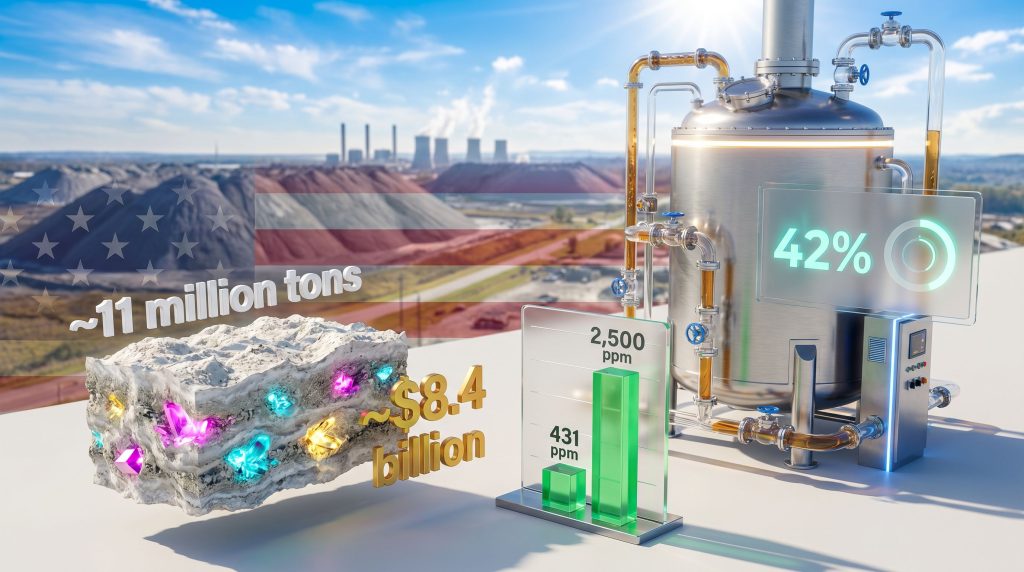
| Highest recorded concentration in power plant ash | Exceeds 2,500 ppm |
| USGS recoverable threshold | 1,000 ppm |
| Estimated total REEs in accessible U.S. coal ash | ~11 million tons |
| Estimated value of accessible REE resource | ~$8.4 billion |
| Ratio vs. current domestic REE reserves | Nearly 8 times larger |
The aggregate picture is striking. The total REE content locked within accessible U.S. coal ash is estimated at approximately 11 million tons — a figure that is nearly eight times larger than current domestic REE reserves. The barrier to accessing this resource is not geological scarcity. It is extraction economics and the infrastructure to process what geology has already concentrated.
What Rare Earth Elements Are and Why Domestic Supply Matters
The 17 rare earth elements — which include neodymium, dysprosium, terbium, europium, and yttrium among others — are foundational to technologies that underpin both the clean energy transition and national defence capability. Permanent magnets made from neodymium and dysprosium power electric vehicle motors and wind turbine generators. Europium and terbium are critical components in phosphors and display technologies. Yttrium appears in jet engine coatings and medical imaging equipment.
The strategic vulnerability of U.S. supply chains for these materials is well established. The United States currently imports more than 80% of its rare earth supply, with approximately 75% of that total sourced from China. This dependency became acutely visible during the 2010–2011 REE price spike, when Chinese export restrictions drove neodymium prices to extraordinary levels and exposed the fragility of rare earth supply chains that had been built on the assumption of stable, low-cost access to Chinese production.
That episode, and the broader geopolitical trajectory since, has accelerated interest in unconventional domestic REE sources. Coal waste offers a particular advantage in this context: it does not require new mine permitting, it already exists in enormous quantities near existing infrastructure, and its remediation represents a regulatory obligation that creates a natural economic incentive to develop commercially viable extraction processes.
The Regional Divide: Not All Coal Ash Is Created Equal
One of the most practically important findings from research into coal waste as an REE source is the significant regional variability in both grade and extractability. These two variables — how much REE is present and how efficiently it can be recovered — together determine whether any given deposit is worth developing.
Appalachian Basin
The Appalachian Basin, encompassing coal-producing states from Pennsylvania through West Virginia and into Kentucky, is the most extensively studied region. Coal ash from this region averages approximately 431 ppm of total rare earth elements, which sits well below the USGS recoverable threshold. Furthermore, extractability using green processing methods runs at around 30%, meaning a significant share of the REE content cannot be economically recovered with current technology.
Powder River Basin
The Powder River Basin in Wyoming and Montana presents a more commercially interesting profile. While total REE concentrations can be lower in absolute terms, the extractability of REEs from Powder River Basin ash is approximately 70% — more than double the Appalachian figure. This matters enormously for project economics because a lower-grade deposit with high extractability can outperform a higher-grade deposit with poor recovery rates.
This regional divergence has direct implications for where pilot projects should be sited and where capital should be allocated as the sector matures.
Green Extraction Methods: The Technology Closing the Viability Gap
The extraction of REEs from coal ash is chemically more complex than recovering them from primary ore deposits, primarily because the REEs are dispersed at lower concentrations through a heterogeneous matrix of silicate minerals, heavy metals, and other combustion byproducts. Traditional hydrometallurgical approaches using strong mineral acid leaching and solvent extraction can achieve relatively high recovery rates but generate significant volumes of chemically aggressive waste and carry substantial environmental risk. For a broader overview of REE processing challenges, these difficulties extend well beyond coal-derived feedstocks.
Emerging green extraction pathways are changing this calculus:
- Water-based leaching as a low-intensity primary separation step that mobilises a fraction of REEs without introducing harsh chemicals
- Citric acid leaching as a biodegradable alternative to sulphuric or hydrochloric acid, reducing the volume and toxicity of process waste
- Supercritical CO₂ extraction as a selective mobilisation technique that uses pressurised carbon dioxide to dissolve and carry specific REE fractions from the ash matrix
When these methods are combined, researchers have achieved extraction efficiencies of up to 42% from coal ash feedstocks. While this falls short of the recovery rates typical in conventional REE processing, it represents a meaningful technological advance and establishes a credible baseline from which further optimisation can proceed.
Step-by-Step: How Coal Ash REE Extraction Works
- Feedstock Sourcing — Identifying and securing access to legacy coal ash ponds or active fly ash streams from power stations, with preference for sites demonstrating higher REE concentrations and extractability
- Pre-Treatment and Characterisation — Assessing REE concentration, mineralogy, particle size distribution, and extractability profile of the specific ash deposit to inform process selection
- Primary Leaching — Applying water, citric acid, or supercritical CO₂ to mobilise REEs from the ash matrix under controlled temperature and pressure conditions
- Solid-Liquid Separation — Removing residual ash solids from the REE-bearing leachate using filtration or centrifugation
- Selective Recovery — Using solvent extraction or ion exchange resins to isolate individual REE fractions from the complex leachate chemistry
- Refining and Separation — Producing separated REE oxides or metals of sufficient purity for downstream manufacturing applications
- Waste Management — Treating and disposing of or repurposing the depleted ash residue, ideally in a manner that satisfies existing environmental compliance obligations for the original ash impoundment
Federal Investment and the Push Toward Commercial Scale
The U.S. Department of Energy has committed $75 million across five pilot plant projects specifically targeting coal and coal waste as REE feedstocks. This funding is structured to bridge the gap between laboratory-demonstrated extraction chemistry and industrial-scale production — the stage at which technology readiness meets real-world processing complexity.
The selection of five geographically and technologically diverse projects reflects a deliberate strategy of testing multiple approaches simultaneously rather than concentrating risk in a single technology pathway. Project selection criteria have emphasised feedstock availability, technology readiness level, and the geographic distribution of coal waste resources across different U.S. coal-producing regions.
Pilot plant results from these programmes will typically inform commercial feasibility decisions within a 3 to 5 year window, making the period from 2026 to 2030 a defining phase for determining whether coal waste can realistically contribute to domestic REE supply chains.
This federal investment sits alongside other international efforts. New Zealand has committed NZ$50 million toward rare earth processing plant development, reflecting a broader recognition among allied nations that processing infrastructure — not just mining access — is the critical bottleneck in building resilient critical mineral supply chains. Consequently, the evolving U.S. critical minerals landscape is reshaping how policymakers prioritise domestic alternatives to foreign supply.
The next major ASX story will hit our subscribers first
ESG Dimensions: Liability Converted to Asset
The environmental case for coal waste REE extraction is arguably as compelling as the economic one. Legacy coal ash impoundments contain not only rare earth elements but also toxic constituents including arsenic, selenium, mercury, and various heavy metals. The long-term containment of these materials represents an ongoing regulatory and financial liability for site owners and a public health risk for surrounding communities.
REE extraction creates a financial incentive to actively remediate sites that would otherwise remain in passive containment indefinitely. The revenue potential from recovered REEs can cross-subsidise the cost of processing and disposing of the remaining ash in a manner that eliminates the contamination risk.
Comparative ESG Profile: Coal Waste REE Recovery vs. Primary REE Mining
| ESG Dimension | Coal Waste Recovery | Primary REE Mining |
|---|---|---|
| Land disturbance | Low (existing waste sites) | High (new mine development) |
| Waste generation | Converts existing waste | Creates new tailings |
| Chemical intensity | Moderate (green methods reduce this) | High (acid mine drainage risk) |
| Community impact | Legacy coal regions (complex) | New greenfield areas |
| Radioactive byproduct risk | Moderate (thorium/uranium in ash) | High (monazite processing) |
| Carbon footprint | Lower (no ore extraction) | Higher (full mining cycle) |
One underappreciated ESG risk in coal ash REE processing is the co-mobilisation of radioactive trace elements. Coal ash contains low but non-trivial concentrations of thorium and uranium, which can be concentrated alongside REEs during leaching. Conventional acid leaching methods increase this risk significantly compared to green extraction pathways, providing another reason beyond environmental preference to pursue citric acid and supercritical CO₂ approaches at the pilot stage.
Community engagement in legacy coal regions adds a further layer of complexity. Many of these communities have complicated relationships with industrial operations on former coal infrastructure, and the transition from coal extraction to critical mineral recovery requires careful stakeholder management to build social licence.
The Honest Economic Assessment
The commercial viability question deserves a straightforward answer: the conversion of coal waste to rare earth elements is not commercially viable at scale today for most deposits, and conflating pilot-stage promise with near-term production reality would misrepresent where the sector stands.
The primary barriers are not geological. They are:
- Extraction efficiency: The 42% recovery rate achieved by green methods falls short of the 70–85% recovery rates typical in conventional REE processing
- Processing infrastructure: There is currently no commercial-scale infrastructure designed specifically for coal ash REE extraction in the United States
- Workforce capacity: REE hydrometallurgy requires specialised skills that are in short supply globally and critically scarce in the U.S.
- Grade economics: At current REE prices, most coal ash deposits below the 1,000 ppm threshold do not generate sufficient revenue per tonne of processed ash to cover extraction costs
Several scenarios could alter this calculus materially:
- A significant reduction in Chinese REE export volumes, comparable to or more severe than the 2010–2011 episode, would compress supply and elevate prices to levels where lower-grade domestic sources become economically competitive
- Incremental improvement in extraction efficiency from 42% toward 65–70% would substantially improve project economics without requiring any change in market conditions
- Co-product recovery of gallium, germanium, and other critical minerals present in coal ash alongside REEs improves overall project economics by spreading processing costs across multiple revenue streams
- The formalisation of financial value for environmental remediation outcomes — through carbon credits or regulatory compliance offsets — could underwrite a meaningful portion of extraction costs
Investor Note: Coal-to-REE projects currently carry pre-commercial technology risk. The combination of strategic federal funding, improving extraction chemistry, and structural geopolitical pressure creates a credible pathway to viability within the next 5 to 10 years, but investors should calibrate expectations to the pilot-stage nature of current activity. This is not investment advice, and independent financial advice should be sought before making any investment decisions.
Frequently Asked Questions: Coal Waste to Rare Earth Elements
What rare earth elements are typically found in coal waste?
Coal ash and coal tailings contain a broad spectrum of REEs, including neodymium, dysprosium, europium, terbium, and yttrium — all of which are critical to permanent magnets, phosphors, and defence applications. The relative concentrations vary by coal basin and combustion process.
How do coal ash REE grades compare to conventional ore deposits?
Coal ash REE concentrations average 431 ppm in the Appalachian Basin and can exceed 2,500 ppm in some power plant ashes. Conventional REE ore deposits typically range from 1,000 to 10,000 ppm, meaning coal ash generally sits at the lower end of the grade spectrum but overlaps with marginal conventional deposits at its upper range.
Why is co-product recovery important for coal ash project economics?
Coal ash contains not only REEs but also gallium, germanium, lithium, and other critical minerals. Developing extraction processes that simultaneously recover multiple co-products from the same feedstock distributes processing costs across several revenue streams, improving the economics of deposits that would not be viable as standalone REE operations.
Which U.S. regions have the highest coal waste REE potential?
The Appalachian Basin and Powder River Basin are the most extensively studied regions. Powder River Basin ash demonstrates significantly higher extractability at approximately 70% compared to Appalachian sources at approximately 30%, making it a more attractive near-term target despite potential grade differences.
Can coal ash REE extraction replace conventional REE mining?
Not in the foreseeable future. Coal ash represents a supplementary domestic supply buffer rather than a wholesale replacement for primary mining. Its greatest strategic value lies in its ability to provide a domestic alternative during geopolitical supply disruptions, reducing dependence on single-source foreign supply chains.
Building the Industrial Ecosystem for Coal-to-REE Recovery
The five DOE-funded pilot plants will generate performance data across several critical dimensions: extraction efficiency per tonne of ash processed, processing cost per kilogram of REE oxide produced, environmental compliance metrics under real operating conditions, and workforce requirements per unit of output. This data will form the evidentiary foundation for commercial investment decisions.
Beyond the technical results, the sector requires a broader industrial ecosystem to function at scale:
- Workforce development: Universities and vocational programmes need to expand training in REE hydrometallurgy, process engineering, and environmental compliance to meet the demand that commercial-scale operations would create
- Infrastructure co-location: Siting processing facilities near existing coal ash impoundments and former power station infrastructure reduces logistics costs and leverages existing site access and utilities
- Downstream integration: Initiatives such as GreenMet's planned U.S. rare earth processing hub create downstream demand that validates investment in coal-derived REE feedstock supply, establishing the market pull that pilot-stage projects need to attract scale-up capital
- Feedstock characterisation databases: Systematic geochemical mapping of coal ash impoundments across the U.S. would allow developers to rank deposits by combined grade and extractability, accelerating site selection and reducing early-stage exploration risk
If pilot projects validate commercial extraction economics over the next three to five years, coal waste could realistically supply a meaningful share of U.S. REE demand within the 2030 to 2035 timeframe. This is not a guaranteed outcome. It depends on technology performance at scale, market conditions, and the pace of infrastructure development.
However, the structural conditions — a large and pre-existing resource, federal investment in de-risking technology, and persistent geopolitical pressure on conventional supply chains — create a more credible pathway than existed a decade ago. Furthermore, America's rare earth supply chain continues to evolve in ways that make unconventional domestic sources increasingly relevant to long-term strategic planning.
The broader significance may extend beyond REEs. Coal-to-REE development, if successful, establishes a template for urban mining and circular economy approaches to critical mineral supply chains more broadly — converting industrial legacies into strategic assets rather than managing them as perpetual liabilities. In addition, recent CSIRO research into REEs in coal waste has reinforced the scientific case that these deposits warrant serious commercial attention across multiple jurisdictions.
This article contains forward-looking statements and scenario analysis that involve assumptions and uncertainties. Actual outcomes may differ materially from those described. Nothing in this article constitutes financial or investment advice. Readers should seek independent professional advice before making any investment decisions.
Want to Track the Next Major Critical Mineral Discovery Before the Market Does?
Discovery Alert's proprietary Discovery IQ model delivers real-time alerts on significant ASX mineral discoveries — including critical minerals and rare earth plays — instantly transforming complex exploration data into actionable insights for investors at every level. Explore historic discoveries and their returns on Discovery Alert's dedicated discoveries page, or start your 14-day free trial today to position yourself ahead of the broader market.