May 20, 2026
When Glencore turns to China exchange stocks to meet cobalt commitments, it exemplifies how cobalt market volatility forces companies to adapt traditional sourcing strategies. This shift from direct producer relationships to exchange inventory reflects the broader challenges facing the global mining landscape during periods of supply constraint. As export restrictions continue to reshape market dynamics, companies must reconsider their approach to securing essential materials for battery production.
Understanding Market Disruption Through Policy Intervention
Geographic Concentration as Strategic Vulnerability
The Democratic Republic of Congo's dominance in global cobalt production represents one of the most extreme examples of geographic supply concentration in critical minerals markets. With approximately 268,000 metric tons of annual production representing 72% of global supplies, the country's export policies directly influence worldwide availability and pricing mechanisms.
This concentration creates what economists term "chokepoint vulnerability" where policy decisions in a single jurisdiction can immediately constrain global supply regardless of demand patterns or alternative production capacity in other regions.
Timeline of Export Policy Evolution
The transformation from open trade to restricted exports followed a deliberate policy sequence designed to address depressed commodity pricing:
- February 2025: Complete export suspension implemented to address nine-year price lows
- October 2025: Transition to quota-based export system
- Current Period: Quota restrictions extended through at least end-2027
This timeline demonstrates how resource-rich nations employ supply-side controls as economic policy tools. Furthermore, these restrictions create cascading effects throughout the critical minerals energy transition, affecting everything from battery manufacturing to electric vehicle production.
Price Response Mechanisms
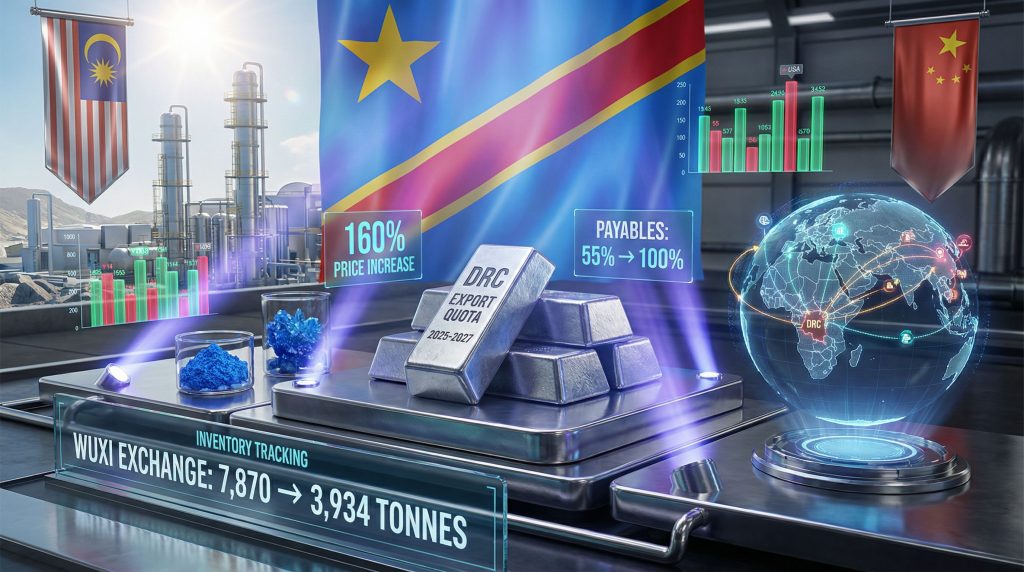
The market's response to export restrictions illustrates the inelastic nature of cobalt demand in the short term. Cobalt metal prices increased 160% from February 2025 baseline levels, reaching $26 per pound or approximately $57,320 per ton. This dramatic price escalation reflects the intersection of inelastic demand (driven by battery manufacturing requirements) and artificially constrained supply.
"The magnitude of price increase demonstrates that cobalt consumers have limited substitution options in the short term, making them price takers rather than price negotiators when supply becomes constrained," according to Reuters' analysis of Glencore's strategy.
When big ASX news breaks, our subscribers know first
Corporate Adaptation Strategies Under Export Quotas
Production Versus Export Allocation Mismatches
When export quotas fall below production capacity, mining companies face operational dilemmas that require strategic adaptation. However, these challenges extend beyond individual companies to affect entire supply networks. For instance, projects like the Halls Creek cobalt expansion must now consider how export restrictions might impact future operations.
Glencore's situation provides a concrete example: the company produced 33,500 tons of cobalt in the DRC during the previous year but plans to export only 22,800 tons under current quota allocations.
This 32% reduction between production capacity and export allowances creates several strategic challenges:
- Inventory accumulation costs: Storage, insurance, and opportunity costs on tied-up capital
- Cash flow constraints: Delayed revenue recognition on produced but unexported material
- Operational inflexibility: Inability to respond to market demand fluctuations
Multi-Jurisdictional Inventory Management
Companies with global operations employ sophisticated inventory positioning strategies to navigate export restrictions. The deployment of pre-positioned stockpiles demonstrates proactive risk management:
Strategic Inventory Deployment Sequence:
- Primary supply: Current production within quota limits
- Regional stockpiles: Pre-positioned inventory (Malaysian reserves)
- Exchange inventory: Market-sourced material from commodity exchanges
- Spot market purchases: Premium-priced emergency sourcing
This hierarchical approach allows companies to manage costs while maintaining contractual compliance. In addition, it demonstrates how companies utilise lower-cost internal inventory before accessing higher-cost market sources.
Exchange Inventory as Strategic Buffer Assets
What Drives Companies to Exchange Stocks?
China's Wuxi commodity exchange experienced unprecedented inventory depletion during the supply restriction period. Stocks declined from approximately 7,870 tons in late January 2026 to 3,934 tons in March 2026. This 50% reduction over two months represents one of the most rapid drawdowns in the exchange's operational history.
| Period | Inventory Level (tons) | Monthly Change | Market Impact |
|---|---|---|---|
| Late January 2026 | 7,870 | Baseline | Stable pricing |
| February 2026 | ~5,900 | -25% | Price pressure begins |
| March 2026 | 3,934 | -50% | Severe supply constraints |
Transition from Price Discovery to Supply Buffer
Exchange-held inventories traditionally serve dual functions: enabling price discovery through futures contracts and providing physical delivery mechanisms for contract settlement. During supply restrictions, these inventories transform from passive market infrastructure into active supply chain components.
When companies like Glencore turn to China exchange stocks to meet cobalt commitments, they effectively convert financial market inventory into operational supply chains. Consequently, this transition indicates that traditional sourcing channels have become inadequate for maintaining business continuity.
Cost Implications of Exchange Sourcing
Accessing exchange inventory typically involves higher costs than direct producer relationships due to several factors:
- Transaction fees: Exchange-mandated costs for inventory withdrawal
- Transportation: Additional logistics from exchange warehouses to end users
- Quality assurance: Verification procedures for exchange-certified material
- Timing premiums: Urgent sourcing commands higher pricing
Payables as Market Stress Indicators
Understanding Cobalt Payable Mechanics
Cobalt payables represent the percentage of London Metal Exchange prices that processors pay for cobalt hydroxide feedstock. This pricing mechanism creates a transparent method for allocating value between miners (who produce hydroxide) and refiners (who convert it to battery-grade materials).
The evolution from 55% payables in January 2025 to record-high levels of 100% represents an extraordinary compression of refining margins. Furthermore, it indicates extreme supply tightness affecting the entire value chain.
Margin Compression Analysis
Normal Market Conditions (55% payables):
- Processors retain 45% of LME price as refining margin
- Covers conversion costs, capital depreciation, and profit
- Reflects balanced supply-demand relationship
Stressed Market Conditions (100% payables):
- Processors receive zero refining margin
- Operate at break-even to maintain capacity utilisation
- Indicates feedstock scarcity overrides processing economics
This 82% increase in payable rates directly correlates with physical inventory depletion. Moreover, it demonstrates how supply constraints translate into margin redistribution across the value chain.
Asian Processing Sector Vulnerabilities
China's Processing Dominance and Supply Dependencies
China's position as the world's dominant cobalt processor creates a two-point concentration vulnerability: geographic concentration of primary supply (DRC) combined with geographic concentration of processing capacity (China). This structure amplifies the impact of African export controls on Asian manufacturing.
Chinese electric-vehicle battery manufacturers depend on continuous cobalt hydroxide flows to maintain lithium-ion cell production schedules. When DRC export quotas restrict hydroxide availability, processors face constraints that cannot be resolved through operational improvements alone.
Alternative Chemistry Considerations
Supply restrictions accelerate research into cobalt-reduced battery chemistries. However, technical and commercial limitations constrain near-term substitution:
Battery Chemistry Options:
- Nickel-rich cathodes: Reduce cobalt content but increase nickel requirements
- Lithium iron phosphate: Eliminates cobalt but reduces energy density
- Manganese-based systems: Early development stage with performance trade-offs
Manufacturing Capacity Utilisation
Asian processors face difficult decisions when feedstock becomes constrained: reduce output (economically inefficient due to fixed costs) or source alternative materials at premium prices. Most companies choose the latter option to preserve market share and customer relationships.
Strategic Storage and Logistics Networks
Malaysian Storage as Supply Chain Shock Absorber
Intermediate storage facilities in locations like Malaysia serve multiple strategic functions in global cobalt supply chains:
- Geographic arbitrage: Position inventory closer to Asian processing centres
- Regulatory flexibility: Operate outside DRC export restrictions
- Logistics optimisation: Reduce transportation time to key markets
- Risk diversification: Distribute inventory across multiple jurisdictions
Glencore's use of Malaysian stockpiles demonstrates sophisticated supply chain planning. Nevertheless, the eventual depletion of these reserves illustrates that pre-positioned inventory has practical volume limits relative to sustained demand.
The next major ASX story will hit our subscribers first
Market Psychology and Investment Implications
How Do Export Quotas Affect Investment Decisions?
Cobalt market disruptions force investors to reconsider traditional commodity investment approaches. The current situation forms part of a broader critical minerals strategy that governments and companies must navigate carefully. Key considerations include:
Supply Chain Security Assessment:
- Geographic diversification of production sources
- Inventory positioning strategies across multiple jurisdictions
- Contractual protection mechanisms during force majeure events
- Alternative chemistry development timelines
Financial Risk Modelling:
- Price volatility scenarios under continued restrictions
- Cash flow impact of quota-limited export volumes
- Working capital requirements for inventory accumulation
- Currency exposure through multi-jurisdictional operations
Strategic Value of Secured Supply Agreements
In constrained markets, long-term supply agreements transition from cost optimisation tools to strategic assets. Companies with secured cobalt supplies gain competitive advantages through:
- Price stability: Fixed or formula-based pricing protects against spot market volatility
- Volume security: Guaranteed allocation regardless of market conditions
- Operational continuity: Maintained production schedules during supply disruptions
Technical Factors in Cobalt Quality and Processing
Hydroxide to Sulphate Conversion Challenges
Cobalt produced in the DRC requires processing from hydroxide form to battery-grade cobalt sulphate for lithium-ion applications. This conversion process involves several technical considerations:
Processing Requirements:
- Purity standards: Battery applications demand 99.8%+ cobalt content
- Impurity removal: Elimination of copper, iron, and other metallic contaminants
- Particle size control: Optimal size distribution for cathode manufacturing
- Moisture content: Strict limits to prevent battery performance degradation
Quality Assurance Under Supply Constraints
When companies source cobalt from exchange inventory rather than direct producer relationships, quality assurance becomes more complex. Exchange-certified material meets trading standards but may require additional processing to achieve battery-grade specifications.
According to Yahoo Finance's coverage of Glencore's cobalt operations, these quality considerations significantly impact procurement decisions during periods of supply constraint.
Future Supply Chain Evolution Scenarios
Scenario 1: Extended Quota System (High Probability)
Current quota restrictions extending through end-2027 suggest a multi-year adaptation period for global supply chains. This scenario requires:
- Alternative source development: Non-DRC production capacity expansion
- Inventory strategy evolution: Increased strategic stockpiling across the value chain
- Contract structure adaptation: Force majeure provisions and alternative allocation mechanisms
Scenario 2: Quota System Expansion (Medium Probability)
The DRC's success in supporting cobalt prices through export restrictions may encourage similar policies in other critical mineral-producing nations. This could create:
- Cascading restrictions: Multiple countries implementing similar policies
- Supply chain complexity: Navigation of multiple quota systems simultaneously
- Investment in processing capacity: Downstream countries developing domestic capabilities
Scenario 3: Policy Reversal (Lower Probability)
Economic pressure from reduced export revenues might force policy reversal. However, this appears less likely given successful price support outcomes and the strategic importance of the materials.
Risk Management Framework for Critical Minerals
Inventory Diversification Strategies
Companies operating in concentrated supply markets require sophisticated inventory management approaches:
Geographic Diversification:
- Primary storage: Near production sources for cost optimisation
- Intermediate storage: Regional hubs for supply chain flexibility
- Strategic reserves: Emergency stockpiles for crisis management
Temporal Diversification:
- Current production: Immediate supply needs
- Forward contracts: Medium-term supply security
- Strategic stockpiles: Long-term supply insurance
Financial Hedging Mechanisms
Traditional commodity hedging becomes more complex when underlying supply faces non-market restrictions:
- Physical hedging: Inventory accumulation as price protection
- Financial hedging: Futures and options with limited effectiveness during supply disruptions
- Supply hedging: Long-term purchase agreements with multiple producers
Investment Strategies in Constrained Markets
Value Chain Positioning Analysis
Investors must evaluate where value creation occurs during supply constraints:
Upstream (Mining): Limited by export quotas despite production capacity
Midstream (Trading/Storage): Enhanced value through inventory positioning
Downstream (Processing): Margin compression through payable rate increases
End Users (Battery Manufacturers): Cost pressure from material availability
Portfolio Allocation Considerations
Cobalt market dynamics suggest several investment themes:
- Alternative chemistry development: Companies developing cobalt-reduced battery technologies
- Recycling capacity: Secondary cobalt supply from battery waste streams
- Storage infrastructure: Facilities enabling strategic inventory positioning
- Non-DRC production: Mining companies with cobalt production outside restricted jurisdictions
Technical Outlook and Market Fundamentals
Demand Elasticity Analysis
The 160% price increase with continued strong demand indicates extremely inelastic short-term demand for cobalt in battery applications. This reflects:
- Technical constraints: Limited near-term substitution options
- Investment commitments: Existing battery manufacturing capacity requires cobalt inputs
- Performance requirements: Electric vehicle specifications demanding cobalt-containing batteries
Long-term Supply Balance Projections
Market balance restoration requires either demand destruction (through alternative chemistries) or supply expansion (through non-DRC production development). Current evidence suggests supply expansion is more likely than demand destruction in the medium term.
Key Variables:
- Alternative chemistry adoption rates: 3-7 year development timelines
- Non-DRC mine development: 5-10 year project development cycles
- Recycling capacity scaling: 2-5 year infrastructure development
- Policy duration uncertainty: Quota system timeline beyond 2027
Investment decisions in cobalt-related assets should consider the multi-year nature of supply chain adaptation and the potential for continued policy-driven market distortions. This analysis is for informational purposes and does not constitute investment advice. Commodity markets involve substantial risk of loss.
Ready to Identify the Next Critical Minerals Discovery?
Discovery Alert's proprietary Discovery IQ model delivers real-time alerts on significant cobalt and critical minerals discoveries across the ASX, instantly empowering subscribers to identify actionable opportunities ahead of the broader market. Begin your 14-day free trial today and secure your market-leading advantage in the evolving critical minerals landscape.