
May 20, 2026
When Geopolitics Rewires a Supply Chain: The Sherritt Cuba Sanctions Crisis
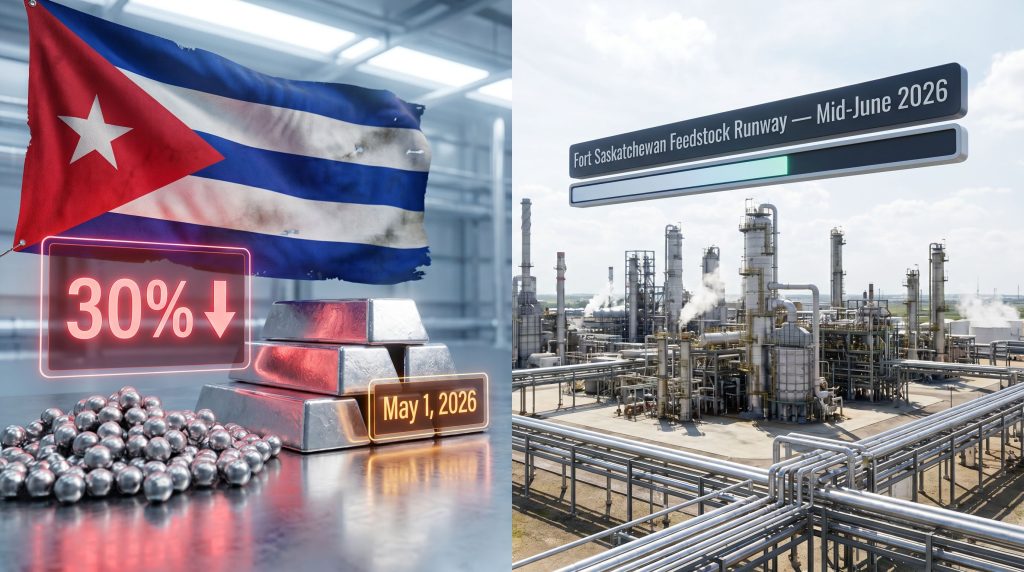
Few forces reshape mining economics as abruptly as the stroke of a sanctions pen. While commodity cycles, ore grades, and capital costs dominate most investment frameworks for resource companies, the geopolitical dimension is often underweighted until it becomes the only variable that matters. For Sherritt International, Sherritt Cuba sanctions became an existential operational threat almost overnight when a sweeping U.S. executive order targeting Cuba's core economic sectors arrived on May 1, 2026.
Understanding how this crisis unfolded requires more than a reading of the headlines. It demands an examination of how Sherritt's unique corporate architecture, its Cuban joint venture structure, and its Canadian refinery model interact with sanctions law, supply chain reality, and investor psychology in ways that most observers have not fully mapped.
When big ASX news breaks, our subscribers know first
The Architecture of Sherritt's Cuba Exposure
Sherritt International is one of the world's most unusual nickel and cobalt producers. Its business model is built on a vertically integrated chain that begins with mining operations in Cuba and ends at its Fort Saskatchewan refinery in Alberta, Canada. The Cuban operations are conducted through joint ventures, with Sherritt's interests held through Barbados-based corporate entities — a structure historically used to manage the legal and compliance complexities of operating in a U.S.-sanctioned jurisdiction.
The practical mechanics of this model are worth understanding in detail:
- Cuban joint ventures produce mixed sulphide precipitate (MSP), a partially refined nickel-cobalt intermediate product
- This MSP is shipped from Cuba to Fort Saskatchewan, where it undergoes hydrometallurgical refining into finished nickel and cobalt products
- The Barbados entities serve as the legal intermediaries between the Canadian parent company and the Cuban operating ventures
- Fort Saskatchewan is one of a small number of refineries globally capable of processing this type of Cuban-origin feedstock at scale
| Operational Element | Detail |
|---|---|
| Primary Cuban Activity | Nickel and cobalt mining and refining joint ventures |
| Canadian Refining Hub | Fort Saskatchewan refinery, Alberta |
| Offshore Structuring | Barbados-based entities managing Cuba-related operations |
| Cuban Asset | Moa Joint Venture, one of Cuba's largest laterite nickel deposits |
| Feedstock Runway Post-May 2026 | Estimated to last only until approximately mid-June 2026 |
This integrated structure, while commercially efficient during periods of stable U.S.-Cuba relations, creates a single point of failure that the May 2026 executive order has now exposed in dramatic fashion. As reported by the Toronto Star, Sherritt moved to suspend its Cuban joint venture participation directly in response to the tightened sanctions environment.
What the May 1 Executive Order Actually Does
The executive order signed on May 1, 2026, significantly expanded the existing U.S. sanctions framework targeting Cuba. Critically, the order extended blocking sanctions to foreign persons operating within specific Cuban economic sectors, including metals and mining, energy, defence, financial services, and security. This is a material departure from prior sanctions iterations, which were more narrowly targeted at Cuban state entities and direct U.S. counterparties.
The concept of blocking sanctions is important to understand in this context. A blocking sanction does not merely restrict the targeted party from transacting in U.S. dollars or through U.S. financial institutions. It potentially exposes any counterparty, anywhere in the world, to secondary sanctions liability if they continue doing business with the designated entity. This mechanism is what makes the threat so commercially devastating even before a formal designation is issued.
For Sherritt, the relevant exposure is threefold:
- Pre-designation risk: The company acknowledges it could be formally named as a sanctioned entity at any time, which would trigger immediate counterparty withdrawal across banking, insurance, and offtake relationships
- Sector-level risk: Even absent a formal designation, operating in explicitly named sectors creates a reputational and compliance burden that many financial institutions will not accept
- Structural risk: The Barbados corporate architecture, designed to create legal distance from U.S. jurisdiction, may no longer provide adequate insulation under the expanded scope of the new order
Furthermore, the broader mining geopolitical landscape in 2025 and 2026 has increasingly demonstrated how quickly regulatory shifts can restructure entire supply chains, making this case study particularly relevant for investors across the resources sector.
Operational Suspension and the Fort Saskatchewan Clock
In direct response to the new executive order, Sherritt moved quickly to suspend its direct participation in the Cuban joint ventures and began repatriating expatriate personnel from the island. This was not a gradual wind-down but a rapid operational pivot driven by the legal risk of continued involvement.
The most immediate practical consequence of this suspension is the supply cliff now facing Fort Saskatchewan. The refinery's entire feedstock model depends on the regular arrival of Cuban-origin MSP. With the suspension cutting off new shipments, the existing inventory of Cuban feedstock at the refinery is estimated to be sufficient only until approximately mid-June 2026 — a window of roughly six weeks from the date of the order.
Critical operational context: Fort Saskatchewan's refinery is specifically configured for processing laterite-derived nickel-cobalt intermediates of the type produced at the Moa Joint Venture in Cuba. Cuban laterite ores produce a chemically distinct feedstock compared to sulphide-origin concentrates common in Australian or Canadian production. This means a feedstock switch is not simply a procurement exercise but potentially requires significant process modifications and capital expenditure.
The technical barriers to a rapid feedstock transition are considerable:
- Laterite-derived MSP from Cuba has a different impurity profile than sulphide-derived feeds from alternative sources
- Process chemistry at Fort Saskatchewan has been optimised over decades specifically for Cuban-origin material
- Qualifying alternative feedstocks through refinery trials typically takes months, not weeks
- Global availability of laterite-derived MSP from non-sanctioned sources is limited, with Indonesia and the Philippines being the most plausible candidates but with existing long-term supply commitments to other processors
The 30% Share Price Collapse: What Markets Are Pricing
Financial markets processed the news swiftly and brutally. Sherritt shares declined by as much as 30% following the announcement of the operational suspension — a move that reflects not merely short-term revenue disruption but a market reassessment of the fundamental viability of Sherritt's business model.
The investor psychology at work here is instructive. When a company's entire operating thesis rests on a single-country feedstock relationship, and that relationship is severed by a force entirely outside management control, the market begins discounting scenarios that management itself may not yet be publicly acknowledging. Market Screener's coverage of the halt confirms how rapidly investor sentiment deteriorated following the announcement.
The key scenarios being priced by the market include:
| Risk Category | Trigger Event | Near-Term Impact | Long-Term Consequence |
|---|---|---|---|
| Operational | Suspension of Cuban JV participation | Loss of mining output and feedstock flow | Potential full exit from Cuba |
| Supply Chain | Feedstock depletion (~mid-June 2026) | Refinery slowdown or shutdown | Revenue gap and idle asset costs |
| Legal/Regulatory | Formal U.S. designation as sanctioned entity | Banking and financing restrictions | Counterparty withdrawal across the business |
| Corporate Structure | Scrutiny of Barbados-based entities | Increased compliance burden | Potential restructuring requirement |
| Market/Investor | 30% share price decline | Capital raising difficulty | Long-term valuation discount |
The formal designation risk deserves particular attention. Once a company is placed on the U.S. Office of Foreign Assets Control (OFAC) blocked persons list, the practical consequences extend far beyond restrictions on U.S. dollar transactions. Major banks in Canada, Europe, and Asia routinely apply OFAC compliance standards as a matter of internal policy, meaning a formal designation could effectively cut Sherritt off from mainstream banking relationships even in jurisdictions that are not legally obligated to comply.
Cuba's Nickel and Cobalt in a Global Context
How Does Cuban Supply Fit Into Global Markets?
The broader market implications of a Sherritt supply disruption are meaningful but should be contextualised accurately. Cuba holds some of the world's largest laterite nickel-cobalt deposits, with the Moa region in eastern Cuba representing a particularly significant resource. Cuban nickel production has historically contributed a modest but non-trivial share of global cobalt supply, with greater relative importance in the cobalt market specifically.
What makes Cuban cobalt particularly notable from a supply chain perspective is its chemical characteristics. Laterite deposits in Cuba yield cobalt as a co-product with nickel in a sulphate form that is well-suited to precursor cathode active material (pCAM) production for lithium-ion batteries. This makes Cuban-origin cobalt somewhat more directly applicable to battery supply chains than some alternative sources, though the Democratic Republic of Congo still dominates global cobalt supply by a large margin.
The key downstream exposure points in the event of a sustained Sherritt supply disruption are:
- Battery materials producers sourcing cobalt sulphate for EV cathode manufacturing
- Specialty chemical companies using high-purity nickel products from Fort Saskatchewan
- Stainless steel producers who source refined nickel from non-Asian suppliers as part of supply chain diversification strategies
What Are the Alternative Supply Options?
While the Indonesian nickel market has rapidly expanded production capacity through high-pressure acid leaching (HPAL) technology to produce battery-grade nickel intermediates, these supply chains are largely locked into existing offtake agreements with Chinese processing partners. The spot availability of alternative laterite-derived feedstock for a refinery like Fort Saskatchewan is therefore more constrained than headline production numbers might suggest.
In addition, the DRC cobalt export ban has further complicated the global cobalt supply picture, reducing the flexibility available to downstream processors seeking to diversify away from disrupted sources. Consequently, the compounding effect of multiple simultaneous supply constraints is creating a more challenging environment for battery materials procurement globally.
The next major ASX story will hit our subscribers first
Four Strategic Scenarios for Sherritt's Path Forward
Scenario 1: Pursue a Sanctions Licence or Exemption
OFAC does maintain a licensing mechanism that allows companies to apply for specific authorisations to engage in otherwise prohibited activity. However, the historical record for Cuba-related mining licence applications under hawkish U.S. administrations is not encouraging. The current political environment, characterised by a hardening stance on Cuba across multiple policy dimensions, makes a favourable licence outcome unlikely in the near term. Even if pursued, the timeline for an OFAC licensing decision could extend well beyond the Fort Saskatchewan feedstock runway.
Scenario 2: Full Operational Withdrawal from Cuba
A complete exit from the Cuban joint ventures would crystallise what are likely to be substantial asset write-downs, given that the Moa Joint Venture represents the core of Sherritt's asset base. Potential acquirers for Sherritt's Cuban interests are limited to non-U.S.-aligned entities comfortable with sanctions exposure — a pool that narrows considerably under the expanded framework. Chinese state-owned mining enterprises represent the most plausible category of acquirer, though any such transaction would itself carry significant geopolitical and reputational complexity.
Scenario 3: Fort Saskatchewan Feedstock Pivot
Converting the Fort Saskatchewan refinery to process non-Cuban feedstock is technically feasible but faces the timeline and chemical compatibility challenges outlined earlier. This scenario likely requires a period of partial or full refinery idling while alternative supply arrangements are negotiated, qualified, and executed. The capital cost of process modifications and the revenue loss during transition would place significant pressure on Sherritt's balance sheet.
Scenario 4: Corporate Restructuring or Distressed Acquisition
The Sherritt Cuba sanctions crisis may ultimately accelerate interest from strategic acquirers focused on Fort Saskatchewan as a standalone asset. The refinery itself, absent its Cuban feedstock dependency, represents genuine infrastructure value as one of North America's few large-scale nickel-cobalt hydrometallurgical facilities. Furthermore, the U.S. mineral production order signed in early 2025 underscores how critical domestic and allied-nation processing infrastructure has become to Western governments, making Fort Saskatchewan potentially attractive to strategic or government-backed investors. A carve-out or acquisition of the Canadian assets, separate from the Cuban JV interests, is a scenario that merits serious consideration by investors assessing residual value.
Frequently Asked Questions: Sherritt Cuba Sanctions
What are the Sherritt Cuba sanctions and why do they matter?
The Sherritt Cuba sanctions refer to the impact of a May 1, 2026 U.S. executive order that extended blocking sanctions to foreign operators in Cuba's metals, mining, and energy sectors. Sherritt, as a Canadian company with its primary operations in Cuban nickel-cobalt mining, is directly affected. The sanctions matter because they threaten to sever the feedstock supply to Sherritt's Fort Saskatchewan refinery and expose the company to formal OFAC designation, which could restrict its access to global banking and counterparty relationships.
Has Sherritt been formally designated as a sanctioned entity?
As of the time of writing, Sherritt has not been formally designated under the new executive order. However, the company has publicly acknowledged that a formal designation could occur at any time, prompting the suspension of direct participation in Cuban operations as a precautionary measure.
What is the Fort Saskatchewan refinery and how is it affected?
Fort Saskatchewan is Sherritt's Canadian hydrometallurgical refinery located in Alberta. It processes Cuban-origin mixed sulphide precipitate into finished nickel and cobalt products. With Cuban feedstock shipments suspended, the refinery's existing inventory is estimated to last only until approximately mid-June 2026, creating a narrow window for Sherritt to secure alternative supply or face a production shutdown.
What does this mean for cobalt and nickel prices?
A sustained disruption to Sherritt's output is unlikely to move global nickel prices significantly given the scale of Indonesian supply expansion. The cobalt impact is more nuanced, as Cuban-origin cobalt has specific chemical properties relevant to battery supply chains. Prolonged disruption could tighten the market for battery-grade cobalt sulphate in the short term, particularly if the disruption coincides with rising EV demand through 2026.
Key Takeaways at a Glance
- May 1, 2026: U.S. executive order expands Cuba sanctions to explicitly cover foreign operators in metals, mining, and energy sectors
- Immediate response: Sherritt suspends direct participation in Cuban joint ventures and repatriates expatriate staff
- Supply cliff: Fort Saskatchewan refinery feedstock estimated to run out by approximately mid-June 2026
- Market reaction: Sherritt shares fell as much as 30% following the announcement, reflecting deep structural concern about business model viability
- Legal overhang: Formal U.S. designation as a sanctioned entity remains an active risk with significant financing and counterparty implications
- Technical barrier: Fort Saskatchewan's refinery is specifically optimised for Cuban laterite-derived feedstock, making a rapid pivot to alternative supply technically and commercially challenging
- Strategic crossroads: Sherritt must navigate between pursuing a sanctions licence, executing a full Cuba exit, pivoting refinery feedstock, or positioning itself as a distressed acquisition target
This article is intended for informational purposes only and does not constitute financial or investment advice. Forward-looking statements, scenario analyses, and market assessments involve inherent uncertainty. Readers should conduct independent due diligence before making investment decisions related to any company or commodity discussed herein.
Want To Stay Ahead of Supply Chain Shocks in the Resources Sector?
When geopolitical events reshape mining economics overnight — as the Sherritt Cuba sanctions crisis demonstrates — early intelligence on emerging mineral opportunities becomes critical. Discovery Alert's proprietary Discovery IQ model delivers real-time alerts on significant ASX mineral discoveries, instantly translating complex data into actionable insights for both traders and long-term investors — explore historic discovery returns on Discovery Alert's discoveries page and begin your 14-day free trial to secure a market-leading edge before the next major shift occurs.