
May 20, 2026
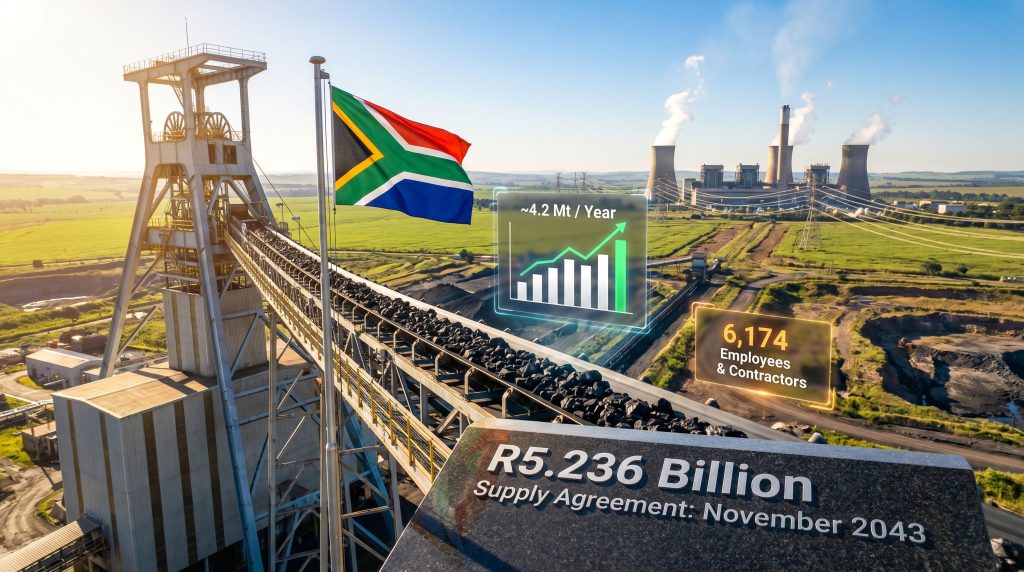
The Mine-Mouth Advantage: Why South Africa's Coal Supply Architecture Still Defines Grid Stability
Across most of the world's major electricity systems, the transition away from fossil-fuelled baseload generation is being narrated as a clean break: old infrastructure retired, new capacity commissioned, and the grid reborn. South Africa's energy reality is considerably more nuanced. The country's national grid remains structurally anchored to a fleet of coal-fired power stations, and the supply chains feeding those stations are not interchangeable commodity flows. Understanding why the Exxaro new Matla Mine 1 Eskom coal supply agreement matters requires stepping back from the headline figures and examining the physical and contractual architecture that makes this particular supply relationship one of the most efficient in the country's primary energy portfolio.
When big ASX news breaks, our subscribers know first
South Africa's Baseload Reality and the Irreplaceable Role of Domestic Coal
Coal-fired generation currently supplies well over 80% of South Africa's electricity, a proportion that has remained stubbornly high despite successive rounds of renewable energy procurement under the Renewable Energy Independent Power Producer Procurement Programme (REIPPPP). The reason this figure has not shifted faster is not simply political resistance to change; it reflects the physical constraints of a grid that was designed around large, dispatchable, centralised generation units.
Eskom's coal fleet, concentrated heavily in the Mpumalanga province, provides the inertia, reactive power support, and dispatchable capacity that keeps frequency stable across a network serving tens of millions of consumers. As variable renewable energy from solar photovoltaic and wind farms increases its share of the generation mix, the stabilising function of dispatchable coal units actually becomes more operationally critical in the short term, not less. This creates a structural dependency that no amount of procurement policy can eliminate overnight.
Within this context, the distinction between transitional coal dependency and strategic coal anchoring matters enormously for investors and policymakers alike. Transitional dependency implies a system moving steadily away from coal as renewables scale. Strategic anchoring implies that certain coal assets — specifically those with the lowest-cost supply arrangements, the greatest efficiency advantages, and the longest contractual visibility — will remain load-bearing components of the generation fleet until the grid has sufficient alternative capacity to absorb their retirement.
The Matla power station, located in Mpumalanga and supplied by the adjacent Matla coal mine complex, sits firmly in the second category. Furthermore, broader coal supply challenges across the sector make the Matla arrangement even more strategically significant for grid stability.
The Mine-Mouth Model: A Supply Chain Advantage Most Observers Underestimate
What makes the Matla arrangement structurally distinct from most other Eskom coal supply contracts is a logistical feature that rarely receives adequate attention: coal is delivered from the Matla mine directly to the power station via conveyor belt infrastructure, eliminating road and rail transport entirely from the fuel supply chain.
This mine-mouth model is not merely a convenience. It eliminates two of the largest variable cost components in coal-fired electricity generation: haulage and logistics. At stations supplied by third-party contractors delivering coal over road or rail, fuel costs fluctuate with diesel prices, truck availability, and rail network reliability. At Matla, those variables are structurally removed.
This conveyor-linked supply model creates a cost floor that contracted coal supply at other Eskom stations cannot match. In addition, it eliminates the supply disruption risk associated with transport infrastructure failures, a factor that has contributed to generation outages at other stations in Eskom's fleet during periods of rail network deterioration.
The Engineering Crisis That Made a R5.236 Billion Investment Necessary
The original Mine 1 at the Matla complex was suspended in 2016 after engineering assessments identified deteriorating safety pillars near the shaft infrastructure. This was not a production optimisation decision; it was a safety-driven suspension that created an immediate and long-term coal supply gap for the Matla power station.
Why Deep Underground Mining Creates Unique Structural Risks
The structural problem at old Mine 1 illustrates a less-discussed reality of deep underground coal mining in South Africa's Witbank and Highveld coalfields. As underground panels are progressively extracted, the coal pillars left in place to support the roof and shaft surrounds gradually deform under load. In mines operating for several decades, pillar deterioration can accelerate unpredictably, particularly where historical mining records are incomplete or where pillar sizing was based on older geotechnical standards.
Rather than attempting remediation of the compromised infrastructure, the decision was made to develop an entirely new underground operation capable of safely accessing the remaining coal reserves. This became the New Mine 1, delivered under the Matla Life of Mine Project framework.
| Project Metric | Detail |
|---|---|
| Total MLOMP Capital Investment | R5.236 billion |
| Annual Coal Production Target | ~4.2 million tonnes |
| Mine Workforce | 6,174 employees and contractors |
| Original Mine 1 Suspension | 2016 (safety pillar deterioration) |
| Extended CSA Formalised | 2 April 2026 |
| CSA Supply Horizon | Through November 2043 |
The capital requirement of R5.236 billion for the MLOMP reflects both the engineering complexity of establishing new underground infrastructure in an active mining district and the operational enhancements incorporated into the design. This is not a simple shaft deepening or panel extension; it represents a comprehensive life-expansion programme engineered from the outset to operate within a cost-plus contractual framework.
Understanding the Cost-Plus Contract: Who Bears the Risk?
The cost-plus operating model at Matla is one of the most consequential but least understood features of the Exxaro-Eskom supply relationship. Under this structure, Eskom as the offtaker assumes contractual responsibility for funding the mine's operating costs, with the objective of ensuring the lowest achievable fuel cost for the power station.
From a risk allocation perspective, this model functions as follows:
- Exxaro is insulated from commodity price volatility because its cost recovery is contractually guaranteed rather than market-linked.
- Eskom absorbs operational cost risk but benefits from a structural cost floor significantly below what it would pay for equivalent coal volumes on spot markets or under conventional fixed-price supply contracts.
- The power station achieves fuel cost predictability that supports stable electricity tariff planning.
The renegotiated Coal Supply Agreement, formalised on 2 April 2026, was developed in alignment with Eskom's internal Cost Optimisation and Revenue Enhancement programme, known as CORE. This initiative targets systemic efficiency improvements across Eskom's primary energy procurement portfolio, and the Matla CSA renegotiation represents one of its most substantive outcomes.
Scenario Analysis: The Three Futures for Matla Coal Supply
Investors and energy planners assessing the long-term significance of the Exxaro new Matla Mine 1 Eskom coal supply agreement should consider three plausible scenarios for how this supply relationship evolves through the 2043 contract horizon.
Scenario A: Full Operational Continuity
New Mine 1 sustains approximately 4.2 Mt of coal output annually through to 2043, providing Eskom with roughly 17 years of stable, cost-efficient baseload fuel. Under this scenario, the cost-plus structure delivers consistent savings relative to market procurement, and Matla remains a pillar of Eskom's lowest-cost generation fleet.
Scenario B: Partial Output Disruption
A geotechnical event, infrastructure failure, or labour disruption reduces Matla's production below nameplate capacity. Eskom is forced to supplement supply through spot market procurement or alternative contracted sources, increasing primary energy costs and potentially creating pressure on generation scheduling at the Matla station.
Scenario C: Accelerated Renewables Displacement
South Africa's renewable energy buildout, combined with battery storage deployment and demand-side improvements, reduces Matla power station's utilisation rate ahead of 2043. Under this scenario, the CSA's long-dated supply obligations create partial stranded asset exposure within the contractual framework, requiring renegotiation or early termination provisions to be exercised.
Each scenario carries materially different implications for Exxaro's revenue visibility and Eskom's generation cost trajectory. Scenario A represents the base case embedded in the current contract; Scenario C represents the principal long-term risk that the 2025 Exxaro-Eskom emissions MOU is partly designed to manage.
The next major ASX story will hit our subscribers first
365 Days Without Loadshedding: What Supply Chain Discipline Actually Looks Like
Eskom's achievement of 365 consecutive days without loadshedding as of mid-2026 is being widely discussed as a grid-level milestone. However, what receives less attention is the supply chain infrastructure that makes sustained loadshedding-free operation possible.
Coal stock levels at power stations have historically been one of the leading indicators of loadshedding risk. When stockpiles fall below operational minimums, typically measured in days of burn-cover, the probability of unplanned generation unit shutdowns increases sharply. Maintaining adequate stockpiles requires not just productive mines, but reliable logistics and consistent delivery cadence — precisely what the mine-mouth conveyor model at Matla is engineered to provide.
The sustained operational performance at Matla, underpinned by Exxaro's execution of the MLOMP within budget and on schedule, is a concrete illustration of how mine-level discipline translates into grid-level outcomes. Consequently, South Africa's mining decline in other sectors makes this kind of operational continuity even more critical.
The Socio-Economic Weight of 6,174 Jobs in Mpumalanga
Community Impact and the Just Transition
The Matla mine complex employs 6,174 people, including permanent employees and contractors. In the context of Mpumalanga's provincial economy, which remains heavily dependent on coal mining and related industries, this workforce represents a significant economic anchor.
The MLOMP has also delivered community investment, local procurement development, and entrepreneurship support programmes in the surrounding area. These outcomes align with South Africa's Broad-Based Black Economic Empowerment framework and the developmental objectives embedded in the Mining Charter.
Minerals and Petroleum Resources Minister Gwede Mantashe, who spent six years working at the Matla mine before entering politics, emphasised during the new mine opening that coal mining continues to evolve through improvements in safety standards and ongoing investment in innovation and research, and that the workforce engaged in this sector deserves recognition rather than stigma.
This perspective reflects a broader tension in South Africa's energy policy discourse. Global decarbonisation narratives increasingly frame coal employment as a liability to be managed down. South Africa's just energy transition framework attempts a more textured response, recognising that communities whose livelihoods depend on coal cannot absorb an abrupt transition without structured socio-economic support.
How the Exxaro-Eskom Emissions MOU Changes the Relationship Dynamic
The Memorandum of Understanding signed between Exxaro and Eskom in 2025 covering emissions reduction, carbon capture research, and responsible transition planning represents a meaningful evolution in how the two organisations define their partnership. Historically, the relationship was purely transactional: coal mined, coal delivered, invoices settled.
The emissions MOU introduces a collaborative dimension that positions both parties as co-participants in managing the long-term environmental and regulatory risks associated with coal-fired generation. Furthermore, Exxaro's renewable energy strategy underscores how this collaboration extends well beyond immediate coal supply obligations.
It is important to note that carbon capture and storage technology applicable to South African coal operations remains at early commercial stages globally, and the gap between MOU commitments and deployable emissions reduction solutions is substantial. The MOU should therefore be understood as a strategic framework for research collaboration and transition planning rather than a near-term emissions reduction mechanism.
| Country | Transition Model | Primary Mechanism |
|---|---|---|
| South Africa | Phased, socially managed | Long-term CSAs alongside renewables scale-up |
| Germany | Legislated exit by 2038 | Structured compensation, retraining |
| India | Demand-driven expansion alongside renewables | Parallel capacity growth |
| Australia | Market-led, state-level variation | Renewable zones and progressive mine closures |
South Africa's approach most closely resembles a hybrid of the German and Indian models: legislated transition ambition combined with pragmatic recognition that coal-dependent communities and generation infrastructure cannot be retired on a timetable dictated solely by climate policy. The broader renewable energy transition and mining decarbonisation trends will, however, progressively reshape the parameters of this balance.
What the Extended CSA Means for Exxaro's Capital Allocation Strategy
Long-Dated Revenue Visibility in an Uncertain Market
From an investor perspective, the extended supply agreement through November 2043 delivers something that commodity-linked mining companies rarely achieve: long-dated revenue visibility in a market characterised by price uncertainty.
The strategic logic of extending an existing mine's operational life rather than pursuing greenfield development in the current environment reflects a capital discipline philosophy that is increasingly valued by institutional investors assessing mining equities. Greenfield coal projects face permitting, financing, and ESG-related headwinds that make them difficult to underwrite. Life-extension projects at established operations with contracted offtake arrangements carry a fundamentally different risk profile.
Exxaro's broader portfolio strategy involves maintaining coal cash flows to fund investment in energy transition opportunities, including renewable energy assets. The Exxaro new Matla Mine 1 Eskom coal supply agreement provides the financial foundation for that diversification programme, ensuring that the company is not forced to choose between operational continuity and strategic reinvention.
Disclaimer: This article contains forward-looking statements, scenario projections, and financial analysis that involve assumptions and uncertainties. Nothing in this article constitutes investment advice. Readers should conduct their own due diligence and consult qualified financial advisers before making investment decisions.
Want to Stay Ahead of the Next Major Resource Discovery on the ASX?
Discovery Alert's proprietary Discovery IQ model delivers real-time alerts on significant ASX mineral discoveries, transforming complex resource data into actionable investment insights — ideal for both short-term traders and long-term investors navigating the evolving energy and commodities landscape. Explore historic examples of major mineral discoveries and their market returns, then start your 14-day free trial at Discovery Alert to position yourself ahead of the broader market.