May 20, 2026
The Exploration Gap That's Defined a Decade of Missed Opportunity
Few structural weaknesses have cost a resource-rich nation more than South Africa's chronic underinvestment in greenfield mineral exploration. While Australia and Canada sustained exploration spending through multiple commodity cycles, South Africa allowed its discovery pipeline to thin to a point where future production viability became a genuine concern. National onshore geoscience mapping coverage sat below 5% in 2019 — a figure that, by itself, explains why international junior mining capital consistently bypassed the country in favour of better-mapped jurisdictions.
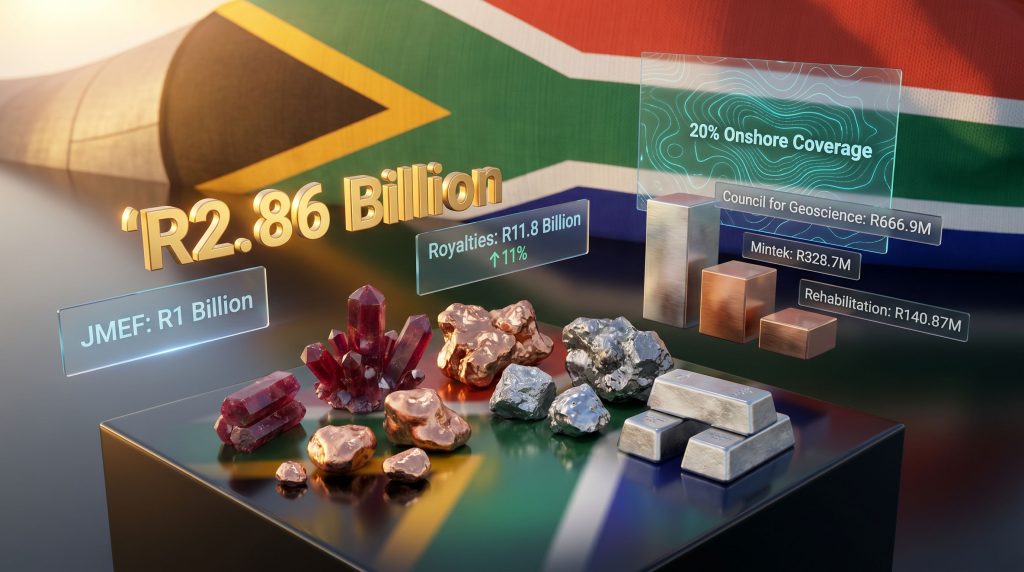
That context makes the South Africa mining budget push — specifically the DMPR's R2.86 billion budget for 2026/27 — more than a routine fiscal exercise. It represents a deliberate attempt to close a structural gap that has compounded quietly for over a decade, while simultaneously positioning the country to compete for the battery metals and rare earth supply chains investment flows that geopolitical fragmentation is redirecting away from traditional incumbents.
Whether the strategy delivers depends on factors both within and beyond the department's control.
When big ASX news breaks, our subscribers know first
Decoding the R2.86 Billion: Where the Money Actually Goes
The budget envelope breaks down across several priority areas, with the Council for Geoscience receiving the largest single allocation at R666.9 million. This weighting is deliberate. Geological data scarcity has historically been the first deterrent encountered by exploration companies evaluating South African project opportunities, and the government's decision to front-load geoscience funding reflects an understanding that public data investment is a prerequisite for private capital mobilisation.
| Allocation Area | Budget (ZAR) |
|---|---|
| Council for Geoscience | R666.9 million |
| Mintek | R328.7 million |
| Derelict and Ownerless Mine Rehabilitation | R140.87 million |
| Petroleum Agency South Africa | R94.98 million |
| Shale Gas Implementation Programme | R48.1 million |
| Artisanal and Small-Scale Mining Support | R31.12 million |
The R140.87 million allocated to derelict and ownerless mine rehabilitation addresses a liability that extends beyond environmental concerns. Unrehabilitated legacy mine sites create permitting complexity for adjacent tenements, distort land tenure confidence, and generate ongoing community opposition that complicates new project approvals. Addressing the rehabilitation backlog is therefore as much an investment facilitation measure as it is an environmental one.
Mintek's R328.7 million allocation supports South Africa's beneficiation research infrastructure, an area critical to the government's ambition of moving beyond raw mineral exports toward downstream value addition.
The Junior Mining Exploration Fund: Architecture of a Structural Shift
The Junior Mining Exploration Fund (JMEF) deserves particular analytical attention because it represents a financing model South Africa has not previously deployed at scale. Rather than relying purely on fiscal incentives or regulatory reform to attract exploration capital, the JMEF operates as a co-investment vehicle, pairing government seed funding with institutional and corporate contributions to de-risk early-stage geological programmes.
The mechanics matter here. Exploration is notoriously difficult to finance because it is binary in outcome, long in duration, and produces no cashflow before discovery. Institutional lenders avoid it. Equity markets for junior explorers have dried up in most jurisdictions outside of Toronto and Sydney. The JMEF partially solves this problem by absorbing a portion of the discovery-stage risk that private capital has been unwilling to carry. This approach mirrors some of the thinking behind junior exploration incentives seen in other resource-rich jurisdictions seeking to rebuild their discovery pipelines.
The fund's evolution tells its own story:
- Initial capitalisation of R400 million alongside the Industrial Development Corporation
- Anglo American contributed R600 million, expanding total capitalisation to R1 billion
- The Public Investment Corporation committed R1.35 billion in continuation funding
- 13 active projects are already underway across rare earths, copper, nickel, and gold
- Drilling activity includes programmes in the Giyani and Bothaville regions
The Anglo American commitment is particularly significant. A major mining house deploying R600 million into a government-anchored exploration fund is not a passive endorsement. It signals that at least one globally significant capital allocator views the South African exploration environment as sufficiently de-risked to justify material participation. Mining analyst Peter Major of Mergence Corporate Solutions has noted that the budget marks a meaningful philosophical change in how government approaches its role in rebuilding the country's depleted exploration pipeline, acknowledging that sustained greenfield investment is the only path to maintaining a viable future production base.
What this means for investors: The JMEF structure creates a new category of investable exposure for those seeking South Africa critical minerals risk. Projects funded through the vehicle carry partial public risk absorption, which changes the risk-return profile relative to conventional junior exploration financing.
Geoscience Mapping: The Unglamorous Infrastructure Behind Every Discovery
One of the least-discussed but most consequential aspects of the South Africa mining budget push is the continued expansion of the Council for Geoscience's Integrated and Multi-Disciplinary Geoscience Mapping programme. National onshore coverage has grown from below 5% in 2019 to 20% by the 2025/26 financial year — a fourfold increase that meaningfully changes what exploration companies can determine about prospective ground before committing drill budgets.
To understand why this matters, consider the economics. A junior exploration company evaluating a tenement in an unmapped jurisdiction must allocate the first phase of its programme to basic geological characterisation work that, in well-mapped countries like Australia or Canada, would already exist in public databases. That initial cost hurdle eliminates many projects before they reach the drill-ready stage, particularly for smaller operators without the capital to fund multi-phase programmes.
Additional geoscience initiatives advancing under the current budget cycle include:
- Offshore geoscience mapping activities to complement the accelerating onshore programme
- The Virtual Core Library, launched at Mining Indaba 2026, which digitises drill core data to improve accessibility for exploration companies and reduces duplication of subsurface work
- Forward planning toward broader national coverage beyond the current 20% baseline
The Virtual Core Library deserves specific attention from a technical perspective. Drill core is irreplaceable physical evidence of subsurface geology, but historically it has been stored in fragmented ways across private company archives, making it inaccessible to subsequent explorers working adjacent ground. Digitising and centralising this data removes a significant information asymmetry that has suppressed re-evaluation of historically drilled ground.
Critical Minerals Strategy: Beyond the Policy Rhetoric
South Africa's Critical Minerals and Metals Strategy is now being framed as an active industrialisation tool rather than a long-term planning document. This distinction matters because it changes the operational posture of government engagement with prospective investors, moving from passive regulatory administration toward active investment facilitation. Furthermore, understanding critical minerals demand in the context of the global energy transition underscores just how timely this strategic repositioning is.
The mineral portfolio at the centre of this strategy spans both the country's established production base and its emerging exploration pipeline:
- Platinum Group Metals (PGMs): The world's largest known reserve base, with beneficiation upside in catalytic applications, hydrogen fuel cell technology, and battery materials
- Manganese and Iron Ore: Strong export performance contributing to the 11% year-on-year royalty revenue growth that brought total mining royalties to R11.8 billion in the most recent reporting period
- Rare Earth Elements: Active JMEF-funded exploration programmes underway
- Copper and Nickel: Drilling activities progressing across multiple project areas
- Gold: Exploration pipeline being actively rebuilt after prolonged underinvestment
South Africa's G20 membership is being positioned as a platform to advocate for greater critical minerals exploration financing across the broader African continent, a framing that aligns the domestic budget agenda with a larger geopolitical narrative around supply chain diversification.
The macro context: Global battery metals supply chains are actively being restructured in response to geopolitical fragmentation. Countries with credible geological endowments and improving regulatory environments are gaining investor attention. South Africa's challenge is converting geological potential into competitive investment destinations before that capital allocation cycle concludes.
The Electricity Contradiction at the Heart of Beneficiation
No analysis of the South Africa mining budget push is complete without confronting the central tension embedded in the DMPR's industrial ambitions: the government wants to attract energy-intensive downstream processing investment while Eskom's tariff trajectory continues to erode the competitiveness of existing operations.
The DMPR's own budget documentation acknowledged that South Africa cannot fully realise its beneficiation aspirations until affordable electricity becomes consistently available. For mining analysts and investors, this admission is notable precisely because it places Eskom's reform trajectory as a co-determinant of whether the minerals strategy delivers industrial outcomes or remains aspirational.
| Factor | South Africa | Australia | Canada |
|---|---|---|---|
| Electricity tariff trajectory | Escalating | Stable to moderate | Stable |
| Beneficiation competitiveness | Under pressure | Competitive | Competitive |
| Deep-level mining viability | Increasingly constrained | Less exposed | Less exposed |
| Energy reform progress | In progress | Mature market | Mature market |
The sectors most exposed to this structural tension include:
- Ferroalloy and smelter operations, where electricity can represent 30-40% of total operating costs and tariff escalation directly compresses margins
- Deep-level gold and platinum mines, where rising power costs compound the operational pressure of declining ore grades and increasing extraction depth
- Downstream manufacturing aspirations, where electricity cost competitiveness is a baseline requirement before processing investment can be attracted
Independent mining economist Dr. Azar Jammine has framed this as a fundamental competitiveness contradiction: pursuing beneficiation and downstream manufacturing growth simultaneously with escalating power prices creates structural headwinds for the very industrial outcomes the strategy is designed to achieve. Senior executives across the platinum and gold sectors have indicated that the sector has moved past problem identification and now requires measurable implementation on power pricing, transmission access, and energy market reform with defined timelines.
Is Decarbonisation Adding to the Pressure?
In addition to electricity tariff concerns, mining decarbonisation in Africa is introducing a further layer of capital expenditure and operational complexity for producers already navigating cost headwinds. Consequently, the intersection of energy reform and decarbonisation commitments is becoming one of the more challenging strategic tensions for South African mining executives to manage.
The next major ASX story will hit our subscribers first
Oil, Gas, and the Energy Sovereignty Argument
Parallel to the solid minerals agenda, the DMPR is advancing an upstream oil and gas programme that frames domestic petroleum development as an economic necessity in an era of geopolitical supply disruption. Minister Gwede Mantashe's budget vote speech positioned energy sovereignty as a non-negotiable national security objective, defending upstream expansion against environmental opposition by characterising petroleum security as an economic imperative rather than an ideological choice.
Key instruments advancing this agenda include:
- Acceleration of the South African National Petroleum Company (SANPC) Bill to establish a state-owned upstream participant under the Upstream Petroleum Resources Development Act
- R94.98 million directed to the Petroleum Agency South Africa for upstream regulatory support
- R48.1 million for the Shale Gas Implementation Programme
- Long-term domestic refining capacity expansion as a petroleum security objective
For investors, the oil and gas dimension introduces a bifurcated risk profile. ESG-focused institutional capital will apply heightened scrutiny to South African energy sector exposure. Conversely, energy security-oriented investors and national oil companies may view the SANPC's operationalisation as an opportunity for upstream participation in an underexplored jurisdiction.
One underappreciated dynamic: if domestic gas development progresses, it could provide a lower-cost energy input for mining and processing operations, partially addressing the electricity competitiveness problem that threatens beneficiation ambitions. Gas-to-power infrastructure would create an indirect benefit for the minerals strategy that is not yet fully priced into investor assessments.
Mine Safety: Record Progress With Persistent Risk
South Africa recorded 41 mining fatalities in 2025, the lowest figure in the sector's recorded history. The improvement is broadly distributed across commodity sectors, though performance remains uneven.
| Sector | 2024 Fatalities | 2025 Fatalities | Change |
|---|---|---|---|
| Coal | 6 | 2 | Down 67% |
| Platinum | 19 | 11 | Down 42% |
| Overall industry | Higher | 41 | Historic low |
The gold sector was specifically flagged by the DMPR as exhibiting uneven performance requiring focused accountability measures. The Ekapa disaster, which claimed five lives, was cited as evidence that operational complacency remains a live risk even as aggregate fatality statistics improve.
The Mine Health and Safety Bill, currently progressing through Parliament, is designed to:
- Strengthen enforcement mechanisms across all operational categories
- Introduce clearer management accountability frameworks
- Address sector-specific underperformance, particularly in gold mining
- Create a binding legislative foundation to complement the cultural improvements reflected in the fatality data
Regulatory Reform: The Legislative Pipeline That Will Determine Investment Confidence
Beyond budget allocations, two pieces of legislation are advancing that carry potentially greater weight for medium-term investment decisions than any single spending line item.
The Mineral Resources Development Bill is undergoing legal certification before Cabinet submission. Its primary purpose is to modernise the licensing and regulatory framework, addressing investor concerns about approval timelines and administrative efficiency that have persistently suppressed capital formation in South African mining. The mineral exploration importance of getting this right — particularly for gold and copper — cannot be overstated.
The Mine Health and Safety Bill is already before Parliament and focuses specifically on enforcement standards and operational accountability.
Investor consideration: Regulatory certainty is consistently ranked above exploration incentives as a primary driver of mining investment decisions. The speed at which these bills move from legislative process to operational implementation will be a more decisive signal for capital allocation in 2026 and 2027 than any individual budget line. Historically, South Africa has produced strong policy frameworks that have been undermined by slow implementation, and international investors will be watching execution velocity closely.
Execution Risk: The Gap Between Policy Intent and Investment Outcomes
The coherence of the South Africa mining budget push strategy is not genuinely in dispute. The geoscience investment rationale is sound, the JMEF financing model is well-structured, and the critical minerals framing aligns with global supply chain dynamics. The question investors must honestly assess is whether execution will match ambition. However, as South Africa enters a new resources boom, the pressure to convert policy intent into tangible outcomes has never been greater.
| Risk Factor | Nature of Risk | Severity | Current Status |
|---|---|---|---|
| Electricity tariff escalation | Operational cost competitiveness | High | Ongoing — Eskom reform in progress |
| Logistics infrastructure constraints | Export capacity and reliability | High | Transnet reform underway |
| Regulatory approval delays | Investment deterrence | Medium-High | Legislative reform in pipeline |
| Environmental opposition to oil and gas | Social licence and ESG pressure | Medium | Active tension |
| Slow capital formation | Exploration pipeline rebuilding | Medium | JMEF partially addressing |
| Mine safety incidents | Reputational and regulatory risk | Medium | Historic low but incidents persist |
Three conditions will ultimately determine whether this strategy produces measurable investment growth:
- Electricity reform velocity — The pace at which affordable, reliable power reaches energy-intensive operations will determine whether beneficiation ambitions become industrial reality
- Regulatory implementation speed — Both bills must move from legislative process to operational certainty without the delays that have historically undermined investor confidence
- Logistics system recovery — Transnet's ability to restore rail and port reliability to export-competitive levels remains a foundational requirement for sustained capital attraction
South Africa's R477 billion mining Gross Value Add in 2025, representing approximately 6.3% of GDP, demonstrates that the sector retains genuine scale and economic significance. The 11% year-on-year royalty revenue increase to R11.8 billion provides the fiscal headroom to sustain these commitments through the investment cycle.
The 2026/27 DMPR budget sends a credible signal of intent. Whether it translates into a revitalised exploration pipeline, competitive beneficiation investment, and sustained capital formation will depend on South Africa's capacity to deliver structural reform at the speed that global capital allocation decisions demand. The policy architecture is in place. The execution test is only beginning.
This article is intended for informational purposes only and does not constitute financial or investment advice. Forecasts and projections referenced herein involve uncertainty and should not be relied upon as predictive of future outcomes. Readers should conduct independent due diligence before making investment decisions.
Want To Catch The Next Major Mineral Discovery Before The Market Does?
Discovery Alert's proprietary Discovery IQ model delivers real-time alerts on significant ASX mineral discoveries, transforming complex geological data into actionable investment insights for both short-term traders and long-term investors. Explore how historic discoveries have generated substantial returns on Discovery Alert's dedicated discoveries page, and begin your 14-day free trial today to position yourself ahead of the market.