May 20, 2026
The Structural Gap Driving Multilateral Interest in North African Mining
Critical minerals demand has quietly become one of the most consequential investment themes of the 2020s. As the global economy accelerates its pivot away from fossil fuels, the supply chains underpinning clean energy technology, electric vehicles, and grid storage systems have emerged as a new frontier of geopolitical and financial competition. Against this backdrop, resource-rich but institutionally underdeveloped economies occupy a peculiar position: vast geological endowments that remain commercially dormant, not for lack of material, but for lack of the governance architecture that institutional capital requires before it moves.
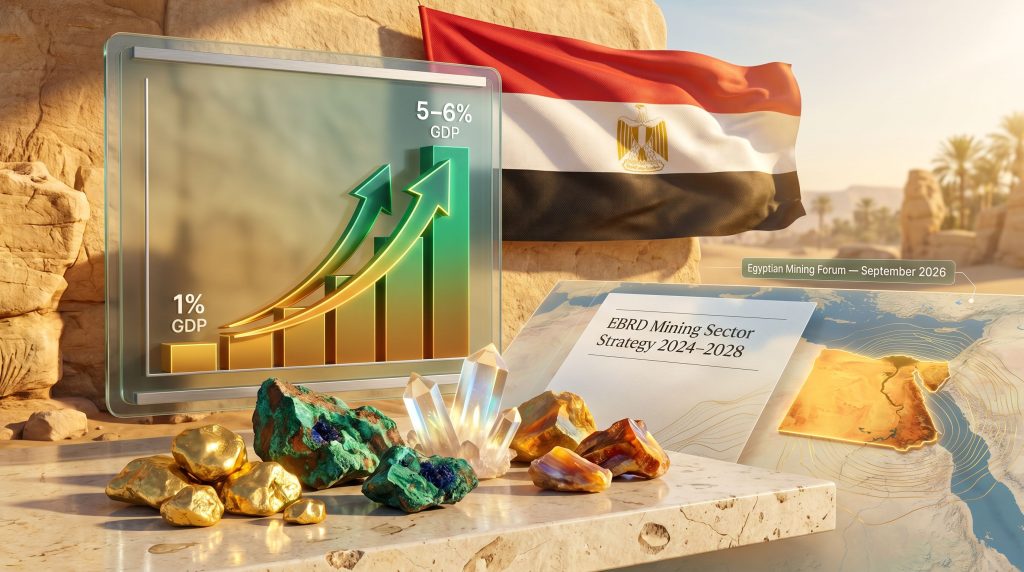
Egypt sits precisely in this category. Its territory contains documented deposits of gold, copper, phosphate, and a range of industrial minerals distributed across some of the oldest geological terranes on Earth, yet the country's mining sector contributes approximately 1% of national GDP, a figure that development economists consistently flag as disproportionately low relative to the country's resource base. Understanding why that gap exists, and what it will realistically take to close it, is central to interpreting the significance of the EBRD Egypt mining sector partnership formalised in May 2026.
When big ASX news breaks, our subscribers know first
Egypt's Mining Underperformance: A Governance Story, Not a Geological One
Why Egypt's Mineral Wealth Has Remained Structurally Underutilised
Egypt's geology is, in many respects, its least constrained asset. The Eastern Desert, stretching between the Nile Valley and the Red Sea, hosts a Precambrian basement complex known as the Arabian-Nubian Shield, one of the world's most prospective terranes for orogenic gold and volcanogenic massive sulphide deposits. This shield formation underlies significant portions of the region and has historically received far less systematic exploration investment than geologically comparable zones in West Africa or South America.
The constraint is not the rock. The barriers that have suppressed Egypt's mining sector development fall into identifiable institutional categories:
- Fragmented regulatory architecture: Mining governance has historically been distributed across multiple agencies, creating jurisdictional ambiguities that extend permitting timelines and increase administrative risk premiums for international investors.
- Limited geodata accessibility: Comprehensive airborne geophysical surveys and modern geochemical databases, the foundational tools that allow exploration companies to prioritise drill targets, have not been systematically compiled or made accessible at the scale required to attract global junior mining capital.
- Underdeveloped fiscal frameworks: Royalty structures, profit-sharing mechanisms, and taxation schedules that lack clarity or precedent make bankability assessments difficult for project finance teams at mining companies and their lenders.
- Exploration-stage financing gap: Early-stage mineral exploration is inherently high-risk and requires patient, risk-tolerant capital. Egypt has lacked the institutional financing instruments needed to bridge the gap between grassroots exploration and project feasibility.
These are not peripheral issues. They represent the core value-destruction mechanism in any emerging mining jurisdiction, and they explain why a country with Egypt's geological credentials has attracted a fraction of the exploration investment that its endowment would justify.
The 5% GDP Target: What Closing the Gap Actually Requires
Egypt's government has set a formal medium-term target of raising mining's contribution to national GDP from roughly 1% to 5-6%. Achieving that transformation is not primarily a question of finding more minerals. It is, furthermore, a question of building the institutional, regulatory, and financial architecture that allows known and yet-to-be-discovered resources to flow through to productive commercial output.
Key Insight: A five-to-six-fold increase in mining's GDP contribution, if achieved, would represent one of the most significant sectoral transformations in the MENA region's recent economic history. The precedent set by Morocco's phosphate sector, which operates at roughly 3-4% of GDP, illustrates both what is achievable and how long sustained institutional development takes.
The four-dimensional reform framework required to hit Egypt's target includes:
- Legal and regulatory modernisation aligned with internationally recognised mining codes and transparent permitting processes.
- Geoscientific infrastructure investment, encompassing systematic airborne geophysical surveys, geochemical sampling programmes, and publicly accessible mineral occurrence databases.
- Foreign direct investment climate reform, including clear and bankable fiscal terms and streamlined licensing procedures with defined decision timelines.
- Digital transformation of the technical systems used for resource mapping, licensing management, and compliance monitoring within government mining agencies.
What the EBRD Egypt Mining Sector Partnership Is Designed to Deliver
The MoU's Architecture and Institutional Logic
The Memorandum of Understanding signed between Egypt's Board of Minerals and Mining Industries and the European Bank for Reconstruction and Development was executed by Yasser Ramadan, head of Egypt's Board of Minerals and Mining Industries, and Mark Davis, EBRD Regional Director for the South and Eastern Mediterranean. The signing took place in the presence of Mohamed Al-Bajouri, head of the Central Department of Legal Affairs of the Ministry, along with representatives from both institutions.
The agreement is structured around four strategic pillars that map directly onto the root causes of Egypt's mining underperformance:
| MoU Pillar | Strategic Objective |
|---|---|
| Legal and Regulatory Alignment | Harmonise Egypt's mining frameworks with global governance and transparency standards |
| Investment Incentive Design | Develop targeted fiscal and procedural incentives for exploration-stage and early-project companies |
| Governance and Transparency | Embed internationally recognised governance principles across sector operations |
| Digital Transformation | Accelerate technical system modernisation, geodata infrastructure, and licensing digitisation |
This is not a generic cooperation agreement. Each pillar directly addresses a documented constraint on Egypt's mining investment climate, and the sequencing reflects an understanding that governance and regulatory reform must precede, rather than follow, large-scale capital mobilisation.
Why the EBRD Is the Appropriate Institutional Partner
The EBRD is not simply a development lender. It operates one of the most sophisticated natural resources technical assistance platforms of any multilateral development bank, with specific experience in supporting resource sector governance reform across Central Asia, Eastern Europe, and the Southern Mediterranean. Its Mining Sector Strategy 2024-2028 explicitly prioritises minerals critical to the green energy transition, with ESG compliance, decarbonisation, supply chain resilience, and digitisation as organising principles.
Several EBRD instruments are directly relevant to Egypt's needs:
- Technical assistance programmes for geodata digitisation, fiscal framework design, and licensing reform, drawing on the bank's experience in comparable jurisdictions.
- The JUMP programme, a dedicated early-stage mining financing instrument that provides capital and structuring support for exploration-stage companies, precisely addressing the funding gap that prevents discoveries from advancing to feasibility.
- Capacity building and workforce development frameworks that strengthen human capital within government mining agencies, a requirement for sustaining digital transformation beyond initial deployment.
Egypt is already an established EBRD priority country, with existing sector reform programmes providing an operational foundation that reduces institutional friction and accelerates programme deployment timelines.
Egypt's Broader Reform Momentum and the Forum Catalyst
Mining as a Structural Pillar of Egypt's Economic Diversification
Egypt's economic diversification strategy has historically centred on hydrocarbons, tourism, and the Suez Canal as primary growth engines. The explicit elevation of mining to a strategic growth sector represents a meaningful shift in planning priorities, one that aligns with broader global recognition that green transition minerals are becoming as strategically important as energy infrastructure.
Egypt's Minister of Petroleum and Mineral Resources, Karim Badawi, has indicated that the EBRD Egypt mining sector partnership functions as a catalyst for accelerating a broader reform agenda, with parallel workstreams underway on infrastructure upgrades, investment environment enhancement, and the digital transformation of the sector's technical systems. The Minister specifically noted that momentum in digital transformation is already building, but sustained institutional support is required to maintain that trajectory.
The Egyptian Mining Forum: September 2026 as a Commercial Inflection Point
The timing of the MoU's execution is strategically deliberate. The Egyptian Mining Forum in September 2026 represents the most significant near-term convergence point for government entities, international mining investors, and sector operators focused on Egypt's resource development potential.
Strategic Signal: Formalising the EBRD partnership in advance of the Forum positions Egypt's mining sector under a reformed, internationally-credentialled governance narrative at precisely the moment when capital allocation decisions are being shaped. Working groups between the EBRD and the Ministry of Petroleum and Mineral Resources have already commenced pilot project identification and technology evaluation, indicating the partnership has transitioned from conceptual agreement into operational planning.
This pre-Forum execution timeline creates structured accountability for early deliverables, which is critical for shifting the risk perception of institutional investors who have historically discounted Egypt mining project valuations due to administrative uncertainty.
Egypt in the MENA Mining Landscape: A Comparative View
How Egypt's Mining Sector Stacks Up Regionally
Placing Egypt within its regional peer group illustrates both the scale of the transformation being attempted and the institutional distance that remains to be covered:
| Country | Mining GDP Contribution | Key Minerals | Notable Partnerships |
|---|---|---|---|
| Egypt | ~1% (target: 5-6%) | Gold, copper, phosphate, rare earths | EBRD MoU (2026) |
| Morocco | ~3-4% | Phosphate (world's largest reserves), cobalt | World Bank, EU frameworks |
| Saudi Arabia | Growing (Vision 2030 target: ~3%) | Phosphate, bauxite, gold | Multiple multilateral frameworks |
| Jordan | ~2% | Phosphate, potash | Various bilateral arrangements |
Morocco's phosphate sector offers the most instructive regional comparison. The depth of institutional development behind Morocco's Office Chérifien des Phosphates (OCP) illustrates that commodity-scale mining GDP contributions require decades of sustained governance investment, not just mineralogical endowment. Egypt is attempting a compressed version of that journey, which is precisely why multilateral bank partnerships with pre-built technical assistance frameworks are structurally important rather than merely symbolically significant.
In addition, comparable mining licence reform efforts across the region demonstrate that sustained regulatory transformation does, over time, translate into measurable increases in foreign exploration investment.
The Green Transition Dimension: Why Global Capital Is Looking at North Africa
Critical Minerals Demand and Egypt's Positioning
The International Energy Agency has modelled global demand for critical minerals increasing three-to-six-fold by 2040 under accelerated clean energy transition scenarios. Copper, required in vast quantities for electrification infrastructure, and a range of battery metals, are at the centre of this demand surge. Egypt's Eastern Desert hosts copper mineralisation systems that have been incompletely explored by modern methods.
What is less widely understood is the intersection between Egypt's geological setting and the geochemical signatures associated with critical mineral potential. The Arabian-Nubian Shield terranes that underpin Egypt's Eastern Desert are also associated in other parts of their extent with rare earth supply chains, niobium-tantalum mineralisation, and cobalt-bearing sulphide systems. The systematic geophysical and geochemical mapping that the EBRD partnership is designed to support could materially expand understanding of Egypt's critical mineral prospectivity beyond its better-known gold and phosphate endowment.
Multilateral development banks including the EBRD, the World Bank Group, and the African Development Bank are increasingly directing technical assistance and direct financing specifically toward green transition mineral supply chain development. Egypt's geographic position, bridging Africa, the Middle East, and within economically viable shipping distance of European manufacturing centres, gives it a structural logistics advantage as European supply chain diversification accelerates. The region's growing attractiveness is further reinforced by evolving Saudi exploration licences, which signal a broader MENA-wide shift toward institutional mineral sector investment.
The next major ASX story will hit our subscribers first
Key Risks and Execution Realities
What Could Limit Partnership Outcomes
A clear-eyed assessment of the EBRD Egypt mining sector partnership requires acknowledging the execution challenges that structural reform programmes consistently encounter:
- Reform velocity constraints: Legal and regulatory framework overhauls in resource sectors typically require multi-year implementation timelines. Political continuity and sustained bureaucratic capacity within the relevant agencies are critical variables that no MoU can guarantee.
- Investor perception lag: Institutional mining investors operate with risk frameworks shaped by historical experience. Even well-executed reforms take two to three investment cycles to register meaningfully in the risk-adjusted return assumptions that drive capital allocation decisions.
- Infrastructure dependencies: Mining sector growth at the scale Egypt's targets imply requires parallel investment in transport corridors, water supply systems, and power infrastructure, none of which are within the direct scope of this MoU.
- Human capital requirements: Digital transformation of government mining agencies demands not just technology deployment but sustained training, retention of technically skilled personnel, and institutional culture change, which are often the most difficult reforms to sustain over time.
Factors That Strengthen Execution Probability
Balanced against those risks, several factors meaningfully improve the partnership's probability of delivering tangible outcomes:
- The EBRD's established operational presence in Egypt reduces the institutional learning curve and accelerates programme deployment relative to a new entrant.
- Working groups between the two parties are already operational, providing evidence of genuine implementation momentum.
- The September Forum timeline creates external accountability pressure that incentivises early deliverables rather than indefinite conceptual planning.
- The JUMP programme provides a ready-made financing mechanism for the exploration-stage investment gap, rather than requiring the design of new instruments from scratch.
Furthermore, Egypt's recent agreement with the EBRD to support broader mining sector reforms underscores the institutional seriousness with which both parties are approaching execution.
Frequently Asked Questions: EBRD Egypt Mining Sector Partnership
What is the core purpose of the EBRD Egypt MoU?
The agreement establishes a formal cooperation framework targeting legal and regulatory alignment with global standards, investment incentive development for exploration-stage companies, governance modernisation, and digital transformation of the sector's technical infrastructure. It is designed to address the institutional root causes of Egypt's mining underperformance, not simply to signal intent.
What is Egypt's current mining GDP contribution, and what is the target?
Egypt's mining sector currently contributes approximately 1% of national GDP. The government's medium-term target is 5-6%, which would require sustained regulatory reform, increased foreign direct investment, and expanded mineral exploration and extraction activity across multiple commodity classes.
What specific tools does the EBRD bring to this partnership?
The EBRD provides technical assistance for geodata digitisation and fiscal framework design, policy advisory services for licensing reform, and direct financing instruments including the JUMP programme for early-stage mining project development. Its Mining Sector Strategy 2024-2028 provides the institutional mandate underpinning its engagement.
How does this connect to the global energy transition?
Egypt's geological endowment includes copper, gold, phosphate, and potential critical mineral prospectivity within the Arabian-Nubian Shield terrane system. The EBRD's current mining strategy explicitly prioritises minerals critical to clean energy supply chains, creating strategic alignment between the bank's mandate and Egypt's development ambitions.
What are the most significant risks to the partnership's success?
The primary risks are the pace of regulatory reform implementation, infrastructure bottlenecks outside the MoU's scope, the time lag between governance reform and shifted investor perception, and the human capital requirements of sustained digital transformation within government agencies.
This article is based on publicly available information and analysis of reported facts. It does not constitute financial or investment advice. Forward-looking statements regarding Egypt's mining sector development targets, EBRD programme outcomes, and critical mineral demand projections involve inherent uncertainty and should not be relied upon as guarantees of future outcomes.
Ready to Position Yourself Ahead of the Next Major Mineral Discovery?
Discovery Alert's proprietary Discovery IQ model delivers real-time alerts on significant ASX mineral discoveries — cutting through the complexity of 30+ commodities into clear, actionable insights for both short-term traders and long-term investors. Explore how historic mineral discoveries have generated extraordinary returns and begin your 14-day free trial today to secure a market-leading advantage.