
July 26, 2026
The Hidden Cost of Price Intervention: Why Reservation Policy Design Shapes Energy Markets for Decades
Resource-exporting nations have long wrestled with a fundamental tension at the heart of energy policy: the gas flowing through export terminals was produced by private capital attracted by commercial returns, yet that same gas underpins the industrial competitiveness and household affordability of the country that hosts it. When global prices surge and domestic users feel the strain, governments face intense pressure to act. The question is rarely whether to intervene, but how to do so without inadvertently dismantling the investment conditions that make long-term supply possible in the first place.
Australia's proposed east coast gas reservation scheme sits squarely inside this dilemma. Announced as a centrepiece of the 2026-27 Federal Budget, the mechanism has drawn both strong industry opposition and vocal support from manufacturers and consumer advocates, making it one of the most contested energy policy developments in Australia's recent history. Furthermore, Australia's resource and energy exports face mounting scrutiny as domestic affordability concerns increasingly intersect with global competitiveness pressures.
When big ASX news breaks, our subscribers know first
Understanding the East Coast Supply Problem
The structural imbalance driving this policy is not a recent phenomenon. Queensland's coal seam gas fields, which supply Australia's three east coast LNG export trains, were developed specifically to feed long-term export contracts with Asian buyers. The commercial logic was sound at the time: export-oriented projects attracted the billions in capital expenditure needed to build liquefaction infrastructure. However, the downstream consequence has been a market where southern states — particularly Victoria, New South Wales, and South Australia — compete for gas in a domestic spot market increasingly exposed to international price movements.
As legacy Bass Strait fields continue their natural production decline and new domestic-focused supply investment has lagged, energy market forecasters have flagged the prospect of a genuine east coast supply shortfall materialising through the late 2020s and into the 2030s. It is this looming deficit that has pushed domestic gas reservation firmly onto the federal government's agenda. Consequently, the interplay of trade and geopolitics in energy markets has further complicated the domestic supply equation.
How the Domestic Gas Reservation Mechanism Works
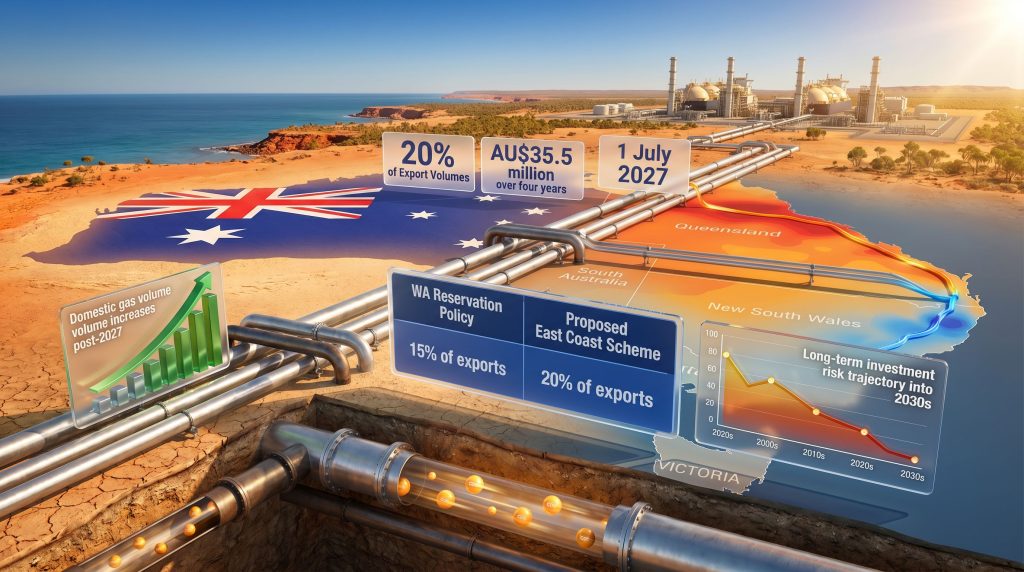
The proposed Domestic Gas Reservation Mechanism, scheduled to begin on 1 July 2027, would require LNG exporters operating on the east coast to redirect the equivalent of 20% of their export volumes into the domestic market. Critically, the policy targets spot market and uncontracted gas volumes rather than gas already committed under binding long-term export agreements, which reduces the immediate legal exposure to contract disputes but also limits the volume of gas that can realistically be captured under the scheme.
The 2026-27 Federal Budget allocated AU$35.5 million over four years to fund the implementation and administration of the mechanism, framing the policy as a domestic energy security measure rather than a purely commercial intervention. For further detail on the government's formal announcement, the joint media release from Minister Bowen outlines the scheme's core objectives and design principles.
Policy Snapshot:
| Key Parameter | Detail |
|---|---|
| Reservation Rate | 20% of export volumes |
| Gas Type Targeted | Spot and uncontracted volumes only |
| Scheme Start Date | 1 July 2027 |
| Budget Funding | AU$35.5 million over four years |
| Geographic Scope | East coast LNG exporters |
| Primary Objective | Reduce domestic supply shortfall and price pressure |
Energy Minister Chris Bowen has described the policy's aim as engineering a modest domestic oversupply condition capable of exerting sustained downward pressure on prices for households and industry without fundamentally disrupting the export sector.
East Coast vs Western Australia: A Tale of Two Frameworks
The comparison with Western Australia's long-running domestic gas reservation policy is instructive, and the differences reveal why design choices matter enormously.
Western Australia introduced its domestic gas reservation requirement over a decade ago, mandating that producers set aside 15% of LNG export volumes for the domestic market. The WA framework has been widely credited with insulating Perth's industrial users from the worst of global gas price volatility. However, the mechanism that makes it workable from a producer perspective is a critical design feature that the east coast proposal, as currently structured, does not replicate: timing flexibility.
Under the WA model, producers can satisfy their reservation obligations across the life of a project rather than being compelled to deliver reserved volumes into the domestic market immediately. This temporal flexibility allows producers to sequence domestic supply obligations in a way that aligns with production profiles and existing contractual commitments. In addition, government intervention in resource markets more broadly demonstrates how the framing of such obligations can fundamentally shape long-term investment behaviour.
| Design Feature | WA Reservation Policy | Proposed East Coast Scheme |
|---|---|---|
| Reservation Rate | 15% of exports | 20% of exports |
| Gas Type Covered | Broader LNG export base | Spot and uncontracted volumes |
| Delivery Timing | Flexible across project lifecycle | Near-term supply focus |
| Producer Flexibility | Higher | Lower as currently proposed |
| Policy Maturity | Established, long-running | New, commencing July 2027 |
The east coast scheme proposes a higher reservation rate of 20% while simultaneously offering producers less flexibility over when and how they meet that obligation. Industry analysts and legal commentators have noted this combination creates a more commercially disruptive framework than the WA precedent.
What Industry Leaders Are Warning About
The most pointed industry warnings have come from the chief executives of Australia's largest LNG producers, speaking at the Australian Energy Producers conference in Adelaide.
Santos managing director and CEO Kevin Gallagher argued that forcing LNG exporters to sell gas into the local market would provide only a temporary reduction in prices before deterring the investment in new supply that the east coast will need through the 2030s. He drew a direct parallel with Argentina, where a combination of export taxes and domestic price controls contributed to the progressive hollowing out of that country's gas export industry, as capital retreated in response to deteriorating commercial returns.
"The Argentine experience is a well-documented case study in how interventions designed to protect domestic consumers can, over time, destroy the upstream investment base that sustains supply for those same consumers."
Shell Australia chair Cecile Wake raised a more technical but equally significant concern: the distinction between an obligation to offer gas domestically and an obligation to sell it. A requirement to offer reserved gas to the domestic market at market-reflective prices preserves investment signals. A requirement to sell, potentially at regulated or administratively determined prices, fundamentally alters the commercial calculus for upstream investment decisions.
Woodside Energy CEO Liz Westcott articulated what may be the most structurally important argument against the scheme's current design: the intertemporal supply allocation problem. Gas redirected into the domestic spot market during the mid-2020s cannot simultaneously be drawn upon to support export contract obligations or domestic demand in the 2030s. Satisfying near-term demand by accelerating reservoir drawdown may simply pull forward a supply shortfall rather than resolve it.
This is not a trivial technical point. Gas reservoir management involves real physical constraints, and production decisions made today affect the trajectory of recoverable volumes over the life of a field. Policies that create commercial incentives to accelerate production into the domestic market may have consequences for long-run supply that are not immediately visible in spot price indices.
Who Supports the Scheme and Why
The reservation mechanism has attracted meaningful support from outside the upstream sector:
- Energy-intensive manufacturers across Victoria and South Australia argue that sustained access to affordable gas is essential for the viability of process industries, including petrochemicals, food processing, and materials manufacturing, where gas functions as both a fuel and a feedstock.
- Pipeline and transmission infrastructure operators, including APA Group, have expressed conditional support for the scheme, provided the design framework is sufficiently clear to enable investment planning in gas transmission networks. APA has publicly argued that rapid, well-designed implementation of a reservation mechanism is preferable to prolonged policy uncertainty.
- Consumer advocacy organisations support the principle of domestic price relief, particularly for lower-income households exposed to gas price volatility through utility bills.
The manufacturer support is particularly significant from a policy durability standpoint. Industrial gas users represent a concentrated, economically influential constituency, and their backing gives the government a substantial counterweight to upstream producer opposition. For instance, concerns about the impact on consumer prices have become central to the political case for intervention across multiple sectors of the economy. Analysis from the Australian Financial Review further illustrates how manufacturers have rallied behind the scheme as a mechanism for cost relief.
The next major ASX story will hit our subscribers first
The Critical Design Variables That Will Determine Outcomes
Policy analysts and legal commentators consistently identify scheme architecture as the variable that separates successful reservation frameworks from those that produce unintended consequences. The following design parameters will be decisive:
- Offer versus sell obligation: Whether producers must offer reserved gas to the domestic market or are compelled to complete sales at administratively influenced prices is the single most commercially significant design choice.
- Reservation rate calibration: Industry and policy commentary suggests a rate within a 15% to 25% range is workable, but the rate must be considered alongside the offer/sell obligation structure.
- Compliance measurement: Multi-train LNG projects involve complex gas aggregation, processing, and allocation arrangements. Defining what counts as an export volume for the purposes of calculating the 20% reservation obligation is technically complex.
- Exemption framework: Projects in early development stages or those with fully contracted export books require specific treatment if the scheme is not to deter greenfield investment entirely.
- Interaction with state-level policies: Victoria, NSW, and South Australia each have their own gas market frameworks, and the east coast gas reservation scheme will need to interface coherently with these existing structures.
- Infrastructure coordination: Perhaps the most overlooked dimension, physical pipeline capacity constraints limit the ability to move Queensland-produced gas southward into Victoria and South Australia. Reserved volumes that cannot reach demand centres due to transmission bottlenecks do not actually improve domestic supply conditions.
The Long-Run Investment Risk
The risk scenario that concerns independent energy market analysts most is not the scheme's immediate impact but its effect on the 2030s supply outlook. Australia's east coast gas market faces a structural challenge: the fields that have historically supplied southern states are in terminal decline, and replacement supply requires substantial new investment in exploration, development, and infrastructure. This challenge mirrors broader debates internationally, including Canada's energy superpower strategy, which similarly grapples with balancing export ambitions against domestic affordability obligations.
| Time Horizon | Potential Benefit | Potential Risk |
|---|---|---|
| 2027-2029 | Increased domestic volumes; downward price pressure | Commercial disruption to existing arrangements |
| 2030-2034 | Stabilised domestic market if scheme design is sound | Reduced new field investment if returns are inadequate |
| 2035 onwards | Improved energy security if production base is maintained | Supply shortfall if upstream investment was deterred |
A poorly calibrated scheme could deliver a modest improvement in spot prices through 2028-2030 while simultaneously sending a signal to global capital that Australian LNG projects carry unacceptable regulatory risk. The consequence would not appear immediately in domestic price indices but would materialise as production shortfalls in the early-to-mid 2030s, precisely when demand from industrial transition and any remaining gas-fired power generation is expected to remain significant.
Frequently Asked Questions: East Coast Gas Reservation Scheme
What is the east coast gas reservation scheme?
A federal government policy requiring east coast LNG exporters to redirect a portion of their uncontracted export volumes, proposed at 20%, into the domestic market to ease supply pressures and reduce prices for households and industry.
When does the scheme start?
The east coast gas reservation scheme is scheduled to commence on 1 July 2027, following a consultation and design period funded through the 2026-27 Federal Budget.
How does it differ from Western Australia's reservation policy?
The WA policy requires 15% of LNG exports to be reserved for domestic use and gives producers flexibility over the timing of delivery across a project's life. The east coast proposal sets a higher rate of 20% and is more focused on near-term supply delivery, with reduced producer flexibility over timing.
Does the scheme affect existing long-term export contracts?
No. The mechanism targets spot market and uncontracted volumes and does not directly disrupt gas already committed under binding long-term export agreements.
What is the budget allocation for the scheme?
The 2026-27 Federal Budget allocated AU$35.5 million over four years to support the implementation of the Domestic Gas Reservation Mechanism and related domestic energy security measures.
The Path Forward: Milestones and Outstanding Questions
The coming 18 months will be critical in determining whether the east coast gas reservation scheme delivers on its objectives or becomes a cautionary study in the limits of price intervention. Key milestones include:
- Mid-2026: Industry and government consultation on scheme architecture, including reservation rate, compliance frameworks, and exemption criteria.
- Late 2026 to early 2027: Legislation or regulatory instrument to formalise the mechanism before the July 2027 commencement date.
- 1 July 2027: Scheme commencement and first reporting obligations for covered exporters.
- 2028-2029: Initial policy impact assessments examining domestic price movements and any observable change in upstream investment activity.
The outstanding design questions — particularly whether the obligation will be framed as an offer or a sell requirement, and how compliance will be measured across complex multi-train LNG projects — are not technical footnotes. They are the variables that will determine whether this policy achieves lasting consumer benefits or triggers the investment retreat that producers have warned against.
The central challenge for policymakers is constructing a framework robust enough to deliver meaningful domestic supply improvement while remaining commercially credible enough to sustain the upstream investment pipeline that the east coast will depend on through the 2030s and beyond. Those two objectives are reconcilable, but only if the scheme's architecture is calibrated with precision that the current design timeline will need to deliver.
This article is for informational purposes only and does not constitute financial or investment advice. Forecasts, projections, and policy analysis involve inherent uncertainty. Readers should seek independent professional advice before making investment or commercial decisions.
Want to Stay Ahead of ASX Mineral Discoveries Shaping Australia's Energy Future?
As Australia's energy policy landscape evolves and resource investment signals grow increasingly complex, Discovery Alert's proprietary Discovery IQ model delivers real-time alerts on significant ASX mineral discoveries — instantly translating complex data into actionable opportunities for traders and investors alike. Explore how historic discoveries have generated substantial returns on Discovery Alert's dedicated discoveries page, and begin your 14-day free trial today to position yourself ahead of the market.