
July 13, 2026
Why Cobalt Price Benchmarking Has Never Been More Consequential
Commodity price discovery has always carried weight far beyond the trading floor. However, in the era of accelerating energy transition, the standards that govern how critical mineral prices are assessed, reported, and verified have taken on an entirely new level of systemic importance. Cobalt sits at the intersection of this shift — a metal whose price signals ripple outward through battery supply chains, long-term offtake agreements, and financial instruments spanning multiple continents. Understanding the global cobalt supply landscape is therefore essential context for any serious market participant.
When a price reporting agency of global scale updates or clarifies how it assesses cobalt metal prices, the implications extend well beyond technical housekeeping. They touch contract settlement integrity, procurement planning, and the reliability of investment models built on those price references. The Fastmarkets cobalt methodology clarification issued in July 2026 represents precisely this kind of operationally significant communication, and understanding its mechanics in depth is essential for any market participant active in cobalt metal, battery raw materials, or related financial markets.
When big ASX news breaks, our subscribers know first
The Two Cobalt Metal Assessments at the Centre of This Clarification
Fastmarkets maintains two primary cobalt metal spot assessments that serve as foundational price references across global supply chains:
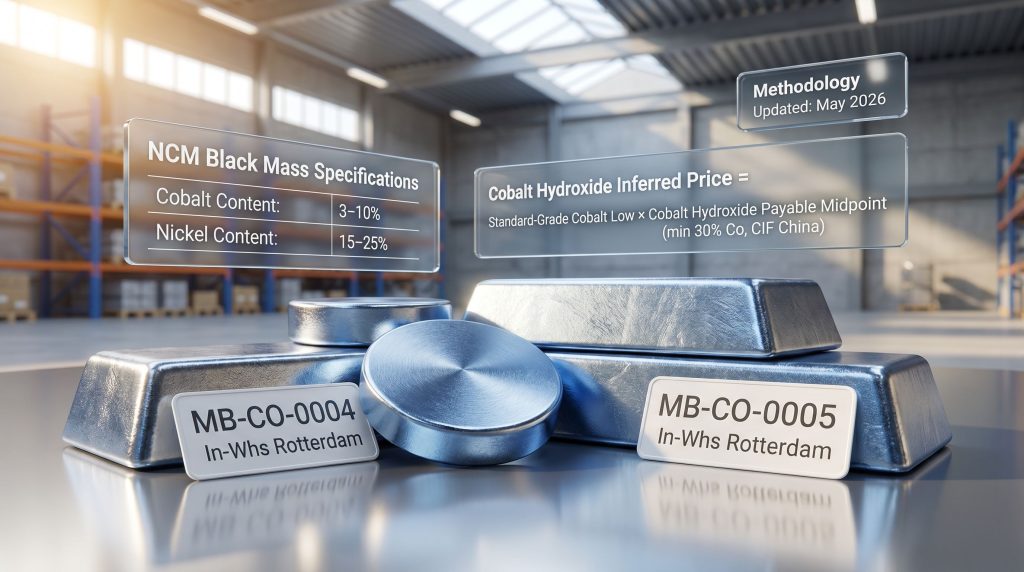
- MB-CO-0004 covers cobalt alloy grade, in-warehouse Rotterdam
- MB-CO-0005 covers cobalt standard grade, in-warehouse Rotterdam
These designations reflect a meaningful compositional and commercial distinction. Alloy-grade cobalt is typically characterised by higher purity specifications and is predominantly consumed in aerospace, superalloy, and high-performance tooling applications. Standard-grade cobalt, while still a high-purity refined product, feeds a broader market that includes battery cathode precursor production and general industrial uses.
Rotterdam serves as the global reference delivery point for cobalt metal pricing because it concentrates warehouse inventory, logistics infrastructure, and active trading within a single, liquid European hub. CIF or in-warehouse Rotterdam pricing therefore functions as the effective world price for physical cobalt metal — a convention deeply embedded in long-term supply contracts and financial settlement agreements worldwide.
Fastmarkets serves more than 14,000 global customers across metals, mining, agriculture, and the battery raw materials market. Its cobalt price assessments are embedded as reference benchmarks in physical supply contracts and, in some cases, financial derivatives structures that require a transparent, consistently applied methodology to function as intended.
Understanding the IOSCO Framework and Its Role in Cobalt Price Integrity
The credibility of any price reporting agency rests on its adherence to internationally recognised methodology standards. Fastmarkets applies the IOSCO Principles for Oil Price Reporting Agencies, which have become the global baseline for commodity price reporting integrity across energy and metals markets alike — not just petroleum.
Under this framework, the data collection window for each cobalt assessment runs from the moment the prior assessment is published through to 2:00 PM on the day of the subsequent assessment. This window defines the period during which submitted trade, bid, and offer data is eligible for consideration.
Data evaluation within this window follows a structured two-tier hierarchy:
- Reporter confidence in the reliability and verifiability of the submitted information
- The significance of the data point itself — its volume, timing, representativeness, and proximity to market conditions
This hierarchy matters because it means not all submitted data carries equal weight. A confirmed, documented trade between unaffiliated counterparties in an arm's-length spot transaction will carry substantially more weight than an indicative value with limited supporting evidence.
How the Fastmarkets Cobalt Methodology Clarification Addresses Brand Optionality
Perhaps the most technically significant element of the Fastmarkets cobalt methodology clarification involves the concept of seller-side brand optionality. This is a pricing convention that many market participants may not fully appreciate but which fundamentally shapes how the cobalt metal assessment operates.
Under the Fastmarkets specification, when a seller submits offer data to the assessment process, that seller retains the right to nominate any qualifying brand from Fastmarkets' published cobalt brand list. This design is intentional: it creates a single, unified price signal that reflects the full universe of qualifying brands rather than fragmenting the market into multiple brand-specific assessments that would each carry less liquidity and less representativeness.
The operational implication of this design choice is significant. A submission that grants buyers the right to select the brand — rather than sellers — is structurally inconsistent with the methodology specification. Furthermore, submissions that artificially narrow the brand universe being offered, or that omit brand information entirely, diverge from what the specification requires.
Data that fails to reflect seller-side brand optionality is treated as lower conformance with the Fastmarkets specification. Such data may be subject to normalisation, and normalised data carries reduced priority during the price assessment process compared to data that meets the specification outright.
This distinction matters practically. Trading desks that submit offer data with buyer-side brand selection clauses embedded in their commercial terms should understand that such data may be downweighted during the assessment process. Ensuring submissions correctly reflect seller optionality across the full brand list is the clearest path to maintaining full conformance.
Data Submission Standards: What Market Participants Need to Know
Confidence Level Determination and the Four-Factor Framework
The confidence or trustworthiness Fastmarkets assigns to any submitted data point is determined by four interconnected factors:
| Confidence Factor | Description |
|---|---|
| Transparency of Activity | Whether the transaction or quotation is clearly documented and independently verifiable |
| Direct Party Involvement | Whether the submitter was a principal in the reported transaction |
| Completeness of Data | Whether specification details, delivery windows, and all required parameters are included |
| Quality of Supporting Evidence | Whether contracts, purchase orders, or correspondence records accompany the submission |
Confirmed trades and competitive bids or offers are consistently treated as higher priority than indicative values. This creates a direct incentive for market participants to submit hard data with documentation rather than soft indications that reflect general market sentiment.
What Defines an Open and Competitive Market Transaction?
Fastmarkets cobalt assessments are designed to reflect arm's-length spot market conditions. This means several categories of transaction data are explicitly not representative of the market conditions the assessment is designed to capture:
- Transactions between affiliated counterparties
- Prices embedded within long-term supply agreements rather than negotiated at prevailing spot levels
- Submissions restricted to a narrow counterparty pool that does not represent broad market exposure
Where broad market exposure is structurally difficult to achieve, independent corroboration from other participants' data can help establish confidence in a submitted price level. The assessment process is designed to aggregate evidence from multiple sources rather than relying on any single submission.
Documentation, Confidentiality, and Verification
Supporting documentation raises the confidence level assigned to submitted data. Fastmarkets may request counterparty names, specification details, delivery window information, and proof that bids or offers were genuinely submitted to the broader market. Evidence including contracts, purchase orders, and commercial correspondence all serve this function.
Critically, all submitted data and supporting documentation are treated with strict confidentiality. Counterparty anonymity is preserved throughout the assessment and trade performance review processes. This protection is designed to encourage open, accurate submission without commercial risk to the submitting party.
Trade Performance Reviews: An Underappreciated Compliance Mechanism
One area of the Fastmarkets cobalt methodology that receives less attention than brand optionality or data submission standards is the trade performance review process. This mechanism is operationally important and carries direct consequences for market participants who fail to engage with it appropriately.
Fastmarkets reserves the right to periodically verify that trades reported to the assessment process were actually executed as submitted. Verification may involve requesting delivery confirmation, warehouse release records, or bills of lading. This process protects the integrity of the assessment by creating accountability for the accuracy of submitted trade data.
The consequences of non-cooperation are concrete: a market participant that fails to cooperate with a trade performance review may see reduced confidence assigned to all subsequent data submissions from that participant. Over time, this could meaningfully diminish the weight that participant's data carries during price assessment, effectively reducing their influence on the benchmark they rely upon.
The next major ASX story will hit our subscribers first
Monthly Average Calculations: A Distinction That Matters for Contract Settlement
A widely underappreciated nuance within the Fastmarkets cobalt methodology involves the difference between how monthly averages appear on the platform and how they are calculated for financial settlement purposes. For further context on how these price signals interact with broader market dynamics, the DRC cobalt export ban illustrates how supply-side disruptions can amplify the importance of precise benchmark definitions.
| Output Type | Calculation Method | Example (June 2022) |
|---|---|---|
| Platform Display Midpoint | Midpoint of the average high and average low for the month | $35.12/lb |
| Financial Settlement Average | Average of each individual daily midpoint across the month | $35.11/lb |
The distinction arises because rounding is applied to the individual low and high monthly averages before the midpoint is calculated, rather than after. The resulting figures are typically close but not identical. For contracts settled against Fastmarkets cobalt prices, referencing the daily midpoint average rather than the platform display midpoint ensures precise financial settlement accuracy.
Market participants structuring cobalt-linked financial instruments or procurement contracts should specify which calculation methodology applies to their settlement terms to avoid potential disputes arising from this difference.
NCM Black Mass Assessments: Updated Specifications and Scope Changes
The 2024 methodology update introduced important changes to how Fastmarkets assesses NCM black mass payables, reflecting the evolving composition of battery recycling streams reaching the spot market. In addition, a notable battery recycling breakthrough in China has further highlighted the growing significance of these assessment parameters for the industry.
Quality Parameter Specifications
| Parameter | Specification |
|---|---|
| Nickel Content | 15-25% |
| Cobalt Content | 3-10% |
| Lithium Content | 3-4.5% |
| Minimum Combined Ni + Co | 20% |
| Maximum Aluminium | 2% |
| Maximum Copper | 2% |
| Maximum Iron | 1% |
| Maximum Fluorine | 2% |
| Maximum Moisture | 5% |
The Removal of NCA from Assessment Scope
Nickel-Cobalt-Aluminium (NCA) battery chemistry was removed from the NCM black mass assessment scope and naming conventions as part of the 2024 update. This change reflects a structural shift in the recycling feedstock market: as the volume of end-of-life NCM batteries entering recycling streams grows, NCA material has become a sufficiently distinct and minority stream to warrant separate treatment rather than inclusion within a consolidated assessment.
The renaming of inferred prices for high-cobalt materials, based on a 10% cobalt assay, now explicitly signals that these prices represent the upper boundary of cobalt content within NCM payable parameters rather than a separate product category.
South Korea Data Acceptance Criteria
CIF South Korea data is accepted only when the material is consumed by a South Korean hydrometallurgical or pyrometallurgical refiner. Trans-shipment material is explicitly excluded. This boundary condition ensures the South Korea assessment reflects genuine end-use consumption by domestic processing capacity rather than intermediary trading flows that would distort the price signal.
The Cobalt Hydroxide Inferred Price: Formula and Market Function
The daily cobalt hydroxide inferred price provides a formula-driven reference linking the physical cobalt metal market to the intermediate hydroxide market. The calculation uses two components:
- The low-end price of the Fastmarkets standard-grade cobalt metal assessment (MB-CO-0005)
- Multiplied by the midpoint of the Fastmarkets cobalt hydroxide payable indicator (minimum 30% Co, CIF China)
Formula: Cobalt Hydroxide Inferred Price = Standard-Grade Cobalt Low (MB-CO-0005) x Cobalt Hydroxide Payable Midpoint (min 30% Co, CIF China)
The use of the low-end standard-grade price as the base input reflects a conservative, market-anchored approach to inferred valuation. This is particularly relevant for procurement teams and investors evaluating cobalt hydroxide as a key intermediate in NMC cathode active material supply chains, where the relationship between hydroxide payables and refined metal prices directly affects processing economics and offtake pricing. Consequently, the cobalt price impacts flowing from supply disruptions are felt acutely through this formula-driven linkage.
Key Operational Takeaways for Trading Desks and Procurement Teams
For market participants actively engaged with Fastmarkets cobalt price assessments, the July 2026 Fastmarkets cobalt methodology clarification reinforces several operational priorities. Staying current with the latest cobalt pricing data from Fastmarkets is strongly recommended alongside these compliance considerations.
- Brand optionality compliance: Submissions must reflect seller-side brand selection from the full Fastmarkets brand list; buyer-directed brand selection reduces data conformance and priority weighting
- Timely submission discipline: All available spot data should be submitted during active pricing sessions; late or selective submissions reduce confidence weighting regardless of the underlying data quality
- Documentation readiness: Trading desks should maintain complete, consistent supporting evidence for all submitted trades, bids, and offers, including contracts, purchase orders, and correspondence records
- Settlement calculation awareness: Cobalt-linked contracts should clearly specify whether settlement references the platform display midpoint or the daily midpoint average, as these figures differ due to rounding methodology
- NCM black mass compliance: Submissions should apply the updated 2024 quality specifications; NCA materials are no longer within the NCM black mass assessment scope
- Trade performance cooperation: Market participants should be prepared to engage with periodic trade performance reviews and provide execution verification documentation on request
Market participants wishing to submit feedback on the cobalt brand list or other methodology elements can contact Fastmarkets at pricing@fastmarkets.com and temlondon@fastmarkets.com, using the subject line re: Cobalt clarification. Comments may be marked confidential, with non-confidential submissions made available upon request. Those seeking the full technical specification should consult the official Fastmarkets cobalt methodology documentation directly. The most recent version of the full Cobalt Price Assessment Methodology was updated in May 2026.
Disclaimer: This article is intended for informational purposes only and does not constitute financial, investment, or trading advice. Cobalt price assessments, methodology specifications, and market conditions are subject to change. Market participants should refer to the official Fastmarkets methodology documentation at fastmarkets.com/methodology for current specification details before making commercial or financial decisions based on these assessments.
Want to Stay Ahead of the Next Major Cobalt Discovery on the ASX?
Discovery Alert's proprietary Discovery IQ model delivers real-time alerts the moment significant cobalt and battery minerals discoveries are announced on the ASX, transforming complex data across more than 30 commodities into clear, actionable insights for both traders and long-term investors. Explore why major mineral discoveries have historically generated extraordinary returns on Discovery Alert's dedicated discoveries page, and begin your 14-day free trial today to position yourself ahead of the broader market.